Twin Peaks Decaps — Episode 2.04 — “Laura’s Secret Diary”
In which the writers call an episode “Laura’s Secret Diary” and then have it barely be about Laura’s secret diary at all.
Twin Peaks Decaps — Episode 2.04 — “Laura’s Secret Diary”
In which the writers call an episode “Laura’s Secret Diary” and then have it barely be about Laura’s secret diary at all.

Imagine, giving your work a title and then having it barely be about that.
Please enjoy this new installment of Twin Peaks Decaps.
![[exhaustedly bewildered] Who would do such a thing?](https://miro.medium.com/v2/resize:fit:798/1*cJAfwXgqihTGZDEp85m6Ug.jpeg)
[exhaustedly bewildered] Who would do such a thing?
SO.
One screenshot, probably unrealistic. Maybe I can limit myself to fifty or so?
JUST SOME LITTLE HOLE IN THE WALL

So we start out with a shot that not only is visually stunning, it wins the Alan Splet Memorial Sound Design Award for all the different stuff going on in there, which is best appreciated with headphones and a heart free of fear.

Now we’re dealing with the simple Leland murder here. Consensus, which is right in this case because it agrees with me, holds that the murder of Jacques Renault in his hospital bed and the pummeling of Lawrence Jacoby at the gazebo — Gazebo… — were conscious acts of Leland Palmer, bereaved and unstable father, “decent man” and semi-shady lawyer to a business-class criminal, human person uninhabited by malevolent murder spirits at the moments of commission other than in the purely metaphoric sense.
Then I ask of you, dear reader… why the smell of scorched engine oil?

This question would keep me up at night if I ever thought about it, but to be honest I rarely do unless I am thinking about Leland’s culpability in his entire series of crimes, BOB or no BOB, and I do sometimes think about that but not often enough to mention in any other context than an essay about Twin Peaks so painfully overwritten as to cruelly test the patience of its audience and the enthusiasm of its writer and the entire idea that a written work should somehow serve the needs of any theoretical reader or even consider them as part of the equation of creation in the first place.

Also it’s possible that I’m gonna become super-misogynistic for the last maybe six or seven epsiodes
So I don’t know. The scorched engine oil is clearly meant to be something mysterious and tied to the esoteric side of Cooper’s investigation, not the prosaic side. This connection to the murkier realms even becomes explicit much later in the story.
Now, if we are willing to read Leland’s murder of Jacques as an action performed or influenced by BOB, this explains the oil smell. But it unexplains the revenge motive.
BOB murdering Jacques Renault through Leland makes sense if his goal is to end a source of information about the night of Laura’s murder. In other words, to eliminate a witness.
BOB does not seem like an eliminate a witness kind of guy.
A Leland who was aware of his crimes against his daughter might be, though.
Of course, that forces us to re-evaluate Leland’s final, rainy, devastating confession. What has been taken so often during the Who Really Killed Laura Palmer debate as an indicator that Leland was not conscious of his actions and was in a sense blacking out during his performance of them now seems like an elision of the truth of his awareness and an attempt to protect himself even in death from his true responsibility in the matter.
And this also hews more closely to the Leland presented in the film, who, although he was not necessarily always in control of what was happening through him — “Don’t make me do this!” — definitely knew.
The film basically succeeds philosophically in a way the series fails, or fails to try to. It does this not by clarifying the line between Leland and BOB but by making it blurrier and therefore more true-to-life.
So I basically just talked myself out of my previous position. Which means the consensus is wrong now, and sucks. Suck it, consensus.
Anyway, returning to the simplicity of grieving crazy dad murders daughter’s murder suspect, this is the kind of scene where an actor gets to really swing for the bleachers, and when they connect it’s glorious to watch. Yes, there are moments where you can just start to see the edge of the Acting happening, which, tough scene, single take, pressure on everyone to get it in the can and move on, they probably still say “in the can” even though there aren’t cans anymore, whatever, it’s Leland as Lelandy as we’ll ever see him and he’s confessing to committing a murder as Lelandy Leland and for flawed but recognizably human reasons

and there are some beautiful character gestures and riffs on a technical level

and mostly you just want things to be okay for Leland again somehow.
(The best part: as good as this scene is, it’s only Ray Wise’s third-best interrogation-room confession of the show. That has to be a record.)
So as we leave the scene of Leland’s devastation, it promises to be quite a serious and well-crafted episode ahead of us! I wonder who wrote it?

MEN TALKING ABOUT MAN STUFF, AND I MEAN MAN STUFF
Gosh, that’s so many names I can’t believe it!
And an “and” and an “&”!
So there’s a looming writers strike in Hollywood as I write this. The main issue, as far as I can tell from the many screenwriters and zero studio executives I follow on Twitter — sorry, one, I forgot Megan Ellison for a moment, but she’s probably cool, I mean she seems cool — is that screenwriters would like to make a higher base of pay since so many of them are working ten-episode seasons now instead of the old standard of twenty-some, and they would also like the studios to put in a little more money into their health care. The studios, conversely, would like to not do that, and would also like to put in less health care money than they already do.
Now, I don’t want to get too political or take sides or anything, but fuck the studios, and everyone who works at any job tier where they can’t drink at lunch should have a union representing them because the upper level of management that actually gets to decide real things will always fuck you over, every chance they get, that’s what these assholes went to school for, and it’s what they enjoy, because they’re sick.
Okay, got that out of my system, at least for today.

Now, writers. (Sure, they drink at lunch too, but they hide it instead of expensing it.)
That “and” up there has a particular meaning when you see it in the credits on a Writers Guild of America production. You are connecting distinct writers or writing teams, which on a practical level usually means one did their work in a different time and/or place than the other and without any direct collaboration.
“&”, on the other h&, is used to group individual writers into a writing team. So this set of credits probably indicates that Jerry Stahl was assigned a script and turned it in and then the writers room home team of Frost, Peyton, and Engels kicked it into Twin Peaks Condition, or that Stahl was given certain character(s)/plotline(s) to do on his own while the team worked on the others.
Is there such a thing as too many men? Let’s find out!
SPERMS
Right off the bat, here’s a little action for those Andy-lovers out in teeveeland.

Alas, the next close-up will disappoint 93% of you.
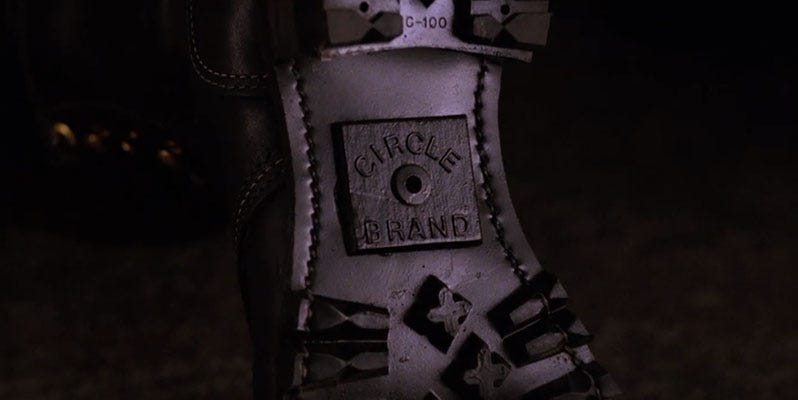
The deal was that Andy just jerked off in the washroom — and if I tell you I passed over some excellent potential screenshot material on our way here it might give you the wrong idea, but it’s the truth — and now he’s taking his seed, previously established as unviable, to have science done to it in hopes it has recovered its potency.
Lucy mocks him for his efforts, yet he is doing it for her. Typical.
How come women never want to date a nice, reasonable guy like me just because I call them sex terrorists?
(Incidentally, we learn this while that raft of credits appears; Andy is talking to Doc Hayward about the possibility of re-testing his sperms and Doc really puts him on the spot. Andy being a total cuck aside, the scene is of interest to me because of the way a professional seasoned actor can maintain his (or her, I suppose, eyeroll) poise in the event of a minor stumble. Listen to their conversation: Doc’s line is “I’ll need to take a sample with me”, and Warren Frost accidentally says “an” instead of “a”. But listen close. As a trained actor with an intuitive sense and the confidence to not get hung up on it, he immediately defaults to a slight pause that adds a grace note to the flow of the sentence and sounds like a small stylistic detail but in fact distracts the ear such that many people never notice the flub at all. I would even swear that he slightly swallows the end of the word “an”, so on top of it is he. And I know this is a lot of words to spend on a tiny detail, and the scene wasn’t so long that they couldn’t have picked it up from the start again. I just like to acknowledge cool displays of skill and professionalism. You want a proper recap that covers shit in a reasonable manner, leave me alone*, go read Noel Murray**, I figure he’ll get here in a couple of weeks.)
Yeah, so Andy’s got them thangs, and Cooper sees the logo as Andy scampers under the chair to retrieve his costly burden and now knows that Phillip “Yes, We Know, He Has One Arm” Gerard sells Circle Brand, which is the boot that was found at Leo’s house, and hey, Harry is also a police officer, yeah? And he handled and looked at a half-dozen different boots that Gerard brought to him but never noticed that branding on the bottom? Maybe didn’t think to check, I mean, he was just looking at a selection of shoes sold by a man who only came to their attention because of his possible involvement in the murder they’re investigating, and there was an odd and memorable finding of a shoe clue at the home of a different person involved with the same murder, but I guess the shortest distance between two thoughts is not necessarily a straight line or whatever.
Anyway, Lucy’s still being a total B-word — only Catherine and Leo get to say that word at full strength on the show — and the ominously-named Judge Clinton Sternwood and the mildly-comically-named State Prosecutor Daryl Lodwick are both due in town soon for Leland’s bail hearing.
WALK AND TALK
By which I mean Ben Horne and Mischievous Great Northern Desk Sprite Louie walk, and talk, in the traditional and time honored “walk and talk” television tradition, but by which I also mean Ben literally begins the walk and talk by saying to Louie “walk and talk”, which is maybe the first explicit storefront use of the phrase in this way? I don’t know, I’m not a tv historian.

Some people don’t like Louie because she’s perky and maybe the actor is pushing the performance to be cartoony, but I think it works just fine and as far as characters who don’t stick around she’s certainly one of the most memorable.
Louie’s Prime Directive is to relay to Ben, and officially launch, the Legend of MT Wentz, the travel writer. Yes, MT Wentz, the travel writer.
The surface level of that, that there’s a travel writer coming to Twin Peaks pseudonymed MT Wentz, and the farcical escapades that will ensue as Hank and Norma try to impress whoever he or she may be to snag a good review for the RR Diner — a diner — is a damp squib of a C-plot, the main value of which being that it introduces us to Normer’s new dad-in-law, Ernie Niles.
The secret function of the MT Wentz kerfuffle, which is rather ingenious, though hardly unsurprising from the writing team that managed to obfuscate Leland’s true role in the enduring drama, is to muddy up that plot water, so that A, the reveal of Wentz can catch us and the affected characters off-guard, which, who cares, and B, that our supply of extremely reasonable suspicion regarding the extremely weird arrival (and, frankly, just presence) of Tojimura has a bucket for us to immediately reach for so we can pour it in.
(Sorry for that bucket metaphor, it’s awkward. I’m drinking Fresca and my sugar is lower than usual for this time of day.)
This makes all the Wentz stuff forgiveable, even though on its own it’s nutritionally pretty thin, because it’s all a sideshow to distract us from thinking too hard right away about who Tojimura really is, in hopes that once we get used to him the question will slip away from us and we can be truly surprised later when it turns out to be Mickey Rooney.
Gotta say, though, having no Tojimura in the end credits is suspicious as hell, and I assume people who were dissecting the show back in the day on Usenet or whatever crude UrReddit they were using noticed this exclusion and rightly suspected that underhanded dealings were afoot, to mix my appendages.

(Also gotta say, though, I looked up Bellina Logan on IMDb to confirm the spelling of “Louie”, and as you might guess from the above image it was little help. But I did discover two interesting things. One, she was in David Lynch’s hugely underrated (and, due to poor digital camera technology, nearly unwatchable) Inland Empire (which you may remember from that horrifying pic of Laura Dern I’ve been posting lately) where she plays “Linda”, and I don’t remember seeing her but based on where she’s listed I’m guessing she’s one of Nikki’s jubilant friends near the start of the movie, and Two, she’s listed as once again being Desk Clerk in season three of Twin Peaks, which, although it seems to indicate a shameful lack of professional ambition on Louie’s part, I am happy about, so, in the spirit of sainted Louie, eeeee! with a little fists-shake for that.)
The third and most structurally traditional function is that we get a little levity to set us up for a serious meeting.
LESS IS MORE; MORE IS ALSO MORE

Welcome to you’re “OFFICE!”
I went on way longer than I wanted to about the walk and talk. So I’m gonna shave some time off here. It’s a fine scene, it serves its purpose. There one moment I want to highlight, and unsurprisingly it is a Michael Parks moment.
Which is not to take away from Richard Beymer. His performance of Ben Horne, often while withstanding some serious script zigzags, is top notch. His measured and subtly idiosyncratic line deliveries are an acting class on their own. I’m still a little mad at him for not agreeing to do the prequel, but I suppose that’s none of my tea-sipping Kermit.
But Parks as Jean Renault in this scene has one moment, it’s maybe a second long, and I’m already worried I can’t do it justice.

Look out honey, ’cause I’m using technology
Renault has laid out the deal: he will return Audrey in exchange for a ransom to deliver to the kidnappers, being Ben’s “partner” in the operation of One Eyed Jacks, and, he now reveals, for having the ransom delivered by Agent Cooper, which Ben must arrange.
Ben resists — frankly, he resists at every step of the one-sided negotiation before necessarily giving in — by saying of the kidnappers responsibility for Renault’s last and most difficult request, that “they should bear the cost of their own middleman”.
Renault’s response to this has many layers:
- I acknowledge that I have heard your objection to the request.
- I obviously disagree with the premise, but my non-committal acknowledgement will hopefully signify my disagreement without my needing to make it explicit.
- Yeah, it’s a mean ol’ world where people have to deal with unfair circumstances at the best of times, never mind when engaged in underworldly endeavors, I feel ya.
- Kinda arrogant of you to think you’re being deprived of a fair shake in a ransom situation, though.
- To be honest I’m a little impatient with the courtesy of pretending this was ever a negotiation, so we’ve moving on with it now.
- But as a show of some professional respect***, I will not point out that he who lives by the sword dies by the sword and will therefore transmit in this reaction a core molecule of empathy for the hopelessness of your position.

It’s in the running for the most complex “tough break, pal” in cinema. And he does it with a single small physical gesture that lives somewhere between a shrug and a mock stumble, as though miming the effortful cresting of a ludicrously low-lying hurdle, and a grunt which my best effort at spelling summoned as “Uhn.”
The “LESS IS MORE” part referred to Parks, who, go and watch the moment if you can, it’s worth it for that alone.
The “MORE IS ALSO MORE”, well, I said I was going to be brief and then I wrote all of that instead and it was literally about a one-second reaction.
STILL ON TRACK FOR A 50-SCREENSHOT TARGET THOUGH
So, Donna’s at the RR to pick up some food and head over to Harold’s again. She’s kind of snotty to Hank, who was kind of a dick anyway, but it suits Donna’s current situation as someone setting aside the uncouth and Maddy-canoodling James Hurley in favor the mysterious and probably nicer smelling and definitely more worldly despite never leaving his house Harold Smith.
AND oh god it’s here now it’s time I can’t put it off.
EMPTY WHO?!?
EMPTY WHO?!?

“Empty who?!?”
“Empty who?!?”
I have to admit, Chris Mulkey sells the Happy Hank pretty well. The lighter he’s written, the more Mulkey connects with the material, and as much as I like to make fun of “Empty who?!?” —
— I can make fun of it all day, “Empty who?!?” It’s so dumb —
— but I realize now that I kind of love it, like the worst song on an album that grows on you over time through sheer force of persistence.
And it’s really evident in this episode how Hank gets his tone emotionally yanked back and forth, doing something silly and comedic one moment then suddenly being a creepy menacing presence. The math technically works on that writing gimmick, but it doesn’t really pay off in terms of producing a character who is unpredictable, and maybe part of that is there’s a particular piece of incidental music that probably has a title like “Bad Hank” that plays whenever Bad Hank is about to do something bad so there’s really very little mystery as to what’s coming next.
I also have to admit I’m intrigued by this Rabbi Chili special.
INAPPROPES
Okay, gotta move it along here.

Harold’s not a run-of-the-mill creep, he’s also a pretentious douche who talks about his wank material collection that he wines out of people as his “living novel”, wave your hand around in front of you to indicate you have a special connection to the ineffable aspects of the human condition, if it was today you’d have a lumberjack beard and 5/8" gauge plugs and at some point in your life before you had retired to your final house you would have said the words “bean to bar” in a non-ironic way. (Please don’t take this moment to examine my avatar,

because me and my stupid mustache, we’re really throwing stones in a glass house here. I’ll be back after I raise the security on any photos of me on Facebook. I mean, I made a lot of questionable style decisions and… you know what, I’m not actually ashamed of any of them, and if you have that beard I was making fun of (and those ears I was making fun of) neither should you be, people should feel a lot freer to look the way they want, fuck it.)
Forget I said anything, fellow hipster douchebags. I’m writing a goddamned ironic Twin Peaks blog, who am I fooling?
Anyway, Harold decides they should let their food get cold while he reads from the diary of their common friend who was just murdered, and he goes straight for the wank material. By this point it probably just kinda flips open to certain pages on its own.
So Donna gets to hear the “big big men” bit, which is a lot funnier than you’d think. And it obviously makes her very uncomfortable and was totally inappropes.
So Donna is in no way having a good time and this mess of a date can’t possibly be salvaged and she’s not in any way excited by all of this.

Or maybe, once again, everything is going exactly to Harold’s plan? “Oops, I made you have intense feelings by evoking the memory of your best friend, who embodies sex and death to everyone who knew her, more wine?”
SPECIAL RELATIONSHIPS
Audrey loves Cooper. Cooper cares about Audrey. Ben cares about not looking like someone whose daughter got stolen.

Cooper looks at Ben like Ben is a sleazy schemer, which he is, and Cooper never for a moment is buying the surface level of Ben’s sales pitch. He is listening to the underlying flow of information, beneath the words. He may not know exactly what’s going on, but he knows it’s not what it seems.
And Josie Packard has a special relationship to shopping! Ladies! Am I right, fellas? They love shopping.
I could do another Cerebus riff here but I’m grossing myself out a little with them so maybe I won’t, kind of a one-note joke anyway, it’s just that I have a theme going. Sigh.

WOMEN BE SHOPPIN’!
[wild audience applause]
I know, it’s a real trait some people have, and it was the early nineties, etc.
Yes, I’m nitpicking.
Look, I really do love this show!
So Josie “finds out” that Catherine is “dead” and Pete’s morbid exit joke gets weirdly edited into some trees and makes me think there was more to the scene.
Next, my own special relationship with officious toadies.

When Blackie sat here, it was just a desk with stuff on it, when Jean Renault sits here it’s something else entirely
There are few things in life more satisfying than watching a middle-management toady-bully get murdered while spouting a bunch of meaningless cooperation-flavored bilge-patter that was probably crammed into his earholes at some seminar that some huckster cooked up as the inspiring presentation of the year and got paid a few thousand dollars to deliver so that the owner-boss could claim some extra deductions and act like a responsive and proactive employer cultivating a success-oriented paradigm of inclusive productivity.
On television, I mean. You shouldn’t murder toady-bullies in real life, even if HR protects them while they systematically hurt all your colleagues.

Fine, so Audrey has a special relationship with heroin now,

and I’ve never done heroin but I’m willing to state for the record

that if I ever have to witness a person getting shot to death right next to me

I do not want to be under the influence of heroin for that.

Remember Cooper and Harry? Remember how they have a special relationship? Seems like we haven’t seen a ton of that lately.
But Cooper, who is now on a secret mission containing unknown dangers and a distinct aura of betrayal, needs a hand, and he asks Harry to find him one.
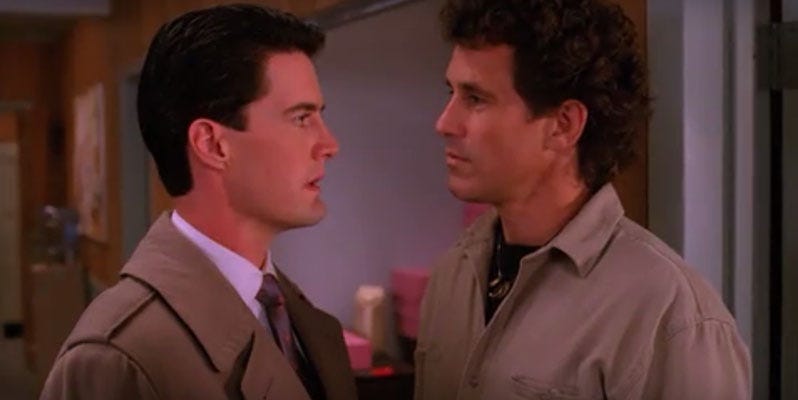
And there’s obviously no question at any point who it will be. The whole “your best man” business is purely to surprise Cooper, never us. We get the joy of knowing something that the Master Detective does not, and the anticipation of his satisfaction when the truth is revealed to him.
Coop’s whole day is revolving around payoffs of one sort or other.
But let’s back up a moment. Some stuff happened just before this that we don’t need to look at but which we would benefit from thinking about, maybe?
There’s a lot of talk lately about representation in all the different levels of the entertainment industry ladder. And “representation” inevitably, due to the industry’s history, means “stop giving all the jobs to straight white cis men”.
One response to this talk is “well, the best people should get hired, and it shouldn’t matter who they are or what political correctness boxes they check off”.
BUT
Let’s look at what unfolds here in the lobby of the Twin Peaks Sheriff’s Department.
- Lucy’s crazy behavior is bugging Cooper — and presumably everyone else, but other than Andy (the recipient of her anger) we don’t see much of these reactions — so Cooper takes her aside about it.
- Lucy expresses superficial dissatisfaction with Andy as a romantic partner.
- Lucy expresses superficial problem-solving abilities by admitting she did not discuss the issues with Andy, but instead took some compensatory advice from a daytime television show that, we can infer, involves women talking a lot.
- Lucy admits having a fling with another man as a sort of impatience-punishment/indulgence she is inflicting upon her relationship with Andy.
- Lucy admits she doesn’t know how to fix her problem or even what a fix would look like.
- Lucy uses the word “asinine” and the joke is that it’s a smart word but Lucy is using it, so don’t take all that other stuff too seriously, we’re all having fun here.
- Lucy cries and runs off.
- Harry explains to Cooper that there’s no point in trying to deal with crazy Lucy, she’s just crazy sometimes.
Now obviously the context of this scene is that Lucy is pregnant, she is unsure who the father is, Andy has seemingly rejected her and at the very least distanced himself, and in general her life is in a worrisome state and this has deeply emotionally affected her.
So if I had to construct a scene that communicated all of that, and carried some jokes in it to keep things entertaining, but which didn’t rely on a stereotypical feminine-weakness/women-be-crazy foundation for it all, what early strategies could I apply to the creative process to make the writers room a place of balanced, nuanced understanding of what it would be like for a woman in this situation?

What pitfalls could I avoid, say, when hiring, staffing, assigning storylines and characters, etc., to ensure that the scripting of the scene was not avoidably disrespectful to women or dismissive of a woman-oriented perspective?
There’s gotta be something, just give me another minute to think…
[time passes]

The segue moon between the Sheriff’s Department and the RR Diner
I feel like I’m really close…
[more time passes]

The actual moon that night; also, nice**
What about a joke comparing a woman’s emotional state to a rained-out highway full of potholes? Is that anything?
SOME KIND OF CULTURAL CRITIC TRICK
And yeah, I get that part of the point is that the men are kind of clueless too. But I’m running out of wordcount here.
So LOOK IT’S A NEW PERSON AND THEY LOOK WEIRD!

It’s gotta be MT Wentz! It’s gotta be the mysterious incoming character we’ve heard so much about, especially if we’ve already forgotten about the other two incoming characters mentioned this episode!

If you have that kind of memory, and you don’t believe this is MT Wentz because that would be too easy, and you also don’t believe this is Judge Sternwood because he just doesn’t look like a Sternwood, then you might be suspecting that this is Daryl Lodwick, State Prosecutor.
Hank, who is good and funny in this scene and then suddenly becomes a villain again, steals his wallet, and discovers that you were right.

The rabbi goes fast
I guess Hank steals the wallet because they don’t know if it’s really Wentz or not, and maybe if it had been Wentz he would have returned it so as not to jeopardize the review. But he did and it’s not and he doesn’t and it won’t.
THERE’S A LODGE, LOTTA BLUE PINE, CAN’T RECALL THE NAME
Harry’s up to see Josie. He’s at a low point, he’s burdened. That looks like this:

Josie comes out in a slinky thing and tries to seduce him away from questioning her about the mill fire. For a while it doesn’t work. She puts on an air of being hurt by his suspicions until he relents and talks about his feelings for her instead. Then she resumes the seduction, asking him to tear that thing she’s wearing that she just bought and that probably cost a lot of money but it’ll give him some sense of expressing his frustration.

Four Cooperspits
Oh and that guy who was following Cooper around is outside watching them bone down.

Maybe he’s got poor eyesight and thought Cooper was Josie in a suit all this time? Their hair is kinda the same.
And by the way, if you think there isn’t any speculation about Harry and Cooper’s relationship in light of the fact that Josie doesn’t exactly not resemble Cooper in certain respects, well, bless your precious innocence, and welcome to the internet, there’s all sorts of cool stuff here, no matter what you’re into.
Now then, look at this shot.

I Love Lucy
Isn’t it great?
That’s it, no big observations. Just a nice shot.
There’s lightning by this point in the show’s day and the power has been intermittently going out for the sake of Drama, and it kinda pays off here with the arrival of Judge Clinton Sternwood, last of the frontiersmen.

No
Judge Clinton Sternwood,

last of the frontiersmen.

They broke the mold
Let’s enjoy this moment of intergenerational bonding between professional men that is in no way fetishized and will not be cynically exploited later on by revealing that the older man is accompanied by a much younger woman of sufficient attractive powers as to throw even our stalwart hero’s poise momentarily off-balance. That definitely won’t happen.

Also Dick shows up and tries to give Lucy abortion money and she screams
So they try to have Leland’s bail hearing but they can’t because apparently Lodwick got locked in that completely private bathroom at the RR, or there’s some sort of weird thing that happens when you get your wallet stolen that you can’t arrive for any appointment you were otherwise in town for on time?

In any case, it gives Judge Sternwood a chance to talk to Leland man-to-man — since as Judge-to-Accused it would be wholly inappropes — without some burger-eating wallet-loser whose presence represents the sanctity of the law and its procedures about which Sternwood enjoys rhapsodizing.
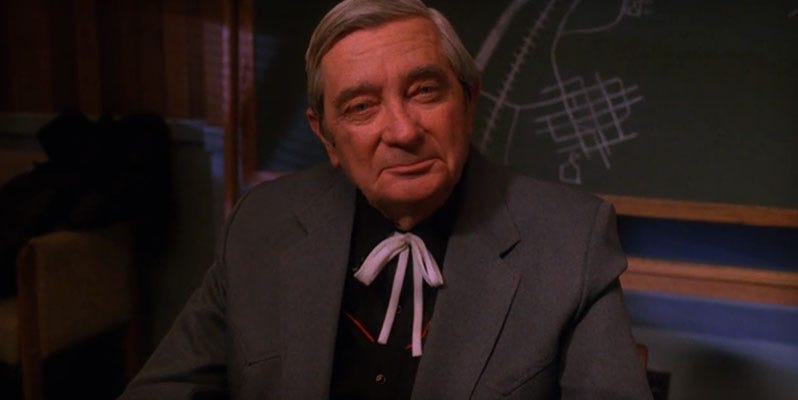
A Hard Job calls for Sternwood.
A SERIOUS BONE TO PICK
Okay, jeez. A lot of this harping I’ve been doing on the gender stuff, I know it might seem kinda on the border, like I’m looking for problems. I get it.
Now.

So Ben’s in his lobby, chatting up some contestants for the Lumber Queen pageant. (I’m not even going to ask how many beauty pageants this town has every month, just gonna let that one go.)
Fine. Ben’s sleazy, we know this. Television shows don’t mind an excuse to put some women in bathing suits. No surprises.
Cranky Older Woman-In-Charge Stock Character drags the bathing beauties away from the ogler. Okay.
Then…

One last contestant, chosen for this role because she is larger than the others, she’s visibly heavier, she’s “the chubby one”, comes scuttling through the frame. She’s tryin’ to catch up to the rest of the girls. She’s lumberin’!
The entire joke is “she’s fat”, and because “she’s fat” she moves awkwardly compared to the other thinner, graceful women, and it’s funny because she has to run because she’s fallen behind, and she has fallen behind because of course she has, poor helpless woman who can’t do anything right and did you notice she’s the heavy one?
And put down your quill and inkwell, sirs of the internet, yes, a woman can do weight humor of which she is the butt and it can be funny. This is not that.
Here’s the thing, most of the ugliness in this show is purposeful, especially the closer to the start we are. But there are certainly some moments that are just ugly on their own merits, and while the age of the show and the standards of the time do mitigate it somewhat, well…

Just as — setting aside the hugely problematic implications of having a white woman made up as a Japanese man for the sake of, essentially, comedy — the mechanics of the Catherine/Tojimura feint are clever, and well-executed!
But…

I’ll just say there are plenty of times I wish I didn’t have to resort to italics and ellipses when talking about

the show’s weaker elements.
(And the heck of it is, this shot, it’s funny!) (It’s also done much more effectively, and without being disrespectful to any class of people other than storybook wizards, ten years later!)

On one hand it’s not really fair to anatomize the cultural politics of a groundbreaking creative work being produced industrially, under difficult circumstances, and a quarter-century ago.
On the other hand, though, it kind of is.

On the third hand, I certainly wouldn’t be the first
IMPORTANT PLOT DEVELOPMENT

Josie introduces Pete to her “cousin Jonathan”. Pete hands him a taxidermy and goes off to make some coffee, bla de bla de bla.
But what’s important is that we learn Josie’s role in this whole Kill the Husband, Burn the Mill, Sell the Land scheme was not her quest, it was just her job.
So all this Evil Wily Womanness of hers, taking advantage of poor Harry, lying to Pete, plotting with Ben to murder Catherine — it’s not her doing, so much as it is her doing someone else’s doings, that someone being Thomas Eckhardt, the Background Big Bad we haven’t met yet (but I assume if you were to look into his heart, you would go “ecch”).
Eckhardt’s’s pulling the big strings, and Josie’s been working for him from the start. (Only the insurance money for Catherine appears to be an actual Josie scheme, and even that is taken from her with the promise of a compensatory payoff so as to minimize Eckhardt’s inconvenience.)
Josie, for all her double-crossing and questionable loyalties, doesn’t even get to be her own villain.
And yes, that plays into her arc later, so you could argue this was a necessary aspect of her character, this status of being a sexually-weaponized proxy killer. I mean, sure, she dies immediately after taking her revenge, and then gets trapped in a drawer knob, hashtag Late Season Two Writers Room Malaise, so she still gets punished for it anyway, but you could argue that this is not unusual for the standard noir femme fatale, maybe even convincingly if this show wasn’t otherwise so dedicated to breaking down predictable standards.
Josie, in her time on the show — and I mention it here instead of later because I think it’s this revelation in this scene that really fixes her subsequent trajectory, and I don’t mean repairs-fixes — is shown to be a liar and a villain, is shown to have possibly-genuine affection for a man who she will betray multiple times and then lose (not by dying, but by having her full betrayal revealed to him before she dies, which, you know, he has to watch happen), is backstoried up as a Pretty Woman Gone Wrong scenario, has her plots fall apart, has her plots ultimately turn out to not even really be her plots, is raped, is kept essentially captive and forced to work as a maid, is “reclaimed” by her former master in a trade orchestrated by the people holding her essentially captive, murders that master in an act positioned somewhere on the vengeance/self-defense axis, has a guns-drawn standoff with her former loved one and the fellow who came to town and looks kind of like her and made her realize “this day would come” (and has to confess that she’s the one who shot him), dies of fear like a cornered animal, apparently gets her departing spirit hijacked by BOB who crams it into that drawer knob like I mentioned before but I’m mentioning it again because, well, it’s no Log, is it?
Josie is the first person we see on the television program Twin Peaks. Her last episode features a reprise of her opening scene.

If she didn’t exit the stage in such a silly way — in what I maintain is the single worst scene in the entire show, Little Nicky dressed as a cartoon devil in Andy’s thought-cloud be damned — her story might be seen as comparable in its tragic condemnation of society’s dangers to women as Laura’s story is.
And considering the role was originally written for Isabella Rossellini, who appeared in David Lynch’s Blue Velvet as the viciously-abused heroine and in David Lynch’s life as his wife, I believe the show originally intended to treat Josie as something more than an increasingly-degraded scarlet woman who we watch dragged down inch-by-inch into hell, or at least into wood.
But Lynch left Twin Peaks, Rossellini left Lynch, and the remaining writers left Josie trapped in a corny CGI nightmare, forever.

< PREVIOUS EPISODE — — — — — NEXT EPISODE >
ASK ABOUT OUR SPECIALS
That seemed like the right place to end so I skipped a couple of late-episode things that are worth poking at.
Here’s Cooper, at a bar, and what would Cooper be like if he’s alone at a bar with worries on his mind? Exactly like this:

I was pretty rough on this episode, even though I love the show and am a fan of these writers whose names I dragged through photoshopped ignominy and Mark Frost has even hearted a couple of my tweets and I get super-excited every time. So it’s only fair to point out that this scene is a perfect little microcosm of the melan-happy parts of the show, the kind of stuff that made moody-but-hopeful cityfolk want to move to Washington state and live around trees.
Cooper’s in a bar being Very Cooper, and there’s an American flag and a cowboy hat and a lot of wood, and people milling around in the background going about their own business. Then Harry shows up and that’s good too. It’s warm and nice.
Also, over at the RR Diner, while the lights and lightning are still doing their ominous nocturnal dance, Hank goes to answer a late-night pounding at the door — I guess he sleeps at the restaurant? — and is surprised by Jonathan in glasses which are totally inappropes for the task at hand and a hat we haven’t seen before but which gets worn briefly and then kicked around on the floor a bit and then disappears forever, but maybe it’s out in the woods with another couple dozen identical hats, and David Bowie plays a weird fellow with teleportation-related concerns

but anyway he knocks Hank down, or really he knocks Michael Allen Lerner down and then Chris Mulkey takes over, and then Hank — defeated and on the floor, like so many discarded hats — pulls out a jokey surrender, just as Ben Horne did earlier in the episode.

It suits Hank’s character to do so, and does him equally little good, because Jonathan threatens him and breaks his flashlight, cut to black,
Executive Producers
MARK FROST
DAVID LYNCH

Twin Peaks is my favorite show.
* please don’t
** please do
*** Renault repeats the respectful approach shortly after; it is obvious to both men that Ben is backed into a corner and has no remaining moves, except to surrender with enough aggravated humor to salvage a scrap of dignity. He says “this was supposed to be an equitable exchange”, as though they were not bargaining over his daughter’s safe return. Renault gives this a chuckle, the courtesy of the fellow professional scoundrel.
And in case you’re wondering, I made it with forty screenshots, a gif, a few repetitions and callbacks, and some shots from other media.
That’s what I call a good day’s work.

메타데이터
- post_id
- ef38f1cb05b3
- slug
- twin-peaks-decaps-episode-2-04-lauras-secret-diary-ef38f1cb05b3
- url
- https://medium.com/@cantplanet/twin-peaks-decaps-episode-2-04-lauras-secret-diary-ef38f1cb05b3
- canonical_url
- https://medium.com/@cantplanet/twin-peaks-decaps-episode-2-04-lauras-secret-diary-ef38f1cb05b3
- author_url
- https://medium.com/@cantplanet
- status
- ok
- fetched_at
- 2026-07-30 12:55:48