Manure Preparation and Composting for Commercial Applications
Modern agriculture faces increasing challenges related to declining soil fertility, nutrient depletion, organic matter loss, environmental…
Manure Preparation and Composting for Commercial Applications
Modern agriculture faces increasing challenges related to declining soil fertility, nutrient depletion, organic matter loss, environmental degradation, and rising costs of synthetic fertilizers. Sustainable agricultural systems require efficient methods of recycling organic wastes while maintaining soil productivity and environmental quality.
Animal manures and organic residues represent valuable nutrient resources that can be transformed into high-quality soil amendments through proper composting and manure management practices. Composting converts unstable organic materials into biologically stable humus-like products that improve soil structure, nutrient availability, microbial activity, and water-holding capacity. Commercial composting has therefore become an important component of circular agriculture, waste management, climate-smart agriculture, and regenerative farming systems.
Concept of Manure and Compost
Manure: Manure refers to animal excreta, often mixed with bedding materials and feed residues, that can be applied to soil as a nutrient source.
Common manure sources include:
- Cattle manure
- Poultry manure
- Goat manure
- Sheep manure
- Horse manure
- Pig manure
- Rabbit manure
Manures contain essential plant nutrients including:
- Nitrogen (N)
- Phosphorus (P)
- Potassium (K)
- Calcium (Ca)
- Magnesium (Mg)
- Sulfur (S)
- Micronutrients
Compost: Compost is a stabilized organic material produced through controlled aerobic decomposition of organic residues by microorganisms. Compost typically contains:
- Humified organic matter
- Beneficial microorganisms
- Stable nutrients
- Improved soil-conditioning compounds
Importance of Manure Preparation and Composting
Proper manure preparation and composting provide numerous agricultural and environmental benefits.
Nutrient Recycling: Organic wastes are converted into valuable plant nutrients.
Soil Health Improvement: Compost enhances soil structure, aggregation, water retention, and microbial activity.
Waste Management: Reduces accumulation of agricultural wastes.
Environmental Protection: Minimizes nutrient runoff, odor problems, greenhouse gas emissions, and water contamination.
Sustainable Agriculture: Supports long-term soil productivity and ecosystem health.
Characteristics of Common Manure Sources
Cattle Manure
- Moderate nutrient content
- High organic matter
- Good compost feedstock
Advantages: Widely available, suitable for large-scale composting
Poultry Manure
- High nitrogen content
- Rapid decomposition
Advantages: Rich nutrient source Challenges: Potential ammonia losses, requires careful management
Sheep and Goat Manure
- Concentrated nutrients
- Relatively dry material
Advantages: Easy handling, good compost ingredient
Horse Manure
- Often mixed with bedding materials
- Good carbon source
Advantages: Excellent compost feedstock
Principles of Composting
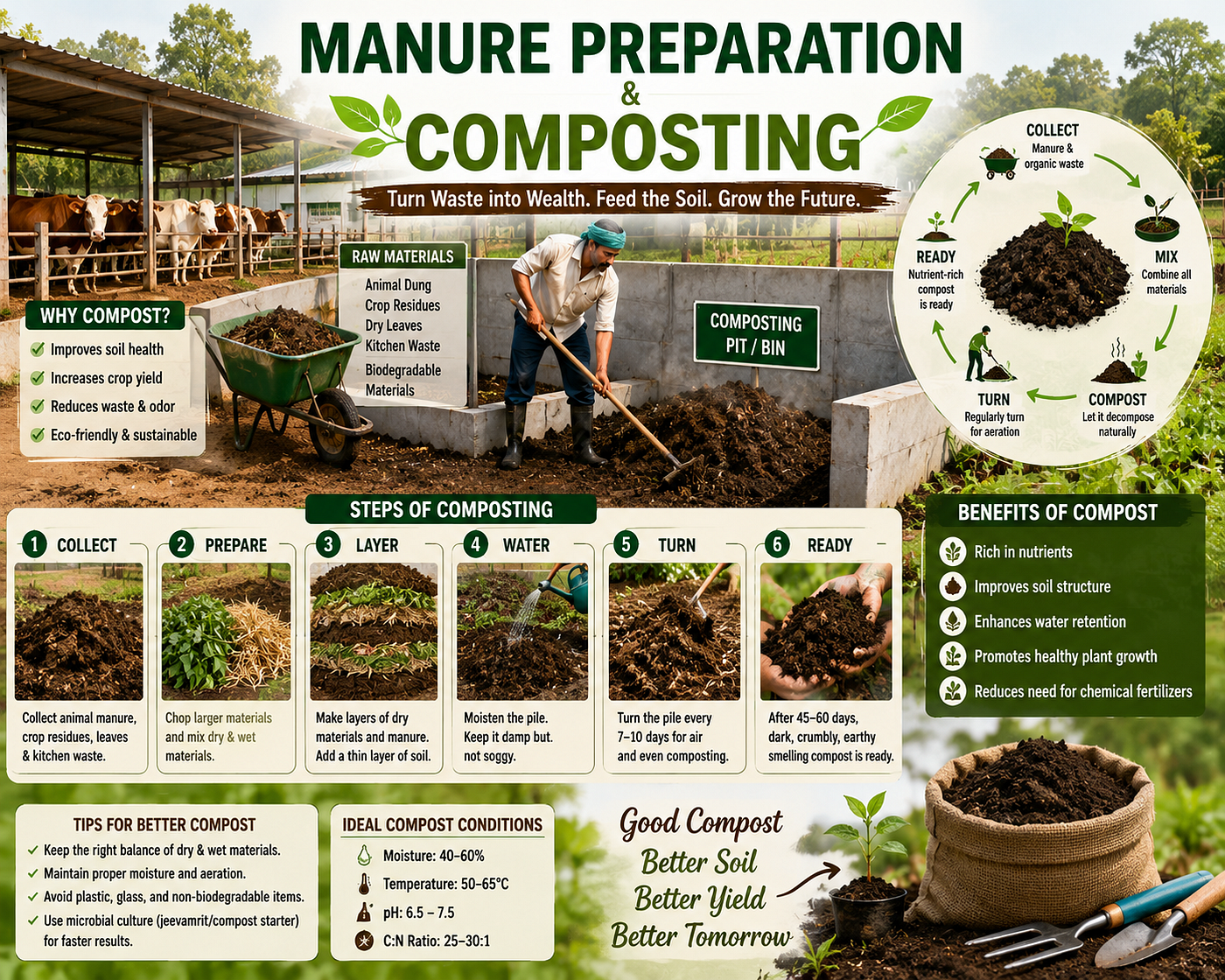
Composting is a biological oxidation process involving microorganisms that convert organic materials into stable humus-like products. Successful composting depends on balancing several factors.
Carbon-to-Nitrogen Ratio: Microorganisms require carbon for energy and nitrogen for growth. An ideal initial C:N ratio typically ranges between 25:1 and 35:1.
Carbon-rich materials: Straw, sawdust, dry leaves Nitrogen-rich materials: Fresh manure, green plant materials, food waste
Moisture Content: Moisture supports microbial activity. The optimal moisture range is 50%–60%. Excess moisture may cause anaerobic conditions, odors, and nutrient losses. Insufficient moisture may lead slows decomposition
Oxygen Supply: Most commercial composting systems rely on aerobic decomposition. Adequate aeration promotes efficient decomposition, odor reduction, and temperature regulation.
Temperature: Temperature influences microbial activity and pathogen destruction. Composting progresses through several phases:
- Mesophilic (20–40°C): Microbial populations establish rapidly.
- Thermophilic (45–70°C): Rapid decomposition, weed seed destruction, pathogen elimination.
- Maturation (Declining temperature): Humification processes dominate.
Feedstocks Used in Commercial Composting
Commercial compost operations utilize diverse feedstocks.
Agricultural Residues: Crop residues, straw, corn stalks, sugarcane trash.
Animal Manures: Poultry litter, dairy manure, feedlot manure.
Food Processing Wastes: Fruit waste, vegetable waste, brewery residues.
Municipal Organic Wastes: Yard trimmings, green waste.
Forestry Residues: Wood chips, bark, sawdust.
Methods of Composting
Windrow Composting: Windrows are long piles of organic materials arranged in rows.
Characteristics:
- Low investment cost
- Suitable for large volumes
Management includes:
- Periodic turning
- Moisture monitoring
- Temperature monitoring
Advantages: Simple operation, scalable Limitations: Large land requirement, weather dependence
Aerated Static Pile Composting: Air is supplied through perforated pipes.
Advantages: Reduced labor, improved aeration, faster composting Limitations: Higher infrastructure costs
In-Vessel Composting: Organic materials are composted within enclosed structures such as drums, tunnels, or containers.
Advantages: Process control, rapid decomposition, reduced odor Limitations: Higher capital investment
Vermicomposting: Earthworms convert organic wastes into nutrient-rich vermicompost.
Common species: Eisenia fetida, Eudrilus eugeniae
Advantages: High-quality product, enhanced microbial activity Limitations: Sensitive to temperature extremes
Composting Process Management
Effective management is essential for producing high-quality compost.
Feedstock Preparation: Materials may require:
- Shredding
- Grinding
- Mixing
Proper particle size improves decomposition.
Pile Construction: Feedstocks are blended to achieve:
- Appropriate C:N ratio
- Adequate porosity
- Uniform moisture distribution
Monitoring: Key parameters include:
- Temperature
- Moisture
- Oxygen levels
- Odor
Turning: Turning provides:
- Aeration
- Heat redistribution
- Moisture uniformity
Pathogen and Weed Seed Control
One major objective of commercial composting is sanitization. Proper thermophilic temperatures destroy:
- Plant pathogens
- Human pathogens
- Weed seeds
Maintaining temperatures above 55°C for several days is commonly recommended for hygienic compost production.
Compost Maturity and Stability
Immature compost may harm crops.
Indicators of Maturity
- Stable temperature, close to ambient
- Reduced odor
- Earthy smell
- Dark, crumbly appearance
- Low ammonia content
- Positive germination test results
Quality Parameters for Commercial Compost
Quality assessment typically includes:
Physical: Texture, particle size, bulk density.
Chemical: pH, electrical conductivity, organic matter content, nutrient concentrations.
Biological: Microbial activity, pathogen absence, compost maturity.
Nutrient Composition: Typical compost nutrients include:
- Macronutrients: Nitrogen, phosphorus, potassium
- Secondary nutrients: Calcium, magnesium, sulfur
- Micronutrients: Iron, zinc, copper, manganese, boron
Nutrient concentrations vary depending on feedstocks.
Commercial Applications of Compost
Field Crop Production: Compost improves soil fertility, water retention, and yield stability.
Horticultural Production: Used in vegetables, fruits, and ornamentals.
Greenhouse Production: Often incorporated into growing media.
Landscaping: Used for turf establishment, urban greening, and land restoration.
Organic Farming: Compost serves as a major nutrient source.
Compost-Based Products
Commercial compost businesses increasingly produce value-added products.
Enriched Compost: Fortified with additional nutrients.
Vermicompost: Produced through earthworm activity.
Compost Tea: Liquid extract used for soil and foliar applications.
Potting Mixes: Compost blended with other growing media components.
Economic Considerations
Commercial composting can provide economic benefits through:
Reduced waste disposal costs
Input cost savings
Additional revenue streams from sales of compost, vermicompost, potting media, and organic amendments
Future participation in carbon and sustainability incentive programs
Challenges in Commercial Composting
Feedstock Variability: Raw materials may vary in composition.
Odor Management: Improper aeration can create nuisance odors.
Pathogen Control: Requires careful process management.
Market Development: Quality assurance is necessary to build consumer confidence.
Transportation Costs: Bulky materials increase logistics expenses.
Quality Assurance and Certification
Commercial producers often implement quality standards involving:
Product testing
Traceability
Labeling
Nutrient analysis
Contaminant screening
Certification may support access to organic and premium agricultural markets.
Emerging Technologies in Composting
Automated Monitoring Systems: Sensors track temperature, moisture and oxygen.
Artificial Intelligence: Supports process optimization.
Precision Composting: Data-driven management improves consistency.
Biochar-Compost Blends: Enhance nutrient retention and carbon sequestration.
Microbial Inoculants: Accelerate decomposition and improve compost quality.
Best Practices for Commercial Compost Production
Successful composting operations should:
- Use balanced feedstock mixtures
- Maintain optimal moisture levels
- Ensure adequate aeration
- Monitor temperature regularly
- Prevent nutrient losses
- Produce fully matured compost
- Conduct quality testing
- Follow environmental regulations
- Develop reliable marketing channels
Conclusion
Manure preparation and composting are essential practices for sustainable and commercial agriculture. Through controlled biological decomposition, organic wastes are transformed into valuable soil amendments that improve soil fertility, enhance nutrient cycling, increase microbial activity, and support long-term agricultural productivity.
Commercial composting provides an effective solution for agricultural waste management while contributing to environmental sustainability, climate resilience, and circular economy principles. As demand for organic inputs and sustainable farming systems continues to grow, manure-based composting and advanced compost production technologies are expected to play an increasingly important role in modern agricultural enterprises worldwide.
Disclaimer: Parts of this content may be AI-generated or AI-assisted. All interpretations, opinions, and conclusions presented are the responsibility of the author. Kindly do not consider this information as any form of advisory. Do your own research before implementing the knowledge shared above.
메타데이터
- post_id
- ef49ac3f1c82
- slug
- manure-preparation-and-composting-for-commercial-applications-ef49ac3f1c82
- url
- https://medium.com/@rohanchhabra2025/manure-preparation-and-composting-for-commercial-applications-ef49ac3f1c82
- canonical_url
- https://medium.com/@rohanchhabra2025/manure-preparation-and-composting-for-commercial-applications-ef49ac3f1c82
- author_url
- https://medium.com/@rohanchhabra2025
- status
- ok
- fetched_at
- 2026-07-10 16:32:07