Hugging Face Builds an Agent That Thinks Like a Research Engineer
Hugging Face Builds an Agent That Thinks Like a Research Engineer
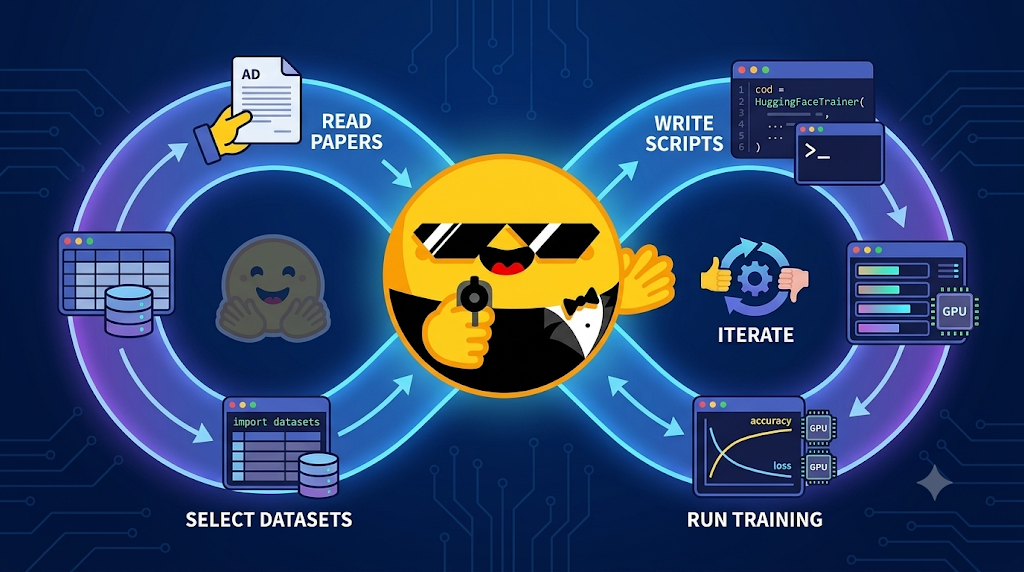
For years, the open source machine learning community has measured progress in terms of artifacts: a new model checkpoint, a new dataset, a new library that makes some technical step easier. Hugging Face’s Transformers library gave the field a shared way to use models. Its Datasets library gave the field a shared way to handle data. What has remained stubbornly manual, despite all of that progress, is the actual research process that connects those artifacts together: reading a paper, deciding which dataset fits a task, writing a training script, launching it on real hardware, watching the results, and iterating when something goes wrong. That loop has always required a human sitting at a terminal making judgment calls. Hugging Face’s newly open sourced project, ml-intern, is an attempt to package that judgment into an autonomous agent rather than just another tool that speeds up a single step of the process.
What ml-intern actually is
At its core, ml-intern is described by its own documentation as an agent that autonomously researches, writes, and ships machine learning related code using the Hugging Face ecosystem, with deep access to documentation, papers, datasets, and cloud compute. The distinction worth sitting with is the difference between a generic coding agent that happens to be pointed at machine learning tasks, and an agent that has been built from the ground up to reason in the native primitives of a research workflow. A generic coding assistant might be able to write a training script if asked directly, but it has no innate sense of where to look for a relevant paper, how to judge whether a dataset on a hub is suitable for a task, or how to request the right kind of cloud compute for a job. ml-intern is designed so that all of these capabilities are first class tools available to it from the start, rather than capabilities it has to improvise.
This matters because the bottleneck in real research work is rarely the difficulty of writing code in isolation. It is the surrounding judgment: knowing which paper actually matters, recognizing when a dataset is too low quality to use as is, and understanding when a training run has gone wrong in a way that calls for an ablation rather than a full restart. By giving the agent direct access to the tools a human researcher would use for these same decisions, the system is positioned to make that judgment itself rather than relying on a person to provide it after the fact.
Getting it running
The setup process is intentionally lightweight for an open source research tool. The repository can be cloned and installed with a small number of commands, after which the command line tool becomes available from any directory on a machine:
git clone git@github.com:huggingface/ml-intern.git
cd ml-intern
uv sync
uv tool install -e .
Once installed, running the tool is as simple as typing its name, which starts an interactive chat session:
ml-internFor automated or scripted use, a single prompt can be passed directly, which runs the agent in a headless mode that automatically approves its own steps rather than asking for confirmation at each one:
ml-intern "fine-tune llama on my dataset"The tool exposes a handful of useful options for adjusting behavior, including a flag to use sandboxed Hugging Face Space based tools instead of the local filesystem, a flag to set a maximum number of agent iterations, and a flag to disable streaming output:
ml-intern --sandbox-tools "your prompt"
ml-intern --max-iterations 100 "your prompt"
ml-intern --no-stream "your prompt"
The choice of underlying language model is also configurable, and the project supports a fairly wide range of options, from large frontier models accessed through Hugging Face’s inference routing layer to smaller open models run entirely on local hardware:
ml-intern --model moonshotai/Kimi-K2.7-Code:novita "your prompt"
ml-intern --model openai/gpt-5.5:fal-ai "your prompt"
Before any model calls can be made, the tool needs a Hugging Face access token capable of making inference provider calls, along with a GitHub personal access token for code search and repository operations. These are typically placed in a local environment file, and the CLI will prompt for a token on first launch if one has not already been configured, unless a fully local model has been selected instead.
Running entirely on local hardware
One detail that distinguishes ml-intern from many cloud first agent tools is that it does not require sending every request to a hosted API. Local model support works through OpenAI compatible HTTP endpoints, using a routing layer that lets the agent talk to a locally running inference server rather than loading model weights directly. A user who already has an inference server running can point the agent at it using a provider specific prefix:
ml-intern --model ollama/llama3.1:8b "your prompt"
ml-intern --model vllm/meta-llama/Llama-3.1-8B-Instruct "your prompt"
This same switch can be made inside an active interactive session as well, which is convenient for comparing how different models handle the same research task without restarting the tool:
/model ollama/llama3.1:8b
/model lm_studio/google/gemma-3-4b
/model llamacpp/llama-3.1-8b-instruct
The supported local prefixes cover Ollama, vLLM, LM Studio, and llama.cpp, and the endpoint configuration can either be set once as a shared base URL for all providers, or overridden individually for a specific provider when a setup uses more than one local inference backend at the same time.
Two tool runtimes for two different needs
ml-intern ships with two distinct modes for how its tools actually execute. By default, the agent runs file operations such as reading, writing, editing, and shell commands directly against the local filesystem of the machine it is running on. This is the natural choice when a developer wants the agent to inspect or modify files inside an existing project checkout.
The alternative is a sandboxed runtime that uses Hugging Face Space based tools instead, which becomes important once a workflow needs to test code remotely or request GPU hardware before committing to a larger training job. This mode is enabled with a flag, and it requires a Hugging Face token even when the model being used for reasoning is entirely local, because creating a private Space to act as the sandbox is itself an action that depends on Hugging Face infrastructure:
ml-intern --sandbox-tools "test this training script in a GPU sandbox"This sandbox mode can also be made the default behavior for every session by setting a configuration value, which is a sensible choice for teams that always want a layer of isolation between the agent’s actions and the host machine it happens to be running on.
Two demonstrations that show what the loop looks like in practice
The most informative way to understand what ml-intern is built to do is through two contrasting examples that accompanied its release, both of which illustrate a complete research loop rather than a single isolated action.
In a healthcare oriented task, the agent was pointed at an evaluation built around medically sensitive scenarios. Rather than immediately reaching for whatever publicly available medical dataset it could find, the agent first inspected the available options and judged that their quality was insufficient for reliable training, particularly around edge cases such as hedging language that a careful medical professional would use, and multilingual emergency communication scenarios that a real deployment would need to handle correctly. Having reached that judgment, the agent then wrote its own synthetic data generation script to produce examples specifically targeting those weak spots, generating roughly a thousand new training examples and upsampling them substantially before retraining and evaluating against the benchmark. According to public reporting following the release, the resulting model outperformed a comparable result produced by a different coding agent on the same benchmark by a wide margin, underscoring that the value here came from the judgment to recognize a data quality problem and act on it, not from any single coding step in isolation.
In a mathematics oriented task, the agent took a markedly different path that better illustrates its handling of a reinforcement learning style training loop. It implemented a training script for Group Relative Policy Optimization, a reinforcement learning technique commonly used in post training that tends to require less memory overhead than more traditional approaches. It launched that training job on real GPU hardware, watched the resulting reward curves as training progressed, and when an initial run showed signs of reward collapse partway through, it ran a series of ablations to isolate which components of the training setup were responsible, rather than abandoning the approach outright. Only after diagnosing the problem did it finalize a working checkpoint. This sequence, propose a method grounded in a known technique, launch it, observe a failure signal, diagnose the cause, and recover, is precisely the kind of iterative process a research engineer goes through by hand, and it is notable that none of these individual steps required a human to intervene partway through.
A separate, widely cited result from the broader evaluation suite involved a scientific reasoning benchmark, where the agent traced citations back from a benchmark’s own reference paper, located several relevant datasets, constructed multiple difficulty filtered variants of the training data, and ran a series of supervised fine tuning passes on a small open model. The reported outcome was a substantial jump in benchmark accuracy achieved in well under a single working day, again driven by the agent’s own research and iteration process rather than a single predetermined recipe handed to it in advance.
What happens underneath the surface
The architecture behind these demonstrations is built around what its documentation calls a submission loop, which processes operations such as user input, execution approvals, interruptions, and context compaction through a queue, and emits a corresponding stream of events back out, such as a tool being called, a tool finishing, or an approval being requested. Inside that loop sits the actual agentic cycle, which can run for up to three hundred iterations on a single task before stopping.
Each iteration follows a consistent pattern. The agent calls its underlying language model with the current message history and the full specification of tools available to it. If the model’s response includes one or more tool calls, those calls are checked against an approval policy, since certain sensitive actions, such as launching a paid training job or running a potentially destructive command, are deliberately routed through a confirmation step rather than executed automatically. Once approved, each tool call is dispatched through a central tool router and its result is folded back into the running context before the loop continues. If no tool calls are present in a given response, the loop considers the turn complete.
Two supporting systems help keep this loop stable over long running tasks. A context manager tracks the full message history and automatically compacts it once it grows past a token threshold, which keeps very long research sessions from simply running out of context space partway through. A separate doom loop detector watches for repeated tool call patterns that suggest the agent has gotten stuck cycling through the same unproductive action, and when it detects this, it injects a corrective prompt to nudge the agent toward a different approach rather than letting it spin indefinitely.
The tool router itself is organized around the specific primitives of the Hugging Face ecosystem rather than generic file and shell access alone. It provides dedicated access to Hugging Face documentation and research papers, to repositories, datasets, and Jobs for cloud compute, to GitHub code search for finding existing implementations, to the sandbox and local tool runtimes described earlier, and to any additional tools exposed through external Model Context Protocol servers that a team chooses to connect.
Recording and sharing what the agent did
Every session run through ml-intern is automatically uploaded to a private dataset on the Hugging Face Hub, stored in the same JSONL trace format used by other popular coding agents, which means the trace can be opened directly in a trace viewer to inspect every turn, tool call, and model response after the fact. By default this dataset lives under the active user’s own namespace and stays private, though it can be flipped to public visibility directly from inside the command line tool or from the dataset’s own page on the Hub, and the agent will respect whichever visibility setting is currently active for future uploads.
/share-traces            # show current visibility and dataset URL
/share-traces public     # publish the trace dataset
/share-traces private    # lock the trace dataset back down
Teams that prefer not to retain any trace history at all can disable the behavior entirely through a configuration file, and the destination repository itself can also be customized if an organization wants traces routed somewhere other than the default per user dataset.
Staying in the loop through notifications
For longer running tasks, particularly ones launched in a headless or unattended fashion, ml-intern supports outbound notifications through Slack. These are one way status updates rather than a full chat integration, meaning the agent can tell a channel that it needs approval, that it hit an error, or that it finished a turn, but the channel itself cannot be used to send new instructions back to the agent. Setting this up involves creating a Slack app with permission to post messages, inviting that bot into the relevant channel, and then providing its token and the target channel identifier as environment variables, after which the integration is created automatically.
Extending the agent
Because the project is fully open source, both its tool set and its model connections are meant to be extended rather than treated as fixed. New built in tools can be added by extending a single function that returns a list of tool specifications, each one paired with a handler function that gets executed when the agent decides to call it. External capabilities can be wired in through Model Context Protocol servers as well, configured declaratively with a transport type, a URL, and any authorization headers a private server might require, with support for substituting in secrets from a local environment file automatically.
Why packaging the workflow matters more than packaging another tool
The most interesting framing around this release is not really about any single benchmark result, impressive as some of them are. It is the observation that Hugging Face’s earlier flagship projects each standardized one piece of the machine learning stack. A shared library standardized how models are loaded and run. A shared library standardized how datasets are stored and accessed. What had been missing was anything that standardized the connective process between those pieces, the actual sequence of judgment calls a researcher makes when moving from a research question to a validated, trained model. By open sourcing an agent that encodes that process directly, rather than open sourcing only the individual components the process depends on, the project is making a claim that the research workflow itself is a legitimate target for tooling, not just an unavoidable manual overhead that sits between the tools.
This also has a practical implication for teams without a large dedicated research staff. The kind of iterative loop demonstrated in the healthcare and mathematics examples, judging data quality, generating targeted synthetic data, implementing a non trivial training technique from a paper, diagnosing a failed training run, and recovering from it, has historically required a reasonably senior practitioner who has internalized that judgment through experience. An open, inspectable agent that can carry out a meaningful portion of that loop autonomously, with sensitive actions still gated behind explicit human approval, changes what a smaller team can realistically attempt without first hiring that expertise outright.
Conclusion
ml-intern represents a notable shift in what an open source release from a major machine learning infrastructure provider can look like. Rather than another library that makes one step of model development easier, it is an attempt to package the entire research loop, reading, judging, building, training, evaluating, and iterating, into something that runs largely on its own, while still keeping a human in the loop for the decisions that genuinely warrant oversight.
With native access to the core primitives of the Hugging Face ecosystem, support for both hosted and fully local models, a sandboxed execution mode for safer experimentation, and full session traceability through the Hub, the project gives practitioners a transparent, extensible foundation rather than a closed black box. For anyone working anywhere near fine tuning, post training, or applied research workflows, it is a tool worth understanding closely, both for what it can already do and for what it suggests about where this kind of tooling is headed next.
The repository is available at: https://github.com/huggingface/ml-intern
메타데이터
- post_id
- ef5196a56d1a
- slug
- hugging-face-builds-an-agent-that-thinks-like-a-research-engineer-ef5196a56d1a
- url
- https://medium.com/open-intelligence/hugging-face-builds-an-agent-that-thinks-like-a-research-engineer-ef5196a56d1a
- canonical_url
- https://medium.com/open-intelligence/hugging-face-builds-an-agent-that-thinks-like-a-research-engineer-ef5196a56d1a
- author_url
- https://medium.com/@eng.fadishaar
- status
- ok
- fetched_at
- 2026-06-20 20:29:01