Where AI Actually Fits in AEM Architecture: Beyond Content Generation
A practical look at integrating AI with AEM Assets, Content Fragments, workflows, and authoring-without turning AI into another buzzword.
Where AI Actually Fits in AEM Architecture: Beyond Content Generation
A practical look at integrating AI with AEM Assets, Content Fragments, workflows, and authoring-without turning AI into another buzzword.
When people hear AI + Adobe Experience Manager, the first thought is often:
“AI can generate content.”
That’s true, but I think that’s one of the least interesting parts of the story.
In a real AEM implementation, we deal with thousands of assets, Content Fragments, components, metadata, approvals, multiple channels, localization, accessibility requirements and publishing workflows.
The bigger question is:
Where can AI remove friction from that entire content lifecycle without taking control away from authors?
Here are a few areas I find interesting.
- DAM asset intelligence
Imagine a marketing team uploading hundreds of images into AEM Assets.
Normally, someone may need to enter:
Title → Description → Tags → Alt text → Classification
Instead, an AI service could analyze the asset and suggest metadata, tags and accessibility descriptions.
The important word here is suggest.
For enterprise content, I wouldn’t allow AI-generated metadata to automatically become trusted production metadata in every situation.
A better pattern is:
Asset Upload → AI Analysis → Metadata Suggestions → Human Review → Approval
AI accelerates the work. AEM still controls the process.
- Content Fragment variations
Suppose we maintain a product description as structured content in AEM.
The same information may eventually appear on:
Website → Mobile app → Email → Campaign → Other digital experiences
Instead of authors rewriting the same message for every channel, AI could generate proposed variations based on the approved source content.
The original Content Fragment remains the source of truth.
AI creates options.
Authors decide what gets published.
That distinction becomes important when you’re dealing with regulated or brand-sensitive content.
- Accessibility assistance
Accessibility is another interesting use case.
AI can potentially help authors identify missing alt text, propose image descriptions, flag content that may be difficult to understand, or assist with repetitive accessibility checks.
But again:
AI suggestion ≠ automatic compliance.
Accessibility still needs proper standards, validation and human oversight.
- Content discovery
This may eventually be more valuable than generation.
Large AEM DAM implementations can contain enormous asset libraries.
Authors often ask:
“Do we already have an asset for this?”
AI-powered semantic search could make finding existing content easier even when the author doesn’t know the exact filename, folder or metadata values.
That could reduce duplicate assets and improve content reuse.
So where should AI sit?
I wouldn’t design AI as a replacement for AEM.
I would treat it as another service in the architecture.
Author → AEM → AI Service → Validation/Review → AEM → Publish → CDN/Edge
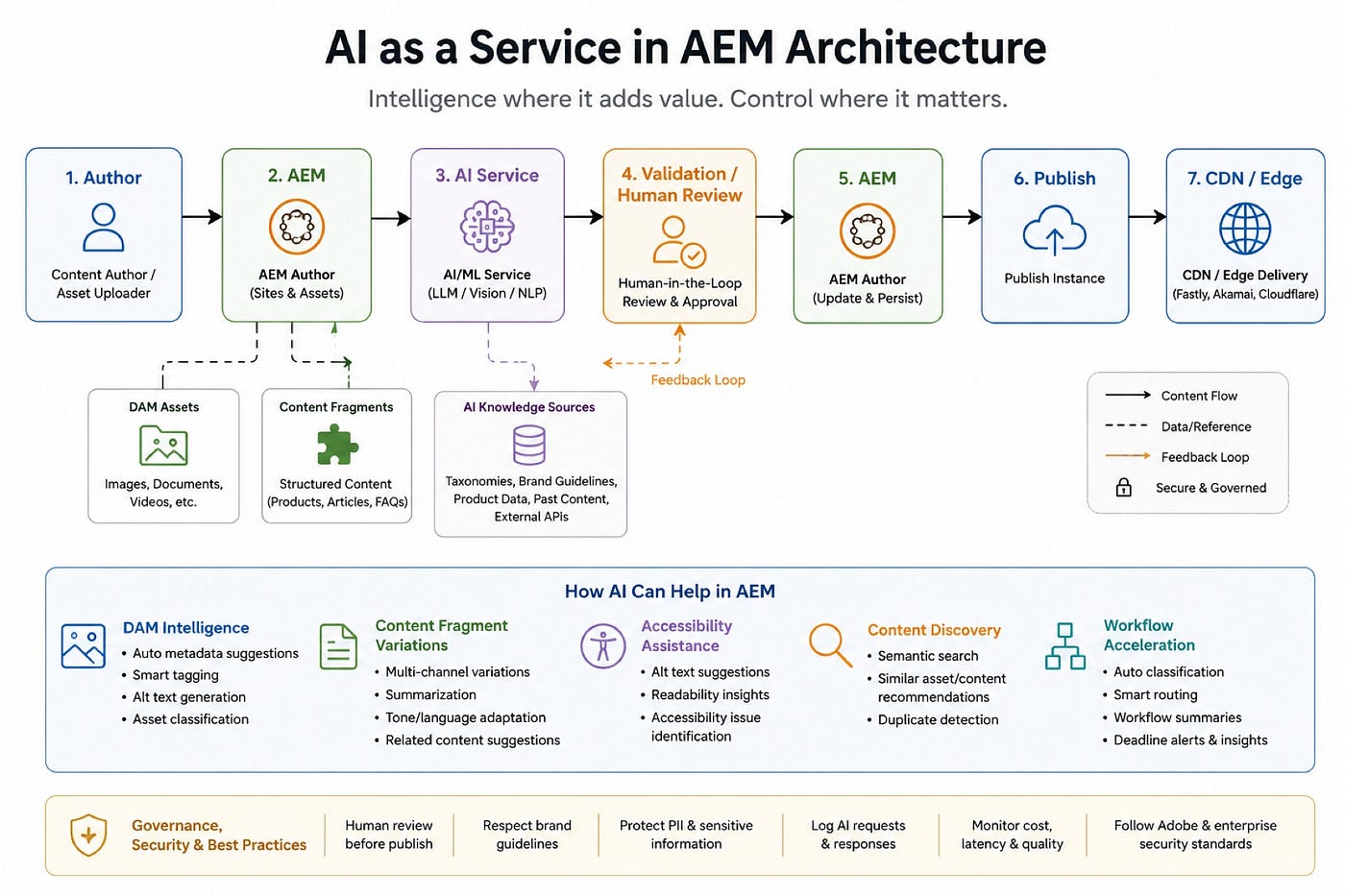
AEM remains responsible for content management, permissions, workflows and publishing.
AI provides intelligence where it adds value.
And the integration layer needs to handle things like authentication, timeouts, failures, cost, observability and data/privacy requirements.
That’s where this becomes an architecture problem, not simply an API call.
The bigger opportunity
For AEM developers, I don’t think the future is:
AEM vs AI.
It’s understanding how:
AEM + AI + APIs + React + enterprise data
work together to build better digital experiences.
That’s the area I’m exploring more deeply, and I’ll document what I learn-including implementations that work and ones that don’t.
Where would you introduce AI into an AEM implementation first?
Kailash Ramagiri is an AEM & React developer with 8+ years of experience working with Adobe Experience Manager. He focuses on AEMaaCS, React, headless experiences, and the growing intersection of AEM and Generative AI.
I’m documenting what I learn while exploring how AI can solve practical problems in modern AEM implementations.
메타데이터
- post_id
- ef5e87b9bbf2
- slug
- where-ai-actually-fits-in-aem-architecture-beyond-content-generation-ef5e87b9bbf2
- url
- https://medium.com/@kailash.ramagiri/where-ai-actually-fits-in-aem-architecture-beyond-content-generation-ef5e87b9bbf2
- canonical_url
- https://medium.com/@kailash.ramagiri/where-ai-actually-fits-in-aem-architecture-beyond-content-generation-ef5e87b9bbf2
- author_url
- https://medium.com/@kailash.ramagiri
- status
- ok
- fetched_at
- 2026-08-03 23:41:01




