Sheriff “Billy” Cook: A Saga and Scandal
Discoveries on AZ Territory’s Sheriff William W. “Billy” Cook
Sheriff “Billy” Cook: A Saga and Scandal
Discoveries on Arizona Territory’s Sheriff William W. “Billy” Cook
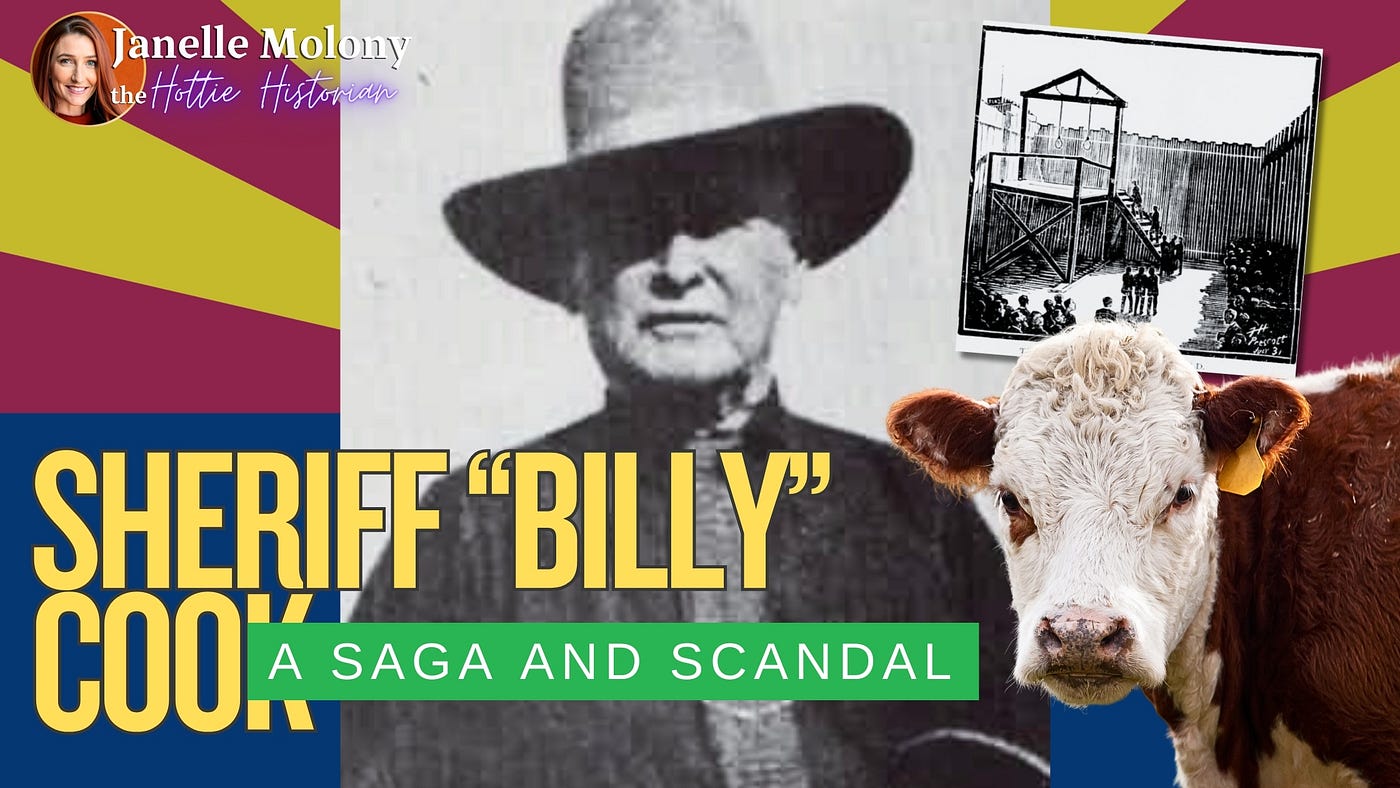
William Walter Cook (1859–1943), two-term sheriff of Maricopa County was better known in Arizona Territory as “Billy.” He was primarily a cattleman of the past, though he also contributed to territorial and early state history as a crime stopper, firefighter, ostrich rancher and philanthropist in the cities of Prescott, Phoenix and Glendale. “His genial, pleasant manner has made him quite popular in both business and social circles,” so says a 1901 biographical sketch on him.[1]
Cook’s story appears in mixed print sources that offer only bits and pieces specific to one interest or to the theme of the publication. His story, as pieced together here, combines several sources identified at the end of the article, but as an outsider looking in on this family, I want to make sure that any living relatives or descendants know that they have an opportunity to contribute or correct what is shared (and send pics!). You can leave a comment at the end of the story or email me here.
Prescott, Arizona: Cattle & Canons
Billy Cook was born January 17, 1859 in Oakland, California to a saddler and harness-maker and his wife, both who’d recently made the trek from back east via the Isthmus of Panama. The Cook family moved to Walla Walla, Washington when Billy was only four, likely in response to the Federal Homestead Act of 1862. There, Billy’s father Josiah applied himself to his craft again and worked as a hotelier. He also served in the local government as the county supervisor and treasurer. Except for two years spent at high school in Rockport, Indiana, Walla Walla was where Billy and his two younger brothers grew up.
When Billy was 17, the family moved out to Prescott, A.T. and settled next to his aunt and uncle, Lewis A. and Fannie (Cave) Stevens, near present-day Watson Lake Park. Uncle Lewis had been a Yavapai County councilman in the territorial capital city. Josiah went into the dairy cattle business with his brother-in-law, and they called themselves “Stevens & Cook.” Billy studied the cattle trade by default but may set his sights on something other than the family business. He left for two years to attend Bryant & Stratton’s Commercial College of Cincinnati, a private business management school.
Cook returned to Prescott in 1880 (age 21). When he came back, he could have seen John Henry “Doc” Holliday for a dental exam.[2] Instead of staying in Prescott (proper) with his parents and siblings, though, Cook established his own ranch on 106 acres near the headwaters of New River.[3] The area he settled is outside of present-day Black Canyon City and is technically part of the New River community, but back then, folks would just say he lived in Prescott. (It’s the same way people in any of the surrounding cities in the greater Salt River Valley say they live in Phoenix.) In the 1880s, that area’s population was miniscule, and it was mostly recognized for Jack Swilling’s old place and Goddard’s Stage Station along what was then the Black Canyon (Stage) Route to Prescott. All that remains of Goddard’s Ledni Lii Creek (formerly Squaw Creek) is a scrap heap.

Cook has been credited as been the first person to start a cattle ranching business in the Black Canyon City/New River area,[4] though Swilling ran cattle nearby at a much earlier date. According to his 1901 biographical sketch, Cook ran 1,500 Shorthorn and Herefords through his (very) isolated canyons.[4]
Cook’s Ranch straddled the boundary of Yavapai and Maricopa Counties. He lived just east of New River Mountains at the foot of what is now called Cook’s Mesa, on New River (about a half mile from Burnt Hole Canyon). Presently, there is a stone trough structure and a small ranch home that has been amended with modern construction (though the original stonework is still visible). Access to the ranch remains is available via off-road vehicle on Fire Service Road 37.[5]

In 1885, Cook made a return trip to Rockport where he married 23-year-old Stella Laird (1862–1923). Their marriage certificate listed their home residence as the “Swilling Ranch” near the Agua Fria River. That might have been a simple formality, as Swilling’s was where the local post office was, and frankly, there was no better answer. Billy Cook and Stella had one son, **Joseph**, born shortly after the marriage. Joseph died at age 15 from an accidental gunshot wound received on a hunting trip. It is unclear why they never had any other children, though the newspaper announcement of Joseph’s funeral service indicated that Stella had become quite fragile after the loss.[6]
Phoenix: Fires, Murders and Election Fraud
After Cook’s father passed away in 1893, the family moved to Downtown Phoenix near 5th Ave. and Van Buren St. Cook was still listed as a cattleman or livestock dealer in relater censuses, but he also became a volunteer member of the Phoenix Fire Department’s sixth company: Five Points Hook & Ladder Company. This was the last group of regularly organized volunteers.[7] They met at a blacksmith’s shop near the corner of 7th Ave. and Van Buren St. and were equipped with a hand-pulled combination hose and ladder truck.
Side Note: Did you know the Phoenix Fire Department has an official historian? His name is Tim Kovacs, and he’s the guy to ask about this subject. He works at the Historic Station #08 at 5th Ave. and Encanto, which is now a small museum (not to be confused with the Hall of Flame Museum of Firefighting at Papago Park). Click any of these links to learn more.
In 1903, Cook was elected as the sheriff of Maricopa County on the Republican ticket. During his tenure, he oversaw plenty of land sales to settle disputes between plaintiffs, but he also chased after criminals through central and southern Arizona. He even made a run out to California to bring in a forger.[8] One of Cook’s biggest cases was tracking down the murderers of **Charles E. Goddard and his short-term employee [Frank E. Cox.](https://www.findagrave.com/memorial/176395781/frank-cox)** Besides this murder feeling a bit personal to Cook, considering the Goddards were a familiar name in the Black Canyon area, it appears Cook and Cox also share a connection as members of the same Shriners Club. (Back then it was the Ancient Egyptian Arabic Order of the Nobles of the Shrine and Cook and Cox were both members of the El Zaribah Temple.)
The newspapers considered the Feb. 2, 1903 murder at Goddard Stage Station one of the bloodiest crimes the area had seen in years.[9] That afternoon, **Francisco Rentenzia **(also seen as Rentaria or Rentario) and Eligio Hidalgo from Mexico stopped at the stage station and conversed in a friendly way with several people. Later, Rentenzia and Hidalgo entered the building just as the Goddards et al sat down for supper. After being asked if they’d like something to eat, the out-of-towners opened fire.[9] One source suggests Rentenzia may have held a grudge against Goddard.[10] As the story goes, Rentenzia was allegedly employed by Goddard back in 1901 to help with his sheep business (like Cox was doing in 1903). A physical altercation between Rentenzia and another sheep shearer resulted in Goddard striking Rentenzia down. Goddard knocked him across the face with his gun and that act caused a deep cut (note the cheek scar in the photograph).

Survivors and locals feared for their lives and stayed hidden until Rentenzia and Hidalgo left the next morning. When a visitor arrived and saw the mess, he sounded the alarm to others and a pursuit began that evening. One survivor provided a physical description of the murderers, which was shared with law enforcement throughout the state. So the papers say, “the most energetic chase was begun.”[9]
“Chas. Goddard and Frank Cox were murdered Sunday evening at Goddard’s Station in New River, about 30 miles southeast of here. The murderers are supposed to be two Mexicans, who were last seen headed toward Phoenix. Sheriff Cook took the trail Tuesday morning and if there is any man in the country that will find them, Billy Cook is the man. New River is his old stamping ground and he knows every foot of the country. Goddard leaves a family who reside in Phoenix.” (News-Herald, Wickenburg, AZ; Sat. January 24, 1903, 5.)
Yavapai County [Sheriff Joseph I. Roberts ](https://www.findagrave.com/memorial/81322357/joseph-isaac-roberts)was assisted by Sheriff Cook, who aimed to prevent the criminals from fleeing the country. In April, the culprits were seen in the border town of Naco, south of Bisbee, Arizona… except they were on the Mexican side. Phoenix City Marshall Billy Blankenship is credited with luring them over to the U.S. side before immediately arresting both. Sheriff Cook collected Rentenzia and Hidalgo from the Territorial Prison in Yuma and personally transferred them to Prescott to be tried.[11]
Though it was a two-month effort, the Arizona Republican read: “They were brought to trial after one of the most persistent hunts and one of the shortest ones ever conducted in this territory, thanks to the activity of Sheriff Roberts of this county.”[9]
Rentenzia and Hidalgo were jailed in the basement of the Yavapai County Courthouse. On June 2, both defendants plead not guilty but were positively identified by three witnesses (Rosa Goddard, Milton Turnbull and Francisco Rodriguez) and evidence was stacked against them. One such piece of evidence was the dead man’s testimony. Charles Goddard lived long enough to provide the description of his own killers. The July 10 trial lasted only thirty minutes. Both defendants were found guilty of first-degree murder and sentenced to hang.

See the full set of postcard images here. WARNING: They are disturbing.
They were brought out to the gallows behind the courthouse on July 31. At the gallows during the execution were Sheriff Roberts, Sheriff Cook and his deputy Jeff Duncan, and a Catholic priest identified as Father Quetu. The Republican reported: “Aside from Hidalgo, the coolest men on the scaffold were Sheriffs Roberts and Cook. Rentario betrayed some trembling and regret…” [9] As shown in the historic image, Hildalgo smiled at the audience of 500. He even called out, “Adios todos!” (Goodbye everyone!) and “Adios Amigos!” (Goodbye, Friends!). Hildalgo’s final words came after Cook placed a black hood over his face: “Goodbye Frank.” …And that was the last hanging that would ever take place before a public audience at the old courthouse plaza.
As a side note: A length of rope from this hanging is on display at the Sharlot Hall Museum, as is the trap door portion of the gallows platform. See them for yourself by visiting, or by checking out this tourist’s blog: American Expeditioners.

Cook ran for re-election in 1904, but the results were tied: 1843 each for Cook and J. Elliott Walker. The results were contested and misconduct alleged on both sides of the vote.[12] Cook ultimately took that win, but Walker was elected the following year.
Outside of crime stopping, Cook has been consistently recognized as “one of the pioneers in the cattle industry’s development in the West.”[13] In January 1904, Cook also helped found the Arizona Cattle Grower’s Association (ACGA). He served on the bylaws committee and was once the 2nd VP and the President.
The ACGA was established to protect the industry from theft, support the livestock sanitary commission, contribute to lawmaking related to livestock owners and their property, and to promote the official formation of the Arizona Rangers. The Arizona Rangers emerged as a Governor-authorized and loosely monitored voluntary law enforcement group that operated from about 1901 to 1909. They specifically focused on the prevention of rustling in Arizona Territory. Cook’s obituary writer claims he rode as a Ranger alongside Major Frederick Russell Burnham (early proponent of the Boy Scouts of America), though corroborating evidence is lacking.[13] In his President’s Address at the 1911 Annual Meeting to members, Cook stated an ongoing need for fellow “cowmen” to continue influencing legislation towards more protections: “Cattle stealing is becoming more prevalent in the southern counties of the Territory and measures should be discussed towards a means of discouraging this criminal practice.”[14]
Glendale: New River, New Land and Ostriches
In 1907, Cook partnered with his brother-in-law Clarence Bruner Laird (1866–1946) to start the “Cook & Laird” cattle ranch in northwest Glendale. According to multiple city directories, they raised both cattle and horses. One history enthusiast has found that their cattle brand featured an upright T directly above an upside-down T, though there is no cited source for this knowledge.[15] Per the township map of 1911, of the entire section 20, T2N R1E, Billy owned 320 acres, Clarence owned the adjoining 160 acres, as did Stella and Clarence’s mother Celia (who died in 1914). In later maps, Celia’s portion is jointly owned by the in-laws.
Before ranching, Stella’s brother Clarence had worked in Phoenix as a school supply salesman but, in 1909, he took a more unusual job. That year, Laird was a ranch foreman at the Pan-American Ostrich Company in Cashion (annexed by Avondale). After learning all he thought he needed to know, Laird bought a few ostriches and the family launched a new livestock operation: The Salt River Valley Ostrich Company. It is unclear how many ostriches Cook & Laird started with at 99th Ave. and Indian School. We can verify, however, that by 1913, there were 6,080 ostriches carefully counted in Maricopa County.[16] At that time, that number was 80% of the nation’s entire ostrich population. Salt River Valley’s was not the smallest ostrich troop in the area, but it was far from being the largest. The Pan-American, about four miles south of Cook’s Ranch, claimed around 5,000 of that total.
Around this time, Cook & Laird’s neighbors Addison Fox McCaleb and Charles Dee (CD) Young also opened the Desert Ostrich Co. at 99th Ave. and Camelback Rd. Seven miles east were the George Alkire’s Ostrich Ranch and the National Ostrich Co. on 51st Ave. Coincidentally, Jacob Miller who rented his fields at 51st Ave. & Thomas Rd. to the National Ostrich Co. was a former Five Points Hook & Ladder crewmember. Another Five Pointer, Vernon L. Clark, co-owned the Arizona Ostrich Company, on the property of the U.S. Industrial Indian School.
Laird was a founding member of the Arizona Ostrich Breeders’ Association and when he served as the association’s Secretary and Treasurer, he championed the need for industry cooperation and “systematic experimentation.”[16] In Tempe, Carl T. Hayden (Maricopa County Sheriff from 1907 to 1912) was similarly interested in what was happening with the booming ostrich feather industry. When he was elected to the House of Representatives in 1912, one of his first goals was to pass an amendment to the annual budget for the United States Department of Agriculture’s existing animal research programs to include a budget specific for ostriches. After some debate, $2,500 was approved to fund a research station which was initially established in Tucson, at the University of Arizona. (Read Rep. Hayden’s 1913 speech before Congress here.)
Side note: There are two resources I’d like to direct you to if the experimental research station just made your ears perk. 1. Birds Gone Wild (And Other Stories of Arizona Ostrich Ranching), by Janelle Molony, 2026. And 2. A road trip video and discussion about The U.S. Ostrich Experiment Station on YouTube.

Click here for a list of other historical ostrich ranches in Arizona.
Between 1914 and 1915, Cook and Laird acquired an additional 1,360 acres of land at the confluence of New River and the Agua Fria River (near 107th and Glendale Avenues). Per city directories, the Cook’s home residence was downtown, though that would create quite a commute for the livestock trader. Glendale residents have recalled seeing ostriches from the road at the new ranch location. Motorists could even park along the road and get out to visit the birds up close. A former Glendale Mayor, Byron Peck, had visited the Salt River Valley Ostrich Co. as a child and came home with an ostrich eggshell souvenir.[17]
In 1915, the USDA was looking for a more permanent location for the U.S. Ostrich Experiment Station and temporarily housed 12 red and blue necked ostriches at Cook & Lairds. In 1917, Cook & Laird offered the government 80 acres of their property, right on the bank of New River (near the Glendale Regional Airport). A deed was executed in March of 1918 for a 99-year lease, to be paid at the rate of $1 per year.[18] At the station, cross-species breeding experiments attempted to produce the best feather outputs. The stationmaster (H. C. Cross) observed what feeds boosted feather gloss, volume and length, he learned ways to increase chick survival rates, and he tested out veterinary care options.
When the American feather-wearing trend ceased and experiments were no longer of interest to the government, Glendale residents pitched the idea of a poultry-only (chicken) experiment station. The USDA approved of the shift, but Glendale residents also wanted a more centralized location for this work and found a better suited area at 59th Ave. and Bethany Home. Cook pledged $500 towards the investment (more than anyone else) and even furnished teams to support the safe transfer of livestock and equipment to the new location.[18] The U.S. Poultry Experiment Station opened at their new location on May 21, 1921 at what is now called Bonsall Park. Long-time residents, however, remember it as “Chicken Park.”
Regarding Cook’s generosity, at post-mortem trial contesting Cook’s last will, someone claimed that Cook tended to be “so financially involved that he was frequently in danger of losing all his possessions.”[19]
Side Note: It seems an irresponsible trait for someone who had gone to business school.
It is unknown when Cook got out of the ostrich business, or out of ranching entirely. By 1921, he was 62. In 1923, Cook’s wife Stella died tragically in a fire at their home. Shortly after, Clarence Laird moved up to Yavapai County and joined the Evans brothers in purchasing T-Ranch on the northern end of New River, AZ.[15] While Laird moved on to other interests, Cook brought on a new investor for the Glendale property: his childhood friend and esteemed Los Angeles attorney, Neil McCarthy. He and McCarthy’s names continue to appear on maps of the ranch land until at least 1929.

A Post-Mortem Scandal
Starting in 1927, Cook rented out his family home at 141 E. Palm Ln. and became a boarder in the home of two sisters, Mrs. Florence MacCallen DeWitt (1885–1952) and Miss Lucile MacCallen (1884–1947), a spinster secretary. They lived at 902 N. 6th St. in the historic Garfield District. Shown is the 1917-built, 1,262 sq. ft., single bathroom bungalow. Redfin reports this property last sold in 2021 for an astounding $645K.[20]
In 1932, at Cook’s insistence, he brought both women back with him to live in his old family home.[19] They were joined by one other unmarried woman, Miss Elizabeth Arnold, whose relationship to the sisters is unclear to the author (though it has been found that she lived with them until the end of their lives).[21] Everyone was supposed to pitch in toward shared living expenses, except the sisters took on an uneven share. They were expected to keep the home and provide care to Cook but were also frequently called on to loan him “substantial sums of money.”[19] Finally, Cook sold off his remaining ranch lands in 1937 for around $92,600, supposedly ending his financial struggles.[19]
An alternative theory is that a financial burden he’d assumed through an extra-marital affair had just been removed when a woman named Faustina Calles passed away in 1935.
Cook apparently showed an enormous appreciation to his housemates by granting the ladies city lots, farm parcels and by promising the sisters the balance of his estate upon his passing. This motion was made official and they were made joint executrices of his will (signed into effect on Aug. 30, 1939). Billy Cook passed away from a heart attack in 1943, just three weeks after his 84th birthday.[19] The sisters immediately, who had been his caretakers for his final 16 years, filed for their inheritance. Upon doing so, three other people showed up to appeal their claim.
The appellants were **Carlos Guillermo Calles (born Nov. 5, 1918, going by the name William Charles Cook), [Virginia Lilia Calles Lopez](https://www.findagrave.com/memorial/54062990/virginia-apodaca) (born Sep. 30, 1920, going by Virginia Cook Lopez), and [Josefa Lilia Calles](https://www.findagrave.com/memorial/101342250/lily_jo-harris) (born June 13, 1923, going by Josephine Lily Cook). (Please note, the court document specifically distinguished their legal and preferred names.) These were the children of [Faustina Calles](https://www.findagrave.com/memorial/195450412/faustina-d-calles%201/2) **(1888–1935), who was a secret girlfriend of Cook’s (and 29 years younger than him). The Calles children alleged they were the “sole surviving children and the sole heirs at law.”[19]
The children accused DeWitt and MacCallen of influencing a delusional, dying man to gain his estate. The sisters stood their ground and defended Cook’s mental capacity. The children were accused of laches, which is when a person waits an unreasonable (negligent) amount of time to make an important claim.
The eldest two children were born before a law change allowing illegitimate children to be recognized as inheritors, even if proven to have been adopted extra-judicially. Still, they tried. The court found that Carlos, Virginia and Josefa (ages 25, 23, and 20 at the time of Cook’s death) had “ample evidence… that Billy Cook was the father of all three contestants,” having personally acknowledged the children during his lifetime and even signing as their father on school enrollment forms.[19] They testified that they occasionally visited Cook’s home, that he bought them Christmas gifts, purchased their groceries and even sent their mother so-called “alimony” checks each month, entirely off the record. William even claimed Cook gave him money for a Studebaker, but an issue arose when Cook wrote the check to “William Calles” and refused to change it to “Cook,” as the child requested.[19]
Side Note: If these were proven Cook’s natural children, I think it’s interesting to consider while Cook struggled financially, DeWitt and MacCallen were the ones funding the secret “alimony”/child support/hush money situation. Also, it is interesting that, though the children claimed to have visited Cook’s home many times, the sisters had no knowledge of their existence. Finally, even without “ample evidence” of the Calles’ being his children, they pass the eye test with flying colors, don’t you think?

Children’s images from their FindAGrave contributors. Billy Cook from the Arizona Fraternal Order of Police.
Opposition found that Cook never permitted the children use of his last name, he never allowed them to live with him as a family member would, and ten of Cook’s closest friends testified “they had never seen or heard of” the children whatsoever. Additional inquiry found that Stella, Cook’s late wife most likely had no knowledge of her husband having had an affair or children besides their own. There is also the consideration of a 1930 census in which Faustina claimed to be a widow. I’m not a lawyer, but this suggests to me that Miss Calles knew what was expected of her in order to continue receiving financial support.
Still, Carlos (William) and Virginia had no legal ability to make a claim, per the law. This left Josefa as the only plaintiff with an opportunity. The sisters pled an estoppel on the point of laches. Josefa’s mother failed to have her child publicly recognized as Cook’s daughter. Case in point: the 1930 census. Josefa herself, was considered to have been able to assert her claim to the relationship since the age of 16, but did not. The judge also noted that, seeing as how Josefa was now in her 20s, she was far beyond calling on a legal provision originally intended for a child.
The trial came down to the specific crafting of Cook’s will. As recorded in 1939, he stated he knew no existence of any illegitimate children. And he provided that, if any claimed to be and were found proven to be per the law, then they could receive a $10 from the estate (about $182 in 2025). Josefa asserted that Cook must have been insane or delusional to have forgotten his illegitimate children. She suggested that was evidence that he was not sound of mind to have even signed the document. Alternately, ten witnesses, including two doctors who had treated Cook, provided that Cook was wholly sound of mind at the time he wrote his will.
The court record permits that by Cook’s phrasing it as “no known issue” and including the caveat of proving parentage in court, he may have intended to deter such an action. If they were truly his children, one comment in the record suggests this was “a cagey way of handling a delicate situation.”[19] Seventeen disinterested witnesses from Maricopa County agreed that, “It was [Cook’s] privilege to disinherit these children if he desired to do so,” and that he left his estate to the persons he thought were “entitled to receive it.”[19] The jury sided in the sisters’ favor.
The court denied the Calles children financial gain but did not deny them the ability to continue acknowledging Cook as their natural father. Each of them continued to use the Cook surname (I’m not sure why or how), but I did notice that not one of their obituaries from the early 2000s acknowledges Cook as a relative, or even existing. I suppose it was the family’s privilege to ensure so.
Conclusion
While nobody has a perfect, drama-free family life, I will say this: Billy Cook excelled at keeping a lid on things. His reputation in the Phoenix community remained untarnished. Part of this could be due to his years of involvement in fraternal societies with his best interests in mind (and theirs). Cook was an active member of Lodge №2, Free and Accepted Masons; Phoenix Chapter, Royal Arch Masons; Phoenix Commandry №3, Knights Templar, and El Zaribah Temple Shriners. He also belonged to the Elks Lodge, the Jesters, the Scottish Rite, and the Independent Order of the Odd Fellows, Encampment and Uniform Rank. All of these are high “degrees,” showing a lengthy investment and deep loyalty to the brotherhood.
Side Note: The featured image shown of Billy Cook wearing a tall hat with a short tie comes from the archives of the Arizona Fraternal Order of Police.**[22]** That group organized in 1915 and Arizona’s first lodges were established in 1936. I have no idea if Cook was a member or not… but I’d be surprised if he wasn’t.
Remember how Cook avenged brethren Fox’s murder? Though none of Cook’s witnesses were named in the court records, I wonder how many of them were considered brethren, too. I guess we’ll never know. Conspiracies aside, the man was an enterprising, highly influential, and gregarious character from Arizona’s past and should continue to be recognized as such. The Arizona Republic has included Cook in their 2017 list of “top lawmen of Maricopa County.”[23]

What family history story will the author cook up next? Stay tuned for more!
About the Author
Janelle Molony, M.S.L. is an award-winning nonfiction author from Phoenix, Arizona. She has a particular interest in women-centric stories and local history. Her lively storytelling and vibrant YouTube content has earned her the official moniker as the “Hottie Historian.”
Molony’s writing has been featured in magazines and journals such as Wild West History Association Journal, History Nebraska, The Michigan Historical Review, Minnesota Genealogist, Annals of Wyoming, the Tombstone Epitaph, and more. Her newest book, ***Birds Gone Wild (and Other Stories of Arizona Ostrich Ranching)* **launched on Jan. 1, 2026.
See more from the author by following on Medium and on social media. More publications by Molony can be found on her official author webpage.
Sources Used
[1] “William Walter “Billy” Cook,” Portrait and Biographical Record of Arizona (Chicago: Chapman Publishing Co., 1901): 75–76. [2] The June 2, 1880 Census shows Cook and Stevens in households 47 and 49. Holliday is HH#52, living at Montezuma and Gurley Sts. [3] Bureau of Land Management, Patent Document # 028365 for William Cook (106.52 acres on T8NR4E). [4] “William Walter “Billy” Cook,” Portrait and Biographical Record of Arizona (Chicago: Chapman Publishing Co., 1901): 75–76. [5] “Upper Ranch on New River” (Photos and Commentary by Oregon_Hiker), HikeArizona.com, Feb. 13, 2019. [6] “BURIAL OF JOSEPH COOK,” Arizona Republican, Oct. 31, 1900, p. 3. [7] James M. Barney, A Historical Sketch of the Volunteer Fire Department of Phoenix, Arizona (Phoenix: NP, 1954), 26. [8] “Importation of Forgers,” Arizona Republican, May 6, 1905. [9] “The Ghost of Goddard,” Arizona Republican, Aug. 1, 1903, p. 1). [10] “Goddard Family Murderers Renteria and Hidalgo” Photograph and archival notes from 1903, AZ Memory Project. [11] “A Happy Representation,” Arizona Republican, April 4, 1903. [12] “Sheriff’s Contest,” Arizona Republican, Dec. 31, 1904. [13] “Funeral Services are Set Today for W. W. (Billy) Cook,” Arizona Republic, Feb. 9, 1943. [14] Proceedings of the Sixth Annual Meeting of the Arizona Cattle Growers’ Associaiton,” Phoenix, AZ, November 8–11, 1911. (Digital version available through UofA*)) [15] “The Historic T-Ranch Homesite: New River, Arizona,” Just West of My Heart (Blog) by M. J. Miller, January 29, 2015. [16] “Industry is in its Infancy,” Arizona Republican, Dec. 11, 1913. [17] “Ex Mayor, ostrich egg are historic pair,” Arizona Republic, Dec. 2, 1981. [18] H. C. Cross, “Miscellaneous Information on the Ostrich Industry,” in United States Department of Agriculture, Bureau of Animal Husbandry, Animal Husbandry Division, March 11, 1918 & December 30, 1920 [ NARA Record Group 17]. [19] Supreme Court Record: “Estate of Cook,” Case 159 P.2d 797, 63 Ariz. 78, 91,” (June 19, 1945). (Available for review through CaseMine.) [20] “902 N 6th St, Phoenix, AZ 85004,” RedFin.com, https://www.redfin.com/AZ/Phoenix/902-N-6th-St-85004/home/27325206 [21] 1. “Florence DeWitt,” FindAGrave Memorial #88147869; 2. Santa Barbara News, April 22, 1952, p. 7). [22] 1. “Arizona Cattle Growers Association,” 1920 Arizona State Business Directory; 2.[ “The Top Lawmen of Maricopa County: A History of the County’s Sheriffs,” AZCentral](https://www.azcentral.com/story/news/local/arizona-history/2017/01/03/top-lawmen-maricopa-county-history-countys-sheriffs/92793798/#), Jan. 3, 2017. [23] [“The Top Lawmen of Maricopa County: A History of the County’s Sheriffs,” AZCentral](https://www.azcentral.com/story/news/local/arizona-history/2017/01/03/top-lawmen-maricopa-county-history-countys-sheriffs/92793798/#)*, Jan. 3, 2017.
메타데이터
- post_id
- ef619cbc6259
- slug
- sheriff-billy-cook-a-saga-and-scandal-ef619cbc6259
- url
- https://medium.com/gentales/sheriff-billy-cook-a-saga-and-scandal-ef619cbc6259
- canonical_url
- https://medium.com/gentales/sheriff-billy-cook-a-saga-and-scandal-ef619cbc6259
- author_url
- https://medium.com/@janelle.molony
- status
- ok
- fetched_at
- 2026-07-08 21:20:17