Why Clients Approve AI Output Faster With Less Feedback
There is a psychology behind it. And it has nothing to do with quality.
Why Clients Approve AI Output Faster With Less Feedback
There is a psychology behind it. And it has nothing to do with quality.
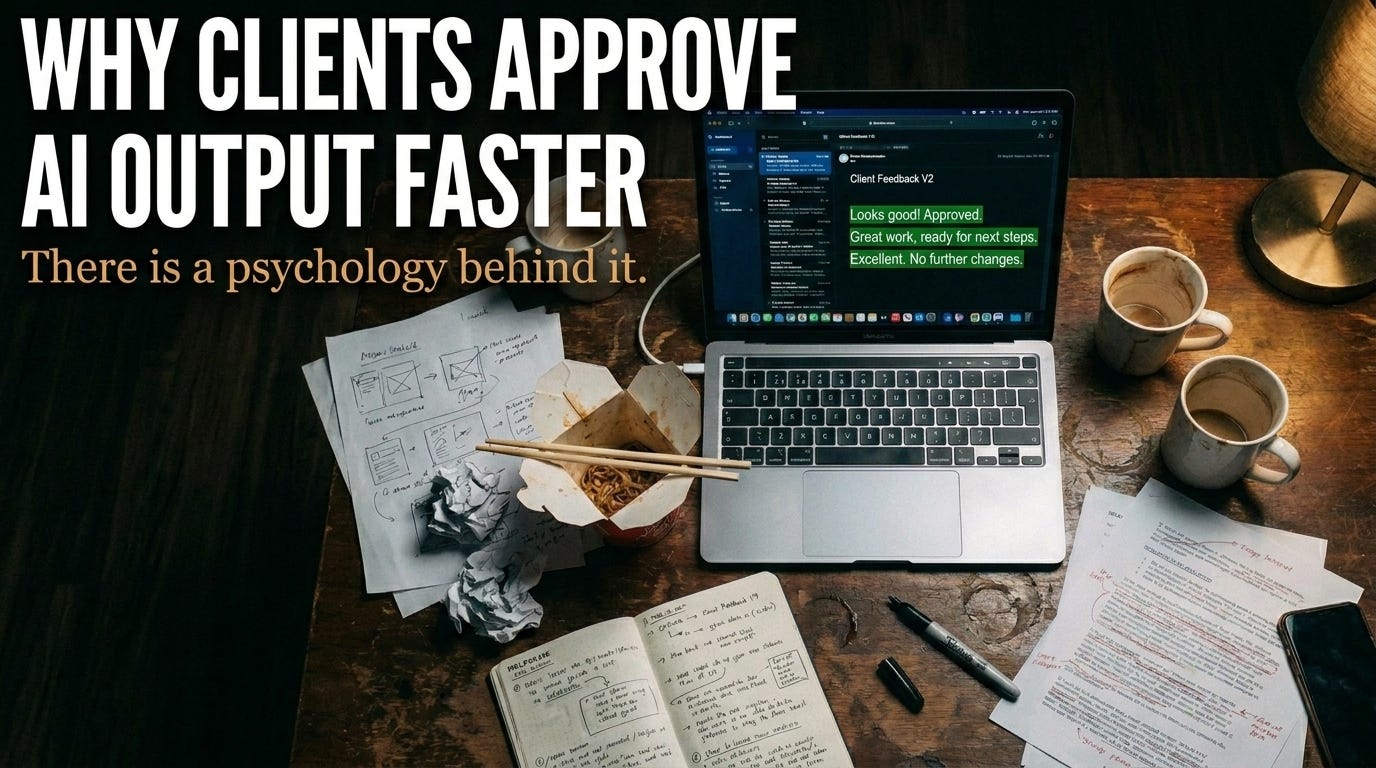
Creative directors, project managers, and designers have noticed something that nobody has named properly yet.
Clients who demand ten rounds of revisions on traditional design work will approve a GenAI output on the first or second pass. Same client. Same brief. Completely different behavior.
The instinct is to call it a double standard. It is not. The real explanation is more interesting.
The render problem
Traditional design work reveals its process. A sketch looks like a sketch. A first draft layout shows construction lines, placeholder copy, rough proportions.
The client’s brain receives an incomplete signal. It automatically starts filling gaps. That gap-filling is where feedback comes from.
GenAI output does not show its process. It produces a render. Clean edges. Smooth finish. Professional-looking output the moment it arrives. The client’s brain receives a completion signal before anyone in the room says a word.
This is not about quality. It is about how the human brain reads visual information.
Cognitive closure
Psychologist Arie Kruglanski identified a pattern he called cognitive closure.
The mind has a strong drive to reach a definitive answer and stop processing. The longer the open loop, the more the brain searches for reasons to close it. Either by finding flaws or generating new ideas.
GenAI output triggers closure fast. It looks finished. The brain stops searching.
Traditional design keeps the loop open. The brain keeps searching. More feedback is the natural result.
The wait time multiplier
There is a second factor that compounds this.
A client gives direction on Monday. The designer presents on Wednesday. In those 48 hours the client has continued thinking. New references. New ideas. A slightly different vision of the outcome. The bar has quietly moved.
GenAI returns something in minutes. The output arrives while the client’s original mental image is still fresh and dominant. The brain compares what it sees against what it just imagined. Close enough triggers approval.
The wait resets the threshold. Speed preserves it.
These are not the same process
The deeper issue is that most people in the room are still treating GenAI output like an accelerated version of traditional design. It is not.
A design brief to a human designer is a specification. The designer can manually adjust every element. Every pixel. Every proportion. The feedback loop is granular because the control is granular.
A prompt to a GenAI system is a direction. Not a specification. You cannot push a single pixel. You redirect the model and generate again. The output is always a render of the closest interpretation of your direction. You approve the closest visual to what you imagined. Or you redirect.
The client is not lowering their standard for AI. They are responding correctly to a different kind of output. A render that looks complete will be evaluated as complete.
What nobody in the room has explained yet
The problem is not the client approving too fast. The problem is that most creative teams have not established a new evaluation framework for GenAI output.
Traditional design is evaluated against a specification. GenAI output needs to be evaluated against a direction. The questions are different. The criteria are different. The number of expected iterations is different.
Until that framework exists inside the client relationship, the mismatch will keep happening. Clients will keep approving renders that look final but are not fully resolved. Creatives will keep feeling like the process was too fast to be right.
I have been directing creative teams and GenAI workflows for over 20 years combined. The gap is never the tool. It is always the framework around it.
The render looks done. That does not mean the thinking is.
Frederick Tadeo is a Dubai-based GenAI Creative Lead and founder of STIRMIND, a GenAI-native creative platform. He publishes GenAI workflows and creative breakdowns at stirmind.com
메타데이터
- post_id
- ef6640fa0fa4
- slug
- why-clients-approve-ai-output-faster-with-less-feedback-ef6640fa0fa4
- url
- https://medium.com/@stirmind/why-clients-approve-ai-output-faster-with-less-feedback-ef6640fa0fa4
- canonical_url
- https://medium.com/@stirmind/why-clients-approve-ai-output-faster-with-less-feedback-ef6640fa0fa4
- author_url
- https://medium.com/@stirmind
- status
- ok
- fetched_at
- 2026-08-10 16:39:29