The Age of (Software) Abundance
An Economic and Organizational Analysis of Generative and Agentic AI–Driven Software Production, the Reconfiguration of the Software…
The Age of (Software) Abundance
An Economic and Organizational Analysis of Generative and Agentic AI–Driven Software Production, the Reconfiguration of the Software Development Life Cycle, and the Emergence of Natural-Language–Mediated Systems
Just an year ago, “we should build a tool for that” usually meant a roadmap conversation, a ticket, a sprint, and an apology about timelines.
Today, the first draft of that tool often appears in the time it takes to describe the problem.
That’s the lived reality behind the Age of Software Abundance. It’s not a slogan about “more code.” It’s a change in the economics of creation: software shifts from a scarce, centralized capability to a plentiful, on-demand one — shaped in natural language, stitched together by agents, and rebuilt whenever the context changes.
You can see the shift in the toolchain. OpenAI Codex, Claude Opus, Cursor and Copilot have turned “write code” into “collaborate with a model in your editor.” Codex has moved from autocomplete to long-running agentic work — researching, using tools, and executing multi-step tasks. OpenAI’s GPT‑5.3‑Codex is positioned explicitly as an “agentic coding model” designed for longer, tool-using workflows and it is brilliant at that. Windsurf, Anti-gravity — the list is long and growing.
You can see it in the benchmarks too. SWE‑bench frames the new standard plainly: give the model a real GitHub issue and a codebase, then ask it to produce a patch that makes tests pass. Anthropic now publishes SWE‑bench Verified results in launch materials for Claude Opus 4.6 — including an 81.42% figure under specific prompting conditions.
And you can see it in the exhaust of modern software production. GitHub’s own Octoverse reporting describes a surge that would have sounded implausible a few years ago: more than 986 million commits in 2025 (up about 25% YoY), with repository creation rates north of 230 new repositories every minute in the same reporting cycle.
The important point isn’t that engineers type faster. It’s that the cost of trying keeps dropping. When the price of iteration collapses, organizations attempt more experiments, build more internal tools, and test more variants of an idea. That’s abundance: the ability to produce more “working software” than the organization previously had the capacity to even imagine.
The long economics lineage of “abundance” — and why software is its next chapter
“Abundance” has a history. The phrase gets recycled every time technology bends a cost curve.
- Keynes, writing in 1930, sketched a future where technological progress could ease the “economic problem” over the course of a century.
- Buckminster Fuller put a design-science frame around the same intuition with “ephemeralization”: doing more and more with less and less.
- The internet delivered the first widely experienced abundance shock for knowledge workers: digital goods became cheap to copy and distribute.
- Rifkin popularized the idea that networked technologies push marginal costs toward “near zero” across categories of goods and services.
What changes in the LLM era is the object of abundance. The internet lowered the marginal cost of distribution. Cloud lowered the marginal cost of deployment. LLMs lower the marginal cost of creation — particularly for the messy middle of software: glue code, internal workflows, integrations, reports, dashboards, scripts, migrations, and UI scaffolding.
That’s why the “age of software abundance” feels different from past waves. It reaches beyond engineering into the rest of the enterprise, because the interface for making software has started to look like the interface for running a business: language.
Microsoft’s Power Apps documentation now describes creating apps “through conversation” with Copilot — describe what you want in natural language, and the system generates an app and underlying data structures. That’s low-code growing up into something bigger: conversational software as a default mode of work.
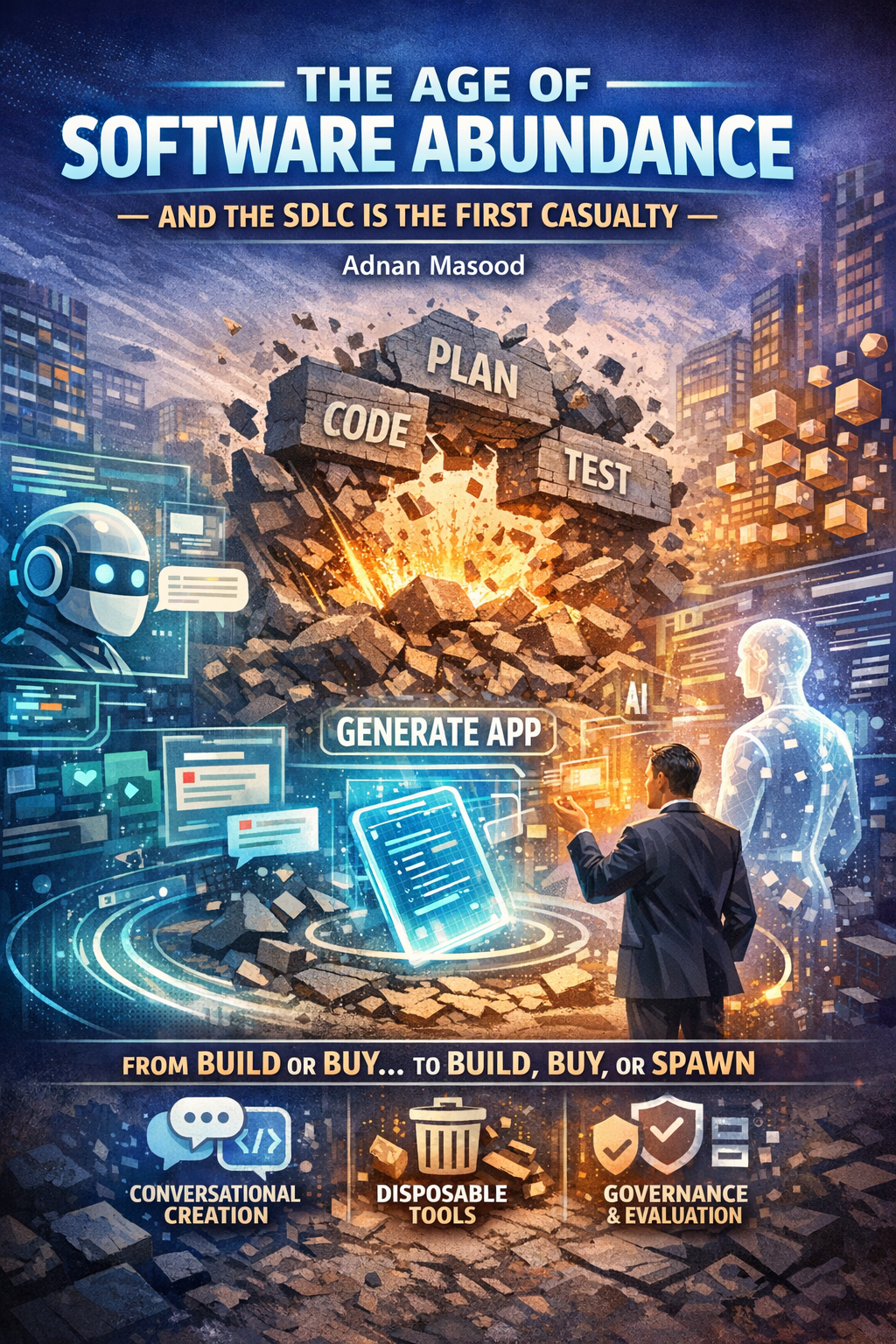
Democratization changes “build vs. buy” into “build vs. buy vs. spawn”
Enterprises have spent decades teaching themselves one strategic reflex: buy commodity software, build differentiating software. The difficulty of building made that a sound heuristic.
Abundance changes the decision surface. Teams will still buy systems of record. They’ll still build durable products that matter. They’ll also spawn a third category: tools that exist because a moment exists.
These tools won’t justify the overhead of “product thinking,” and they won’t survive long enough to deserve a roadmap. They’ll do a job and evaporate.
In abundance, the rational unit of software shifts:
from “application” to “capability” to “task” to “one-time outcome”
That’s why agentic language matters. When the software can accept intent (“reconcile these invoices,” “summarize these exceptions,” “draft the customer comms,” “pull the anomalies”) and then act with tools, software stops looking like a fixed artifact and starts looking like a responsive colleague.
Gartner is already forecasting a structural shift in enterprise application design: up to 40% of enterprise applications will include integrated task-specific agents by 2026, up from less than 5% in 2025.
Whether Gartner’s exact percentage lands is less important than the direction: agents become embedded inside the software people already use. The organization moves from “systems of record” toward “systems that take action.”
The modern SDLC reorganizes around what stays expensive
Here’s where a lot of commentary stays too polite. The SDLC as we learned it was built around expensive code. When code becomes cheap to generate, the lifecycle reorganizes around what stays costly.
In practice, modern SDLC starts to look like:
generation → governance → evaluation
Generation: models draft code, tests, docs, configs, and glue. They handle breadth. They move quickly.
Governance: the enterprise decides what this software is allowed to see, touch, change, and disclose. Governance defines authority: data access, identity, approvals, logging, retention, and compliance.
Evaluation: the enterprise proves that the generated software does what it claims — under real conditions, with predictable behavior, with measurable risk.
This is already how leading providers frame deployment safety. OpenAI’s GPT‑5.3‑Codex system card emphasizes sandboxing and controls around running commands, including patterns where users can approve unsandboxed actions when needed. In other words: the “dev tool” ships with a governance philosophy because governance has become part of the product.
Economic theory explains where the pain moves
Software abundance doesn’t remove constraints. It relocates them. Economics gives a clean vocabulary for what happens next.
Marginal cost curves: When marginal creation cost falls, supply expands rapidly. Demand expands too, because customization becomes affordable. The result is an explosion in the long tail: software for every niche workflow, every team preference, every temporary project.
Baumol’s cost disease: In sectors where productivity rises quickly, costs fall relative to stagnant sectors. Over time, the expensive part becomes the part that can’t be automated at the same rate. Nordhaus’ macro perspective on Baumol’s “diseases” summarizes the underlying dynamic: relative prices rise in sectors where productivity growth lags.
Apply that to modern development: generation accelerates. Governance and evaluation lag. The organization starts “feeling” a cost disease in security reviews, compliance evidence, data permissions, and operational risk management.
Coase and transaction costs: Coase argued firms exist because markets impose transaction costs; internal coordination sometimes costs less than market coordination. In the age of abundant software, the boundary of “what should be a centralized engineering function” shifts because a chunk of production becomes cheaper than coordination. Teams act locally. They generate tools in context. The enterprise pays the coordination bill later unless it builds rails up front.
Schumpeter and creative destruction: Creative destruction describes how innovation rearranges industries by making old structures obsolete and opening space for new ones. Britannica’s definition is straightforward: innovation reshapes economies as new combinations displace the old. SDLC as a gated funnel and “simple workflow SaaS” as a business model both sit in the blast radius. The new value pools form around platforms, data, distribution, trust, and governance.
Abundance runs straight into a coordination bottleneck — and builders keep building anyway
Every abundance story runs into reality: coordination becomes the bottleneck.
The evidence shows up in developer behavior. Stack Overflow’s 2025 survey reports 84% of respondents use or plan to use AI tools, and 51% of professional developers use AI tools daily. Yet trust lags adoption; a large share of developers report distrust in AI output accuracy.
We also have hard data that complicates the “speed of thought” narrative in a productive way. METR ran a randomized controlled trial with experienced open-source developers and found that allowing early‑2025 AI tools increased completion time by about 19% in that setting, even though developers believed the tools made them faster.
That finding is often used as a rebuttal to the abundance thesis. It supports the abundance thesis — just not the lazy version.
Abundance doesn’t mean perfection. It means volume. It means the draft becomes cheap. It means the review becomes the work.
Coordination bottlenecks won’t slow builders down for long, because builders respond to friction the way markets respond to scarcity: they route around it. If central processes block progress, teams create shadow workflows. If compliance cycles take months, teams prototype in ungoverned sandboxes. If integrations are hard, teams scrape exports and run sidecar tools.
The enterprise faces a choice: build rails that allow safe speed, or inherit a sprawling, unaccountable tool ecosystem.
Gartner’s own cautionary note reinforces the point: it predicts over 40% of agentic AI projects will be canceled by the end of 2027, often because of cost, unclear value, and inadequate risk controls. That’s what happens when organizations treat agents like demos rather than infrastructure.
What leaders should do now: build the rails
In the Age of Software Abundance, speed comes from permissioned autonomy.
The winners won’t be the companies with the most prompts or the loudest AI strategy decks. They’ll be the companies that build a production-grade environment where thousands of small tools can be created, used, and retired without turning into operational debt.
That means investing in five rails:
- Policy as code Turn security and compliance into enforceable constraints that apply by default.
- Data access as a product Clean contracts, stable APIs, permissioning, and audit trails. Abundance amplifies the value of good data plumbing.
- Runtime safety Sandboxes, tool permissions, human approvals for high-risk actions, and “break glass” workflows with traceability. (This is where the leading agentic dev tools are already heading.)
- Evaluation as a discipline Golden datasets, regression harnesses, adversarial tests, and measurable success criteria. You don’t manage abundant software with hope and vibes.
- Monitoring and cost control Observability for agents and generated tools: logs, traces, action histories, and unit economics. In abundance, spend and risk scale fast.
The real headline — The Age of Software Abundance Is Here — and the Scarcity Has Moved
The Age of Software Abundance is an economic story disguised as a tooling story.
It inherits Keynes’ optimism about technological possibility. It echoes Fuller’s “more with less.” It extends Rifkin’s marginal-cost intuition beyond distribution into creation.
And it carries Schumpeter’s warning: industries reorganize around new production functions, and incumbents lose their footing when they treat structural change as a feature upgrade.
Software becomes conversational and agentic because language sits closer to human intent than tickets and backlogs ever did. Most tools become disposable because regeneration costs less than maintenance. SDLC becomes generation, governance, and evaluation because that’s where the expensive work goes.
The enterprise that wins will feel different from today’s enterprise. It will resemble a well‑run platform economy inside the firm: decentralized creation, centralized rails, constant evaluation, and tight accountability.
That’s the paradigm we are seeing unfolding in front of our eyes.
메타데이터
- post_id
- ef6fabb2be09
- slug
- the-age-of-software-abundance-ef6fabb2be09
- url
- https://medium.com/@adnanmasood/the-age-of-software-abundance-ef6fabb2be09
- canonical_url
- https://medium.com/@adnanmasood/the-age-of-software-abundance-ef6fabb2be09
- author_url
- https://medium.com/@adnanmasood
- status
- ok
- fetched_at
- 2026-07-19 02:36:33