Salesforce Consulting Partner Checklist Before Signing a Contract
Choosing a Salesforce consulting partner is one of the most important decisions you’ll make during your CRM journey. The right partner can…
Salesforce Consulting Partner Checklist Before Signing a Contract
Choosing a Salesforce consulting partner is one of the most important decisions you’ll make during your CRM journey. The right partner can help you streamline operations, improve customer experiences, and maximize your Salesforce investment. The wrong one, however, can lead to project delays, budget overruns, poor user adoption, and costly rework.
With hundreds of **Salesforce consulting firms** available, how do you know which one is the right fit?
The answer lies in asking the right questions before signing a contract.
This checklist will help you evaluate potential partners, compare proposals, and make a confident decision that supports your long-term business goals.
Why Choosing the Right Salesforce Consulting Partner Matters
Salesforce is far more than a CRM platform. It can power your sales, customer service, marketing, AI initiatives, and business automation. To unlock that potential, your implementation needs more than technical expertise — it needs strategic planning, industry knowledge, and a clear understanding of your business.
An experienced **Salesforce Consulting Partner** doesn’t just configure Salesforce. They help you design processes, improve efficiency, and build a CRM that grows with your business.
Before you commit to a long-term partnership, use the following checklist to evaluate your options.
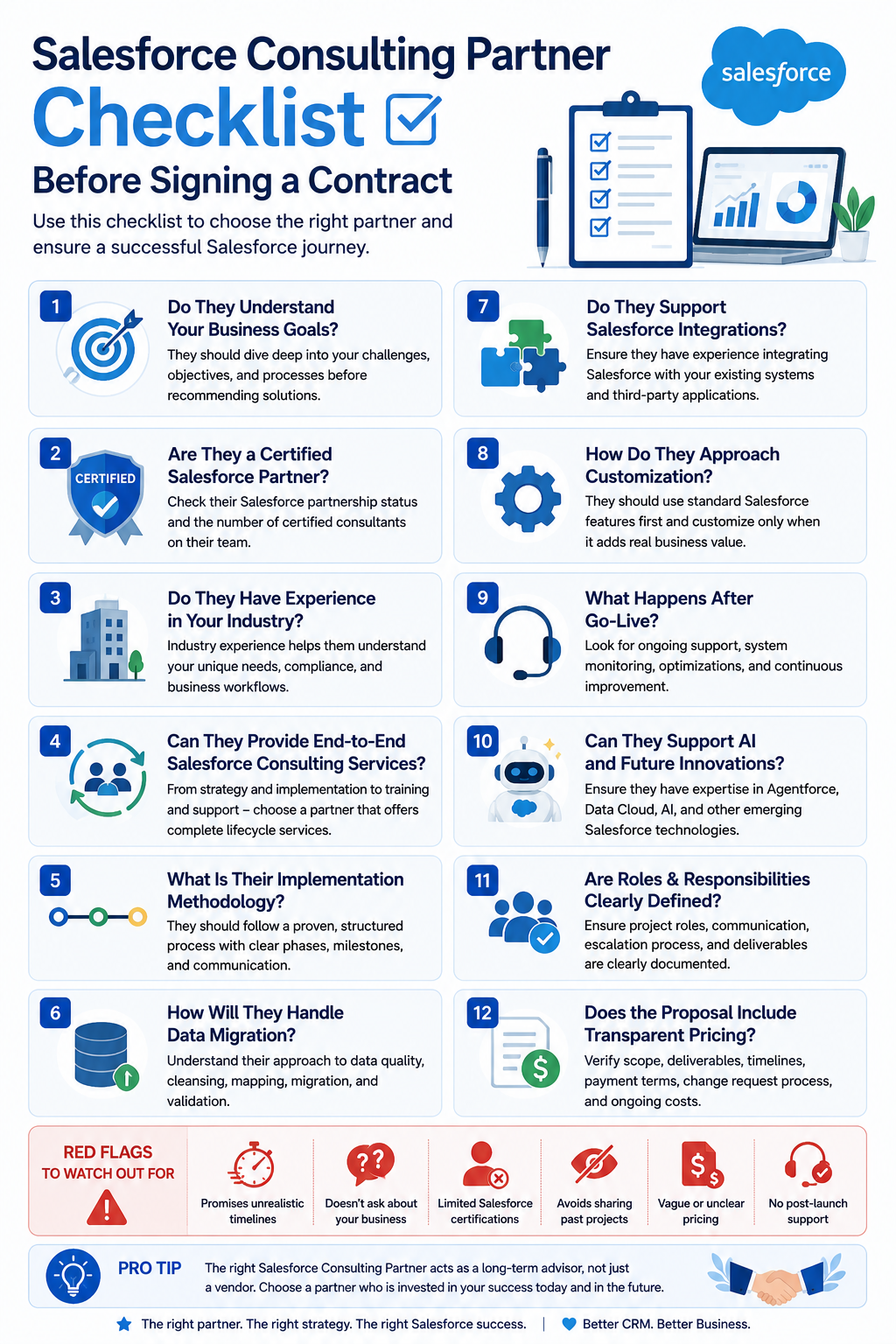
1. Do They Understand Your Business Goals?
Every successful Salesforce project starts with understanding the business — not the technology.
A reliable partner should ask questions such as:
- What challenges are you trying to solve?
- What are your growth objectives?
- Which teams will use Salesforce?
- How will success be measured?
If a vendor immediately starts discussing features without understanding your business, consider it a warning sign.
2. Are They a Certified Salesforce Consulting Partner?
Certification demonstrates that the company has professionals who understand Salesforce products, implementation methodologies, and platform best practices.
Ask questions like:
- How many Salesforce-certified consultants are on your team?
- Which certifications do your consultants hold?
- Who will actually work on my project?
Working with a certified Salesforce Consulting Partner gives you greater confidence in the quality of advice and execution.
3. Do They Have Experience in Your Industry?
Every industry has unique workflows, compliance requirements, and customer expectations.
Whether you’re in healthcare, manufacturing, finance, retail, or professional services, industry experience can significantly reduce implementation risks.
Ask for:
- Similar client projects
- Relevant case studies
- Industry-specific references
Real-world experience often matters more than generic Salesforce expertise.
4. Can They Provide End-to-End Salesforce Consulting Services?
Some companies only handle implementation, while others provide complete lifecycle support.
Look for Salesforce Consulting Services that include:
- Business discovery
- CRM strategy
- Solution design
- Implementation
- Customization
- Data migration
- System integration
- User training
- Post-launch optimization
Working with one partner throughout the project improves collaboration and accountability.
5. What Is Their Implementation Methodology?
A structured implementation process reduces uncertainty and keeps projects on track.
Ask your potential partner to explain:
- Project phases
- Timeline
- Milestones
- Testing approach
- Risk management process
- Communication plan
A clearly defined methodology reflects maturity and experience.
6. How Will They Handle Data Migration?
Data migration is often one of the most challenging parts of a Salesforce project.
Ask questions such as:
- How will duplicate records be handled?
- How will data quality be validated?
- What happens if migration issues occur?
- Will historical data be preserved?
A strong migration strategy helps ensure accurate reporting and user confidence after launch.
7. Do They Support Salesforce Integrations?
Most businesses rely on multiple systems beyond Salesforce.
Ask whether they have experience integrating Salesforce with:
- ERP platforms
- Marketing automation tools
- Accounting software
- Customer support systems
- E-commerce platforms
- Third-party applications
Seamless integrations improve efficiency and eliminate manual data entry.
8. How Do They Approach Customization?
Salesforce is highly flexible, but too much customization can create long-term maintenance challenges.
A trusted Salesforce Consulting Partner should recommend standard Salesforce functionality whenever possible and customize only when it adds real business value.
The goal is to build a scalable platform that remains easy to upgrade and maintain.
9. What Happens After Go-Live?
Many businesses focus only on implementation and overlook ongoing support.
Ask whether the partner provides:
- System monitoring
- Performance optimization
- User support
- Platform enhancements
- Security reviews
- Regular health checks
Salesforce should continue evolving as your business grows.
10. Can They Support AI and Future Salesforce Innovations?
Salesforce continues to invest heavily in AI through solutions like Agentforce and Data Cloud.
If AI is part of your long-term roadmap, ask whether the partner offers Salesforce Agentforce Consulting Services or has experience implementing AI-powered automation.
Choosing a forward-thinking consulting partner helps future-proof your CRM investment.
11. Are Roles and Responsibilities Clearly Defined?
Before signing the agreement, make sure everyone understands their responsibilities.
Clarify:
- Project ownership
- Communication channels
- Escalation process
- Deliverables
- Approval workflows
- Timeline expectations
Clear accountability reduces misunderstandings later.
12. Does the Proposal Include Transparent Pricing?
Price should never be the only deciding factor — but it should always be transparent.
Review the proposal carefully and confirm:
- Project scope
- Deliverables
- Payment milestones
- Change request process
- Additional service costs
- Ongoing support fees
Understanding the commercial terms upfront helps avoid unexpected expenses later.
Red Flags to Watch Before Signing
Not every consulting company is the right fit.
Be cautious if a provider:
- Promises unrealistic timelines.
- Doesn’t ask about your business goals.
- Has limited Salesforce certifications.
- Avoids discussing previous projects.
- Offers vague pricing.
- Doesn’t include post-launch support.
- Recommends excessive customization without justification.
A trustworthy partner values transparency and realistic expectations.
Final Thoughts
Choosing a Salesforce Consulting Partner is about more than technical capability. It’s about finding a team that understands your business, communicates clearly, follows proven methodologies, and remains invested in your long-term success.
Before signing any agreement, use this checklist to evaluate experience, certifications, implementation approach, support capabilities, and future readiness.
A thoughtful selection process today can save significant time, cost, and effort throughout your Salesforce journey.
Whether you’re planning your first CRM deployment or expanding your Salesforce ecosystem, partnering with experienced **Salesforce Consulting Services** providers gives your business the confidence to implement, optimize, and scale Salesforce successfully.
Frequently Asked Questions
Why should I evaluate a Salesforce Consulting Partner before signing a contract?
Evaluating a Salesforce Consulting Partner helps reduce project risks, ensures alignment with your business goals, and increases the likelihood of a successful Salesforce implementation.
What certifications should a Salesforce Consulting Partner have?
Look for partners with Salesforce-certified consultants, solution architects, developers, and administrators who have experience delivering projects similar to yours.
What should be included in Salesforce Consulting Services?
Comprehensive Salesforce Consulting Services should cover business strategy, implementation, customization, integrations, training, optimization, and ongoing support.
Why is post-launch support important?
Post-launch support helps improve user adoption, resolve technical issues, optimize workflows, and ensure Salesforce continues to deliver value as your business evolves.
Can a Salesforce Consulting Partner help with AI implementation?
Yes. Many consulting firms now offer Salesforce Agentforce Consulting Services to help businesses implement AI-powered automation, improve customer experiences, and increase operational efficiency.
메타데이터
- post_id
- ef8d1d397ee2
- slug
- salesforce-consulting-partner-checklist-before-signing-a-contract-ef8d1d397ee2
- url
- https://medium.com/@cloudanalogy.crm/salesforce-consulting-partner-checklist-before-signing-a-contract-ef8d1d397ee2
- canonical_url
- https://medium.com/@cloudanalogy.crm/salesforce-consulting-partner-checklist-before-signing-a-contract-ef8d1d397ee2
- author_url
- https://medium.com/@cloudanalogy.crm
- status
- ok
- fetched_at
- 2026-08-02 20:32:08