1. On Beauty
What is beauty? There are quite well established definitions and perceptions of what beauty is; but is beauty an is, a concrete thing, or…
1. On Beauty
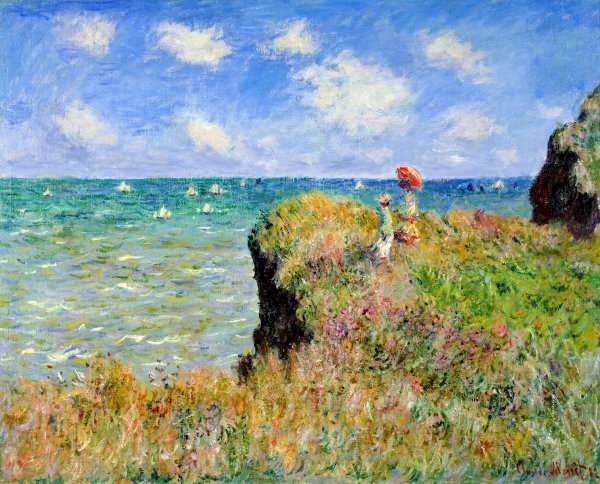
Claude Monet The Cliff Walk Pourville Oil Painting Reproduction. Source: Claude Monet Gallery
What is beauty? There are quite well established definitions and perceptions of what beauty is; but is beauty an is, a concrete thing, or is it fluid and non-dimensional? We can name things that are consistently beautiful such as good art, painting, music, people, food, drink, nature, and so on. But that sentence has a very important word: good. Is bad art, painting, music, and so on not beautiful? What constitutes it as bad and not beautiful? Could it be consistently displeasing to a majority of people who thus enforces this sense of “good or bad” beauty upon others who may see that same “bad” beautiful thing as good? This leaves me wondering how much subjectivity and objectivity goes into beauty. I’ve recently finished a book, Contextualizing Aesthetics from Plato to Lyotard, and many have struggled to concretely say that beauty, or art in this instance, is necessarily subjective or objective — often both, sometimes one side heavier than the other. While there were many philosophers I read in this book such as Edmund Burke, Hume, Schopenhauer, Heidegger, and Deleuze, I was actually most interested in Nietzsche’s take on beauty and aesthetics.
While I will not dive too deeply into what he believes aesthetics, art, and beauty to be, it can be well supported that he leaned toward tragedy as “higher form of art.” He often oscillates between the words Apollonian and Dionysian, “…as representing two distinct modes of ecstasy?” This is interesting because it feels like the world of beauty is sprung up through two distinct forms of being or creation. The Apollonian lends itself towards measured restraint or reason. It is as said by Nietzsche, “mere appearances,” or, “Apollonian ecstasy acts above all as a force of stimulating the eye, so that it acquires the power of vision.” The Dionysian lends itself toward aesthetic intoxication or passion. As he says, “In the Dionysian state, on the other hand, the whole system of passions is stimulated and intensified…” In that state, the passion one has is unbridled, as if the world is opening the floodgates, surging beauty and life into yourself. Tragedy, in his case, is a fusion of both, a balance between the two in harmony. In addition, he must have found a sense of beauty in beholding the tragic.

Tragedy at Sea, George Inness. Source: Birmingham Museum of Art
This idea of tragedy being a higher form of art lends itself toward darker themes and what people may find to be beautiful despite social norms. As mentioned before, beauty holds a sense of semi-consistency about it — we pressupose beauty through what a majority sees as beautiful. To only take into account a majority view of beauty is a mistep. The darker themes of war, killing, or otherwise controversial areas of human existence is normally seen as simply bad, immoral, and not holding any sense of beauty to them. Although out of the norm, take a killer, for example. While I cannot say for sure that killers find what they do to be beautiful, I have found many sources saying that killers do not necessarily find their acts in themselves as beautiful in the aesthetic sense; but a depiction of beauty, for them, may have had a part in the process, thinking, or perception of killing. These people may see the acts they do as an artistic expression or a sort of performance. And while I do not find a killing beauty in any sense whatsoever, I find a natural death to be actually beautiful. Let me explain:
It seems, to me, that a natural death is the completion of a story or piece of art. Each step or action of their life is a brushstroke or sentence written; and even if the story or artwork is “unfinished” by a premature natural death, it is still finished as a complete whole. But death taken at face value isn’t necessarily beautiful, it’s just death, but there is a person tied to that death as well as nuance within that person. With the actual person tied to the death and the nuance that comes with it, I find the completion of a human life quite beautiful. But why only natural and not an unnatural death? It would seem to me that an unnatural death is the ripping of a page or smearing of paint; there could be beauty found in the smear or the rip itself — I will absolutely grant that — I just haven’t reasoned or found a certain way to perceive it as beautiful yet. But to me, a natural death, whether tragic or peaceful in the end, has a sense of beauty to it because of its intertwinement with the human condition.
My point here is that beauty can be potentially seen in the most horrible and “unbeautiful” things we can think of in an individual sense. Am I saying that horrible instances of actions are beautiful? No, not in my perception of beauty. But the judgements of aesthetics and beauty cannot simply be identified with moral goodness as many have demonstrated.
These paragraphs have been my reasoning on a sense of subjectivity or objectivity to beauty, and I think that most, if not all, philosophers are trying to come up with a sense of an objective/subjective sense of beauty. I believe that I lean towards a subjective sense of beauty in the eyes of who perceives something to be as beautiful as well. What if we are looking at this wrongly? What if beauty necessarily transcends objectivity and subjectivity? Beauty isn’t an is, as I think it to be more fluid and changes. Nietzsche writes, “Nothing is beautiful; man alone is beautiful,” but I actually partially disagree; I don’t even think that “man is beautiful”. It seems to me, almost, that beauty may not even reside in the same realm as objective/subjective, even through the person perceiving. So what is beauty then?
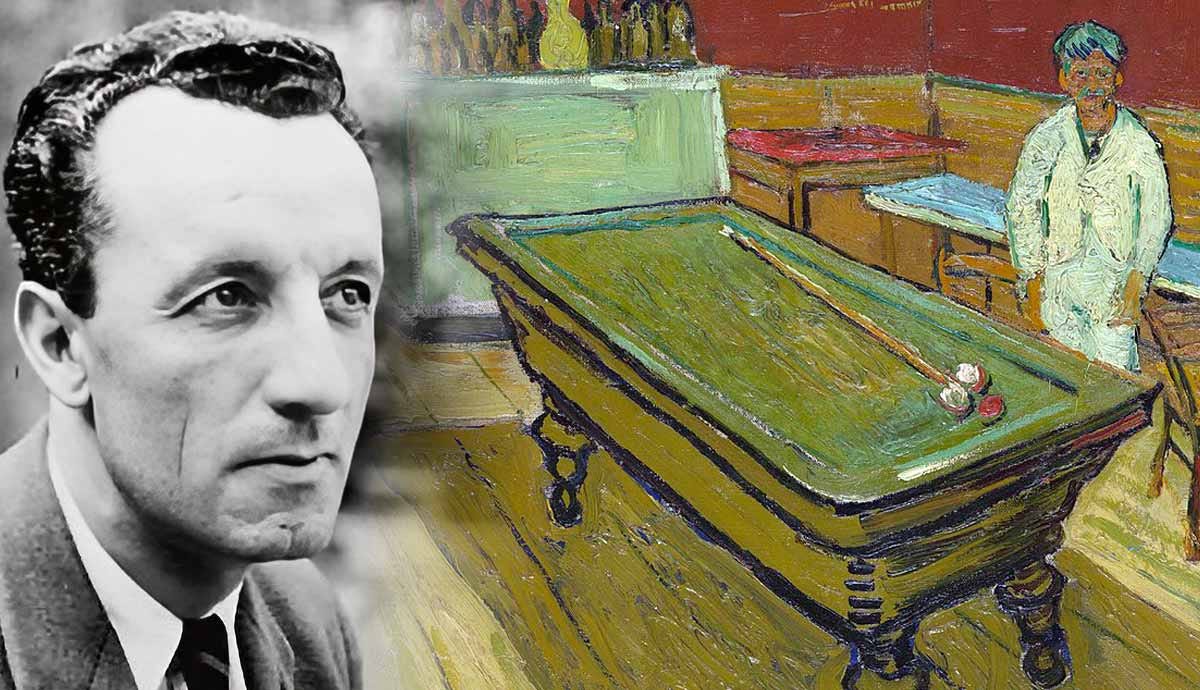
I hold the notion of Nietzsche’s perspectivism or similar thoughts to Merleau-Ponty’s ideas on subjectivity/objectivity — his mentioning of a view from nowhere. Merleau-Ponty writes in the Phenomenology of Perception, “Whereas God’s perspective is the ideal “view from nowhere,” ours is always a view from somewhere — hence, partial and imperfect.” I don’t believe that humans can achieve a “god’s eye view” of the world, one that is outside of our humanistic perception looking from the outside. We only have our perception as humans, and this is where we can find, maybe, a sense of “objectivity” if only in the human sense — we can only ever achieve, if it is even achievable, a “human objectivity” towards the world. “Human objectivity” is a topic for another time though. So, would we have to look at beauty as being something objective or subjective only through the eyes of humans? If it is transcendent of objective/subjective lenses, then how would it still reside in the perception of humans? I think I want to say that “transcendent” may mean something simply different from the previous two terms rather than “to be above”. Beauty is something all too different than the labels of subjective or objective. And my question is: what is this different something we may apply to beauty, if anything? I would like to rid my mind of the two oscillating points of objectivity and subjectivity in reference to aesthetics and beauty, and try to see if beauty might be something we haven’t yet discovered, or is even something incomprehensible.
Humans have created “objective” descriptors as being things in the world. Humans have, I think, created the word beauty to simply describe something beautiful. By saying this, I wish to point out that “beauty” is only a construct made by humans. But I think that the most important part here is to ask: why was it made by humans? Why is something beautiful? Why did we create this concept for us to describe things? Ultimately, what is the essence of beauty?
Writer’s Note: This essay is my attempt to question what beauty is and our assumptions of it. My goal is to formulate questions, rather than answer them quite yet. If beauty is neither subjective nor objective, then it may belong to an entirely different category of existence than many others have thought. My next essay will be my exploration of this different category of existence.
메타데이터
- post_id
- ef97ccb3bc98
- slug
- on-beauty-1-ef97ccb3bc98
- url
- https://medium.com/@writer-in-the-world/on-beauty-1-ef97ccb3bc98
- canonical_url
- https://medium.com/@writer-in-the-world/on-beauty-1-ef97ccb3bc98
- author_url
- https://medium.com/@writer-in-the-world
- status
- ok
- fetched_at
- 2026-08-12 11:02:35