Dragons, Elephants, and Eagles: What the 2026 Shangri-La Dialogue Means for the New World Order
As the curtains drew to a close on the 23rd edition of the Shangri-La Dialogue in Singapore, key differences emerged among the West, China…
Dragons, Elephants, and Eagles: What the 2026 Shangri-La Dialogue Means for the New World Order
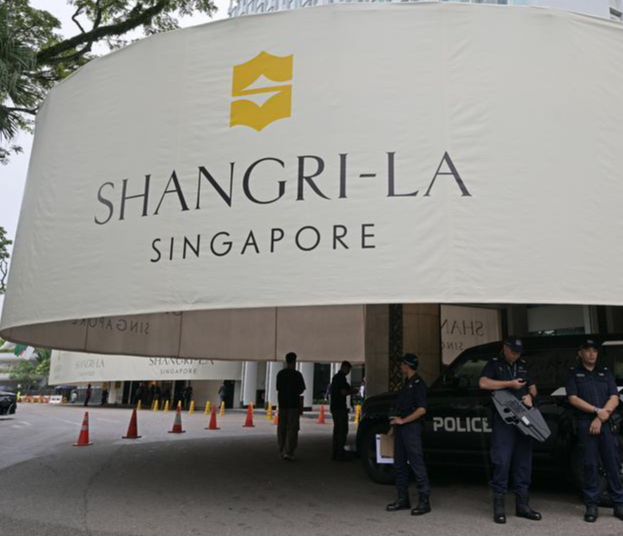
Credits: CGTN
As the curtains drew to a close on the 23rd edition of the Shangri-La Dialogue in Singapore, key differences emerged among the West, China and other Asian powers over regional security challenges, including in the Indo-Pacific. These differences reflect the emergence of a new world order characterised by an increasing emphasis on strategic autonomy and competitive co-existence rather than cooperation. Hosted by the International Institute for Strategic Studies, the Shangri-La Dialogue is a unique platform for debate among global leaders on Asia’s developing security challenges. This article aims to explore the different themes and perspectives uncovered in the dialogue and their significance for the current world order.
Firstly, China loomed large in the dialogue despite the absence of its foreign minister. Chinese leaders stressed the need to reshape the international order towards multilateralism amid current geopolitical tensions. For instance, China talked about extending membership in key regional forums such as the SCO, BRICS, and ASEAN to African and Latin American nations. This reinforces China’s commitment to emerge as the leader of the Global South, besides expanding its legitimacy as a better alternative to American hegemony.
Credits:CNA
In addition, the “red lines” for Chinese leadership were clearly articulated in the summit. Examples include the unification of Taiwan with the mainland, countering Japan’s call for defence cooperation or “new militarism”, and reframing the pre-World War 2 history that aligns with the Chinese narrative of “Century of Humiliation.” In addition, Beijing advocated for: (a) the prevention of nuclear conflict through a mutual “no-first-use of nuclear weapons” policy among nuclear-armed states, (b) expressed interest in filling the regulatory vacuum for emerging technologies (particularly AI), and (c)working on the progress of US-China relations and maritime security to secure China’s trade-related interests. These aspects reflect China’s vision of a Post-Western World Order.
Contrary to China’s clear vision, the diplomacy played by the middle and small powers reflected concerns over disrespect for international norms. For instance, take the discussions over the South China Sea. Recently, a Dutch ship sailed near the Paracel Islands under the pretext of “freedom of navigation”. Though the Dutch leadership emphasised that the ship’s actions were non-provocative and rules-abiding, China had raised alarms over the same.

Credits: Asia Pacific Leadership Network
In addition, the Filipino leadership commented on China’s illegal territorial claims in the South China Sea. In 2016, a tribunal constituted at the Permanent Court of Arbitration (PCA) in The Hague ruled overwhelmingly in favour of the Philippines in its dispute with China regarding the South China Sea. The court had invalidated China’s so-called “Nine-Dash Line” theory, which Beijing used to claim historical rights over the sea’s waters. Also, Japan highlighted the progress of its military modernisation and defence cooperation with allies beyond the US, which is crucial in the increasingly contested Indo-Pacific region.
Similarly, India sought more bilateral engagements to protect strategic maritime interests in the Indian Ocean, particularly to ensure a free, open, secure and inclusive Indo-Pacific region. New Delhi stressed on working with regional partners, promoting multilateralism and deepening India-US military cooperation. On the sidelines of the summit, the Indian leadership also deepened its engagement with non-state actors (think tanks and academic institutions) to discuss the Indo-Pacific security architecture, defence industrial cooperation and emerging technologies. India’s willingness to forge issue-based partnerships reflects strategic flexibility and autonomy as an emerging power.

Credits: Insights IAS
On the other hand, US Secretary of Defence Pete Hegseth urged Asian allies to boost military spending to prevent China’s dominance in the region. This reflects the shift in Washington’s thinking to rely on states with operational readiness rather than political solidarity. While it is debatable how many countries would be able to fulfil the quota of 3.5 per cent of GDP spending on defence, as advocated by America, the message was realist in nature: dialogue matters less than hard military capability. Regarding US-China relations, the American leadership called for more stability and dialogue amidst growing strategic competition to avoid unnecessary escalation.

Credits: The Atlantic
To conclude, the 2026 Shangri-La Dialogue reflects the emerging decentralised security architecture of the Asia-Pacific region. As security challenges become more sophisticated in nature, there is a growing need for small and middle powers to emphasise strategic autonomy and a rules-based order. For the bigger powers, their interest lies in enhanced tactical cooperation and forging partnerships rather than creating one-sided dependence. Hence, this year’s Shangri-La Dialogue reflects the emergence of a multipolar world order, albeit with features of bipolar competition.
References:
Jie, L. H., & Ossinger, J. (2026, May 31). Defense spending, China in Asia and lessons from Ukraine: Takeways from the 2026 IISS Shangri-La Dialogue. CNBC. https://www.cnbc.com/2026/05/31/takeways-from-the-2026-shangri-la-dialogue-.html
Mahmud, A. H. (2026, June 6). “Unrealistic” for Southeast Asia to meet Hegseth’s defence spending demand amid Sino-US rivalry. CNA. https://www.channelnewsasia.com/asia/us-asia-china-defence-spending-hegseth-6164091
Pant, H. V. (2026, June 4). From Rules to Realism: The message from Shangri-La 2026. orfonline.org. https://www.orfonline.org/research/from-rules-to-realism-the-message-from-shangri-la-2026
Tian, L. (2026, May 31). Shangri-La Dialogue 2026: What key messages has China sent? CGTN. https://news.cgtn.com/news/2026-05-31/Shangri-La-Dialogue-2026-What-key-messages-has-China-sent--1NACM80opeU/p.html
Trivedi, S. (2026, May 29). Defence Secretary holds key meetings at Shangri-La Dialogue 2026, pushes for Indo-Pacific security cooperation. The Hindu. https://www.thehindu.com/news/national/defence-secretary-holds-key-meetings-at-shangri-la-dialogue-2026-pushes-for-indo-pacific-security-cooperation/article71037441.ece
Yichao, H. (2026, June 5). What Shangri-La 2026 revealed about the future regional order. The Diplomat. https://thediplomat.com/2026/06/what-shangri-la-2026-revealed-about-the-future-regional-order/
메타데이터
- post_id
- ef98dbb0ba3c
- slug
- dragons-elephants-and-eagles-what-the-2026-shangri-la-dialogue-means-for-the-new-world-order-ef98dbb0ba3c
- url
- https://medium.com/@thakernachiketa/dragons-elephants-and-eagles-what-the-2026-shangri-la-dialogue-means-for-the-new-world-order-ef98dbb0ba3c
- canonical_url
- https://medium.com/@thakernachiketa/dragons-elephants-and-eagles-what-the-2026-shangri-la-dialogue-means-for-the-new-world-order-ef98dbb0ba3c
- author_url
- https://medium.com/@thakernachiketa
- status
- ok
- fetched_at
- 2026-06-24 04:09:36