Why CBAM Could Spark the Largest Green Investment Wave in Industrial History
The world’s biggest investment opportunities rarely look obvious in the beginning.
Why CBAM Could Spark the Largest Green Investment Wave in Industrial History
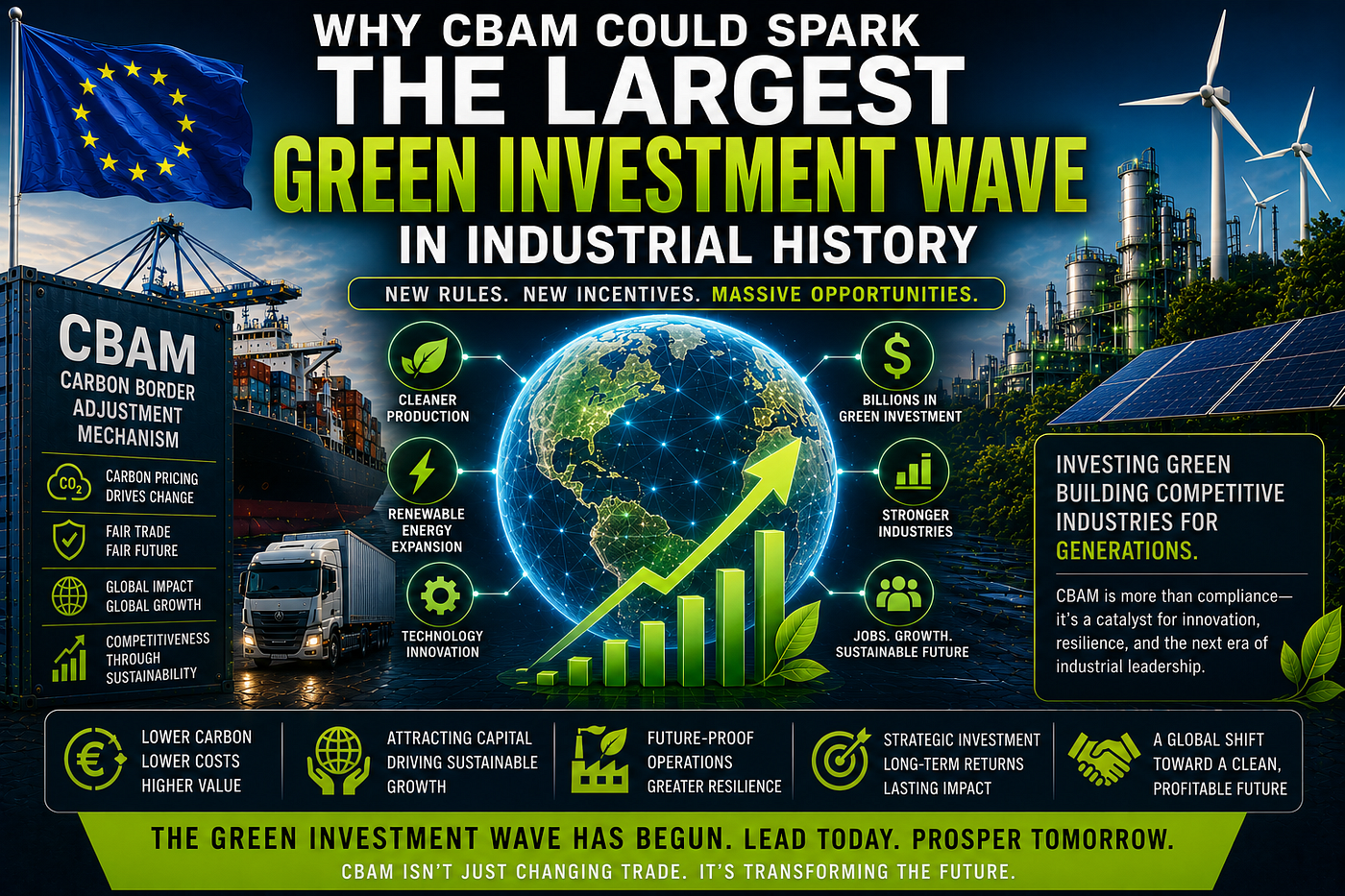
The world’s biggest investment opportunities rarely look obvious in the beginning.
When the internet emerged, many businesses saw it as a communication tool.
When cloud computing appeared, many organizations viewed it as an IT upgrade.
When artificial intelligence entered the mainstream, many executives initially considered it another software innovation.
In each case, the technology ultimately became much larger than expected.
It transformed entire industries.
The European Union’s Carbon Border Adjustment Mechanism (CBAM) may be creating a similar moment.
Most companies currently see CBAM as a regulatory framework designed to address carbon emissions in international trade.
That description is accurate.
But it may not capture the full significance of what is happening.
Because beneath the reporting requirements and compliance obligations lies something much bigger.
A powerful investment signal.
And throughout economic history, investment signals have often reshaped industries faster than regulations themselves.
CBAM is sending a clear message to global markets.
Lower-carbon production is becoming economically valuable.
The implications are enormous.
For decades, industrial investment decisions focused primarily on factors such as labor costs, access to raw materials, logistics infrastructure, and energy prices.
Environmental performance mattered, but it rarely influenced competitiveness in a direct and measurable way.
CBAM changes that equation.
For the first time, carbon intensity is becoming increasingly connected to international trade performance.
That connection alters investment behavior.
When markets begin rewarding a specific capability, capital flows toward that capability.
Businesses build new infrastructure.
Investors fund new technologies.
Entrepreneurs create new solutions.
Innovation accelerates.
This process may already be underway.
Across the industrial economy, companies are investing in cleaner production systems, renewable energy projects, energy-efficiency technologies, digital monitoring platforms, carbon-accounting solutions, and advanced manufacturing processes.
The scale of investment is growing rapidly.
And the opportunity extends far beyond traditional sustainability sectors.
Steel manufacturers are exploring low-carbon production methods.
Cement producers are investing in alternative technologies.
Aluminum companies are modernizing facilities.
Chemical manufacturers are improving energy efficiency.
Logistics providers are electrifying transportation networks.
Technology firms are developing carbon-intelligence platforms.
Every part of the industrial ecosystem is being affected.
What makes this particularly important is that industrial transformation tends to generate long investment cycles.
Factories operate for decades.
Infrastructure projects last for generations.
Energy systems require enormous capital commitments.
Once investment decisions are made, their impact often shapes economic competitiveness for years.
This means companies making strategic investments today may enjoy advantages long into the future.
The role of renewable energy is especially significant.
As organizations seek to reduce emissions intensity, demand for clean electricity continues expanding.
Solar power.
Wind energy.
Battery storage.
Grid modernization.
Hydrogen infrastructure.
These sectors are increasingly viewed not only as environmental solutions but also as industrial competitiveness assets.
Cheap, reliable, low-carbon energy could become one of the most important economic advantages of the next decade.
Regions capable of providing it may attract substantial manufacturing investment.
This creates a powerful feedback loop.
More renewable energy attracts more industrial investment.
More industrial investment drives greater demand for clean power.
Greater demand encourages additional infrastructure development.
The cycle reinforces itself.
Technology is accelerating this transformation.
Artificial intelligence is helping companies optimize energy consumption.
Advanced analytics are identifying efficiency opportunities.
Digital twins are improving industrial design.
Smart monitoring systems are enhancing operational visibility.
Automation is reducing waste.
Together, these technologies make decarbonization more practical and more profitable.
The result is that environmental performance and business performance are becoming increasingly interconnected.
Investors recognize this trend.
Many financial institutions now evaluate climate-related opportunities alongside traditional business metrics.
Companies demonstrating strong transition strategies often attract greater attention than those appearing unprepared for future market changes.
The reason is straightforward.
Markets reward adaptability.
Organizations capable of responding effectively to emerging economic realities tend to outperform those that resist change.
CBAM is helping define one of those realities.
Carbon transparency is becoming more important.
Supply-chain visibility is becoming more valuable.
Operational efficiency is becoming more critical.
Clean-energy access is becoming more strategic.
These shifts influence where capital flows.
And capital flows influence how industries evolve.
Perhaps the most fascinating aspect of CBAM is that its impact extends well beyond Europe.
Global supply chains are interconnected.
Manufacturers serving European customers often operate across multiple continents.
Suppliers support buyers located thousands of miles away.
Investment decisions made in one region can influence production strategies worldwide.
As a result, the incentives created by CBAM reach far beyond the borders of the European Union.
The mechanism effectively sends signals throughout the global economy.
Companies everywhere are paying attention.
The businesses that recognize these signals early may gain significant advantages.
Rather than viewing CBAM solely as a compliance requirement, they view it as a roadmap for future competitiveness.
They invest in cleaner operations.
They improve transparency.
They modernize infrastructure.
They strengthen supply chains.
They build capabilities aligned with future market expectations.
Over time, these investments can create powerful advantages.
Lower operating costs.
Stronger customer relationships.
Greater investor confidence.
Enhanced resilience.
Improved market access.
The benefits accumulate.
History shows that major investment waves often begin before the broader market fully understands their significance.
Railroads transformed economies.
Electricity transformed industries.
The internet transformed commerce.
Cloud computing transformed business operations.
Each wave created extraordinary opportunities for organizations that acted early.
The transition toward carbon-accountable trade may become another such wave.
Not because regulations alone drive change.
But because regulations help create incentives.
And incentives drive investment.
CBAM is creating incentives for transparency, efficiency, innovation, and lower-carbon production.
Those incentives are attracting capital.
That capital is driving transformation.
And that transformation may ultimately produce one of the largest green investment cycles industrial markets have ever experienced.
If that happens, CBAM may be remembered not only as a climate policy.
It may be remembered as the catalyst that accelerated the next great industrial investment revolution.
Here’s another premium CBAM article for your Medium paywall series:
Why CBAM Could Spark the Largest Green Investment Wave in Industrial History
The world’s biggest investment opportunities rarely look obvious in the beginning.
When the internet emerged, many businesses saw it as a communication tool.
When cloud computing appeared, many organizations viewed it as an IT upgrade.
When artificial intelligence entered the mainstream, many executives initially considered it another software innovation.
In each case, the technology ultimately became much larger than expected.
It transformed entire industries.
The European Union’s Carbon Border Adjustment Mechanism (CBAM) may be creating a similar moment.
Most companies currently see CBAM as a regulatory framework designed to address carbon emissions in international trade.
That description is accurate.
But it may not capture the full significance of what is happening.
Because beneath the reporting requirements and compliance obligations lies something much bigger.
A powerful investment signal.
And throughout economic history, investment signals have often reshaped industries faster than regulations themselves.
CBAM is sending a clear message to global markets.
Lower-carbon production is becoming economically valuable.
The implications are enormous.
For decades, industrial investment decisions focused primarily on factors such as labor costs, access to raw materials, logistics infrastructure, and energy prices.
Environmental performance mattered, but it rarely influenced competitiveness in a direct and measurable way.
CBAM changes that equation.
For the first time, carbon intensity is becoming increasingly connected to international trade performance.
That connection alters investment behavior.
When markets begin rewarding a specific capability, capital flows toward that capability.
Businesses build new infrastructure.
Investors fund new technologies.
Entrepreneurs create new solutions.
Innovation accelerates.
This process may already be underway.
Across the industrial economy, companies are investing in cleaner production systems, renewable energy projects, energy-efficiency technologies, digital monitoring platforms, carbon-accounting solutions, and advanced manufacturing processes.
The scale of investment is growing rapidly.
And the opportunity extends far beyond traditional sustainability sectors.
Steel manufacturers are exploring low-carbon production methods.
Cement producers are investing in alternative technologies.
Aluminum companies are modernizing facilities.
Chemical manufacturers are improving energy efficiency.
Logistics providers are electrifying transportation networks.
Technology firms are developing carbon-intelligence platforms.
Every part of the industrial ecosystem is being affected.
What makes this particularly important is that industrial transformation tends to generate long investment cycles.
Factories operate for decades.
Infrastructure projects last for generations.
Energy systems require enormous capital commitments.
Once investment decisions are made, their impact often shapes economic competitiveness for years.
This means companies making strategic investments today may enjoy advantages long into the future.
The role of renewable energy is especially significant.
As organizations seek to reduce emissions intensity, demand for clean electricity continues expanding.
Solar power.
Wind energy.
Battery storage.
Grid modernization.
Hydrogen infrastructure.
These sectors are increasingly viewed not only as environmental solutions but also as industrial competitiveness assets.
Cheap, reliable, low-carbon energy could become one of the most important economic advantages of the next decade.
Regions capable of providing it may attract substantial manufacturing investment.
This creates a powerful feedback loop.
More renewable energy attracts more industrial investment.
More industrial investment drives greater demand for clean power.
Greater demand encourages additional infrastructure development.
The cycle reinforces itself.
Technology is accelerating this transformation.
Artificial intelligence is helping companies optimize energy consumption.
Advanced analytics are identifying efficiency opportunities.
Digital twins are improving industrial design.
Smart monitoring systems are enhancing operational visibility.
Automation is reducing waste.
Together, these technologies make decarbonization more practical and more profitable.
The result is that environmental performance and business performance are becoming increasingly interconnected.
Investors recognize this trend.
Many financial institutions now evaluate climate-related opportunities alongside traditional business metrics.
Companies demonstrating strong transition strategies often attract greater attention than those appearing unprepared for future market changes.
The reason is straightforward.
Markets reward adaptability.
Organizations capable of responding effectively to emerging economic realities tend to outperform those that resist change.
CBAM is helping define one of those realities.
Carbon transparency is becoming more important.
Supply-chain visibility is becoming more valuable.
Operational efficiency is becoming more critical.
Clean-energy access is becoming more strategic.
These shifts influence where capital flows.
And capital flows influence how industries evolve.
Perhaps the most fascinating aspect of CBAM is that its impact extends well beyond Europe.
Global supply chains are interconnected.
Manufacturers serving European customers often operate across multiple continents.
Suppliers support buyers located thousands of miles away.
Investment decisions made in one region can influence production strategies worldwide.
As a result, the incentives created by CBAM reach far beyond the borders of the European Union.
The mechanism effectively sends signals throughout the global economy.
Companies everywhere are paying attention.
The businesses that recognize these signals early may gain significant advantages.
Rather than viewing CBAM solely as a compliance requirement, they view it as a roadmap for future competitiveness.
They invest in cleaner operations.
They improve transparency.
They modernize infrastructure.
They strengthen supply chains.
They build capabilities aligned with future market expectations.
Over time, these investments can create powerful advantages.
Lower operating costs.
Stronger customer relationships.
Greater investor confidence.
Enhanced resilience.
Improved market access.
The benefits accumulate.
History shows that major investment waves often begin before the broader market fully understands their significance.
Railroads transformed economies.
Electricity transformed industries.
The internet transformed commerce.
Cloud computing transformed business operations.
Each wave created extraordinary opportunities for organizations that acted early.
The transition toward carbon-accountable trade may become another such wave.
Not because regulations alone drive change.
But because regulations help create incentives.
And incentives drive investment.
CBAM is creating incentives for transparency, efficiency, innovation, and lower-carbon production.
Those incentives are attracting capital.
That capital is driving transformation.
And that transformation may ultimately produce one of the largest green investment cycles industrial markets have ever experienced.
If that happens, CBAM may be remembered not only as a climate policy.
It may be remembered as the catalyst that accelerated the next great industrial investment revolution.
CTA
Subscribe to Genecapsule for expert insights on CBAM, ESG, sustainability, AI, climate innovation, and the future of global business.
메타데이터
- post_id
- efac20c11939
- slug
- why-cbam-could-spark-the-largest-green-investment-wave-in-industrial-history-efac20c11939
- url
- https://medium.com/@anandv_62921/why-cbam-could-spark-the-largest-green-investment-wave-in-industrial-history-efac20c11939
- canonical_url
- https://medium.com/@anandv_62921/why-cbam-could-spark-the-largest-green-investment-wave-in-industrial-history-efac20c11939
- author_url
- https://medium.com/@anandv_62921
- status
- ok
- fetched_at
- 2026-06-15 20:49:13