ThinkByte | The Hidden Tax of Agentic AI: Why Enterprises Must Prepare for the Post-API World
A quiet structural shift is happening in enterprise AI.
ThinkByte | The Hidden Tax of Agentic AI: Why Enterprises Must Prepare for the Post-API World
A quiet structural shift is happening in enterprise AI.
Most organizations still evaluate AI through the lens of:
- chatbot productivity
- copilots
- prompt engineering
- isolated workflow automation
But the economics underneath AI are beginning to change — rapidly.
A recent discussion around emerging pricing signals from frontier model providers raised an uncomfortable but necessary question:
What happens when enterprise cognition itself becomes metered infrastructure? [1]
The issue is not merely rising API costs. The deeper concern is dependency.
As enterprises increasingly align workflows, orchestration layers, retrieval systems, and decision-support pipelines around a small number of frontier LLM vendors, they may unknowingly recreate — at a much larger scale — the same concentration dynamics that emerged during the cloud computing era.
This time, however, the dependency is not only computational. It is cognitive.
In this context, the “post-API world” does not mean the disappearance of APIs. It refers to the shift beyond simple, direct reliance on frontier model APIs for complex, multi-step agentic cognition — toward more distributed, abstracted, and sovereign architectures.
The Transition from “AI Features” to “AI Operating Systems”
Most current enterprise AI deployments still operate at the “feature layer”:
- summarization
- search augmentation
- copilots
- document extraction
- conversational interfaces
Agentic AI fundamentally changes this equation.
Agentic systems introduce:
- autonomous task decomposition
- recursive reasoning
- multi-agent orchestration
- long-lived memory
- tool invocation chains
- continuous workflow execution
- self-evaluation and retries
A single business workflow may now involve:
- planner agents
- retrieval agents
- validation agents
- policy agents
- evaluator agents
- graph traversals
- memory updates
- external tool calls
The consequence is nonlinear compute amplification.
What previously required one inference request may now require dozens, hundreds, or even thousands of inference operations per workflow. Recent analyses of multi-agent and recursive reasoning systems indicate that token consumption and inference operations can increase by factors of 5X-25X or more relative to traditional single-pass or chatbot interactions, with some complex agent loops driving substantially higher amplification [2], [3].
The economics of “chat AI” and “agentic AI” are fundamentally different.
The Emerging Lock-In Problem
The enterprise AI ecosystem is quietly consolidating around a small number of frontier model providers such as OpenAI, Anthropic, and Google.
This concentration introduces several structural risks:
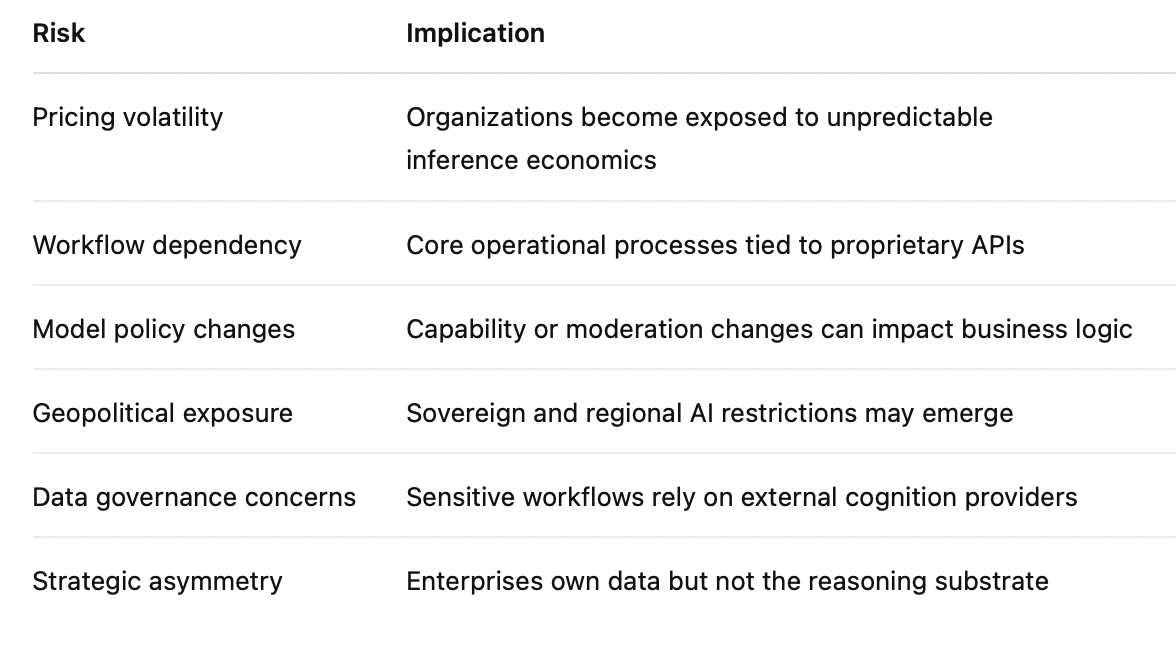
Table: Structural risks with small number of frontiner model providers
The historical analogy is not software licensing. It is cloud hyperscaler dependency.
But AI dependency may become deeper because it affects:
- operational reasoning
- enterprise memory
- workflow intelligence
- semantic interpretation
- decision support
While frontier models continue to advance rapidly, the parallel maturation of high-performing open-weight models [4], [5] and efficient local inference options provides additional levers for reducing long-term dependency when combined with strong abstraction layers .
The Return of Sovereign AI
This is why sovereign AI is no longer merely a national-security discussion. It is becoming an enterprise architecture discussion.
In practice, this is manifesting as hybrid strategies rather than purely isolated deployments. Several counter-movements are likely to accelerate over the next five years.
Recent enterprise reports from Deloitte, Gartner, and Stanford Human-Centered AI Institute increasingly identify AI sovereignty, local inference capability, governance visibility, and operational resilience as strategic priorities rather than optional infrastructure choices [6], [7].
Pathway 1: Distributed Edge and Private AI Infrastructure
The most immediate response will likely be:
- hybrid AI
- edge inference
- private model hosting
- distributed GPU networks
Conceptually, this resembles the evolution of:
- high-performance computing clusters
- Kubernetes orchestration
- distributed CDN infrastructure
- federated cloud architectures
Instead of routing every task to frontier APIs, enterprises may adopt layered inference strategies:

Table: Likely enterprise adoption pattern with Sovergin AI
This creates a more economically sustainable architecture. It also creates strategic resilience.
NVIDIA May Become the New Oil Supplier
An under-discussed consequence is the increasing centrality of GPU infrastructure providers such as NVIDIA.
If agentic AI expands as expected:
- inference demand may grow faster than training demand
- persistent reasoning systems may dominate compute usage
- orchestration overhead itself may become computationally expensive
Inference demand is already shifting revenue mixes at major infrastructure providers, with inference representing a growing portion of overall AI compute spend [8].
This creates a future where:
- GPUs become strategic infrastructure
- inference optimization becomes a core enterprise competency
- semantic caching and model routing become economically critical
The winners may not necessarily be the creators of the largest models, but the owners of the most efficient inference ecosystems.
Emerging technologies such as speculative decoding, quantization, sparse mixture-of-experts architectures, semantic caching, and high-throughput serving frameworks like vLLM are increasingly becoming central to enterprise AI economics [9].
Quantum Computing: Real but Probably Not Immediate
Quantum computing is frequently proposed as the eventual answer to AI compute constraints.
The reality is more nuanced.
Quantum systems may eventually transform:
- optimization
- molecular simulation
- probabilistic search
- cryptography
- combinatorial reasoning
However, current enterprise AI bottlenecks are primarily related to:
- memory bandwidth
- distributed orchestration
- inference latency
- GPU parallelization economics
- context-window scaling
Quantum computing may become strategically important over the long term, but it is unlikely to solve near-term enterprise agentic AI economics.
The more immediate battleground remains:
- inference efficiency
- distributed compute
- hybrid architectures
- model specialization
The Most Important Enterprise Mistake
Many organizations are currently building AI systems directly against vendor APIs without abstraction layers.
This is strategically dangerous.
Enterprises should assume:
- models will change
- pricing will change
- providers may fragment
- regulations may emerge
- some capabilities may become regionally restricted.
Future-ready architectures therefore require:
- model-agnostic orchestration
- provider abstraction layers
- semantic interoperability
- workflow portability
- local fallback models
- hybrid execution pipelines
This includes leveraging maturing open-weight models alongside frontier capabilities where appropriate, routed through abstraction layers.
The organizations that survive the next AI phase may not be those using the “best model.” They may instead be the organizations that own resilient cognitive infrastructure.
Why Semantic Infrastructure Matters More Than Models
One of the most overlooked strategic lessons in enterprise AI is this:
LLMs are becoming commoditized faster than enterprise context.
What remains durable are:
- ontologies
- semantic layers
- enterprise knowledge graphs
- provenance systems
- workflow memory
- explainability frameworks
This is particularly important in regulated industries such as healthcare, finance, and defense.
A model may generate reasoning. But semantic infrastructure determines:
- whether that reasoning is grounded
- explainable
- reproducible
- interoperable
- auditable
This may explain why RDF, graph, and ontology-based architectures are quietly returning to relevance in modern AI systems.
Recent GraphRAG and hybrid retrieval benchmarks increasingly demonstrate improved multi-hop reasoning, contextual coherence, and evidence traceability relative to purely vector-based retrieval pipelines [10], [11].
Not because graphs replace LLMs. But because they stabilize them.
The Next Enterprise AI Stack
A plausible enterprise AI architecture by the late 2030s may look like this:

Next Enterprise AI Stack (Image by Author, created with the help of AI tool)
This resembles the historical evolution of:
- hybrid cloud
- microservices
- distributed storage
- content delivery networks
AI infrastructure may ultimately evolve into a layered, federated, hybrid ecosystem rather than a centralized API economy.
Final Thought
The current AI boom is frequently framed as a race toward larger models.
But the deeper long-term question may be:
Who controls the operational reasoning layer of modern enterprises?
If enterprise cognition becomes permanently centralized behind a few APIs, pricing is only the beginning of the dependency problem.
The organizations preparing now for:
- sovereign AI
- hybrid inference
- semantic interoperability
- explainable orchestration
- resilient agentic infrastructure
may be the ones best positioned for the post-API era — an era defined not by the absence of APIs, but by the presence of robust abstraction, portability, and control over how intelligence is orchestrated and grounded.
EPILOGUE: “The Time Bomb Went Off: AI’s All-You-Can-Eat Era Just Ended in Real Time”: This post on LinkedIN triggered this ThinkByte, making me think over last 3+ days on its implication for AI architecture design shifts. As I was drafting these thoughts here, Google joined the club on compute based usage limit & an email arrived in my mailbox (see below). The question now is: Is this usage limit time bomb is ticking for all other linked services? Reminds me Upload web series….poor are those with low AI usage limit. New societal strata is setting in, those who have it (tokens!) and those who don’t; a real virtual currency!!


Article that triggered this ThinkByte and message received by the author from Google
A Visual Summary

Visual Summary of the Article (Image by the author, created with the help of AI)
References
[1] “The Time Bomb Went Off: AI’s All-You-Can-Eat Era Just Ended in Real Time.” [Online]. Available: https://www.thestateofbrand.com/news/ai-subscription-price-subsidiation-ending
[2] N. Koenigstein, “The Hidden Cost of Agentic Failure,” O’Reilly Media. Accessed: May 20, 2026. [Online]. Available: https://www.oreilly.com/radar/the-hidden-cost-of-agentic-failure/
[3] “The 2026 AI Index Report | Stanford HAI.” [Online]. Available: https://hai.stanford.edu/ai-index/2026-ai-index-report
[4] Meta, “Llama — Open and Efficient Foundation Models,” 2026. [Online]. Available: https://www.llama.com/
[5] DeepSeek, “DeepSeek Official Platform and Models,” 2026. [Online]. Available: https://www.deepseek.com/en/
[6] Deloitte, “State of Generative AI in the Enterprise,” Deloitte Insights, 2026. [Online]. Available: https://www.deloitte.com/az/en/issues/generative-ai/state-of-generative-ai-in-enterprise.html
[7] Gartner, “AI Sovereignty and Enterprise Infrastructure Trends,” Gartner Research, 2026. [Online]. Available: https://www.gartner.com/en/newsroom/press-releases/2026-02-09-gartner-says-worldwide-sovereign-cloud-iaas-spending-will-total-us-dollars-80-billion-in-2026
[8] “Shift in AI Infrastructure Market Towards Inference Workloads.” [Online]. Available: https://intellectia.ai/news/etf/shift-in-ai-infrastructure-market-towards-inference-workloads
[9] vLLM, “vLLM Documentation,” 2026. [Online]. Available: https://docs.vllm.ai/en/latest/
[10] Y. Xiao et al., “GraphRAG-Bench: Challenging Domain-Specific Reasoning for Evaluating Graph Retrieval-Augmented Generation,” Jun. 20, 2025, arXiv: arXiv:2506.02404. doi: 10.48550/arXiv.2506.02404.
[11] Neo4j, NODES AI 2026 - EventKernel: Multi-Hop Reasoning and GraphRAG for AI-Powered Event Intelligence, (Apr. 23, 2026) [Online Video]. Available: https://www.youtube.com/watch?v=sUysPxT9YCk
메타데이터
- post_id
- efae53fe682c
- slug
- thinkbyte-the-hidden-tax-of-agentic-ai-why-enterprises-must-prepare-for-the-post-api-world-efae53fe682c
- url
- https://medium.com/@yogeshparte/thinkbyte-the-hidden-tax-of-agentic-ai-why-enterprises-must-prepare-for-the-post-api-world-efae53fe682c
- canonical_url
- https://medium.com/@yogeshparte/thinkbyte-the-hidden-tax-of-agentic-ai-why-enterprises-must-prepare-for-the-post-api-world-efae53fe682c
- author_url
- https://medium.com/@yogeshparte
- status
- ok
- fetched_at
- 2026-06-09 14:34:10



