Why Elastic SIP Trunking Is Replacing Traditional PRI Lines
The shift is not gradual anymore. It is operationally inevitable.
Why Elastic SIP Trunking Is Replacing Traditional PRI Lines
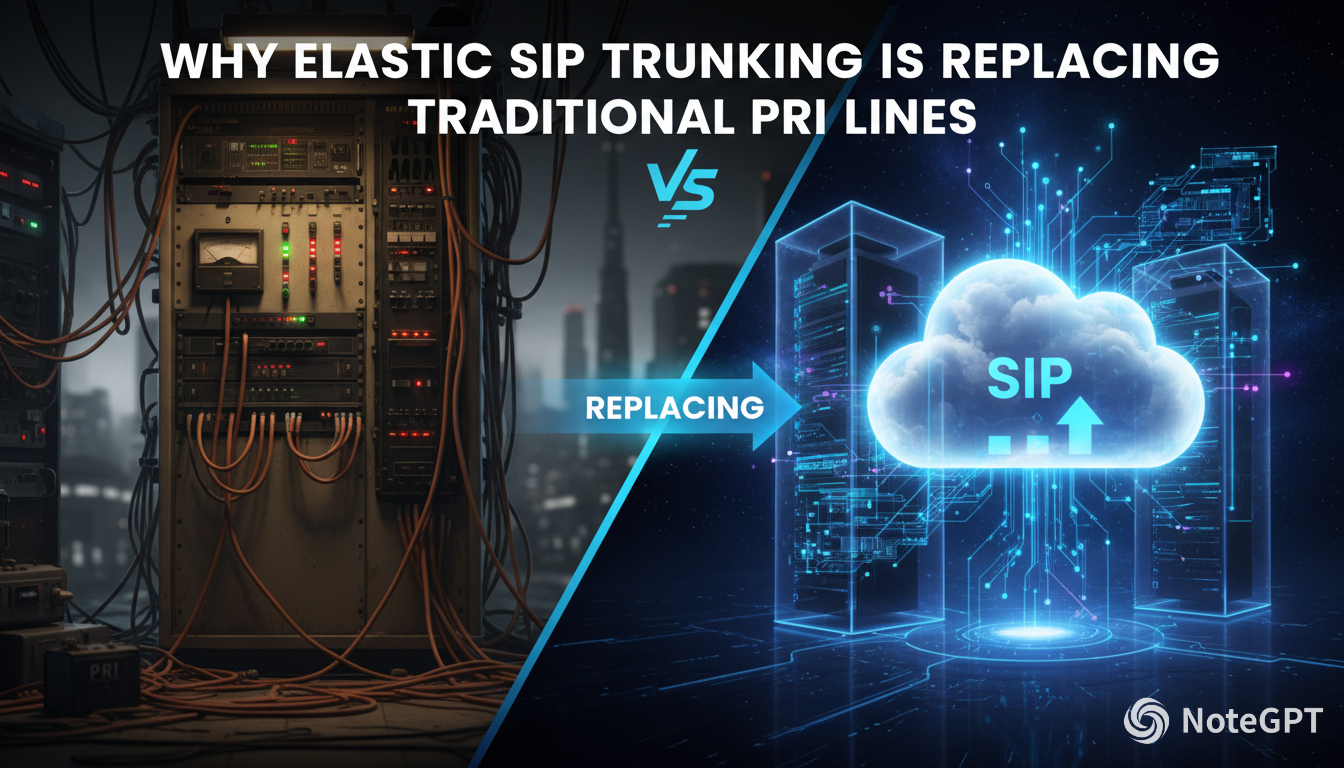
The shift is not gradual anymore. It is operationally inevitable.
For decades, PRI lines formed the backbone of enterprise voice communication. They powered contact centers, sales teams, and support operations reliably. But startups and modern enterprises today operate in an entirely different environment, one driven by cloud infrastructure, remote teams, automation, and real-time analytics.
Legacy telecom systems were not designed for this level of agility. As communication demand becomes more dynamic, businesses are actively moving toward Elastic SIP Trunking as the new standard.
The transition is not just about cost savings. It is about scalability, flexibility, and operational intelligence.
What Is Elastic SIP Trunking and Why Does It Matter Today?
Elastic SIP Trunking is a cloud-based telephony solution that allows businesses to make and receive calls over the internet instead of traditional copper PRI circuits.
Instead of installing physical lines with fixed capacity, SIP trunks connect your communication system to the public telephone network through IP infrastructure. “Elastic” refers to the ability to scale call capacity up or down instantly based on demand.
This means businesses no longer need to predict peak call volumes months in advance or invest in unused capacity.
According to IDC, organizations adopting SIP trunking reduce telephony costs by up to 40 percent compared to traditional PRI infrastructure. This cost advantage alone is driving rapid adoption across startups and enterprises.
Why Are PRI Lines Becoming Operationally Limiting?
PRI technology was built for a different era, one where call volumes were predictable and teams operated from centralized offices.
Today, those assumptions no longer hold true.
Here is where PRI lines fall short:
- Fixed channel capacity, typically 23 or 30 concurrent calls
- Expensive hardware installation and maintenance
- Long provisioning timelines
- Limited flexibility for remote or distributed teams
- High costs for international expansion
If your call demand exceeds capacity, calls fail or require additional physical line installations. If demand drops, you still pay for unused channels.
This rigidity directly conflicts with modern business needs.
How Does Elastic SIP Trunking Solve the Scalability Problem?
Elastic SIP Trunking removes fixed capacity constraints entirely.
Call channels scale dynamically based on real-time usage. Businesses can handle sudden spikes such as campaign launches, seasonal traffic, or support surges without infrastructure upgrades.
Key scalability advantages include:
- Instant provisioning of new channels
- No hardware dependency
- Automatic load balancing
- Cloud redundancy for uptime
Research from Deloitte shows that companies moving to cloud telephony infrastructures improve communication scalability efficiency by 60 percent during peak demand periods.
This elasticity ensures that customer experience never suffers due to technical bottlenecks.
Is Cost Optimization the Biggest Driver of Migration?
Cost is a major factor, but it is not the only one. The financial benefits extend beyond monthly line rentals.
Elastic SIP Trunking reduces:
- Hardware procurement costs
- Maintenance contracts
- Carrier line charges
- International call routing expenses
Because calls travel over IP networks, routing becomes more efficient and affordable. Businesses operating across multiple geographies benefit significantly from localized call handling without physical installations.
More importantly, companies only pay for concurrent usage rather than fixed capacity, making cost structures far more predictable.
What About Reliability and Call Quality?
A common misconception is that internet-based calling compromises reliability. Modern SIP infrastructure is built with enterprise-grade redundancy and carrier interconnections that often outperform PRI uptime.
Elastic SIP providers offer:
- Automatic failover routing
- Geo-redundant data centers
- Real-time call monitoring
- Quality of Service prioritization
This ensures consistent call clarity even during network fluctuations.
For startups and digital-first businesses, SIP reliability aligns better with cloud infrastructure than legacy telecom circuits ever could.
How Does SIP Trunking Support Remote and Hybrid Teams?
Workplace distribution is now permanent. Sales, support, and operations teams function across cities and countries.
PRI lines cannot support this model without complex call forwarding or VPN setups.
Elastic SIP Trunking enables:
- Location-independent calling
- Softphone and VoIP device compatibility
- Unified communication dashboards
- Centralized call tracking
Teams can operate from anywhere while maintaining a single business identity and call infrastructure.
Are You Missing Automation Opportunities with PRI?
Traditional PRI systems operate as standalone telephony layers. They lack native integration with modern business tools.
Elastic SIP Trunking integrates directly with:
- CRMs
- Helpdesk platforms
- AI voice agents
- Analytics dashboards
This enables automation such as:
- Auto-logging call records
- Triggering workflows post-call
- Intelligent call routing
- Voice analytics and transcription
Without SIP infrastructure, these capabilities remain fragmented or impossible.
If your business is still evaluating how cloud telephony fits into your communication stack, this is the right time to act.
**Sign up to explore Elastic SIP capabilities and see how programmable voice infrastructure can modernize your operations without heavy telecom dependencies.**
How Difficult Is It to Transition from PRI to SIP?
Migration is often perceived as complex, but modern providers have simplified the process significantly.
A typical transition involves:
- Assessing current call volumes
- Porting existing business numbers
- Configuring SIP endpoints
- Testing routing and failover
- Phased traffic migration
Most businesses complete migration without operational downtime.
The key is choosing a provider that handles carrier coordination, compliance, and provisioning seamlessly.
What Should Businesses Look for in an Elastic SIP Partner?
Not all SIP providers deliver the same enterprise value.
Decision-makers should evaluate:
- Carrier redundancy and uptime SLAs
- Global coverage
- API and integration flexibility
- Real-time analytics
- Security and compliance standards
A strong SIP partner should function not just as a telecom vendor but as a long-term communication infrastructure enabler.
Where FreJun Teler Fits Into the Evolution
FreJun Teler builds on the advantages of Elastic SIP Trunking and extends them into intelligent voice automation.
It combines scalable SIP infrastructure with AI-powered voice capabilities, enabling businesses to automate outbound calls, manage inbound interactions, and integrate communication directly into operational workflows.
With Teler, companies gain:
- Elastic SIP connectivity
- Automated voice agents
- CRM-triggered call workflows
- Real-time call analytics
- Scalable global calling infrastructure
This unified approach transforms voice from a telecom function into a programmable business asset.
Final Thought
The replacement of PRI lines is not a trend. It is a structural shift in how modern businesses communicate.
Elastic SIP Trunking delivers the scalability, flexibility, and cost efficiency that legacy telecom systems cannot match. For startups and growth-stage companies, adopting SIP early prevents infrastructure bottlenecks and unlocks automation opportunities that drive measurable business outcomes.
If you are planning to modernize your voice infrastructure, schedule a personalized demo with FreJun Teler to see how Elastic SIP and intelligent voice automation work together to future-proof your communication stack.
메타데이터
- post_id
- efaf61523b22
- slug
- why-elastic-sip-trunking-is-replacing-traditional-pri-lines-efaf61523b22
- url
- https://medium.com/@FreJun./why-elastic-sip-trunking-is-replacing-traditional-pri-lines-efaf61523b22
- canonical_url
- https://medium.com/@FreJun./why-elastic-sip-trunking-is-replacing-traditional-pri-lines-efaf61523b22
- author_url
- https://medium.com/@FreJun.
- status
- ok
- fetched_at
- 2026-06-24 23:31:39