The mirror-image of Calvin and Hobbes’ “Stupendous man”, excursus for reading Seminar 13, 5.1.
In Bill Watterson’s comic strip Calvin and Hobbes, a common subgenre, is when the boy Calvin turns into “Stupendous man”, a superhero who…
The mirror-image of Calvin and Hobbes’ “Stupendous man”, excursus for reading Seminar 13, 5.1. 1966.

In Bill Watterson’s comic strip Calvin and Hobbes, a common subgenre, is when the boy Calvin turns into “Stupendous man”, a superhero who fights for “liberty” against “tyranny”. In this case, it often means that Calvin wants to escape some boring chore or getting rid of the home-work. While this can be read as a particular satire and commentary on superheros of the 1980ies, it also offers us an insight into what Lacan means with the unary trait, le traite unaire, and what a subject is in a lacanian understanding of the term. Here I will focus on the way, Lacan in the session 5.1.1966, goes back to the notion of the symbolic cut in reality, the way we are given a “proper name” for example, or any other symbolic mandate (wife, teacher, professor, nurse, daughter….). What makes the comic strip particularly apt for this explanation is the way, that the superhero symbolic mandate “Stupendous man” is shown in its ‘tautological stupidity’ and how it splits the subject. Here is the comic, from October 9th-14th 1989.


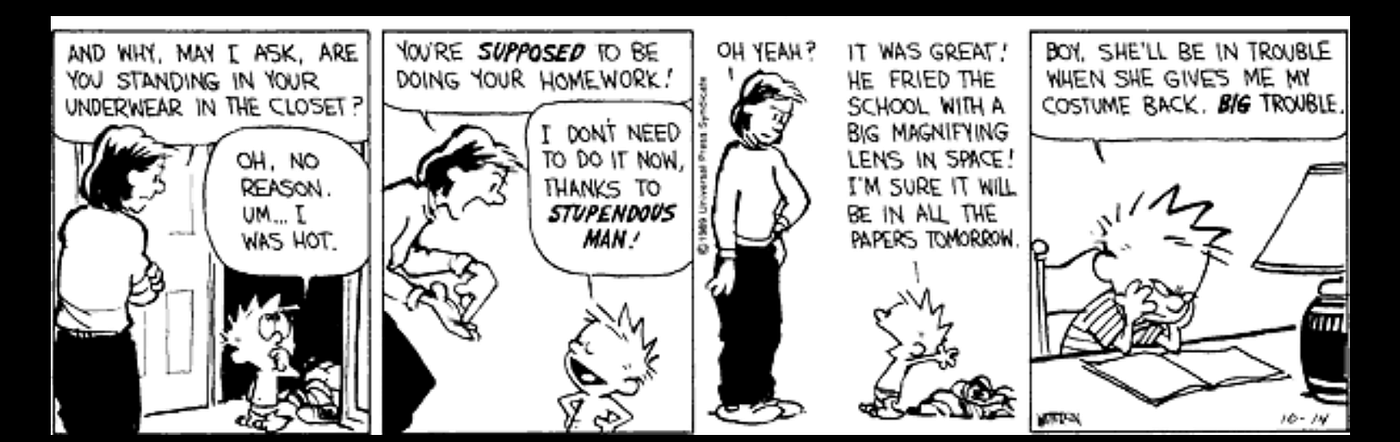
In the story we see the opposition between Calvin as a normal boy doing the home-work (or rather refusing to do it), and himself as the superhero, Stupendous man. Since he does not want to do it he imagines himself as a super-hero. Stupendous man COULD easily do the home-work, but instead rather wants to burn down ‘a certain’ elementary school. Coming back to his room, his mother is knocking on the door, and discovers that he is changing in the closet, and that he has not done the home work.
The comic strip plays on the “dual identity” of the genre of superheroes. Superman is both Clark Kent in regular life, and ‘Superman’, savior of the city. Batman is both the superhero Batman and the ordinary, even if very rich Bruce Wayne. Superheroes are always split, or rather double identities. They have one “regular” life person (here mild-mannered Calvin) and then their superhero identity.
In the superhero genre, these two identities are whole in the themselves. Bruce Wayne can change into Batman or Batman back to Bruce Wayne. We are not dealing with subject as split, divided, but with a whole identity that simply dresses up as the other. Bruce Wayne is not a schizophrenic who merely thinks he is Batman, but he really becomes Batman by dressing up and putting on his many gadgets (the belt, the batmobile, the batwing plane).
Like philosopher Todd Mcgowan, points out, the superhero is not a traditional authority figure, but a fantasy, that is supposed to fill out the gap in authority itself, the fact that authority is not fully guaranted, that it fails to be proper authoritative. This is why the superhero genre emerges precisely when public institution and social reality seem more fragile than before. To quote Mcgowan:
“The superhero occupies a distinct place in the public’s psyche. Superheroes are never traditional authority fi gures but instead reside in the gap in the social order that traditional authority necessarily leaves vacant. That is, they occupy the space of fantasy. Inhabiting the gap in the social order, superheroes are fantasmatic fi gures without parallel. The fantasy of Superman allows us, for instance, to imagine a complement to the traditional authority of the police, one who is able to make up for all the deficiencies of this traditional authority. He can respond more quickly to crises, he can confront threats that exceed normal human powers, and he can avoid the danger of corruption. Superman doesn’t fall victim to any of the problems or limitations that ensnare traditional authority.” (Mcgowan, the fictional Christopher Nolan, 89).
Traditional authority figures are ensnared by the symbolic order. That is to say, as soon as they put on a certain mandate, King, priest, teacher, they are necessarily divided between the mandate and their own empirical being. The empirical being always comes up to short. This is what is called “symbolic castration” in psychoanalysis. No matter how great a king is, he is never fully commensurable with the signifier “the King”. Authority always fails.
But the superhero, by contrast, presents a fantasy of an authority figure that always succeeds. The image of Superman in the 1980ies is precisely of such a figure that can save the city and never comes up short, never fails to corruption. Even if the famous “kriptonite” is his weakness, this is nothing compared to the weaknesses of ordinary politicians. The historical shift, from what Lacan calls the masters discourse, where a certain figure represents authority directly, to the university discourse, where knowledge becomes the site of authority also indicates this shift. In university discourse authority is harder to locate and “ordinary” authority figures seem weaker. Hence, the rise of the superhero genre is by no means an unhistorical matter, but rather indicates a symptom of a specific shift in the codification of symbolic order and enjoyment after 1968.
Calvin and Hobbes should be read as a commentary on precisely this shift. Here the fantasy is traversed, debunked. Calvin is precisely not such a unwavering authority figure, but very Calvin-like even in his fantasy of stupendous man. In Calvin and Hobbes, the ‘grandeur’ and seriousness of the entire genre is mocked and debunked. The fantasy of the superhero as perfect authority figure is undermined. But that is not all. The genre is itself also playfully developed. This can especially be seen in the way that the ironic take does not lead to less quality in the drawings for example. It is almost as though the superhero drawings, a caricature of the real superhero drawings. One can finally enjoy the superhero only through Calvin’s particular take on it.
We are not dealing Calvin really becoming a superhero, saving the city and so on. Instead, even the superhero’s acts are clearly ‘contaminated’ by the personal priorities of “mild-mannered Calvin” (burning down the elementary school, for example). Stupendous man is not altruistic, fighting for the good of all or defending the city. He clearly is only a realization of Calvin’s very personal agenda that goes agains the common good. The comedy is of course, that the personal views of Calvin are transposed as a ‘universal claim’, as though it would be a duty of superhero to get rid of schools, which others, like Susie, clearly enjoys.
We see, instead, compared to the genre, the superhero here as a direct fantasmatic manifestation, a psychic flight from the demands of the reality principle (doing homework). In Hegelian terms, what is only ‘in-itself’ in the normal superhero genre is here ‘for itself’, comes to be explicit. All superhero movies are escapism, but in the comic this escapism is made explicit (comes to be for itself), because we see how Calvin transitions into stupendous man, his motivations for doing it, and also he own narrating voice that generates the superhero universe and its narrative codes (clear opponent, clear mission…). We can, from this comic strip, and this is of course true of Calvin and Hobbes as a whole, return to the superhero movies and see them in a more critical social light. The drawings of Stupendous man is like Critique of Superhero Reason.
When we watch a superhero after the criticism of Calvin and Hobbes, we see how this very “flight from reality”, that Calvin tries to do by turning into stupendous man, is already at work in the superhero-genre, how it is to vary the phrase from Marx “opium for the people”. When we watch Clark become Superman we imagine, that our ego was really as invulnerable as him, able to save the city, and acquire the precious object, that would fulfill us, namely, Lois Lane. This enable us to have a recourse to Lacan’s famous development of the “mirror stage” as formative of the subject’s ego. Lacan will later (for example in seminar 10) much more emphasize the social dimension that underpins and guides this identification. But in his original essay the focus is on the way the subject comes to ‘identify’ with an ego, how it ‘becomes itself’ (that is fostering the illusion that it has a ‘self’) .While Lacan later radically reorients the mirror stage in favour of the dialectics of eye and gaze from seminar 10 onwards, the initial theorization of the mirror stage still can help us understand the comic.
Lacan develops the mirror stage in his early writings, borrowing from Henry Wallon, first in 1936, but canonized in his essay from 1949, of the “wholeness” that our image in the mirror provides. We are not simply spontanosly ourselves. As Freud himself says a human being is born, in comparison with other animals, prematurely. An animal can quickly adapt to its environment. A human animal can never adapt, is always split and in his early theory Lacan understands this not so much as a result of symbolic castration, but as a result of the mirror stage, a time when the small infant has no sense of itself, no ego as an object, but encounter its own image in the form of the mirror. We form a self, or an ego as an identification with the image we see in the mirror.
This identification happens already in early infancy, between 6–18 months. We are as humans brought into the world prematurely, biologically speaking. We cannot satisfy our own needs, but need an Other to help us. We are initially helpless, depending on the social system to provide nourisment and care for us. There must be another human there to take care of us for a long time, a much longer time than other animals, like a kitten or a puppy.
Traditionally, this primary caregiver was the mother. The infant cannot feed itself, nor walk, but needs the mother in this case to provide for it. In contrast to other animals the human animal is motorically much more deficient when it is born and for a much longer time. Yet, as studies of animal behaviour, have shown, that Lacan follows closely, the infant has a very keen sight, and it is captured by its own image in the mirror. In contrast to its real body and its helplessness and fragmentation (the infant does not see itself as whole, but a confused disarray of limps), the image in the mirror is a totality. In front of me even now, I also see to hands writing on the computer. If I look in the mirror, I see a whole body, a face looking at me, hands and arms, growing out of body, legs, torso, everything united. Of course I cannot see my own back. But, I can, on the background of the partial wholeness I see, imagine that it is equally full. It is like looking, not as a mumbo-jumbo fragmentation, here an arm, there a foot, but as a self-governing whole, something that is independent and ‘fit’.
We usually think of the “ego” as simply what we ‘are’. Lacan instead, following Freud, defines the ego as an object. We take ourselves, in the mirror, as an object. In contrast, our real ‘selves’, who we are as subjects, are the bodily uncoordinated helpless being. Lacan writes of this opposition:
“It suffices to understand the mirror stage in this context as an identification, in the full sense analysis gives to the term: namely, the transformation that takes place in the subject when he assumes [assume] an image…”. (Lacan 2006: 76).
The infant ‘is’ not the image of itself, but takes it on as an identification, it assumes its mirror-image as “myself”. This is the fundamental alienation that is at work in all human subjects. Later, Lacan will also talk of the symbolic alienation, but in this early stage he emphasize the alienation through the imaginary, through the visual.
While this identification happens when we are very young, 6–18 months, id does not happen all at once, in one fell swoop, one fine day, but over several months, we can say the the repetition of seeing myself in the mirror constitutes a “stage”, that is an undefined period of time. Lacan emphasize its logical importance, rather than the chronological. The point is that, sooner or later, the infant really takes this “mirror”-image as its own “ego”, it takes this image as “me”, “this is who I am”. My being is what I see in the mirror.
This continues to be a fact throughout life. The effect we have throughout life, whenever we look at ourselves in the mirror, in a photo or in the reflection of a window, and unconsciously or consciously conclude “that’s me”. When we get a new haircut, we tend to obliquely look at ourselves in car-windows for example as we walk by. There is always, in the beginning an initial moment of surprise, “oh, that’s me?!”. We have to get used to the new hair-cut.
Lacan defines this identification as “imaginary” in two senses. It is imaginary in the way that it deals with “images” (the mirror), but it is also imaginary in the sense, that it involves an “illusion”. I am, in the Real, still the deficient body and not the figure of wholeness I see and identify with in the mirror.
While Lacan in the early essays, do not introduce the role of the parent in this experience, except in the passage, where he talks of the baby ‘held tightly by some prop’ (which we could, with the later years in mind take as the primordial caregiver), the symbolic identification becomes more important in later years. Our images, our imaginary egoes, or ideal-egoes are always underpinned by symbolic. The child will often look at the image, a bit curious or confused, and the primary caregiver, for example the mother, will say, “that’s you, baby!”, with a big smile, in other words, the identification is constantly supported by the “big Other” and the symbolic order. The symbolic order is therefore what makes possible the imaginary identifications and regulates them. For the early Lacan, much of psychoanalytical work is to disengage the subject from imaginary identification and see the symbolic as constitutive of him or her. Not ‘how we would like to see ourselves’, but the symbolic point from which we like to see ourselves in this way. Imagine that I always try to be a dutiful student, that this is my ideal-ego. Psychoanalytical work would try to figure out the symbolic Other, the point from which I look at myself in this way (for example to please my father). While being a good student is my ideal ego, my ego-ideal (the symbolic) is the father’s gaze on me fulfilling this imaginary ego.
What matters for our purposes here is the way, that Lacan associates a certain “jubilant” feeling with my mirror-image:
“ This event can take place, as we know from Baldwin’s work, from the age of six months on; its repetition has often given me pause to reflect upon the striking spectacle of a nursling in front of a mirror who has not yet mastered walking, or even standing, but who — though held tightly by some prop, human or artificial (what, in France, we call a trotte-bebe [a sort of walker]) — overcomes, in a flutter of jubilant activity, the constraints of his prop in order to adopt a slightly leaning-forward position and take in an instantaneous view of the image in order to fix it in his mind.” (Lacan 75).
In reality the child is motorically deficient. It walks with a prop, or stumbles, or is carried by the mother or father, or some third adult (big Other). In contrast to this lack of mastery, the mirror-image is itself as a whole, and that is why the child is overcome “in a flutter of jubilant activity”. It is deficient but in the mirror it sees itself as a master over itself, a complete being. In reality it is lacking, but in the image it seems to be complete.
While I have presented it here as first motorically lacking, a more precise description would be to say, that the “instantaneous view of the image” of itself first divides the subject into its identification with the ego and then the deficient body. The deficient body only becomes deficient from the contrast with the image. From then on the subject will be divided between the fragmented real body and the perfect mirror-image. This does not change when the child becomes older and is able to walk. It will always be less powerful than its perceived mirror-image:
“For the total form of his body, by which the subject anticipates the matu ration of his power in a mirage, is given to him only as a gestalt, that is, in an exteriority in which, to be sure, this form is more constitutive than constituted, but in which, above all, it appears to him as the contour of his stature that freezes it and in a symmetry that reverses it, in opposition to the turbulent movements with which the subject feels he animates it.” (Lacan, 76).
Lacan points out, that while animals, like the female pigeon, or the migratory locusts are also captured by the image and that it has an effect on their mating rituals, “the necessary condition for the maturation of the female pigeon’s gonads to see another pigeon as a member of the species”, the human animal never simply ‘fits’ its natural environment. Because of the mirror-image, it involved a “lack” that makes it always come up short, but which also engages it in the world, precisely because it cannot adapt. We can say, that it is constantly looking to coincide with its ideal-ego. The animal always fits its environmment, whereas a human animal “this relationship to nature is altered by a certain dehiscence at the very heart of the organism, a primordial Discord betrayed by the signs of malaise and motor uncoordination of the neonatal months.” in other words, we are never simply ‘organic beings’, we never fit our environment.
As I said, while he only begins to unfold this difference in his seminars, beginning from seminar 1 between the “ideal ego” and the “ego-ideal”, the mirror image (my ideal ego) is supported by the symbolic matrix. The image the child will identify with will depend on the specific cultural context and history it is born into. To take a common example, it might play with a ball, and if it’s a boy, the parents will say, “that’s a good boy!”, thereby supporting the formation of this identification (a good boy plays with a football), whereas if it is a girl, they parents might give it a doll instead). This is a very crude example, but it should serve just as a reminder, that the mirror stage is always dependent on the symbolic.
While the mirror-image is the only sense I can have of an ego it is also a fundamental “alienation”. I can alienate myself in this identification, although there is no way not to take on some sort of mirror-image. Lacan’s early definition of psychosis involves the “fragmented body”, the paranoid vision of a body-in-pieces — another point where it is clear that psychosis in this stage of Lacan’s teaching is again a result from a (failed) mediation with mirror-image as a whole. The psychotic might feel the that the body is falling apart, that the world itself takes on bodily aspects, like worms crawling behind the walls, out to eat me and so on.
While I can never be my image, my ego, it props up the subject as an unconscious ideal to strive for. I can never fully coincide with my ideal ego, that is overcome my lack. No matter how much I try to go to the gym and stay young, my body will eventually age and ‘betray’ me, that is come up short against the ideal. Lacan also, and this is important for my superhero-analysis, describe the ego as an “armor” that the subject puts on.
We can now go to the superhero. The superhero outfit is like the ideal ego, that we can never live up to. In reality we are simply “mild mannered Calvin”, who has to suffer all kinds of demands from reality we can never live up to, but our fantasy is to be like “Stupendous Man”, that is a superpowerful being. Stupendous man, not only does not have to do homework, but can in supreme mastery of the “motorics” even fly around and burn down a ‘certain school’.
The difference from Calvin and Hobbes’ “Stupendous Man” and the other superheroes of the 80ies is that the operation is revealed as such. First the superhero is itself a psychic manifestation, an ideal-ego (it goes on “in Calvin’s head” as is clear from the comic strip), whereas in other superhero comic books, we are allowed to dream to be these superheroes. In other words, other comic books and the whole genre, do not really question this “striving” and the havoc it leaves in its place. Lacan explicitly targets any philosophy of consciousness (he has in mind Sartre’s existentialism and the way it still, for Lacan, relies too much on Descartes’ cogito). Psychoanalysis is different from any philosophy of consciousness, because consciousness always relies on this fundamental “misrecognition”, that I have a “whole self”: “this philosophy grasps that negativity only within the limits of a self-sufficiency of consciousness, which, being one of its premises, ties the illusion of autonomy in which it puts its faith to the ego’s constitutive misrecognitions.” (80).
Lacan points out that the ideal-ego also leads to “primary jealousy” and formation of the double. This is what we see in many superhero movies and comic strips. The superhero must also have a supervillain, an evil that is like an inverted ego. How do we explain this psychoanalytically? Because the ideal ego is a fundamentally alienation it also carries with it a lot of aggression. The subject both wants to be the perfect ego, but it also hates this ego, because it always stands in the subject’s place. It is a vicious circle. The more I try to become this ideal ego, the more I sense my own lack, my own body as fragmented. In the classic superhero movies this inherent aggression and love, this love-hate (what the later Lacan will term “jealoussance” and “hainamoration”) is split between the superhero and the supervillan (the love is for my superhero self and the hate for the supervillan which try to destroy the town).
Paradoxically in the Calvin piece, the supervillan is “mom-Lady”, not another supervillain. We can say that the competition is taken to the symbolic, “stupendous man” fights the symbolic order represented by mom-Lady who says he should do homework. We can read this as a way, if we extent of a critique that the other superhero movies cannot do. They are never able to question the actual symbolic underpinnings of the mirror-images. In the 80ies for example the way that crisis in collective structure led to the image of the “perfect self”, the neoliberal ego that could “train itself” and thereby destroy communism (like in the many action movies of the 80ies). The collective or the communal thereby always took on the aspect of something imposed on the neoliberal ego.
While it could look as though in Calvin we are dealing with a celebration of the superhero against the social order, it is therefore in fact more radical. Much more than this its true power, and the charm of the entire comic strip is clearly the fact that it constantly points to the discrepancy between Calvin’s reality, and the psychic manifestations of it. We constantly see “the dehiscence of the original discord”. The comic sequence of Calvin getting undressed in his closet, the discrepancy between supposed superhero powers, and one’s mother asking how the home-work is going.
Lacan at his early stage defines the psychoanalytical procedure, that can also be moved to the social, as identification with oneself as a “lacking” body. The “thou art that”. I am simply this helpless body, I can never “be” the perfect ideal-ego, I can never overcome my lack:
“In the subject to subject recourse we preserve, psychoanalysis can accompany the patient to the ecstatic limit of the “Thou art that” where the cipher of his mortal destiny is revealed to him, but it is not in our sole power as practitioners to bring him to the point where the true journey begins.”.
The thou art that, is like the “stain” in the mirror-image, what does not ‘fit’ with how I would like to see myself. Calvin is not “Stupendous Man”, but “mild-mannered Calvin”. Or to put it more precisely, “Stupendous man” is itself the fiction of the overcoming of lack with “mild-mannered Calvin” (which also proves to be another lie, because as the reader takes joy in reading, Calvin is anything but “mild-mannered”). Do we not see here, precisely the ec-static aspect of Calvin — that he can never “be” his ideal ego, but also that he cannot simply “be” any other ego. What remains is the division itself, the revelation that “thou art that”, not simply Calvin, but the division of both.
Lacan writes crucially, that all though it seems “innocent” with the ideal-ego this is the aggression that sustains all kinds of supposed altruistic activities, like reforms, pedagogy:
“For such a task we can find no promise in altruistic feeling, we who lay bare the aggressiveness that underlies the activities of the philanthropist, the idealist, the pedagogue, and even the reformer.” (Lacan, 81).
Whenever we try to better the world, as other superhero movies officially do, we should always bear in mind, which kind of latent aggression is work. When we, as nice pedagogues, try to make “healthy egoes”. This is why psychoanalysis is not there to correct the “the passions of the city”. We would however have come a long way, if we recognize the way that ambivalence is tied to the formation of the “ego”, the way we both hate and love it.
One of the most difficult graphic images of the mirror-stage is given by Lacan in his seminars and he later comes back to it several times.

I will not go into detail with it, but describe how Calvin’s “stupendous man” illustrates a certain symbolic inversion of the imaginary identifications. This is also the humour and the delight of the comic strip. It is similar to the way that Lacan often describes Jonathan Swifts humour. Perhaps the best rendition is given by Slavoj Žižek in For They Know not What they Do. The point is not simply to reduce the “virtual” to matter of facts, how ‘reality is’. We can, paradoxically only get at this reality through a shift in the virtual itself. In Jonathan Swifts Gulliver’s Travels, we see an inverted world:
the reader is confronted with a series of mocking inversions of our “normal” human um verse [the island populated by dwarfs two inches tall; a country where ‘normal” relations between humans and horses are reversed -where humans live in stables and serve horses … ).
Swift’s true targets are, of course, our own weaknesses and stupidities: by means of a fantsy-world which presents its inverted image, he endeavours to turn to ridicule the follies -the invertedness -of our own allegedly “normal” world. The image of humans who serve horses should arouse us to the vanity of the human species as compared with the simple dignity of horses; the null disputes of the Lilliputians arc there to remind us of the conceit of human customs, and so on”. (Slavoj Žižek: 11).
To make the point in another way, Swift cannot directly target our human follies. He must first resort to the invention of Gulliver’s travels, and through this detour (the virtual image) we can arrive at the truth of our own. We know the entire time, that Swift is ironic, that he is really mocking human customs. Yet, we also sense that there is something more going on, than mere “censorship” in the common-sense understanding of the term (Swift should not offend certain people). There is an extra produced by the virtual image itself, that constantly “flickers” against our own social reality.
Is it not the same with Calvin’s “Stupendous man”. If we would be dealing with a mere critique of superhero genre it would not be funny. What makes it funny, is the fact, that when Calvin turns into “Stupendous Man” we do know it is all in his head. and yet, the way that the graphics is done is much more spectacular than the other graphics (Stupendous man unscrewing the gigantic lense and flying into space). If we were just dealing with drawings of Calvin running around his room, if we were only dealing with the difference between the “virtual” and the “reality” we would not get to the crucial point, which is that Calvin’s world as Stupendous man, feels even more ‘real’, than normal reality. This is purely the effect of the drawing itself and its contrast. We enjoy this fictional universe of Calvin (the long lists of complaints against the tyranny of home-work because it seems excessive, but believable in Calvin’s head).
There is a sense, where we get from the usual opposition between reality and fantasy and instead encounter the fantasies that sustain normal reality:
Here, we can clearly discern the function of the Ego-Ideal -that is, ;of symbolic identification -from its imaginary counterpart: symbolic identification is identification with the ideal (“virtual”) point from which the subject looks upon himself when his own actual life appears fl him as a vain and repulsive: spectacle. That is to say, Swift, like ,Monty Python, belongs to the “misanthropic” lineage of English :humour based on an aversion to life as the substance of enjoyment, ind the Ego-Ideal is precisely the viewpoint assumed by the subject ,,..,hen he perceives his very “normal” everyday life as something ;:inverted. This point is virtual, since it figures nowhere in reality: it differs from “actual” life as well as from its inverted caricature-that is ,to say, it cannot be located within the mirror-relationship between reality and its inverted image-as such, it is of a strictly symbolic nature. (Žižek, ibid.).
Instead of getting caught up in the imaginary as all other superhero movies, that repress the symbolic point of from which I appear likable as this superhero, we see this symbolic point itself emerge and itself up for negotiation. Calvin’s point, the re-doubling of superhero, where the superhero world seems more real than normal reality, is like the mouse-trap in Hamlet, a fiction within a fiction, that gives us access to the truth of the subject.
Normal comic strips simply depict the imaginary of superheros, of imaginary identifications, but are never able in a critique of its ideology, to introduce the “ego-ideal”, that is the point from which we should find the superhero’s self-sufficiency an attribute to be admired. Within that world we can never articulate lack. Furthermore, they can work as ‘escapism’, precisely because we can disawov the extent to which such fantasies already construct our “normal” reality. It is the same in Jonathan Swifts stories, we see the sublime irony occur, only from within the story.
That is why Žižek attacks, as in many other books, the notion of “emperor has no clothes”. Everyone knows the emperor has no clothes, but the child merely reveals reality how it really is. What the child as a “chatterbox” fails to see and why its words is a catastrophe is the way that the fiction of the emperor’s clothes sustains reality. Reality is itself sustained by fictions. It is symptomatic, that the second, where “cynical reason” became the dominant hegemonic mode, when there were no “more ideologies” (in the 80ies), that fantasies began to explode (all the superhero moves), and today it is even more so. Precisely by “revealing the emperor has no clothes” we miss the way, that the fantasies continue to support social reality (for example the fantasy of the neoliberal subject, that through self-training and self-sufficiency and discipline can overcome its lack, in a social context brought on by social misery, the lack of jobs). While this or that particular neoliberal individual might get a job, the social conditions needs to constant “production” of unemployment -and in this sense, that the market is simply serving individuals’ needs we are dealing with a fantasy that structures social life.
What we get in Calvin and Hobbes is precisely the point, where the imaginary identifications, can in themselves be seen as supported by symbolic identifications and that these symbolic identifications are also “unfounded”.
We can see this also through Žižek’s example of Ring Lardner’s who dealt, where the entire effect of the story relies on narrative perspective. Here is Žižek’s summary:
Ring Lardner’s little masterpiece “Who dealt?” tells the story of such a prattler. There is nothing special in its plot line as such: two friendly couples — the narrator and her husband Tom; Helen and Arthur — spend an evening together playing bridge. The narrator, who is only recently married to Tom, knows nothing about his stormy past: years ago, he and Helen were passionately in love; because of a petty misunderstanding they split up; broken and helpless, Helen married their reliable friend Arthur, while Tom struggled to pull himself out of despair and took comfort in writing poems which, in a half-concealed way, tell the story of his lost love. The narrator has found Tom’s literary efforts among his papers; unaware of their impact, she recites them during the game to amuse the company. The story ends at the precise moment when the catastrophe comes to light: when the narrator becomes aware of saying something terribly wrong …”
There is a similarity between this story, of an “innocent prattler” and then the narrative perspective, where ‘we’ the readers can see the symbolic point, the ego-ideal she disturbs, the way her innocent words affect the social structure. Is it not the same with Calvin? The entire effect of the brilliant piece on Stupendous man derives from Calvin’s own lack of cynicism, that he goes into the story as though he really believes if, while we can inhabit the “impossible” position of knowing that he is merely just playing. We are precisely not part of the story, but as such we are in the position to see the truth. We “know too much”, as Žižek writes again in his conclusion:
So far, nothing special. The effect of the story hinges exclusively on its narrative perspective: it is written entirely as the narrator’s monologue, as her confused prattle accompanying the game- we are strictly limited to her perspective, to what she says and sees. It would be easy to imagine the same story retold from another perspective: that of her husband Tom, for example, who trembles with anxiety as he observes his prattling wife approaching the “dangerous ground”. Lardner wisely preferred the viewpoint of the person who unknowingly acted as the cause of catastrophe: instead of presenting the catastrophe immediately, he evokes it “off champ” (to use this term from cinema theory) — that is, as it is mirrored in the face of its cause. Therein consists his narrative mastery: although strictly limited to the viewpoint of the innocent chatterbox, we — the readers — simultaneously occupy the position of the Hitchcockian “man who knows too much” — who knows that the prattler’s words inscribe themselves in a framework within which they mean catastrophe. Our horror is strictly codependent on the radical limitation of our perspective to that of the ignorant prattler who, until the very end, has no presentiment of the effect of her words.” (Žižek 12–13).
The point is the same with Calvin. If we were limited to his perspective, we would just get imaginary inversion of normal reality. Either home-work or superhero. But now, we can see superhero as a response to the crisis of homework. We occupy the position of the “man who knows too much”. We can see the constitutive split in Calvin, between the imaginary ideal-ego and the Ego-ideal. It is not simply about “how others see me” and “how I really am”, “but the way I see others see me”. (ibid.). The superhero is how I would like to present myself, to the gaze of the others, to the gaze of the Other.
Works cited:
Bill Atkinson, Calvin and Hobbes. Found at https://www.gocomics.com/calvinandhobbes/1989/10/09
Jacques Lacan, Ecrits. tr. Bruce Fink. W.W. Norton and Norton. New York. 2006.
McGowan, Todd. 2012. The Fictional Christopher Nolan. Austin: University of Texas Press.
Slavoj Žižek, For They know not what they do. Verso. London. 2008.
메타데이터
- post_id
- efbe2f7fd78a
- slug
- the-unary-trait-of-calvin-and-hobbes-stupendous-man-reading-seminar-13-5-1-1966-efbe2f7fd78a
- url
- https://medium.com/@akineo/the-unary-trait-of-calvin-and-hobbes-stupendous-man-reading-seminar-13-5-1-1966-efbe2f7fd78a
- canonical_url
- https://medium.com/@akineo/the-unary-trait-of-calvin-and-hobbes-stupendous-man-reading-seminar-13-5-1-1966-efbe2f7fd78a
- author_url
- https://medium.com/@akineo
- status
- ok
- fetched_at
- 2026-09-03 02:43:03