Python as the Cognitive Layer of Modern Cybersecurity
Python did not become dominant in cybersecurity because of libraries or popularity. It became dominant because security stopped being about…
Python as the Cognitive Layer of Modern Cybersecurity
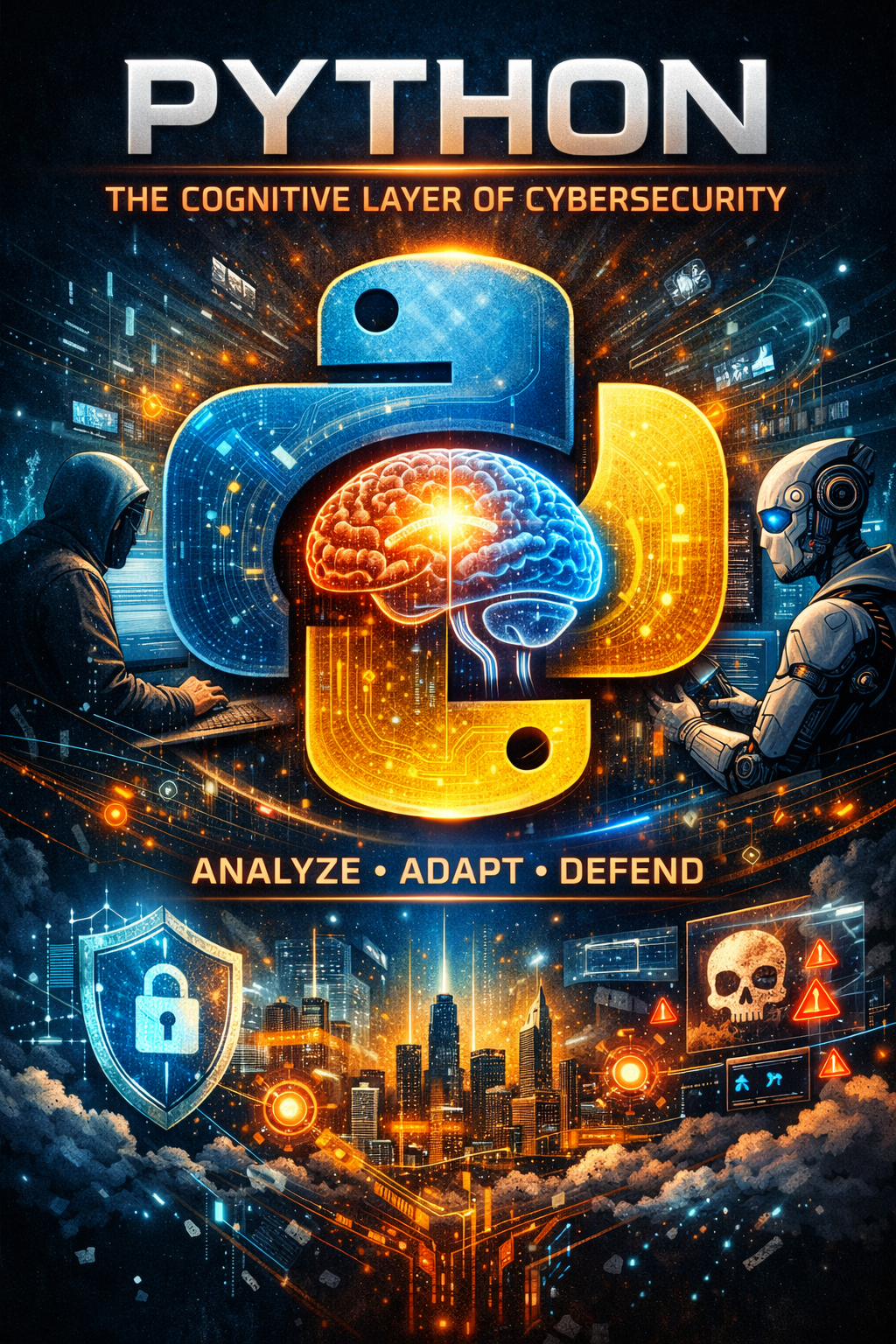
Python as the Cognitive Layer of Modern Cybersecurity
Python did not become dominant in cybersecurity because of libraries or popularity. It became dominant because security stopped being about detection and started being about judgment.
In a world where attacks use valid credentials, legitimate APIs, and expected workflows, the most powerful security systems are not the fastest — they are the ones that can think. Python is where that thinking happens.
How Real Security Systems Reason, Adapt, and Act at Scale
Cybersecurity did not become difficult because attackers suddenly grew more sophisticated. It became difficult because systems grew beyond human-scale reasoning.
Modern infrastructure is distributed, ephemeral, identity-driven, and API-first. In this world, almost every action appears legitimate when observed in isolation. Security failures no longer stem from missing signals — they stem from misinterpreting meaning.
This shift fundamentally changed what matters in cybersecurity. And it explains why Python emerged not as a supporting tool, but as the cognitive layer of modern security systems.
From Deterministic Rules to Probabilistic Judgment
Traditional security systems were deterministic by design.
- An event occurred.
- A rule matched.
- A response was triggered.
This model assumed that malicious behavior could be clearly defined in advance. That assumption no longer holds.
Today, risk is probabilistic. A login may be valid. A configuration change may be expected. An API call may be routine. Threats emerge only when relationships form across time, identity, and behavior.
Security has moved from certainty to inference. Python thrives in this environment because it allows engineers to encode uncertainty directly — not as configuration, but as logic. It enables systems that reason instead of merely reacting.
Why Python Sits Above the Infrastructure Layer
In mature security architectures, Python rarely touches raw telemetry. Low-level systems written in C, Rust, or Go handle:
- Packet capture
- Endpoint instrumentation
- High-throughput event collection
Distributed platforms handle:
- Transport
- Storage
- Query execution
Python operates above all of this — at the point where signals become hypotheses.
This architectural separation is intentional. It allows security teams to evolve detection logic independently of data collection, test new ideas without redeploying agents, and adapt to new attack patterns without destabilizing infrastructure.
At this layer, Python code is not application code. It is a policy expressed as executable reasoning.
Python as a Policy Encoding Language
Modern security policy can no longer be expressed declaratively. Statements like:
- This action is allowed unless it happens at the wrong time.
- This role is safe unless combined with recent privilege changes.
- This access is normal unless it deviates from historical behavior.
cannot be captured by static rules. They require state, context, and memory. Python enables security teams to encode policy as living logic — logic that understands sequence, timing, and relationship. This is why large organizations increasingly treat Python detection code as governance, not software.
Identity-Centric Threats: Where Python Becomes Indispensable
Modern breaches frequently bypass malware entirely. Attackers:
- Use valid credentials
- Assume legitimate roles
- Traverse trust relationships
- Blend into operational workflows
Detecting this requires reasoning over identity graphs, not signatures. Python-based systems analyze:
- Role assumption chains
- Permission drift over time
- Cross-account access paths
- Sudden changes in identity behavior
Using libraries like networkx, pandas, and cloud SDKs, security teams reconstruct intent from fragmented identity events. At large cloud-native companies operating at Netflix / Stripe / Uber scale, Python is used to evaluate whether an identity path makes sense — not merely whether it exists. That distinction defines modern breach detection.
Time as a First-Class Security Dimension
Most failed detections share a common flaw: they ignore time. Security events are inspected individually rather than as sequences. Meaning, however, emerges only when events are ordered. Python enables time-aware reasoning naturally:
- Sliding behavioral windows
- Event ordering under delay
- Temporal clustering
- Causal inference across logs
This capability is critical for detecting:
- Lateral movement
- Slow data exfiltration
- Privilege escalation over hours or days
- Abuse of long-lived credentials
Python’s expressiveness makes temporal logic readable, auditable, and explainable — qualities that matter deeply in enterprise and regulated environments.
Thinking vs Storing: Python and Analytical Databases
High-volume security data lives in systems optimized for storage and retrieval: ClickHouse, Elastic, BigQuery, Snowflake. These systems are exceptional at answering questions. They are not designed to decide what matters.
Python pulls summarized signals from these platforms and applies reasoning externally. This separation of concerns is deliberate. Storage systems scale. Reasoning systems adapt.
More importantly, Python preserves explainability. When a security decision must be defended — to auditors, leadership, or regulators — readable logic becomes an operational necessity.
SOAR Is Not Automation — It Is Encoded Judgment
Security orchestration is often misunderstood as speed optimization. In reality, it is about consistency under stress. Python-powered SOAR workflows encode:
- Organizational risk tolerance
- Escalation boundaries
- Human approval points
- Business impact constraints
This logic evolves continuously and must remain interpretable. Compiled automation systems struggle here because they trade flexibility for rigidity. Python maintains clarity even as complexity grows.
This is why Python dominates both commercial SOAR platforms and internal security automation frameworks.
AI in Security Still Requires Human-Centric Control
AI has changed security — but not in the way headlines suggest. AI does not replace security engineers because security decisions are normative. They involve tradeoffs between risk, availability, and business impact. Python sits between AI and action. It is where:
- Features are engineered
- Models are constrained
- Outputs are interpreted
- Actions are gated
Python ensures AI augments human judgment rather than bypassing it. Every serious AI-driven security platform embeds Python somewhere in its decision loop for this exact reason.
Autonomous Security Systems Still Need a Cognitive Core
Agent-based security systems are emerging across the industry. These systems observe environments, form hypotheses, test assumptions, and act incrementally. Autonomy without oversight is dangerous; autonomy without reasoning is useless. Python provides:
- Memory
- Reasoning loops
- Tool orchestration
- Human-in-the-loop control
As security systems become more autonomous, the need for interpretable, adaptable logic increases — not decreases. Python fulfills that role naturally.
The Unspoken Career Shift
The future security engineer is no longer defined by tools. They are defined by their ability to:
- Reason across systems
- Design behavioral logic
- Encode policy
- Integrate AI responsibly
- Think in probabilities, not certainties
This shift is already visible in senior security and platform engineering roles across top technology companies. Python sits at the center of this evolution.
Final Perspective
Python did not become central to cybersecurity because it is simple or popular. It became central because cybersecurity stopped being about events and started being about meaning.
- Meaning requires context.
- Context requires time.
- Time introduces uncertainty.
- Uncertainty demands judgment.
Python excels where judgment matters. The next decade of cybersecurity will not be defined by faster systems or louder alerts — but by better reasoning under uncertainty. Python is the language that enables that reasoning.
메타데이터
- post_id
- efca5a13ebd5
- slug
- python-as-the-cognitive-layer-of-modern-cybersecurity-efca5a13ebd5
- url
- https://medium.com/@pranavdixit20/python-as-the-cognitive-layer-of-modern-cybersecurity-efca5a13ebd5
- canonical_url
- https://medium.com/@pranavdixit20/python-as-the-cognitive-layer-of-modern-cybersecurity-efca5a13ebd5
- author_url
- https://medium.com/@pranavdixit20
- status
- ok
- fetched_at
- 2026-08-05 14:18:51





