How to Build a Personal Brand That Actually Works — Without Feeling Like a Fraud
Most personal branding advice will make you sound like everyone else. Here’s the approach that doesn’t.
How to Build a Personal Brand That Actually Works — Without Feeling Like a Fraud
Most personal branding advice will make you sound like everyone else. Here’s the approach that doesn’t.
The phrase “personal brand” makes a lot of people uncomfortable.
It conjures images of LinkedIn influencers posting motivational quotes over sunrise photos, of carefully curated highlight reels, of authenticity performed so loudly it stops being authentic. It sounds like marketing yourself — and marketing yourself sounds like the thing people do when they don’t have anything real to offer.
I understand the discomfort. I had it too. And then I watched the people around me — equally talented, equally credentialed, equally capable — get passed over for opportunities, clients, and partnerships that went to people who were simply more visible and more clearly understood.
Visibility is not vanity. It is a professional asset. And building it deliberately is not the same as faking it.
Here is how to do it in a way that feels honest, sustainable, and — crucially — actually works.
Step One: Start With What You Actually Think, Not What You Want to Be Known For
The most common personal branding mistake is starting with the brand.
You decide what you want to be known for, then you reverse-engineer content to fit the identity. You pick a niche, a tone, a set of topics — and then you perform that version of yourself consistently until either it sticks or you run out of energy for the performance.
This approach fails for a simple reason: audiences are extraordinarily good at detecting the gap between what someone is performing and what they actually believe. That gap is what makes most personal brand content feel hollow — technically correct, professionally polished, and somehow completely forgettable.
The approach that works starts somewhere different: with what you actually think.
Not what you think you should think. Not what the smartest people in your field think. What you, specifically, believe — about your industry, your craft, the conventional wisdom that strikes you as wrong, the underappreciated idea you keep coming back to.
Spend a week writing down opinions before you write a single piece of content. Not polished takes — raw, honest reactions to things you read, observe, and experience in your work. These opinions are the raw material of a personal brand that actually has a point of view. Everything else is packaging.
Step Two: Find the Intersection That Only You Occupy
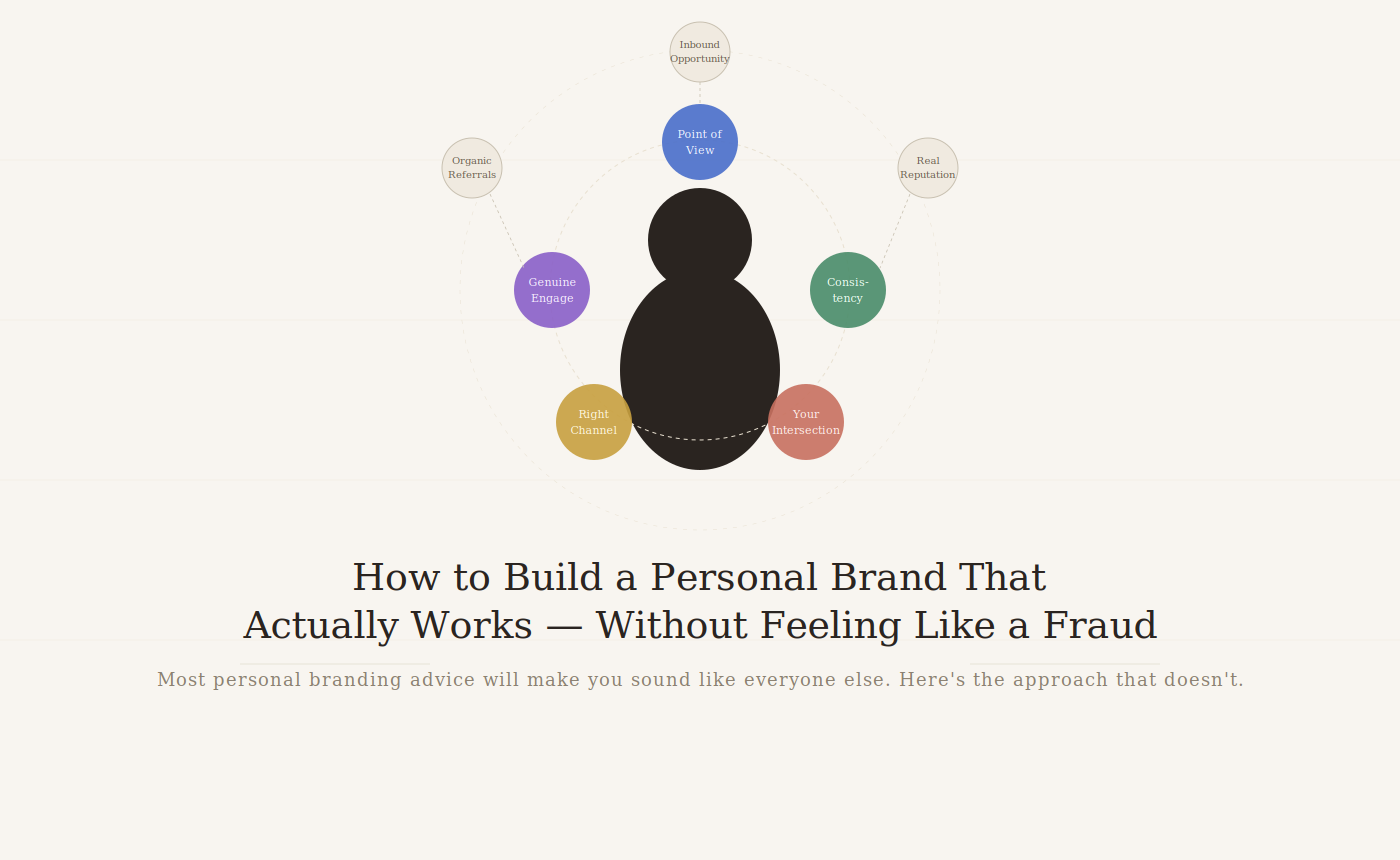
Every strong personal brand is built at an intersection — a combination of expertise, experience, and perspective that is specific enough to be distinctive.
The mistake most people make is staying in one lane. The marketing professional who only talks about marketing. The finance person who only covers finance. The content is technically credible and completely undifferentiated from the hundreds of other credible marketing or finance professionals saying similar things.
The intersection is where the differentiation lives.
What do you know about your primary domain that people in adjacent fields don’t? What does your unusual career path give you that someone who came up the conventional route doesn’t have? What industry do you come from that gives you a lens on your current work that most of your peers lack?
A product manager who spent five years as a nurse brings something to healthcare technology conversations that no one else in the room has. A marketer who started as an anthropologist sees consumer behaviour differently than one who came up through performance marketing. A founder who failed publicly and rebuilt brings a texture to conversations about resilience that someone with a clean success record simply cannot replicate.
Your intersection is the combination of things that makes your perspective genuinely irreplaceable. It is almost never just your job title. Find it. Build from there.
Step Three: Choose One Channel and Go Deep Before Going Wide
The advice to “be everywhere” is the advice that produces mediocre content everywhere and traction nowhere.
Attention is finite. The time required to produce consistently good content on one platform is already significant. Spreading that time across four platforms means producing consistently thin content on all of them — and thin content, regardless of platform, does not build reputation.
Choose one channel based on two criteria: where your target audience actually is, and where your natural communication style fits best.
If you think in long-form — if your ideas need space to breathe and develop — Medium or LinkedIn articles or a newsletter will serve you better than Twitter or short-form video. If you communicate well in conversation, a podcast or video format will be more natural than written content you’ll always feel is slightly inadequate.
The channel that fits your thinking style will produce better content with less effort. And better content with less effort is the only formula for the consistency that actually builds an audience.
Go deep on one channel until you have real traction — a growing audience, genuine engagement, content that gets shared without you promoting it. Then, and only then, consider expanding.
Step Four: Publish at the Edge of Your Comfort Zone
Safe content does not build reputations. It maintains them, sometimes. It builds them, almost never.
The content that builds a personal brand — that gets shared, cited, remembered, that makes people seek you out — is almost always the content that felt slightly risky to publish. The opinion that not everyone in your industry will agree with. The honest account of something that went wrong and what you learned from it. The contrarian take on the received wisdom of your field that you’ve been sitting on because you weren’t sure how it would land.
This does not mean being provocative for its own sake. Manufactured controversy is immediately readable as manufactured. What it means is having the specific courage to say what you actually believe, including the parts that are uncomfortable — rather than the parts that are safe.
A useful test: before you publish something, ask whether a thoughtful person in your field could disagree with it. If the answer is no — if the content is so hedged and consensus that no one could reasonably object — it is not doing the work of a personal brand. It is just adding noise.
Step Five: Engage Like a Human Being, Not a Brand
The single biggest differentiator between personal brands that build real communities and those that accumulate passive followers is how the person behind them engages with other people’s content.
Most people treat their own content as the product and everyone else’s as the distribution channel — they post their stuff, occasionally like other people’s posts, and spend the rest of their time on their own output.
The people who build genuine reputations fastest do something different. They engage substantively with other people’s ideas. They add something — a counterpoint, a connection to another concept, a specific example that extends the argument — rather than just signalling approval. They treat the comment section as a place where their thinking is visible, not just their content.
This matters because substantive engagement is visible to everyone who sees it. A genuinely insightful comment on someone else’s post reaches their entire audience. It demonstrates your thinking in a low-stakes context that is often more persuasive than your own polished content — because it’s unscripted, responsive, and direct.
Engage the way you’d want to be engaged with. Add something real. Do it consistently. The reputation compounds.
Step Six: Make It Easy for People to Understand What You Do and Who It’s For
This is the step most thoughtful people skip because it feels reductive.
You’ve developed a genuine point of view. You’ve been publishing consistently. You’re engaging with substance. And somewhere in all of that, the person who encounters your work for the first time still needs to be able to answer in ten seconds: what does this person do, who is it for, and why should I care?
This is not an elevator pitch. It is a legibility problem. And it is solved not by a tagline but by the consistency of your content — by publishing things that, across time, add up to a coherent answer to those three questions.
Audit your last ten pieces of content. Could a stranger who’d never heard of you identify your area of expertise, your perspective, and your audience from those ten pieces alone? If not — if the content is scattered across unrelated topics, or if the point of view shifts significantly from piece to piece — the brand isn’t yet coherent enough to do its job.
Focus is not a constraint on your range. It is what makes your range legible. The writer who has strong views on three connected topics is more memorable than the one who has mild views on thirty disconnected ones.
Step Seven: Measure the Right Things
Follower counts are the vanity metric of personal branding. They feel like the measure of success because they’re visible and quantifiable. They are, at best, a lagging indicator — and often an irrelevant one.
The metrics that actually tell you whether your personal brand is working are:
Inbound opportunity. Are people reaching out to you — for conversations, collaborations, introductions, clients, speaking invitations — that you didn’t have to pursue? Inbound is the signal that your brand is doing what a brand is supposed to do: making the right people aware of you and what you offer.
Quality of conversation. Are the people engaging with your content the people you want to be in conversation with? A small, high-quality audience is more valuable than a large, indifferent one — both for your reputation and for the practical opportunities it generates.
Referral without prompting. Are people forwarding your content, citing your ideas, or mentioning your name in conversations you weren’t in? Organic referral is the ultimate signal that your brand has genuine value — that people find it worth sharing without any incentive to do so.
Track these. They move more slowly than follower counts. They matter more.
The Foundation Underneath All of It
Every tactical step in this framework rests on a single foundation: having something real to say.
A personal brand is not a marketing problem. It is a clarity problem. The people who build reputations that last — that generate genuine opportunities and genuine respect — are almost always people who have developed real expertise, real opinions, and the willingness to share them honestly.
The tactics make the substance visible. They cannot substitute for it.
If you are not yet sure what you think — if your opinions feel borrowed rather than earned — the work to do first is not content strategy. It is the harder, slower work of going deep enough in something to develop views that are genuinely yours.
That work takes time. It is also the only foundation on which a personal brand worth having can be built.
Start there. Everything else follows.
메타데이터
- post_id
- efcae210cf13
- slug
- how-to-build-a-personal-brand-that-actually-works-without-feeling-like-a-fraud-efcae210cf13
- url
- https://blog.startupstash.com/how-to-build-a-personal-brand-that-actually-works-without-feeling-like-a-fraud-efcae210cf13
- canonical_url
- https://blog.startupstash.com/how-to-build-a-personal-brand-that-actually-works-without-feeling-like-a-fraud-efcae210cf13
- author_url
- https://medium.com/@kalpiprasad
- status
- ok
- fetched_at
- 2026-06-12 10:20:10