The ‘Mini Cooler’ Myth: Why Your Desktop Device Isn’t an AC (and How to Actually Stay Cool)
We’ve all seen the ads. A tiny plastic cube sitting on a desk, glowing neon blue, promising to turn a sweltering room into a walk-in…
The ‘Mini Cooler’ Myth: Why Your Desktop Device Isn’t an AC (and How to Actually Stay Cool)
We’ve all seen the ads. A tiny plastic cube sitting on a desk, glowing neon blue, promising to turn a sweltering room into a walk-in freezer for $40.
If you’ve ever bought one of these based on that promise, you were probably disappointed. You likely set it up across the room, waited for the temperature to drop 10 degrees, and when it didn’t, you threw it in the closet labeled “gimmick.”
But here’s the truth: Portable mini air coolers actually work brilliantly, if you understand the physics of how they operate. They aren’t “Mini Air Conditioners,” and using them like one is why most people fail to get results.
If you want to actually lower your personal temperature by 5 to 10 degrees this summer without spiking your electric bill, you need to change your approach.
The Science: Evaporation vs. Refrigeration
Traditional Air Conditioning (AC) uses a compressor and chemical refrigerants to pull heat out of the air and vent it outside. It is powerful, expensive, and incredibly drying to your skin and eyes.
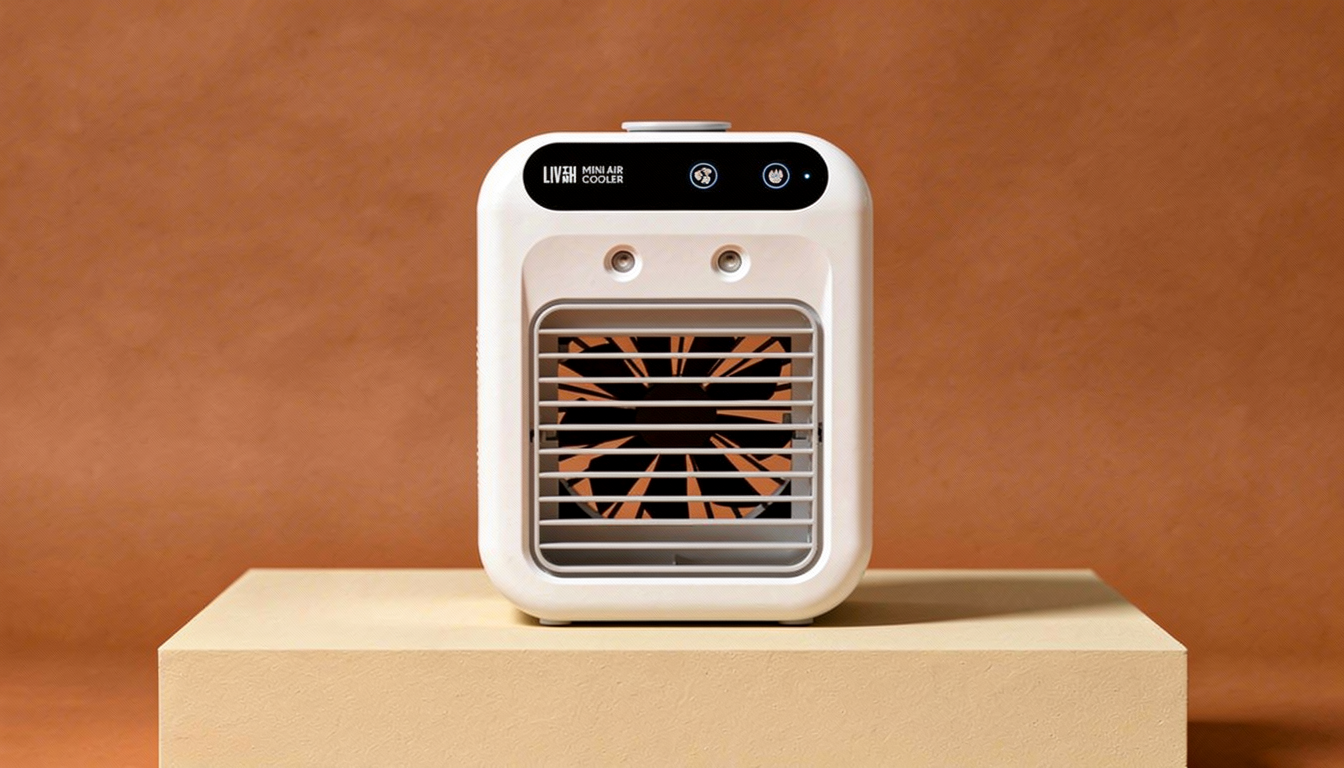
A mini air cooler, like the one from LivinH, uses evaporative cooling. It draws warm air through a wet filter; as the water evaporates, it consumes heat energy, resulting in a stream of air that is significantly cooler than the ambient room temperature.
The “Myth” is that these devices can cool an entire room. They can’t. They are designed for localized cooling. They create a “micro-climate” around your body.
How to Correctly Use a Mini Cooler for a 5-Degree Drop
To get the most out of a device like the Livinh Mini Air Cooler, you have to treat it as a personal cooling zone. Here is the blueprint for making it actually work:
1. Distance is Everything Since this isn’t a central AC unit, placement is key. For the best results, the unit should be within 3 feet of you. It’s designed for your bedside table, your office desk, or next to you on the couch. At this range, the Rapid Cooling Technology can effectively drop the temperature of the air hitting your skin before it mixes with the warmer room air.
2. Manage Humidity Evaporative coolers work best in dry or moderately humid environments. If the air is already 100% saturated with water, evaporation slows down. To combat this, I always keep a window slightly cracked or a door open to ensure fresh airflow. This prevents the room from getting “muggy” and allows the cooler to do its job.
3. Use the “Mist-Boost” Advantage Most cheap coolers just use a wet paper filter. The reason I’ve stuck with the Livinh model is their Mist-Boost humidification. Instead of just soaking a filter, it uses ultrasonic transducers to create a fine mist that significantly accelerates the heat exchange. It feels less like a fan and more like a gentle, cool breeze off a lake.
Why This is Better for Sleep and Focus
Beyond just “being cold,” there are two specific reasons to opt for a mini cooler over a loud window AC unit: Silence and Humidity.
One of the biggest complaints about portable cooling is the “jet engine” noise. If you’re trying to focus on a deep-work session or fall into REM sleep, 60 decibels of compressor noise is a dealbreaker. The Livinh unit runs at a Whisper-Quiet 20dB. To put that in perspective, that’s quieter than a library. It provides that essential “white noise” without the mechanical rattling.
Furthermore, traditional AC units strip all moisture from the air, often leading to sinus headaches, dry eyes, and “morning throat.” Because this device incorporates humidification, you wake up feeling refreshed rather than dehydrated. It’s the sweet spot for better sleep and sustained focus.
The Energy-Efficiency Reality Check
The average window AC unit pulls about 500 to 1,500 watts of power. If you run that all day, your utility provider is going to love you, but your bank account won’t.
Mini coolers are incredibly Energy-Efficient. They run on a fraction of the power, often via a simple USB connection. I’ve found that by using the LivinH unit at my desk during the day, I can keep the house thermostat set 5 degrees higher. The “house” stays warm, but “I” stay cool. It’s a surgical approach to cooling that can save you hundreds over the course of a summer.
Is It Right for You?
If you’re looking to freeze an entire 500-square-foot living room, don’t buy a mini cooler. Buy a 12,000 BTU AC unit and prepare for the electric bill.
However, if you want to stay cool while working, sleeping, or relaxing without the noise and the dry air, stop treating these devices like “cheap ACs” and start using them as personal environment stabilizers.
If you’re ready to stop sweating through your Zoom calls, I highly recommend checking out the LivinH Mini Air Cooler. It’s one of the few models that actually delivers on the “Rapid Cooling” promise through its Mist-Boost tech, and it’s been a total game-changer for my home office setup.
Stop trying to cool the whole house. Just cool yourself.
메타데이터
- post_id
- efcd9150af82
- slug
- the-mini-cooler-myth-why-your-desktop-device-isn-t-an-ac-and-how-to-actually-stay-cool-efcd9150af82
- url
- https://medium.com/@megha.rajoriya/the-mini-cooler-myth-why-your-desktop-device-isn-t-an-ac-and-how-to-actually-stay-cool-efcd9150af82
- canonical_url
- https://medium.com/@megha.rajoriya/the-mini-cooler-myth-why-your-desktop-device-isn-t-an-ac-and-how-to-actually-stay-cool-efcd9150af82
- author_url
- https://medium.com/@megha.rajoriya
- status
- ok
- fetched_at
- 2026-08-20 02:13:47