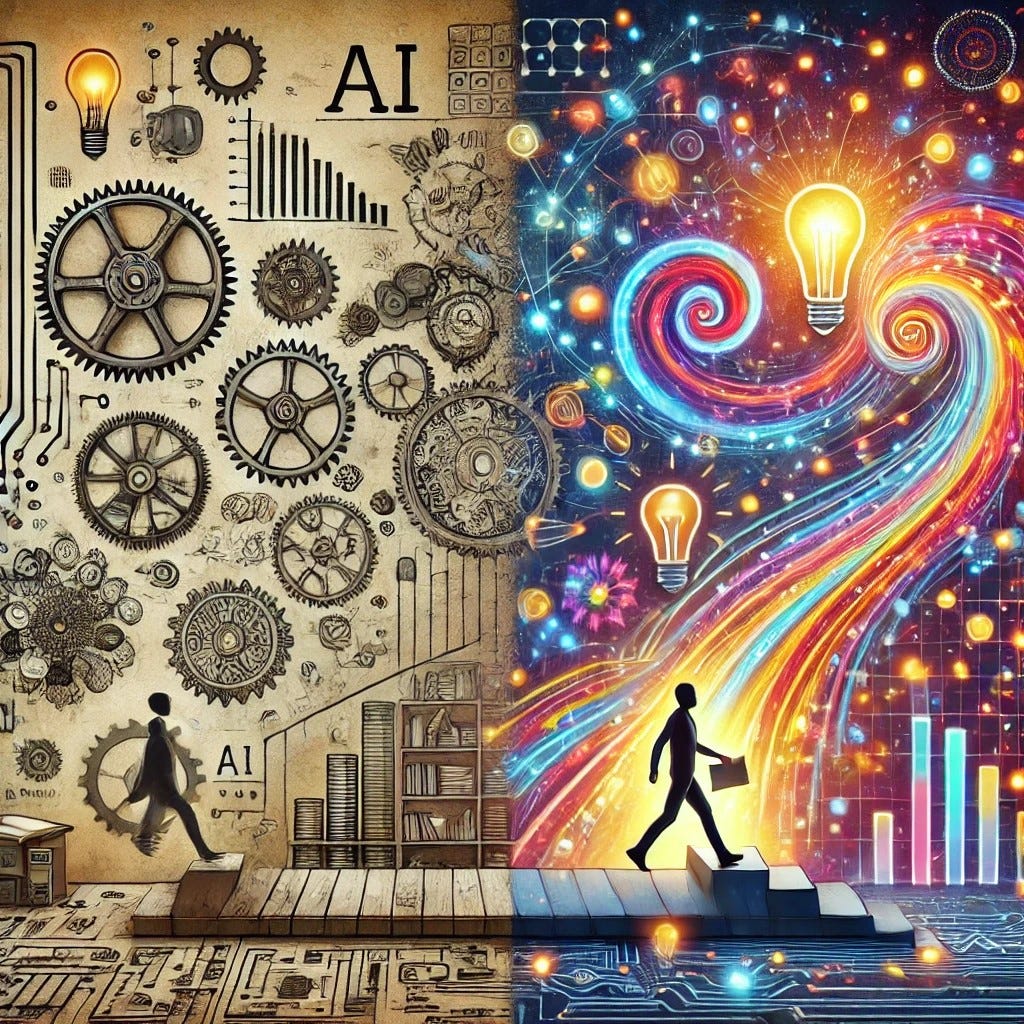
Content and Learning Are Not the Same Thing.
We got very good at building it. We are still figuring out what to do with it.
Content and Meaning Are Not the Same Thing.
We got very good at building content. But what to do with it?
1. When Education Finally Escaped the Classroom
EdTech arrived. As technology tends to do.
It found a problem. It was “access.” And Edtech solved it. Geography stopped being a barrier. Schedules became flexible. Knowledge that once lived inside institutions began to move outward. Millions who couldn’t arrive at a classroom could now open a laptop.
That was the technology doing what technology does.
But there is a distinction I keep returning to… between technology and technique. Technology arrives. Technique is built. Slowly, deliberately, through understanding what you are actually trying to do.
EdTech scaled content. And content, somewhere along the way, became the closest thing we had to a measure of learning. Not because anyone decided that. But because content was visible. Measurable. Deliverable. Learning was always harder to hold.
Expanding access changed who could learn.
It did not automatically change how learning happens.
And that gap… between content delivered and learning formed is where this reflection begins.
Expanding access changed who could learn. It did not automatically change how learning happens.
2. The MOOC Experiment
The early 2010s brought what felt, at the time, like a quiet revolution. Massive open online courses promised something that had never quite been possible before. Courses from leading universities were now available to anyone with an internet connection.
Millions enrolled. Fewer finished.
And this is not a criticism. It is an observation worth sitting with.
The technology had worked. The content had reached. But somewhere between enrolment and completion, between watching and understanding, something had not transferred. Scale had been achieved. Learning remained elusive.
Technology arrived. And as it always does… it filled the room.
MOOCs proved that education could scale. What happened after enrolment… was a different question..
3. The Rise of the Content Machine
By the late 2010s, edtech had built something genuinely impressive. With crafted video assets in collaboration with faculties and designers, platforms managed thousands of learners simultaneously. Program launches became faster, more predictable, more sophisticated.
The ecosystem had grown strong at one particular thing: producing content at scale.
And this matters, not as a limitation, but as context. Because what edtech built during this period was a foundation. Infrastructure. The body of modern digital learning. It deserves to be seen that way.
The question that was always quietly underneath — what does it mean to actually learn something? — had simply not yet found its moment.
EdTech solved for reach. And for a long time… reach was enough.
4. When Content Stopped Being the Hard Part
And then AI arrived. As technology tends to do.
Almost overnight, the thing edtech had spent a decade learning to scale, “content,” became something else entirely. Explanations, summaries, examples, quizzes, study guides. Generated within seconds. Tasks that once required weeks of development could now be produced almost instantly.
Content was no longer scarce.
It was abundant.
I read it as an invitation…
I read it as an invitation. The question that was always underneath, the one that content production kept us too busy to fully ask, has now surfaced.
If content is no longer the hard part, what is?
What determines whether learning actually happens?
When content becomes easy to generate, the challenge shifts from production to purpose.
5. The Learner Is Changing Too
The shift is not happening only on the provider side. Learners are changing and in ways that are easy to underestimate.
With AI tools, learners can now ask questions conversationally, generate explanations instantly, explore unfamiliar territory, test ideas, and summarize complex material within seconds. Knowledge is no longer encountered only through formal programs. It is increasingly explored through dialogue.
Learners arrive with different expectations now: of speed, of iteration, of autonomy. They are not just consuming knowledge. They are navigating it.
And a learner who navigates needs something different from a learner who receives. That difference is where technique becomes everything.
The AI-enabled learner is no longer just consuming knowledge. They are navigating it.
6. An Ecosystem Moving at Uneven Speeds
Not all parts of the learning ecosystem evolve at the same pace. And this unevenness is worth noticing, not with alarm, but with honesty.
AI tools advance rapidly. Learners adapt quickly. Designers and educators experiment… sometimes thoughtfully, sometimes in a hurry. Institutions and curricula move more slowly. The system is evolving, but at different speeds in different places.
Technology, as always, has arrived ahead of technique. The infrastructure is changing faster than our understanding of what to do with it.
This is not a new story. But recognizing it is the first step toward doing something about it.
The learning ecosystem is evolving at uneven speeds. Innovation often begins in moments like these.
7. When AI Starts Designing the Design
There is something worth pausing on here.
AI is not only generating content now. It is beginning to generate design artifacts, learning objectives, course outlines, activity ideas, discussion prompts, and assessment structures. For designers working under pressure, these outputs can feel immediately useful.
And this is precisely where the question of technique becomes most important.
When a plausible course structure appears instantly, it is easy to accept the first reasonable answer rather than interrogate the intent behind it. The output looks right. It may even be right. But plausibility is not the same as depth. A well-structured course is not the same as a well-designed learning experience.
The risk is not that AI will design badly.
The risk is that plausibility may begin to masquerade as depth.
A learning objective that reads well is not the same as one that was thought through. A course outline that flows is not the same as one that was designed. The output may look identical. The experience rarely is.
Functional quality is easy to recognize. Spelling. Structure. A course that opens and closes without friction. These things matter. But they are the floor, not the ceiling.
The other kind of quality… the kind that lives in intent, in order, in experience, in impact… takes longer to show up. Rarely makes it into the room where decisions are made. Not because anyone is wrong. Just because the measurable has always had a louder voice than the foundational.
8. When Tools Become Powerful, Judgment Matters More
I have always believed that technique outlasts technology and evolves with technology. Tools change. The understanding of what you are trying to do and why is what stays.
As AI grows more capable, the role of human judgment does not shrink. It becomes more visible. More consequential.
Which ideas deserve emphasis. Which sequence helps a learner make sense of complexity. Which experience moves an idea from explanation to insight. These are not questions AI can answer on its own. They require someone who understands learning, not just content.
AI can generate possibilities. Judgment decides which possibilities become learning experiences.
Technique and technology don’t take turns. They grow together.
And here is something worth sitting with… judgment is not a fixed quantity that humans bring to the table. It evolves. A designer who has worked alongside AI tools for two years develops a different quality of judgment than one who hasn’t. The environment shapes the thinking. Technology doesn’t just wait for technique to arrive… it participates in building it.
Which means the relationship between technology and technique is not a handoff. It is a conversation that continues.
9. Where Judgment Comes From
Judgment does not come from tools. It never has.
It develops through understanding how people actually learn… not in theory, but in practice. Through recognizing context. Through noticing where learners struggle, where they disengage, where something clicks. Through asking better questions before accepting easy answers.
It grows from inquiry. From experience. From the slow, patient work of observing how understanding forms.
And increasingly… from working inside the technological environment itself. Context changes what we notice. A new tool surfaces a question that didn’t exist before it arrived. Judgment, in this sense, is not just brought to the work. It is built by it.
AI can suggest structures. But the ability to see what matters for learning… that still comes from somewhere deeper. From the human being who cares enough to ask.
Judgment accumulates before the tool arrives. And keeps accumulating long after.
10. The Question Underneath
Before the content. Before the course structure. Before the objectives were written… there was always a question that belonged to both the learner and the business.
What must be different, after this?
Not different in theory. Different in practice. Different in decision. Different in result.
What must the learner be able to do differently by the end of this experience? Where might confusion appear? What activity could move an idea from explanation to insight?
These questions did not arrive with AI. They were always there… underneath the content, underneath the timelines, underneath the production schedules. Most often skipped, not out of carelessness, but because content is easier to count than to express.
These are not content questions. They are technique questions. And they are the ones that determine whether a learning experience leaves something behind… or simply passes through.
And perhaps that is the real opportunity at this moment… not the choice to build faster, but to ask where content begins to deliver meaning.
In this sense, the work of understanding what a learner needs, and what a business demands, is the R&D of the learning ecosystem. The place where new ways of helping people learn are explored, tested, and refined. It is quiet work. It does not always announce itself. But it is where the real frontier lives.
Content is sometimes easier to count than to express. The real work begins where counting stops.
Every industry that sustains itself through change invests in what it does not yet know.
The learning ecosystem is no different. Or rather… it shouldn’t be.
Most innovation in edtech has been production innovation. Faster content. Better interfaces. More elegant delivery. These matter. But they are the surface.
Underneath… the questions that determine whether learning actually happens rarely receive the same investment. Not because no one cares. But because their returns are slower. Harder to see. And almost impossible to column in a quarterly report.
R&D in a learning ecosystem asks differently. Not how do we build this faster… but does this actually change how people think? Not how do we scale this… but what do we know now that we didn’t before we ran it?
These are not soft questions. They are the most rigorous ones in the room.
AI may be the most powerful R&D instrument the learning ecosystem has ever had access to. The ability to test, iterate, and observe at scale means the gap between a question and an answer has never been smaller.
But only if someone is asking the right questions.
Which returns us, always, to technique.
The instrument has never been more powerful. The question is whether we know what to ask of it.
11. The Next Phase of EdTech
The first phase of EdTech solved the access problem. It built the infrastructure that allowed learning to travel. That was the technology doing its work… and it did it well.
The next phase, i believe, belongs to technique.
Not simply building more courses. But asking, more carefully and more consistently, what learning actually requires. How experiences can help learners question, apply, discuss, and internalize ideas… not just encounter them.
AI, in this phase, is the arriving technology. What directs it… is technique.
The next frontier may not be more content. It may be understanding what to do with it.
12. Returning to the Question
EdTech built the body of modern digital learning. AI is reshaping the environment in which that system operates and flowing through it as a powerful new capability.
As both forces grow stronger, the ecosystem has an opportunity. Not to panic, and not to simply automate what already exists. But to finally, seriously, turn its attention to the question that was always there.
Content can now be generated almost effortlessly. But learning still requires intent. Still requires design. Still requires a human being who understands what it means to help another human being grow.
Technology will keep arriving. It always does.
The question is whether the technique will be ready to meet it.
And this, perhaps, is not a question for edtech alone. Anywhere content is made at scale… in marketing, in journalism, in leadership… the same gap lives. Between what is produced and what is understood. Between what is delivered and what remains.
When content becomes abundant, meaning becomes the real frontier.

The form was never in the material.
Anyone can shape the clay. Not everyone knows what they are making.
메타데이터
- post_id
- efd7bf1d8e8e
- slug
- content-and-learning-are-not-the-same-thing-efd7bf1d8e8e
- url
- https://medium.com/technique-and-passion-navigating-learning-design/content-and-learning-are-not-the-same-thing-efd7bf1d8e8e
- canonical_url
- https://medium.com/technique-and-passion-navigating-learning-design/content-and-learning-are-not-the-same-thing-efd7bf1d8e8e
- author_url
- https://medium.com/@anshula2007
- status
- ok
- fetched_at
- 2026-06-16 19:09:56