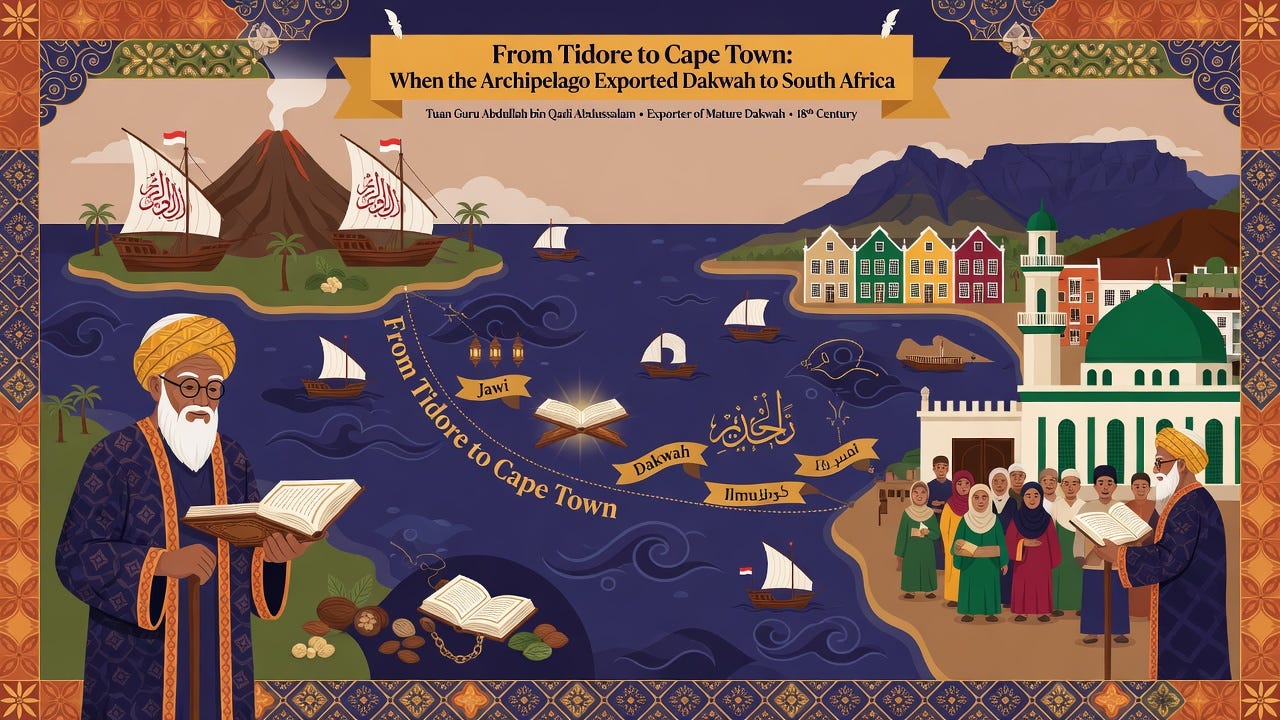
From Tidore to Cape Town: When the Archipelago Exported Dakwah to South Africa
The story of Tuan Guru Abdullah bin Qadi Abdussalam proves that the Indonesia was not merely a recipient of Islam — but an exporter of a…
From Tidore to Cape Town:
When the Archipelago Exported Dakwah to South Africa
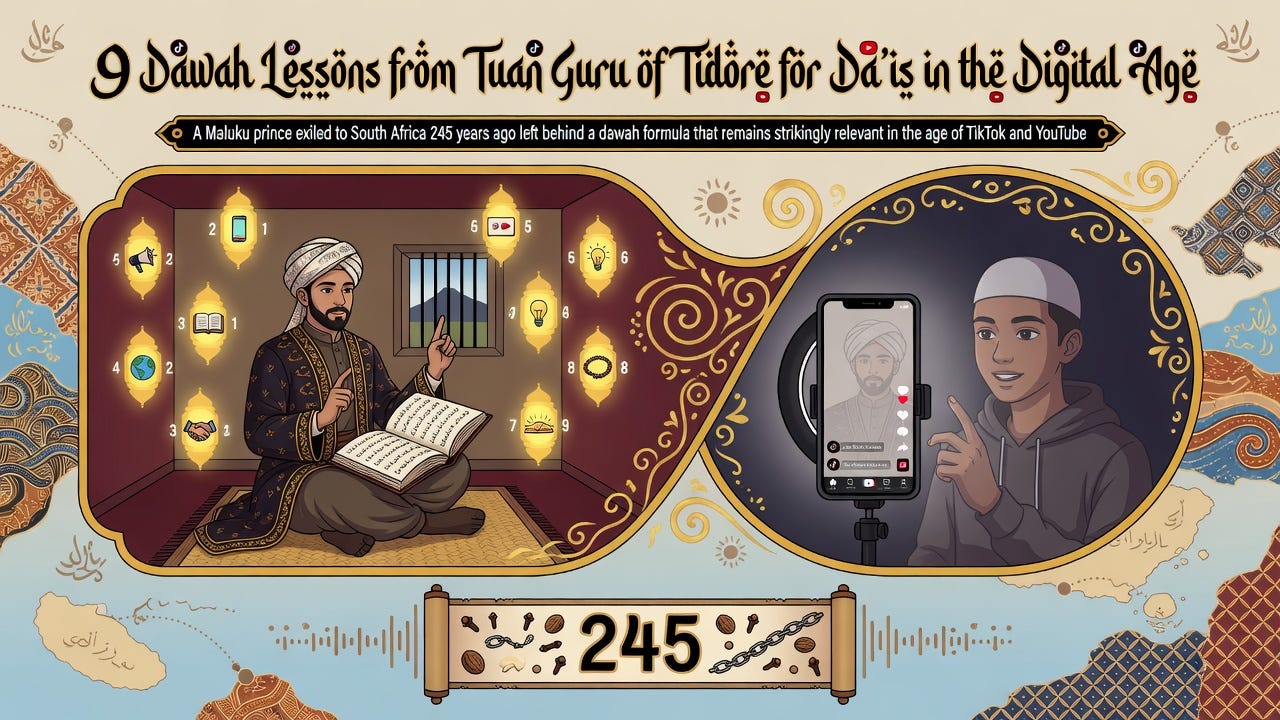
The story of Tuan Guru Abdullah bin Qadi Abdussalam proves that the Indonesia was not merely a recipient of Islam — but an exporter of a mature dakwah system refined over four centuries.
A Historical Misconception That Needs Correcting
There is a narrative we have long accepted without question: that Islam in the Indonesia was always a “product” of dakwah that came from elsewhere — from Arabia, from India, from Gujarat. Within this framework, the Archipelago is always the endpoint, the place where Islam “arrived,” never the point of departure.
But there is one story that flips this narrative entirely. The story of a prince from Tidore who, at the end of the 18th century, was exiled by the Dutch East India Company (VOC) to Cape Town, South Africa — and there laid the foundation of a Muslim community that today numbers in the hundreds of thousands.
His name was Tuan Guru Abdullah bin Qadi Abdussalam. In South Africa, he is recognized as the Father of Islam in South Africa. In Indonesia itself — the land of his birth — his story is almost never taught.
This article traces Tuan Guru’s scholarly lineage, educational background, and dakwah legacy as evidence that the Indonesia was once an EXPORTER of dakwah to the world.
Tidore in the 18th Century: Far from an Isolated Island
The first step to understanding Tuan Guru is to correct the misleading impression of Tidore. Modern readers often imagine this sultanate as a small, remote island at the eastern edge of the Archipelago.
The reality was very different. According to the Journal of Al-Tamaddun, an academic journal published by the University of Malaya in 2026, Tidore was a spatial arena for cultural crossroads — where Iberians, Arabs, Chinese, Malays, and Javanese converged. Their encounters produced Arabic, Portuguese, and Dutch loanwords in the Malay-Tidorese language, as well as hybrid cuisine and mixed architecture [1].
And Islam in Tidore was no marginal faith. Historical records show that, despite the island spanning only a few miles, by the 18th century Tidore already had 25 mosques [2]. This was an extraordinarily mature density of Islamic infrastructure — indicating that religious life there had been thriving for centuries before Tuan Guru was even born.
The Hadrami Connection: From Hadramaut to Cirebon to Tidore
The key to understanding the depth of Tuan Guru’s scholarship lies in his family lineage. His grandfather was Habib Umar Rahmat al-Faruq.
All three names are significant: Habib is an honorific title reserved for descendants of the Prophet Muhammad ﷺ from the Alawiyyin line; al-Faruq is a laqab (epithet) commonly used within certain Sayyid families; and Rahmat is a name frequently found in the Ba’Alawi network from Hadramaut, Yemen.
According to research published by the National Awqaf Foundation of South Africa in 2018, Habib Umar al-Faruq sailed from Cirebon to the Maluku Islands in 1646 to spread Islam, then settled in Tidore and became part of the Sultan’s royal household [3].
Take note: Cirebon. Not directly from Hadramaut, but from Cirebon — the centre of Sunan Gunung Jati’s dakwah, one of the legendary Walisongo (Nine Saints) who was himself of Hadrami descent. This means Tuan Guru’s family was part of the Walisongo dakwah network, in the most literal sense.
The journal Epistemé (2019) explains the classic pattern of Hadrami Sayyids in the Archipelago. The Alawiyyah order was adopted by many Alawiyyin, and the closeness of the Shafi’i school with Alawiyyin traditions influenced Islamic dakwah throughout the Archipelago by the Hadrami Alawiyyin [4]. They would arrive, marry daughters of the local nobility, and assimilate as qadis, muftis, or court advisors.
And this is precisely what happened in Tuan Guru’s family:
• His grandfather, Habib Umar, married into the Tidorese court and entered the palace.
• His father, Qadi Abdussalam, became the royal religious judge.
• His mother, Boki Nuriniyah, was a princess of the palace.
• Tuan Guru was born as a Sayyid descendant, son of a qadi, and grandson of palace nobility.
In other words, Tuan Guru was the mature product of a dakwah system that had been operating for four centuries — from Yemen to Java to Maluku. He was not an anomaly. He was the blueprint.
Four Pillars of Islamic Education in Tidore
According to the journal Aufklärung (2025), which studied educational institutions in the Islamic Sultanates of North Maluku, Tidore’s education system stood on four pillars: the mosque as the centre of learning; the majelis taklim (study circle) as a hub for adult and royal elite religious study; palace-based education exclusively for princes and nobles; and the Sufi orders (tarekat and tasawuf) [5].
Tuan Guru was trained through all four pathways simultaneously. His position was unique: the son of a qadi, the grandson of a Habib, and the child of palace nobility. No door to Islamic knowledge in Tidore was closed to him.
The results of this education became evident through his intellectual output later in life. Three facts demonstrate the depth of his scholarship:
First, he was a hafiz of the Qur’an. This was proven when, imprisoned without access to a single copy of the Qur’an, he was able to write out the entire 30 juz (parts) from memory.
Second, he had mastered three scholarly languages: Classical Arabic, High Malay, and Portuguese. His monumental text was written in Arabic script using both Malay and Portuguese — a linguistic capability on par with cosmopolitan scholars of the Middle East.
Third, he had mastered the Shafi’i school in fiqh (jurisprudence) and the Ash’ari school in aqidah (creed). In his own book, written in 1781, he declared himself a Shafi’i in ritual practice and an Ash’ari in dogmatics [6] — a scholarly position entirely consistent with the classical Sunni tradition of the Indonesia.
The Exile
In 1779, the VOC arrested Sultan Jamaluddin of Tidore for refusing to submit to the Dutch trade monopoly. In the same operation, his court circle was also seized. Tuan Guru — then serving as the Sultan’s religious advisor — was captured along with three others: Callie Abdol Rauf, Noro Iman, and Badrodien [7].
On 6 April 1780, the VOC ship De Zeepard docked at Cape Town, South Africa, carrying Tuan Guru, then 68 years old. They were immediately imprisoned on Robben Island — the harshest isolation prison the VOC possessed at the southern tip of Africa [8].
The choice of Cape Town was no accident. The VOC calculated that at a distance of 10,000 kilometres from the Archipelago, an elderly prisoner would be unable to build any influence whatsoever. They failed to account for one thing: Tuan Guru carried the entire intellectual infrastructure of the Archipelago inside his mind.
Thirteen Years of Productivity in Prison
From 1780 to 1793 — thirteen years on Robben Island — Tuan Guru accomplished feats that made the VOC regret choosing Cape Town as his place of exile. According to biographer Shafiq Morton in From the Spice Islands to Cape Town (Awqaf SA, 2018), one of the reasons he wrote the Qur’an was to lift the spirits of the slaves around him [9].
During those years in prison, he completed three monumental projects:
• Five complete handwritten copies of the Qur’an, written entirely from memory. One copy is still preserved at the Auwal Mosque in Cape Town to this day, regarded as the most precious Islamic artefact in South Africa.
• The Ma’rifah al-Islam wa al-Iman, a 613-page treatise on Shafi’i jurisprudence and Ash’ari creed that would serve as the primary reference for the Cape Muslim community for over 100 years.
• An unofficial madrasah within the prison itself — where he taught fellow prisoners the fundamentals of Islam.
The First Madrasah and Mosque in South Africa
In 1793, after 13 years of imprisonment, Tuan Guru was finally released. He was 81 years old. And it was at that age that his life’s true mission began. According to the official Auwal Mosque website, Imam Abdullah’s first concern upon being freed was to establish a madrasah [10].
He founded a madrasah in a warehouse belonging to Coridon of Ceylon, a former slave, on Dorp Street in Bo-Kaap. This was the first madrasah ever established in South Africa [10]. His students: slaves, former slaves, and free people of colour.
In 1794, after the British temporarily seized the Cape from the Dutch, the warehouse madrasah was converted into the Auwal Mosque — the First Mosque in South Africa. According to the official Wikipedia entry for Auwal Mosque, it was built in 1794 during the first British occupation of the Cape [11].
By 1807, the year Tuan Guru passed away at the age of 95, the madrasah had no fewer than 375 students — so many that the British authorities themselves grew concerned about his influence [12].
Legacy: Recognition from South African Society
The impact of Tuan Guru’s dakwah extends far beyond the Muslim community — reaching into the national identity of South Africa as a whole.
Linguistically, according to research by Achmat Davids published in Mail & Guardian in 2024, the most significant discovery in the recently uncovered history of Afrikaans is that the very first writing of the language was in Arabic script [13]. This means that the national language of South Africa owes a debt to the literary tradition that began in Tuan Guru’s madrasah.
From the small community he pioneered, the Muslim population of Cape Town now stands at approximately 5% of the city’s estimated 4.6 million residents [14]. And around 166,000 people identify as Cape Malay — descendants of the community that Tuan Guru helped shape.
Politically, the tradition of resistance that he began on Robben Island was carried forward by anti-apartheid figures such as Imam Abdullah Haron and Imam Achmad Cassiem. And Nelson Mandela himself — when imprisoned on the very same island as Tuan Guru — studied Islam [15] and visited Tuan Guru’s kramat (sacred shrine) in 1977.
Closing: Restoring the Archipelago’s Place in the History of Dakwah
The story of Tuan Guru compels us to update our framework. For too long, we have been raised with the narrative that the Indonesia was merely the final terminal of global dakwah. Islam arrived in Aceh, then spread to Java, to Maluku. End of story.
Tuan Guru shows us the opposite: the Archipelago was an EXPORTER. The educational system built by the Walisongo, the Hadrami-Archipelago dakwah model refined over 400 years, the scholarly depth cultivated in Malay royal courts — all of this was carried by Tuan Guru to the southern tip of Africa, where it gave birth to a new civilisation.
Allah Ta’ala says in Surah Ali ‘Imran, verse 110:
“You are the best nation produced for mankind. You enjoin what is right and forbid what is wrong and believe in Allah.”
This verse defines the best nation not by numbers or wealth, but by dakwah — calling to good and preventing evil. Tuan Guru embodied this verse not only for the Cape Muslim community — he embodied it for the whole of South African society. Even non-Muslims today enjoy the fruits of his dakwah: the Afrikaans language he helped shape, the national cuisine born from Cape Muslim kitchens, and the moral tradition of anti-oppression that became the foundation of the anti-apartheid struggle.
That is the standard of true dakwah. Not merely creating an isolated Muslim community — but becoming a mercy to all of creation.
May Allah bestow His mercy upon Tuan Guru Abdullah bin Qadi Abdussalam. And may his story awaken us, the people of the Archipelago, to the extraordinary legacy we carry.
Call to Action
This article is part of the Islam Digital Nusantara project, dedicated to uncovering and sharing the history of Islamic dakwah across the Indonesia for a global audience. For further discussion, join our Telegram community at t.me/islamdigitalnusantara. Watch the full video on the YouTube channel @islamdigitalnusantara.
Citations
[1] Wijaya, D. N., et al. (2026). “Pluralistic Religious Societies and Cultural Crossroads in the Early Modern Sultanate of Tidore, Indonesia”. Journal of Al-Tamaddun, 21(1), 107–125. University of Malaya. URL: https://ejournal.um.edu.my/index.php/JAT/article/view/56623 Quotation: “Their encounter created the Arabic, Portuguese, and Dutch loanwords in the Malay-Tidorese language; the hybrid cuisine of hula-keta (baked sago); and the material culture of the Tidorese palace of Kadato Kie and the Iberian forts of Tahula and Torre.”
[2] Tana Baru Cemetery — official website of the Cape Muslim burial complex. URL: http://tanabaru.co.za/tuan-guru/ Quotation: “He was a Prince from Tidore, a small island in eastern Indonesia. Despite only being a few miles in extent, the island already had 25 mosques in the 18th century.”
[3] National Awqaf Foundation of South Africa (Awqaf SA). (2018). “From the Spice Islands to Cape Town: The Life and Times of Tuan Guru” by Shafiq Morton. URL: https://awqafsa.org.za/from-the-spice-islands-to-cape-town-the-life-and-times-of-tuan-guru/ Quotation: “It is from Cirebon that Tuan Guru’s grandfather, Habib ‘Umar Rahmat al-Faruq, travelled to the Moluccan chain in 1646 to spread Islam. He settled on the island of Tidore, becoming a member of the Sultan’s royal household.”
[4] Subchi, Imam. (2019). “The History of Hadrami Arabic Community Development in Southeast Asia”. Epistemé: Jurnal Pengembangan Ilmu Keislaman, 14(2), 229–256. URL: https://pdfs.semanticscholar.org/4827/9023a12b8e387cb8a30cd8144a39c0bdc7c0.pdf Quotation: “Tarekat Alawiyyah which is adopted by many Alawiyyin. The closeness of these two mazhab seems to have influenced the Islamic da’wah in the Nusantara by the Alawiyyin Hadrami.”
[5] Aufklärung: Jurnal Sejarah dan Peradaban Islam, Volume 1, Nomor 01, 2025. “Lembaga dan Tokohnya dalam Kerajaan Islam Ternate, Tidore, Bacan, dan Jailolo”. URL: https://ejournal.kabarmoe.com/index.php/AUFKLARUNG/article/download/37/36 Quotation: “Pendidikan Islam pada masa Kesultanan Tidore berlangsung dalam bentuk yang sama dengan kerajaan Ternate yaitu; Masjid sebagai pusat pendidikan; majelis taklim sebagai pusat kajian agama untuk orang dewasa dan elite kerajaan, Pendidikan di lingkungan istana… serta Tarekat dan Tasawuf.”
[6] Marasabessy, Bunyamin. (2004). “Tuan Guru: The Cape Muslim Philosophy Education System”. MAKARA, Sosial Humaniora, Volume 8, Nomor 3, December 2004, pp. 126–132. Universitas Indonesia. URL: https://scholarhub.ui.ac.id/cgi/viewcontent.cgi?article=1266&context=hubsasia Quotation: “In this book, Tuan Guru declares that he is a Shafi’i in theology and an Ash’ari in dogmatics. By this he implied that in ritual practice (Fiqh or jurisprudence), he was a follower of Imam Shafi, one of the four imams of the Ahli Sunni wa al-jamaah or Traditionalists.”
[7] Wikipedia. “Tuan Guru Abdullah bin Qadhi Abdussalam” (Indonesian Wikipedia). URL: https://id.wikipedia.org/wiki/Tuan_Guru_Abdullah_bin_Qadhi_Abdussalam Quotation: “Tatkala sudah transit di Ternate, Abdullah muda dibawa ke Batavia untuk menjalani peradilan. Hasilnya, hukuman berat dijatuhkan atasnya, ia dibuang (dipenjara) ke Cape Town. Pada 6 April 1780, ia tiba di Cape Town, Afrika Selatan dengan kapal VOC Zeepard.”
[8] Mosques of the World. (2026). “Auwal Mosque in Cape Town, South Africa”. URL: https://www.mosquesofthe.world/mosques/auwal-cape-town Quotation: “He arrived aboard the Zeepard on April 6, 1780, with three other political prisoners. Colonial ‘Bandieten Rollen’ (Bandit Rolls) records accused them of conspiring politically with the English in the East Indies. Robben Island, the windswept prison where authorities held these men, became central to the imam’s legacy.”
[9] About Islam. (2023). “How Cape Town Muslims Saved South Africa’s Oldest Qur’an”. URL: https://aboutislam.net/muslim-issues/world/how-cape-town-muslims-saved-south-africas-oldest-quran/ Quotation: “I believe one of the reasons he wrote the Qur’an was to lift the spirits of the slaves around him. He realized that if he were to write a copy of the Qur’an he could educate his people from it and teach them dignity at the same time. — Shafiq Morton”
[10] Auwal Masjid — official website. (2015). “Tuan Guru”. URL: https://www.auwalmasjid.co.za/index.php/tuan-guru/ Quotation: “Imam ‘Abdullah’s first concern on being released from prison was the establishment of a madrasah [religious school] at the Cape… Such a madrasah was soon established and operated from a warehouse attached to the home of Coridon of Ceylon in Dorp Street. This was the first madrasah to be established in this country.”
[11] Wikipedia. “Auwal Mosque”. URL: https://en.wikipedia.org/wiki/Auwal_Mosque Quotation: “The Auwal Mosque… was completed in 1794 and was the first mosque established in South Africa. It was constructed in 1794 during the first British occupation of the Cape.”
[12] Tana Baru Cemetery. URL: http://tanabaru.co.za/tuan-guru/ Quotation: “In 1807, the year of Tuan Guru’s death, the school had no less than 375 students and the presence of such a strong Muslim educational institute was of great concern to the British authorities.”
[13] Mail & Guardian. (2024). “The Islamic roots of Afrikaans” by Niren Tolsi. 27 March 2024. URL: https://mg.co.za/friday/2024-03-27-the-islamic-roots-of-afrikaans/ Quotation: “The most important part of the uncovered history of Afrikaans is this discovery that the very first writing of the language was in Arabic.”
[14] About Islam. (2023). “How Cape Town Muslims Saved South Africa’s Oldest Qur’an”. URL: https://aboutislam.net/muslim-issues/world/how-cape-town-muslims-saved-south-africas-oldest-quran/ Quotation: “Muslims now make up around 5% of Cape Town’s estimated population of 4.6 million.”
[15] Wikipedia. “Nelson Mandela”. URL: https://en.wikipedia.org/wiki/Nelson_Mandela Quotation: “Though attending Christian Sunday services, Mandela studied Islam. He also studied Afrikaans, hoping to build a mutual respect with the warders and convert them to his cause.”
메타데이터
- post_id
- f000f8fd39ff
- slug
- from-tidore-to-cape-town-when-the-archipelago-exported-dakwah-to-south-africa-f000f8fd39ff
- url
- https://medium.com/@islamdigitalnusantara/from-tidore-to-cape-town-when-the-archipelago-exported-dakwah-to-south-africa-f000f8fd39ff
- canonical_url
- https://medium.com/@islamdigitalnusantara/from-tidore-to-cape-town-when-the-archipelago-exported-dakwah-to-south-africa-f000f8fd39ff
- author_url
- https://medium.com/@islamdigitalnusantara
- status
- ok
- fetched_at
- 2026-07-10 10:46:47