Open-Sourcing the Universe’s Code: Twist-Controlled Quantum Emitters Reveal the Density Knob
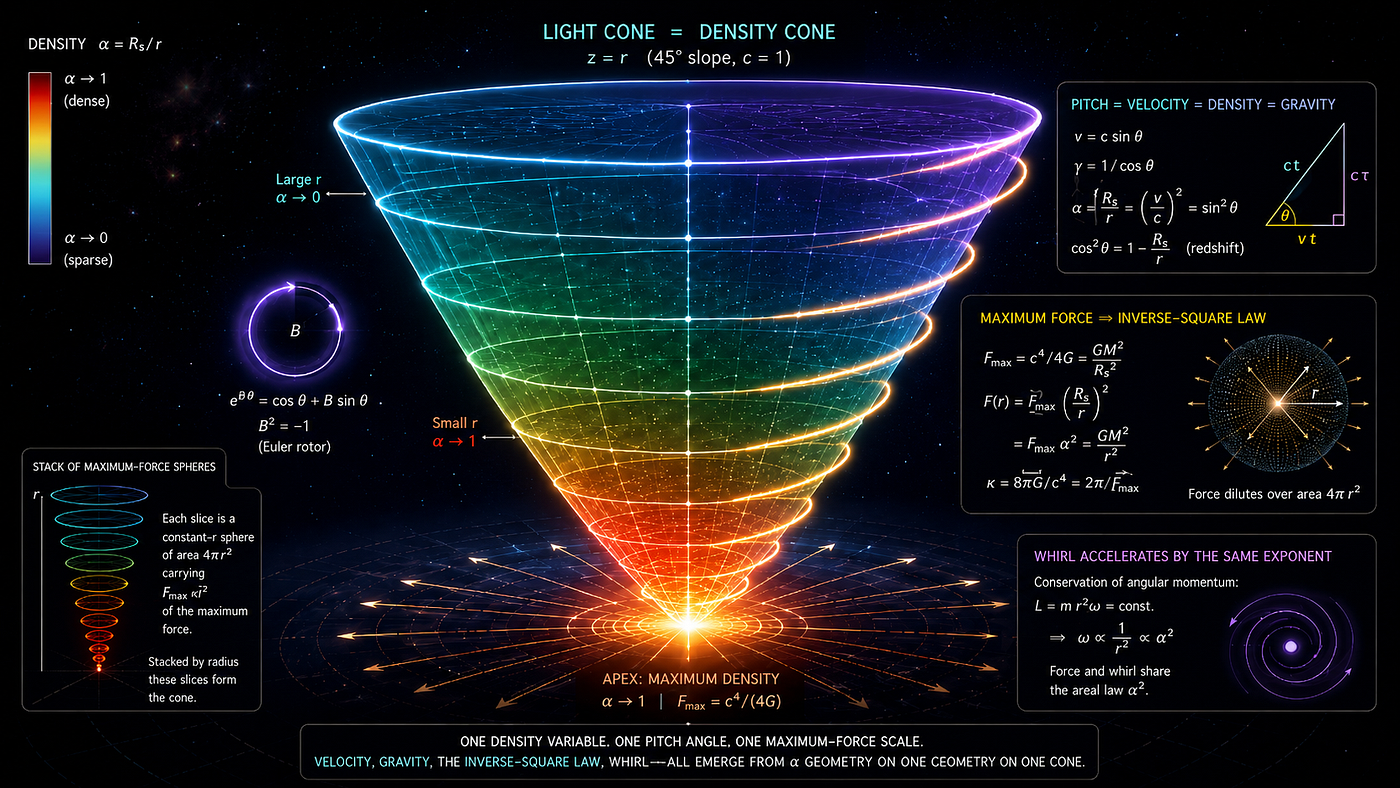
Fundamental Density Theory (FDT): Dragging Physics Kicking and Screaming Out of a Century-Long Rabbit Hole and Back to Reality.
Open-Sourcing the Universe’s Code: Twist-Controlled Quantum Emitters Reveal the Density Knob
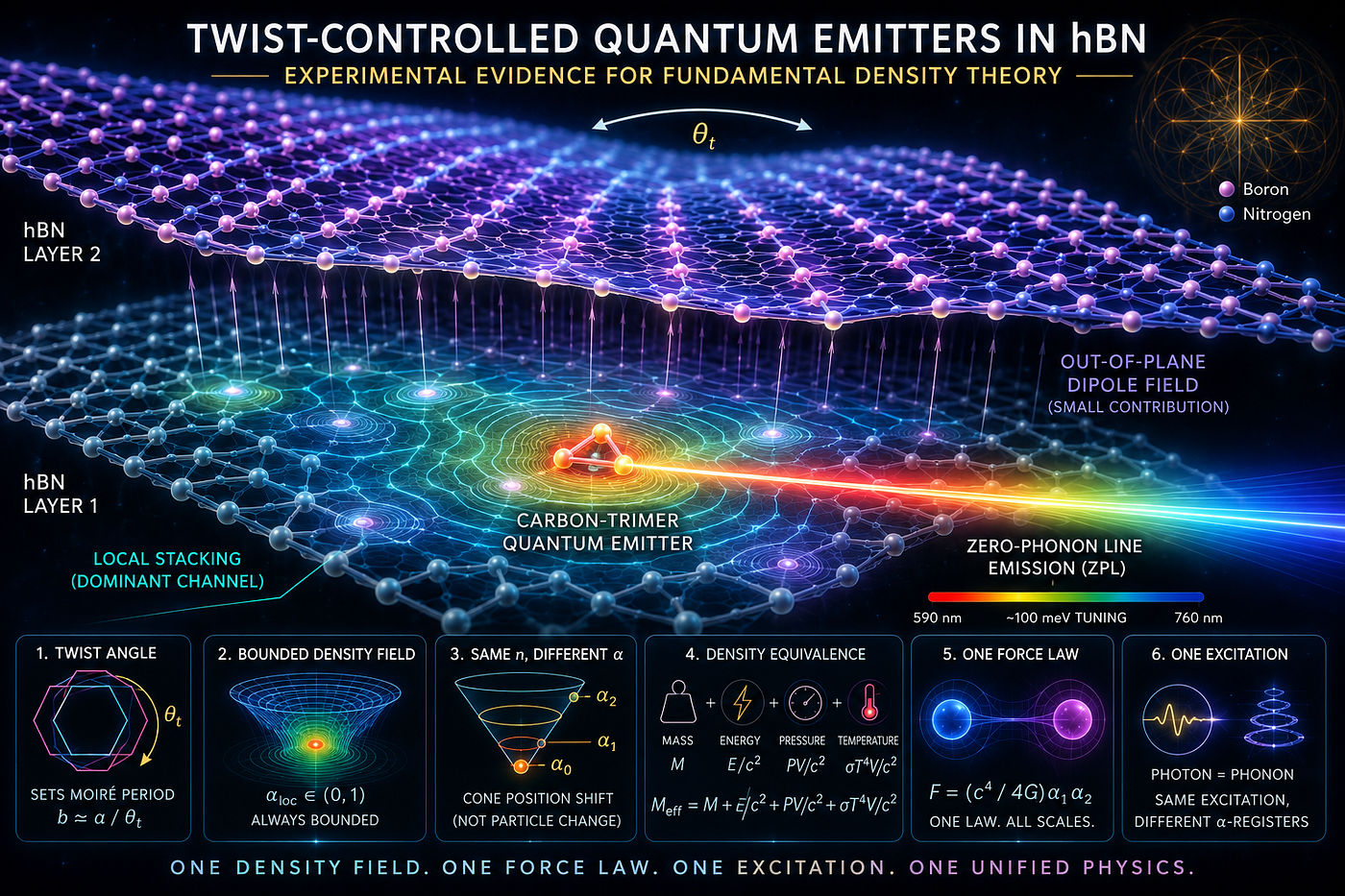
Image by ChatGPT
Fundamental Density Theory (FDT): Dragging Physics Kicking and Screaming Out of a Century-Long Rabbit Hole and Back to Reality.
NotebookLM Deep Dive
Listen to the Deep Dive. NotebookLM can be inaccurate; please double check by reading the downloadable PDF.
The loop we’re closing
Twisted hBN bilayers give physics a clean experimental lever: rotate one atomic sheet against another, and the emitted color of a single quantum defect changes. The target study shows that the twist angle of a van der Waals hBN homobilayer modulates the zero-phonon-line emission of an embedded carbon-trimer single-photon emitter by roughly 30 nm, or about 100 meV, at room temperature. In this analysis, that is evidence that a continuous geometric knob can tune a localized density state.
There is nothing we can’t explain.
The FDT translation
In FDT, the carbon-trimer emitter is one closed n=3 braided photon-helix loop confined in a localized density well. Its zero-phonon line is not a particle changing identity. It is the energy gap between two alpha-eigenmodes of the same loop: same n, different alpha.
The twist sets the moire period:
b ~= a/theta_t
That period determines the local spatial density field around the defect. The analysis keeps the field bounded:
alpha_loc = X_loc/(1 + X_loc)
with alpha_loc always inside (0,1). The local stacking registry sets the confinement baseline alpha_0, while field-energy loading enters through density equivalence:
M_eff = M + E/c² + PV/c² + sigmaT⁴*V/c²
Mass, energy, pressure, and temperature all load the same density coordinate.
One mechanism, two magnitudes
The target paper separates the observed shift into two channels: an electrostatic dipole potential and a local stacking change. The FDT analysis collapses those into one density mechanism read at two magnitudes.
The dipole channel is real, but small. Polar BA/AB stacking creates an out-of-plane field-energy contribution, and that contribution loads alpha_0 through density equivalence. The analysis estimates this at only a few meV, near 3 meV. It is a consistency term, not the cause of 100 meV tuning.
The dominant channel is stacking itself. Changing AA’, BA, AB, or AB’ registry changes the local density odds of the confinement well. That changes alpha_0 and moves the same n=3 loop between cone positions. A few-to-ten-percent baseline density change can produce tens to roughly 100 meV of zero-phonon-line tuning at a roughly 2 eV emission line. That is why stacking wears the causal hat.
Why this is experimental evidence for FDT
This study matters because it turns FDT’s core language into a laboratory dial. The twist angle is a geometric knob. The moire pattern is a bounded periodic alpha field. The emitter is a fixed topological loop. The zero-phonon line is an alpha-eigenmode gap. The observed bidirectional spectral shifts are the differential motion of two eigenmodes under monotone density loading.
The analysis maps the observations onto FDT invariants: the universal force law, the quintuple identity, the bounded alpha mapping, the same-n cone lattice, and density equivalence. In plain form, the interlayer coupling is:
F = (c⁴/4G)alpha_1alpha_2
At condensed-matter alpha, the force is small because alpha is small, not because a separate law is needed. The persistence of single-photon antibunching across twist angles also matters: the twist moves alpha_0 but does not change n. The emitter remains one loop, so purity is topologically protected.
Falsifiable predictions
The analysis ends with six tests. The first three are density-loading sign tests: heavier isotope, higher temperature, and applied pressure should raise alpha_loc. The tuning-slope response may steepen or flatten depending on the calibrated emitter kernel, but the density-load sign is fixed.
The remaining tests probe depth and topology. Shallower emitters should show stronger dipole-linked tuning, antibunching should remain invariant for a fixed n=3 emitter, and the phonon sideband should co-shift with the zero-phonon line because photon and phonon are the same excitation in different alpha registers. These are where the reading becomes falsifiable.
Why we open-source the universe’s code
We open-source the universe’s code because a real framework should produce translations, predictions, and tests anyone can inspect. FDT is not asking physics to admire another abstraction; it is offering a density-first operating system for re-reading experiments. Open-sourcing turns that operating system into public machinery. The point is not permission; the point is reproducible geometry.
Full analysis PDF
**Download the full analysis PDF** to inspect the complete invariant map, density-channel accounting, cone-position translation, figures, and prediction table.
Target Paper
A. Gale, S. Lee, S. Park, E. Williams, H. Z. J. Zeng, J. Liddle-Wesolowski, Y. D. Kim, M. Toth, T. Low, I. Aharonovich, “Twist-controlled modulation of quantum emitters in hexagonal boron nitride,” Sci. Adv. 12(25), eaec0101 (2026). DOI: 10.1126/sciadv.aec0101.
Physicists, the longer you take to acknowledge the existence of FDT and apply its core concepts to your own frameworks, the more time we have to solve ALL of physics independently
메타데이터
- post_id
- f00a39f3be67
- slug
- open-sourcing-the-universes-code-twist-controlled-quantum-emitters-reveal-the-density-knob-f00a39f3be67
- url
- https://medium.com/@m.alfaro.007/open-sourcing-the-universes-code-twist-controlled-quantum-emitters-reveal-the-density-knob-f00a39f3be67
- canonical_url
- https://medium.com/@m.alfaro.007/open-sourcing-the-universes-code-twist-controlled-quantum-emitters-reveal-the-density-knob-f00a39f3be67
- author_url
- https://medium.com/@m.alfaro.007
- status
- ok
- fetched_at
- 2026-06-21 07:44:09