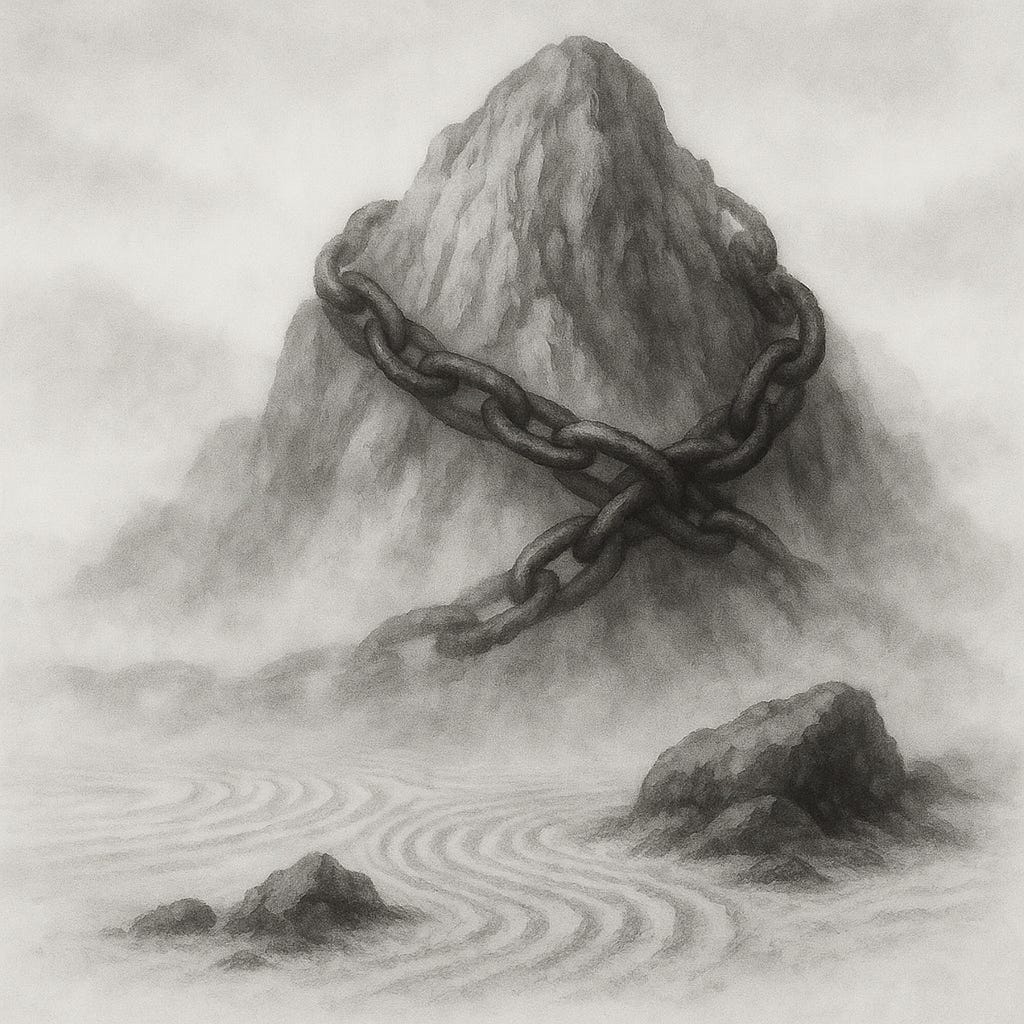
The Exhausting Work of Being Consistently Yourself
Why Identity Was Never Meant to Stay Singular
The Exhausting Work of Being Consistently Yourself
Why Identity Was Never Meant to Stay Singular
This essay was first published on Metastylist on Substack. If you’d like to follow the ongoing work, you’ll find it there.

Every framework for working with identity begins at the same point — with a self that already exists, already shaped, already legible enough to be described, diagnosed, or improved. Personality systems map the configuration you’ve arrived at. Developmental approaches trace how you got there. Even the most sophisticated frameworks for change begin, almost without exception, from what is already present: here is the structure, here is the direction, here is what movement from this point requires.
There is nothing wrong with this. It is, in fact, where most useful work happens.
But it means that something else goes unnamed — a moment that precedes all mapping, all diagnosis, all architecture. A moment that is not a stage in a process and not a reaction to pressure, but something closer to an origin: the point at which a person decides, without external necessity and without a destination already fixed, that they will become someone. Not a better version of what they are. Not the person they were meant to be. Simply — a future form of being, freely chosen, because the capacity to choose is itself the point.
I kept returning to this moment in my work, long before I had language for it. It appeared in the gap between every framework and the person sitting in front of it — the place where no tool, however precise, quite reached. I came to it not through theory but through years of working with people in situations where identity was the actual material: photography sessions, designed experiences, places where the usual story about a person was temporarily set aside. I was never interested in fixing anyone. I was interested in what became possible when the usual story stopped running.
Metaformation is the name I eventually gave to this moment.
What follows is an attempt to describe what happens there — and why it matters for everything that comes after.
The easiest way to misread Metaformation is to place it inside the category of self-development — to hear it as a more intentional version of the same project, a more sophisticated approach to becoming better, more aligned, more fully yourself. This misreading is understandable. It uses familiar vocabulary: choice, identity, becoming. It sounds like something that belongs on the same shelf.
But the category is wrong, and the difference matters.
Let me be specific about what Metaformation is not.
It is not about finding your essence — the authentic core underneath all the conditioning, the real you waiting to be excavated. It is not therapy: not a response to wound, lack, or the need for repair. It is not optimization, not authenticity in the sense that word is usually deployed, not performance, not branding. These frames — all of them — share a single assumption: that identity is a noun. Something you have, or lack, or need to work on.
The reaction was almost always the same sequence. First, surprise — genuine, unguarded. Then something closer to fear: the person in the photograph was unmistakably them, and unmistakably different, and the gap between those two facts was briefly disorienting. Then laughter. Then something I can only describe as delight — the specific pleasure of discovering that something you hadn’t known was possible, was. People would tell me afterwards that it was my talent, the styling and the eye. I understood what they meant, and I also knew it wasn’t quite right. You cannot become someone outside yourself. What I was seeing in those photographs was still them — just in versions they hadn’t yet met. I hadn’t created anything. I had simply created the conditions for something that was already there to appear.
Metaformation does not begin from lack.
It begins from something closer to aesthetic desire — the decision to create a future form of being not because the present one is broken, but because creation itself is possible. Because the capacity to move toward something new, without being pushed by pain or pulled by necessity, is one of the few genuinely sovereign acts available to a person. The gesture is not corrective. It is originary.
This is what I mean when I call it a declaration of creative freedom rather than a program of change. A program of change assumes a destination derived from diagnosis: here is what is wrong, here is what correct looks like, here is the path between them. A declaration assumes something prior to all of that — a will that precedes its own justification. I choose to become. Because I can.
What is chosen, at this stage, is not yet a specific identity. It is closer to a direction of desire — a wish, in the oldest sense of the word: not fantasy, but the first movement of intention toward something that does not yet exist. The framework has not yet been applied. The map has not yet been drawn. No specific form has yet been named.
This is the primary state. Everything that follows gives it form.
So what is this primary state, and where does it happen?
It happens in the gap. The space between the person you have been — the one you know by heart, whose reflexes and preferences and default directions have become so familiar they feel like facts — and the person you haven’t yet become. Not a void. Not a failure of direction. A gap, in the most precise sense: a place where the usual momentum pauses and something else becomes possible.
You can arrive here in different ways. Sometimes the gap opens without your permission — a career ends, a decade closes, something you built for years quietly stops making sense. Sometimes you step into it deliberately, because you’ve understood something about how identity works and you want to use that understanding. Both paths are real. What changes depending on which one brought you here is not the gap itself, but your relationship to it.
And that relationship is everything.
The brain, it turns out, does not perceive the self — it predicts it. The coherent “I” that wakes up each morning already knowing who it is, already recognizing its own face, its own preferences, its own reliable patterns of response — this is less a fact about reality than an extraordinarily successful habit of anticipation. The same model, running reliably, generating the same output, until something disrupts it.
The gap is one of those disruptions. What feels like vertigo — the sense of not quite knowing who you are in this particular moment — is the prediction briefly failing. The model losing its signal. And in that failure, before the system has found its footing again, something becomes possible that is almost never possible from inside a smoothly running prediction: you can see the model. Not from within it. From a position just outside it.
This is not a malfunction. It is a window.
The self you currently inhabit was built from choices made in the past — directions you moved toward, roles you grew into, versions of yourself you practiced until they stopped feeling like practice. Those choices gave you shape. They also narrowed the field. Not wrongly — this is how any life gets built. But the field was always wider than the path you walked through it.
In the gap, the wider field becomes visible again.
I made films and designed events where I would find the right trigger — a role, a game, a situation with actual stakes — and watch what happened when it activated. People showed identities that surprised even them. A reserved person became magnetic. Someone who had described herself as “not creative” built something extraordinary in an afternoon. A man who had spent twenty years in one professional identity inhabited a completely different one for three days and came back changed in ways he couldn’t fully explain. Watching that happen enough times, you stop believing in the singular self. You start seeing what was always there: not one person, but a field of possible ones, waiting for the conditions that would call them forward.
Identity is not a fixed image. It is not the photograph on your desk or the title on your business card or even the story you’ve told about yourself for the last ten years. It is closer to a space of potential — dozens of directions you haven’t moved in yet, versions of yourself that exist as genuine possibility but haven’t been given weight or form. Like a word before it enters a sentence, holding all its meanings at once. The moment you step into the gap, you are no longer the old version — and not yet the new one. You are, in the most honest sense, already and not yet anyone.
Most people experience this as the worst part. The instinct is to close it as fast as possible — to reach for the nearest available identity and make the uncertainty stop.
But if you understand what the gap actually contains, the instinct reverses.
The gap is not the problem. The gap is the point.
This is when productive indeterminacy begins — not as a condition to be endured, but as a deliberate act. The uncertainty is not the problem. It is the resource. The not-yet-decided is precisely what makes genuine choice possible, because until something is decided, everything is still available. You are standing in front of the full range of what you could move toward — not the range defined by who you have already been, but the wider one. The one that includes directions you haven’t tried, combinations you haven’t considered, a future self you haven’t yet had the room to imagine.
This is the most creative position available to a person. And it is exactly where Metaformation lives.
Here is what makes this more than a personal philosophy.
Look around. The culture is already living this way — it just doesn’t have language for it yet.
People maintain multiple accounts that carry genuinely different selves. They build creator personas that run in parallel with professional identities. They move between careers not as failure but as design. They inhabit fandom identities, avatar selves, AI-assisted roleplay, “main character” framings of their own lives. The aesthetic of identity has become, in a single decade, visibly plural. Deliberately constructed. Navigated.
And simultaneously, the anxiety around this has never been higher.
Because the old framework — one true self, stable over time, coherent across contexts — is still the official story. Still what most systems try to find, still what the question “who are you, really?” assumes must have a single honest answer.
Society wants stable identities. Reality is increasingly built for fluid ones.
Consider what maintaining a stable identity actually requires. What looks like stillness is never stillness — matter that appears solid is vibrating constantly at the molecular level, holding its shape through continuous internal movement, equilibrium under pressure rather than rest. Identity works the same way. The consistency you project across contexts, over time, in all the places where different versions of you are expected to arrive as the same person — that consistency is not a natural resting state. It is ongoing work. Continuous maintenance of a pattern against the natural tendency of complex systems toward variation.
Being unchanging is a market requirement, not a biological law.
This is why the exhaustion is not metaphorical. It is structural. The title of this essay is not a complaint. It is a diagnosis.
This is not a trend. It is a structural tension in what it means to be a person right now — in a world where what you can become is expanding faster than the frameworks for understanding identity can follow.
What if identity itself becomes navigable? What if the self is not something to discover but something to design? What if the question is not “who am I” but “who am I moving toward — and do I know how to get there?”
These aren’t rhetorical questions. They are the questions that have driven fifteen years of building a framework capable of holding them seriously.
A declaration is real. But a declaration alone doesn’t move you through the field.
At some point — not immediately, not before the wish has had room to breathe, but eventually — the question changes. Not will I become? but how does this becoming take shape? Not because the declaration was incomplete. Because this is how anything gets built. An architect who only dreams buildings doesn’t build them. The dream is sovereign — it has to be, or the building will be someone else’s idea wearing your name — but the dream and the drawing are different acts, and both are necessary.
This is where most people reach for the nearest available system and hand the question over.
And this is exactly where something goes wrong — not because systems are useless, but because a system designed to fix a problem will always, at some level, treat you as a problem to be fixed. The tools of self-improvement are built on a particular assumption: that there is a gap between what you are and what you should be, and that the work is to close it. If you arrive at those tools carrying a declaration rather than a diagnosis, the tools will quietly reclassify you. They will find the gap. They will name what needs correcting. And the original act of creative sovereignty — I choose to become, because I can — will slowly be replaced by a more familiar story: I am working on myself.
You’ve spent years in that story. You know how it ends.
Because I spent years working outside the frameworks of therapy and efficiency — in fashion, in photography, in designed experience — I kept seeing something those frameworks weren’t built to see. People didn’t need to be fixed. They needed conditions. The right context, the right invitation, the right permission to inhabit a version of themselves that already existed as possibility. My job was never to improve anyone. It was to create the situation in which something possible became actual.
Metastyling is built on that same premise. Not that you are insufficient and need to be developed, but that you have made a declaration and need architecture to realize it. And the tools that serve creative will look different — they don’t diagnose, they map; they don’t prescribe, they navigate; they don’t tell you who to become, they help you understand the territory between who you have been and who you have chosen to move toward.
This is what I mean by navigation — not a self-help journey with a predetermined destination, but a genuine cartographic act. The declaration came first. The map serves the declaration. You already know the direction of desire. What Metastyling gives you is the means to move through the field deliberately, to understand what the territory contains, to make choices that are genuinely yours rather than choices made by default or exhaustion or the momentum of whoever you were last year.
Structure in service of creative will is not a constraint. It is what makes the creative act sustainable — what allows it to continue past the initial declaration, past the productive indeterminacy, past the first exhilarating and terrifying moment of genuine openness, and into the actual work of building a self you chose.
Not improving the one you have.
Building the one you declared.
Once the declaration has been made and the gap has been recognised for what it is — not an absence but an opening — the movement begins. Not as a program. Not as a course with modules and milestones. More like a set of coordinates — positions from which to observe where you actually are before you begin to move.
The first coordinate is the most immediate: what do you actually want to move toward? Not what would be more functional, more aligned, more optimised. Simply — what is the direction of desire? This can be written down, spoken aloud, described in images before it finds precise language. The point is not accuracy. The point is articulation — the first act of giving the wish a form it can be held in.
The second coordinate is harder to see clearly: who are you, right now, in the most honest sense? Everyone carries a set of ways of being that activate almost automatically — the version of you that appears in high-stakes moments, the one that shows up with family, the one that takes over when you’re stretched thin or running on very little sleep. These aren’t flaws in the system. They are the system — the actual landscape of your current identity, the starting material for any genuine movement. Seeing this clearly, without judgment, is not self-criticism. It is the only honest starting position.
The third coordinate is the least obvious — and the one that determines the most: how far can you currently see into your own patterns? Some people can name what happened after it’s over. Some can catch themselves in the middle of it. Some can see, in real time, not just what they’re doing but why — can hold the whole structure of a reaction and choose differently before it completes. Where you can see from determines what kind of movement is available. This is a matter of resolution — how clearly you can see your own field while you are still moving through it. And knowing where you currently stand is the difference between attempting a transition with the tools you have and attempting one with tools you haven’t yet developed.
From here, the movement becomes exploratory. The new territory — the ways of being that belong to the future self you declared — needs to be tried, not just imagined. Not performed for an audience. Rehearsed, in the way an actor rehearses: with full commitment, in real contexts, with the understanding that the first attempts will be approximate and that approximation is part of the process. You are not pretending to be someone you’re not. You are practicing being someone you’re becoming.
And then, finally, the trajectory is designed. Not fixed — designed. You have the wish. You have the current landscape. You have a sense of your observational range and some familiarity with the territory ahead. What remains is the deliberate act of connecting where you are to where you declared you wanted to go — not in a straight line, but with the kind of intelligent, adaptable movement that any real navigation requires.
This is what Metastyling is built for. Not to tell you who to become. To make the becoming architecturally possible.
There is a version of this conversation that ends with a framework. With a methodology, a set of tools, a structured path from where you are to somewhere better. That version is useful. It exists, and it works, and it is available.
But it begins later in the story than this does.
This begins before the framework. Before the map, before the tools, before the first session or the first question or the first moment of structured self-examination. It begins in the place that most systems quietly assume has already been handled — the place where a person decides, without external justification and without a predetermined destination, that they are going to become someone they have not yet been. Not because they are broken. Not because the world requires it. Because the capacity to create oneself is real, and exercising it is one of the few acts that is genuinely, structurally free.
What I find endlessly fascinating — and what fifteen years of watching people step into new versions of themselves has only deepened — is how much is actually available. Not as potential to be unlocked or talent to be developed. As genuine multiplicity: the reality that any person contains more possible selves than any single life will ever fully inhabit. This is not a motivational claim. It is an observation about the nature of identity that the dominant frameworks have consistently failed to take seriously, because taking it seriously requires abandoning the idea that there is one right answer to the question of who you should become.
There isn’t one. There are many. And the question is not which one is true — but which ones you choose, and how deliberately you make that choice.
This is not a right that needs to be granted. It does not depend on circumstances, on resources, on whether the timing is right or the conditions are favorable. It is prior to all of that — the most radical thing available to a person, not radical in the sense of extreme, but in the sense of root: the point from which everything else grows.
You are not a problem to be solved. You are not a version of yourself that needs to be upgraded. You are someone who can choose, from the open field of what is possible, who to move toward — and then build, with real tools and real architecture, a path that makes that movement actual.
To name yourself is to write your own myth.
To form yourself is to touch the sovereign creative force of existence itself.
I choose to become. Because I can.
메타데이터
- post_id
- f00a5ea40c44
- slug
- the-exhausting-work-of-being-consistently-yourself-f00a5ea40c44
- url
- https://medium.com/@alice_93406/the-exhausting-work-of-being-consistently-yourself-f00a5ea40c44
- canonical_url
- https://medium.com/@alice_93406/the-exhausting-work-of-being-consistently-yourself-f00a5ea40c44
- author_url
- https://medium.com/@alice_93406
- status
- ok
- fetched_at
- 2026-06-09 15:37:30