From CUDA to AI Factories: The Next Great Ecosystem Shift in Enterprise AI
For the better part of the last decade, the AI industry has been obsessed with GPUs.
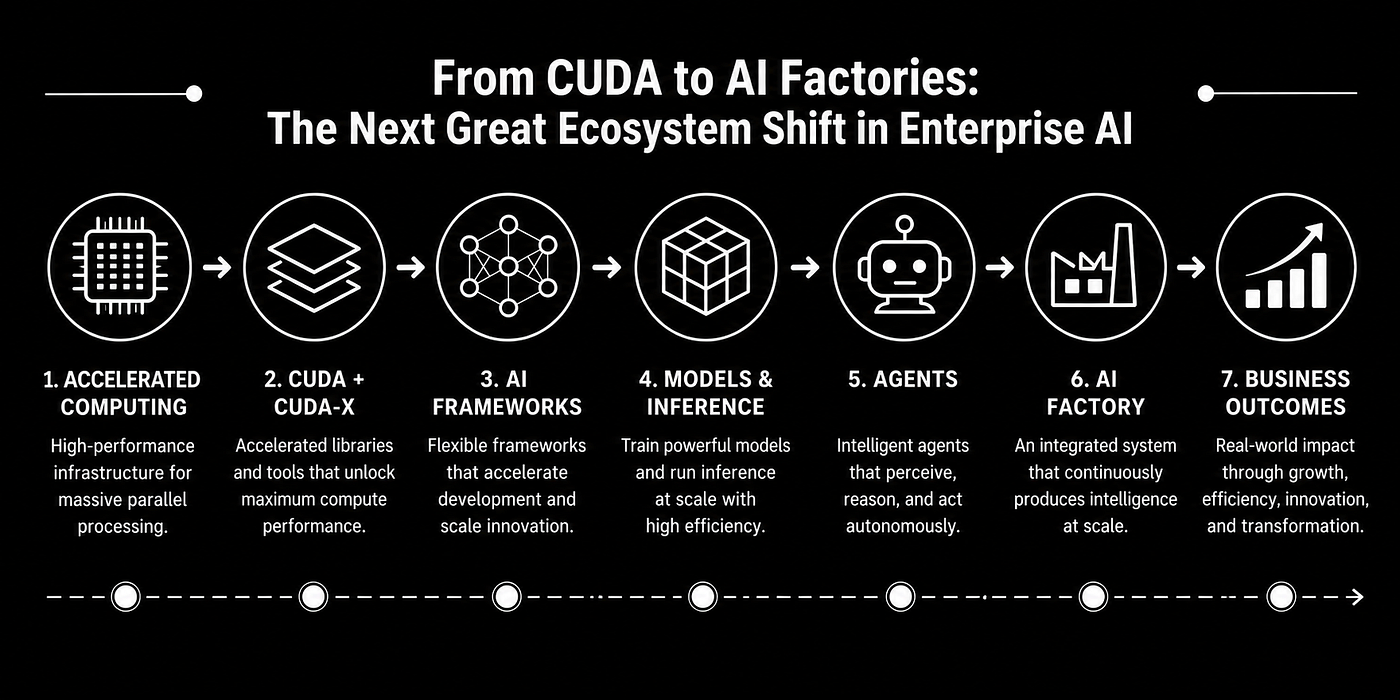
CUDA to AI Factories
From CUDA to AI Factories: The Next Great Ecosystem Shift in Enterprise AI
For the better part of the last decade, the AI industry has been obsessed with GPUs.
And for good reason.
The rise of accelerated computing fundamentally changed what was possible across artificial intelligence, data science, simulation, robotics, digital twins, and high-performance computing. Entire categories of applications that were previously impractical became commercially viable because GPUs delivered orders-of-magnitude improvements in performance.
As AI adoption accelerated, the conversation naturally focused on hardware.
How many GPUs?
Which GPUs?
Who has access to the latest generation?
How quickly can we deploy them?
Today, however, I believe the industry is entering a new phase.
The organizations that will lead the next decade of AI adoption will not necessarily be the ones with the largest GPU clusters.
They will be the ones that can operationalize AI at scale.
That distinction is becoming increasingly important.
The Real Story Was Never Just the GPUs
One of the most common misconceptions in the AI industry is the belief that accelerated computing was primarily a hardware story.
It wasn’t.
The real breakthrough was the ecosystem that formed around the hardware.
GPUs alone did not create today’s AI revolution.
CUDA did.
CUDA-X libraries did.
AI frameworks did.
Inference optimization software did.
MLOps platforms did.
Containerization did.
Kubernetes did.
Developer tools did.
Enterprise deployment architectures did.
Collectively, these technologies transformed raw computing power into business outcomes.
The value of accelerated computing emerged because organizations could actually use it.
This may seem obvious in hindsight, but it is one of the most important lessons in technology adoption.
Technology succeeds when complexity becomes invisible.
The technologies that change industries are rarely the most technically sophisticated.
They are the ones that make sophisticated technology accessible.
The Hardest Thing to Build Is an Ecosystem
The more time I spent working with developers, startups, enterprises, cloud providers, OEMs, and software partners, the more I realized that the most durable competitive advantage wasn’t the hardware itself.
It was the ecosystem surrounding it.
One perspective that shaped my thinking comes from spending more than a decade helping grow AI and accelerated computing ecosystems from the inside.
During my years working across developer relations, platform adoption, strategic alliances, and enterprise AI, I had a front-row seat to one of the most important lessons in technology.
The hardest thing to build is not the technology itself.
It’s the ecosystem around it.
From the outside, it is easy to look at the success of accelerated computing and assume the moat was the GPU.
The reality is more nuanced.
Hardware eventually becomes available.
Features get replicated.
Benchmarks get matched.
But ecosystems compound.
They are built through years of investment in developers, software frameworks, libraries, tooling, education, partnerships, support models, reference architectures, integrations, and customer success.
Every framework integration mattered.
Every software optimization mattered.
Every startup built on the platform mattered.
Every enterprise deployment mattered.
Every developer who successfully solved a problem using accelerated computing strengthened the ecosystem.
Over time, these individual contributions compounded into something far larger than any single product release.
The ecosystem became the moat.
Looking back, one of the reasons CUDA became so powerful was not simply because it unlocked accelerated computing. It created a common foundation upon which thousands of organizations could innovate.
The result was a flywheel.
More developers created more applications.
More applications attracted more enterprises.
More enterprises drove more software investment.
More software increased platform value.
The ecosystem continuously reinforced itself.
That experience profoundly shaped how I think about the next phase of AI.
Today’s discussion often focuses on models, inference performance, token economics, and infrastructure.
Those are important.
But I believe the next enduring moat will be built around operational ecosystems.
The winners will not simply provide infrastructure or models.
They will provide the surrounding capabilities that enable enterprises to build, deploy, govern, evaluate, secure, monitor, and continuously improve AI systems at scale.
In many ways, the AI Factory is becoming the next evolution of that ecosystem mindset.
The challenge is no longer helping organizations access intelligence.
The challenge is helping them operationalize intelligence.
The Workstation Analogy
Consider a simple example.
Imagine a parent buying a workstation for their teenager.
Most people don’t individually source:
- A CPU
- A GPU
- Memory
- Storage
- Cooling
- Power supplies
- Operating systems
- Drivers
- Development tools
- Security software
They buy a system that works.
The complexity still exists.
It has simply been abstracted away.
The customer focuses on outcomes rather than assembly.
This pattern repeats itself throughout the history of computing.
Mainframes evolved into integrated enterprise systems.
Virtualization simplified infrastructure management.
Cloud computing abstracted data center operations.
Software-as-a-Service eliminated software installation and maintenance for many workloads.
Every major technology adoption cycle follows a similar trajectory.
The winners are often the companies that remove complexity, not the companies that create it.
AI is now approaching that same inflection point.
The Enterprise AI Integration Problem
Over the last several years, enterprises have been forced to become system integrators.
To build an AI capability, organizations often needed to assemble:
- Infrastructure platforms
- GPU clusters
- Storage systems
- Networking architectures
- Foundation models
- Embedding models
- Vector databases
- Agent frameworks
- Inference servers
- Evaluation frameworks
- Governance controls
- Security architectures
- Observability platforms
- Deployment pipelines
- Monitoring systems
Each component may be excellent individually.
The challenge is the integration.
Many organizations underestimate the operational complexity created by stitching these components together.
As a result, significant amounts of time, money, and talent are spent building and maintaining the AI stack itself.
The AI project becomes an infrastructure project.
The infrastructure project becomes a platform project.
The platform project becomes an integration project.
And somewhere along the way, the original business objective gets delayed.
The reality is that most organizations do not want to become experts in AI infrastructure.
They want business outcomes.
They want improved customer experiences.
They want operational efficiency.
They want productivity gains.
They want revenue growth.
The infrastructure is merely the means to achieve those outcomes.
The Emergence of the AI Factory
This is where the concept of the AI Factory becomes important.
An AI Factory is not simply a collection of GPUs.
Nor is it merely a data center optimized for AI workloads.
A true AI Factory is a complete operational environment that enables organizations to continuously build, deploy, govern, monitor, and improve AI systems.
Just as a manufacturing factory converts raw materials into finished products, an AI Factory converts data, models, and infrastructure into business value.
The critical word is operational.
Building a proof of concept is relatively easy.
Operating AI at enterprise scale is significantly harder.
Production environments require:
- Governance
- Security
- Compliance
- Evaluation
- Monitoring
- Auditability
- Cost management
- Lifecycle management
- Human oversight
- Continuous improvement
These capabilities often determine whether AI initiatives succeed or fail.
The Rise of Agentic AI Changes Everything
The emergence of Agentic AI further accelerates this shift.
Traditional machine learning systems generated predictions.
Large language models generated content.
AI agents take action.
That creates entirely new operational requirements.
Organizations must now answer questions such as:
How do we evaluate autonomous decisions?
How do we monitor agent behavior?
How do we enforce governance policies?
How do we ensure human oversight?
How do we measure business impact?
How do we manage thousands of agents operating simultaneously?
How do we maintain security across autonomous workflows?
These challenges cannot be solved through hardware alone, they require operational systems, the conversation is moving beyond infrastructure and conversation is becoming about management.
The New Competitive Advantage
Historically, competitive advantage often came from access to infrastructure.
Today, infrastructure is increasingly becoming accessible to everyone.
The emerging competitive advantage lies elsewhere.
It lies in how effectively organizations operationalize AI.
Can they deploy faster?
Can they govern responsibly?
Can they scale efficiently?
Can they measure ROI accurately?
Can they continuously improve outcomes?
These questions matter far more than simple GPU counts.
In many ways, this mirrors what happened in cloud computing.
At one point, owning servers was considered strategic.
Today, very few organizations view server ownership as a competitive differentiator.
The same transformation is beginning to occur in AI.
The strategic advantage is shifting from owning infrastructure to operating intelligence.
What This Means for Enterprise Leaders
For CIOs, CTOs, Chief Data Officers, and AI leaders, the implications are significant.
The key question is no longer:
“How do we build an AI platform?”
The key question is:
“How do we create an operational system that allows AI to generate measurable business value repeatedly and predictably?”
That requires a broader perspective.
Infrastructure remains important.
Models remain important.
Inference remains important.
But increasingly, the organizations that achieve the greatest success will focus on the layers that connect technology to outcomes:
- Governance
- Observability
- Evaluation
- Security
- Lifecycle management
- Operational automation
- Business alignment
Those are becoming the defining capabilities of mature AI organizations.
Looking Ahead
After more than a decade working with accelerated computing, one lesson stands out: breakthrough technology creates value only when organizations can reliably put it to work.
That is the shift underway today.
Competitive advantage will come less from access to models or hardware and more from the ability to deploy, manage, and improve intelligent capabilities across the business.
This is why the AI Factory matters. Not as an infrastructure blueprint, but as a practical framework for turning innovation into repeatable results.
The companies that lead in the years ahead will be those that can move from possibility to execution faster than their peers.
And in many respects, we’re just getting started.
Author’s Note
Over the past fifteen years, I’ve had the opportunity to work with enterprises, technology partners, cloud providers, and AI platform teams across industries ranging from telecommunications, Automotive, financial services to energy, manufacturing, healthcare, and the public sector. My experiences at NVIDIA and now at DataRobot have provided a front-row seat to the evolution of AI infrastructure, platforms, and enterprise adoption.
While the technologies continue to evolve, the pattern remains remarkably consistent: breakthrough innovations create value only when organizations can operationalize them at scale. That observation is what inspired this article.
메타데이터
- post_id
- f00f7dbbf145
- slug
- from-cuda-to-ai-factories-the-next-great-ecosystem-shift-in-enterprise-ai-f00f7dbbf145
- url
- https://medium.com/@manishharsh/from-cuda-to-ai-factories-the-next-great-ecosystem-shift-in-enterprise-ai-f00f7dbbf145
- canonical_url
- https://medium.com/@manishharsh/from-cuda-to-ai-factories-the-next-great-ecosystem-shift-in-enterprise-ai-f00f7dbbf145
- author_url
- https://medium.com/@manishharsh
- status
- ok
- fetched_at
- 2026-07-10 04:31:59



