Lose $3.5 Billion, Do 4 Months in Jail, and Get Rich Again? (Is this even possible in One Life?)
Inside Crypto’s Wildest Loop — Two founders vaporized $3.5B, served 4 months, and used the infamy to launch a new crypto app.
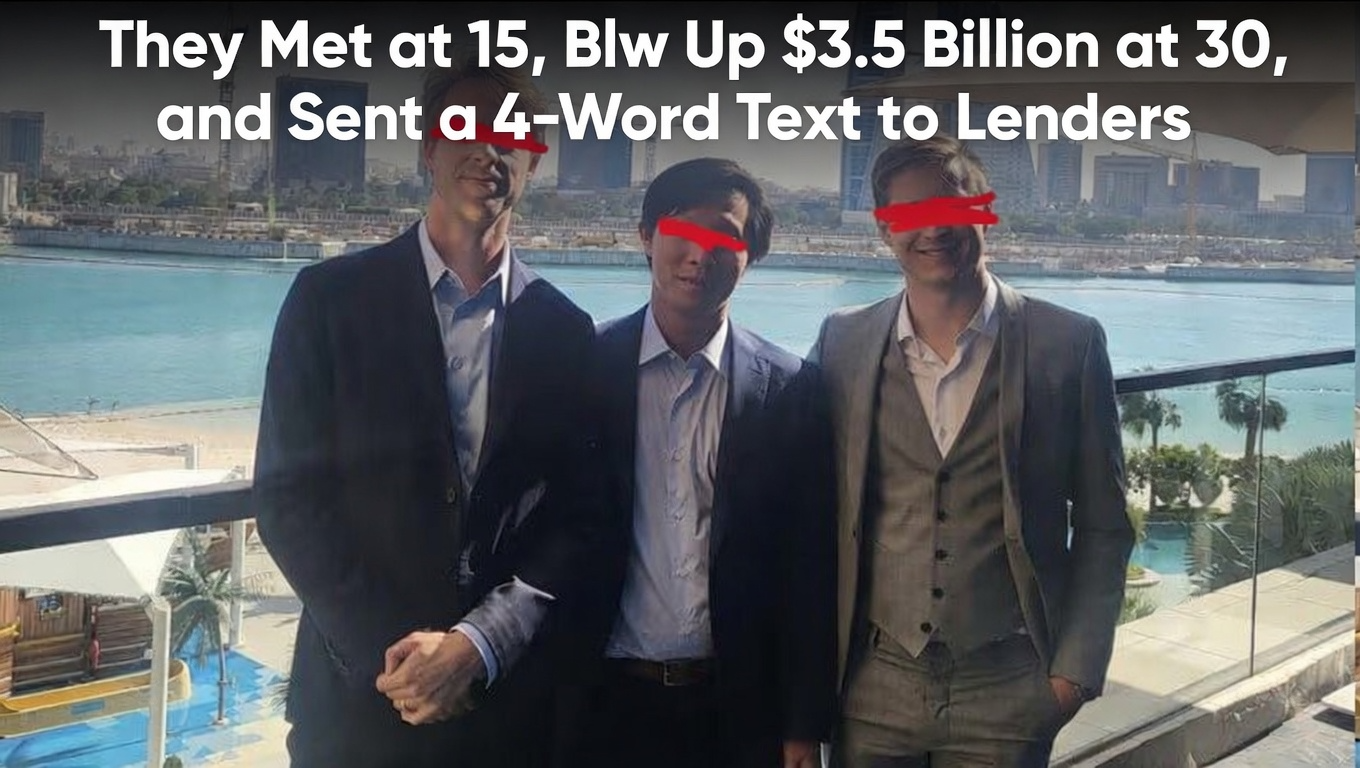
Three Arrows Capital (3AC) liquidation Court Case + Edited by Author
Lose $3.5 Billion, Do 4 Months in Jail, and Get Rich Again? (Is this even possible in One Life?)
Inside Crypto’s Wildest Loop — Two founders vaporized $3.5B, served 4 months, and used the infamy to launch a new crypto app.
You didn’t look away, did you?
The moment your eyes hit that number — $3.5 BILLION — something clicked in your brain. A mix of disgust, morbid curiosity, and maybe a tiny, quiet voice wondering…
How do you even manage to spend that much money without anyone stopping you?
Let’s play a quick game of imagination. Picture the worst mistake you’ve ever made at work. That stomach-dropping, cold-sweat moment where you realized you ruined a project, deleted the wrong file, or emailed the CEO instead of your work best friend. Got it?
Now, imagine that mistake cost three and a half billion dollars. Imagine your text response to the person you owe that money to is literally:
“yo uh hmm”
You’d be hiding under your bed forever. But the two guys who actually sent that text? They aren’t hiding.
In fact, they are probably looking at a computer screen right now, launching their next project, waiting for you to hand them your wallet again.
Welcome to the wildest loop in modern finance every witnessed (most likely if I’m not exaggerating it).
Let’s look at how it actually happened.
The Kitchen Table and the $18 Billion Illusion
Every great villain story starts with an origin text.
Su Zhu and Kyle Davies weren’t random internet scammers.
They met as teenagers at Phillips Academy, one of the most elite boarding schools in America. They went to Columbia University together. They traded on the institutional desks at Credit Suisse. They were the definition of the financial establishment.
In 2012, sitting at a kitchen table, they started a hedge fund called Three Arrows Capital (3AC).
For a long time, they looked like absolute geniuses. They weren’t just trading crypto; they were defining the culture of it.
By early 2022, their publicly stated Net Asset Value (NAV) was a staggering $18 billion. They were the apex predators of the digital asset space.
But here is the dirty little secret of a bull market: When the tide is rising, even a rock looks like it’s flying.
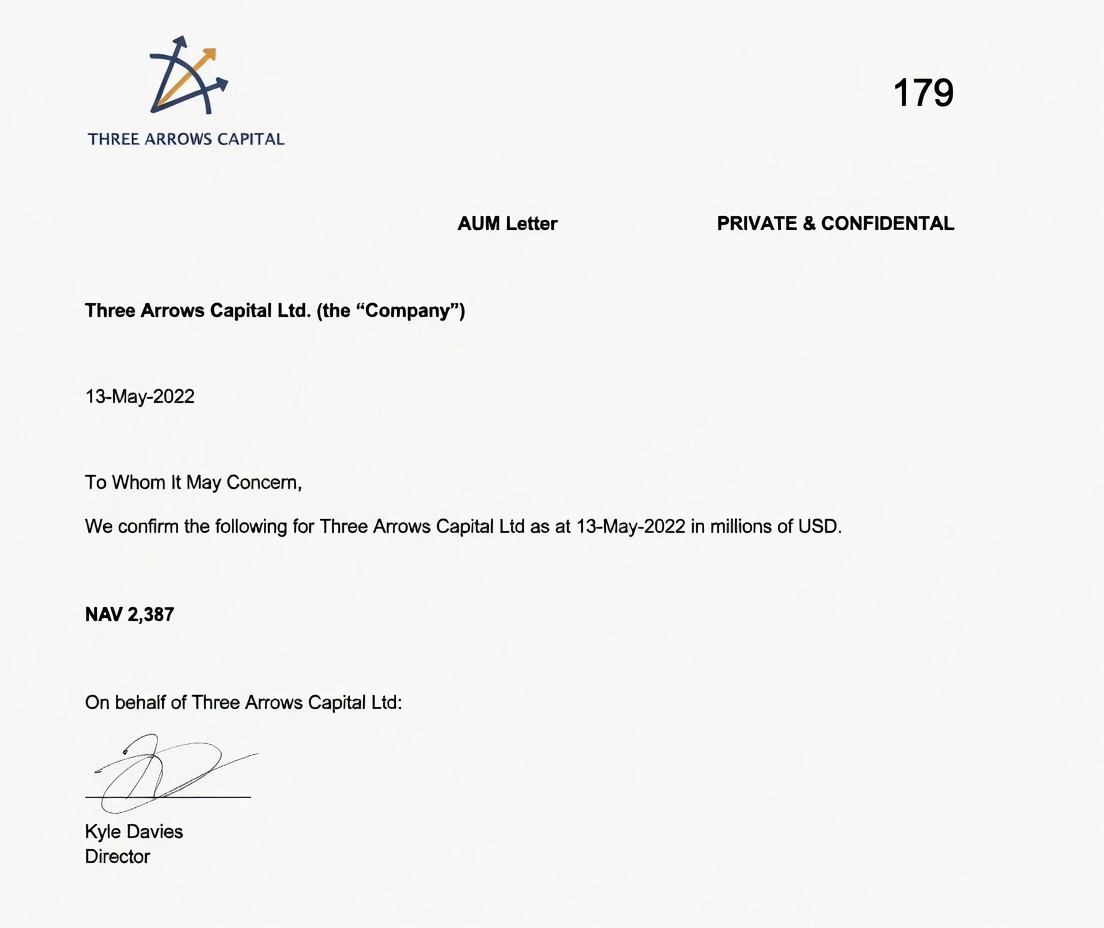
1st Affidavit of Russell Crumpler — Three Arrows Capital (3AC) liquidation case
[The 3AC Domino Effect]
Three Arrows Capital Collapses ($3.5B blown)
       │
       ├──► Voyager Digital (Owed $670M) ──► Bankruptcy
       ├──► BlockFi (Owed $1B+) ───────────► Bankruptcy
       ├──► Genesis (Owed $2.3B) ──────────► Bankruptcy
       └──► Celsius & Blockchain.com ──────► Total Meltdown
Behind the scenes, 3AC wasn’t just investing; they were borrowing billions on naked trust, using the same pool of money over and over again as collateral. By just doing this….
They owed Voyager $670 million. They owed BlockFi over a billion. They owed Genesis a massive $2.3 billion.
When the market turned in June 2022, and $4.2 billion evaporated across their ledger, they didn’t just fall. They pulled the entire ecosystem down with them into a dark, multi-billion-dollar abyss.
And when the panic-stricken lenders started ringing their phones off the hook?
Silence.
Followed by that infamous, history-making text: “yo uh hmm.”
Toddler’s Mansion ( “Enjoyable” Prison )
Now, if you or I owed billions to angry creditors, we’d expect a knock on the door from federal agents within the hour.
But Su and Kyle played an entirely different game.
Months before the bankruptcy papers were filed, they started moving money into the shadows. Five luxury properties in Singapore, worth over $80 million, were quietly shifted into private trusts and family names.
The crown jewel? A $35 million mansion registered entirely in the name of their three-year-old son. Yes a three-year-old…
Think about that for a second. While retail investors were losing their life savings on platforms like Celsius and Voyager because of 3AC’s collapse, a toddler technically owned one of the most expensive pieces of real estate in Asia.
Image Credit — British Virgin Islands (BVI) liquidation proceedings and the U.S. Chapter 15 recognition case
Because it was locked away in a trust, the liquidators couldn’t touch it. Today, that $35 million estate has been converted into an eco-luxury urban farm. It features a fruit forest, 26 organic garden beds, and a swimming pool that was literally turned into a fish pond hosting guided tours and fine-dining experiences.
Anything built overnight and via cheating comes to an end. The same goes for this one; the law caught up — sort of. Singapore’s Monetary Authority handed them a 9-year ban from running financial firms.
In September 2023, Su Zhu was intercepted at Changi Airport trying to flee to Hong Kong with a fake passport.
He served four months in a Singaporean prison. Most people would find that traumatizing.
Not Su Zhu.
He later jumped on a podcast and casually described his time behind bars as “really enjoyable overall,” praising the structure and the time it gave him to meditate… (The place where people freak bro literally used it… to make a comeback)
Meanwhile, Kyle Davies checked into Bali, eventually migrating to the UAE — a country that conveniently does not share an extradition treaty with the jurisdictions chasing him.
Infinite Comeback Machine
In any traditional industry — Wall Street, real estate, tech — losing $3.5 billion of other people’s money is a permanent death sentence.
You become a pariah. Your name is scrubbed from the history books.
But crypto doesn’t operate on traditional logic. In this ecosystem, infamy is just another word for clout.
Look at the timeline of their shameless, relentless rebirth :
OPNX (The Audacity Exchange) —
Their first comeback move was almost poetic in its cruelty. They launched OPNX, a bankruptcy claims exchange designed specifically to let victims trade the claims of bankrupt crypto companies — including the ones they ruined.
Dubai regulators fined them $2.7 million, and the platform folded within a year.
OX Fun —
Next came OX Fun, an exchange that raised $4 million from eager investors looking to catch the next wave.
Once the capital was in, the founders quietly moved on, leaving it adrift.
By late 2024, they leaned entirely into the joke. They launched a literal memecoin called $3AC, featuring a highly concentrated insider supply. The message was clear: We blew up the market, and now you can buy the tokenized memory of it.
Then come the final nail in the coffin — Quanto Exchange (The Current Frontier)
By September 2025, they went back to their roots.
Reports surfaced tying Zhu and Davies to the launch of Quanto, a Solana-based perpetual futures exchange.
It allows retail traders to trade volatile memecoins, NFTs, and liquidity provider tokens with up to 100x leverage.
What Did They Actually Achieve?
When you step back and look at this trail of discarded projects — from the smoldering ruins of 3AC to the quiet abandonment of OPNX and OX Fun — you have to ask: What was the point? What did they achieve from all of this?
The answer is simple, cold, and entirely mercenary. They achieved the ultimate corporate shield.
By bouncing from one decentralized entity to another, they built a moving target.
While liquidators spend millions in legal fees tracking old 3AC assets from 2022, the founders are actively generating fresh, untouched revenue streams in 2026.
Every new project is a reset button.
It forces the old creditors to chase ghosts while new retail capital funds their lifestyle in real time. They achieved total immunity from the standard consequence of financial ruin: obscurity.
Income is the Reality Check
While the average person works a 9-to-5 trying to pay off a mortgage, the founders of 3AC used a four-month prison sentence as a “meditation retreat,” preserved an $80 million real estate portfolio in family trusts, and leveraged their chaotic reputation to attract millions more in venture backing.
They proved a terrifying new thesis for the digital age, that is, if your failure is massive enough, the system stops trying to crush you and starts treating you like an institution.
The system didn’t punish them; it absorbed them. And as long as the next generation of traders' values hype over history, the machine will keep spinning.
The Holl story forces me to look in the mirror and ask a deeply uncomfortable question about the digital age: Has attention completely replaced accountability?
We are living in a financial reality where breaking the system doesn’t disqualify you from running it; it just gives you the ultimate stress-tested resume. To the outside world, it looks like a tragedy of unpunished greed. But inside the high-stakes, degenerate-fueled corners of the web, it’s treated like a badge of honor.
Because in any other industry, losing $3.5 billion ends your career.
In crypto? It’s just the opening paragraph of your next pitch deck.
Lose $3.5 Billion, Do 4 Months in Jail, and Get Rich Again? (Is this even possible?) © 2026 by TechX is licensed under CC BY-NC-ND 4.0
메타데이터
- post_id
- f011e82f10db
- slug
- lose-3-5-billion-do-4-months-in-jail-and-get-rich-again-is-this-even-possible-in-one-life-f011e82f10db
- url
- https://medium.com/techx-official/lose-3-5-billion-do-4-months-in-jail-and-get-rich-again-is-this-even-possible-in-one-life-f011e82f10db
- canonical_url
- https://medium.com/techx-official/lose-3-5-billion-do-4-months-in-jail-and-get-rich-again-is-this-even-possible-in-one-life-f011e82f10db
- author_url
- https://medium.com/@shipx
- status
- ok
- fetched_at
- 2026-06-10 08:17:25