PRS 2026: What the Industry Learned About Personalization, Recommendation & Search in the LLM Era
Notes from the 10th annual Netflix PRS workshop, where DoorDash, LinkedIn, Pinterest, Google DeepMind, Stanford, Zillow, and Netflix shared…
PRS 2026: What the Industry Learned About Personalization, Recommendation & Search in the LLM Era
Notes from the 10th annual Netflix PRS workshop, where DoorDash, LinkedIn, Pinterest, Google DeepMind, Stanford, Zillow, and Netflix shared the latest on rec systems, search, and personalization.
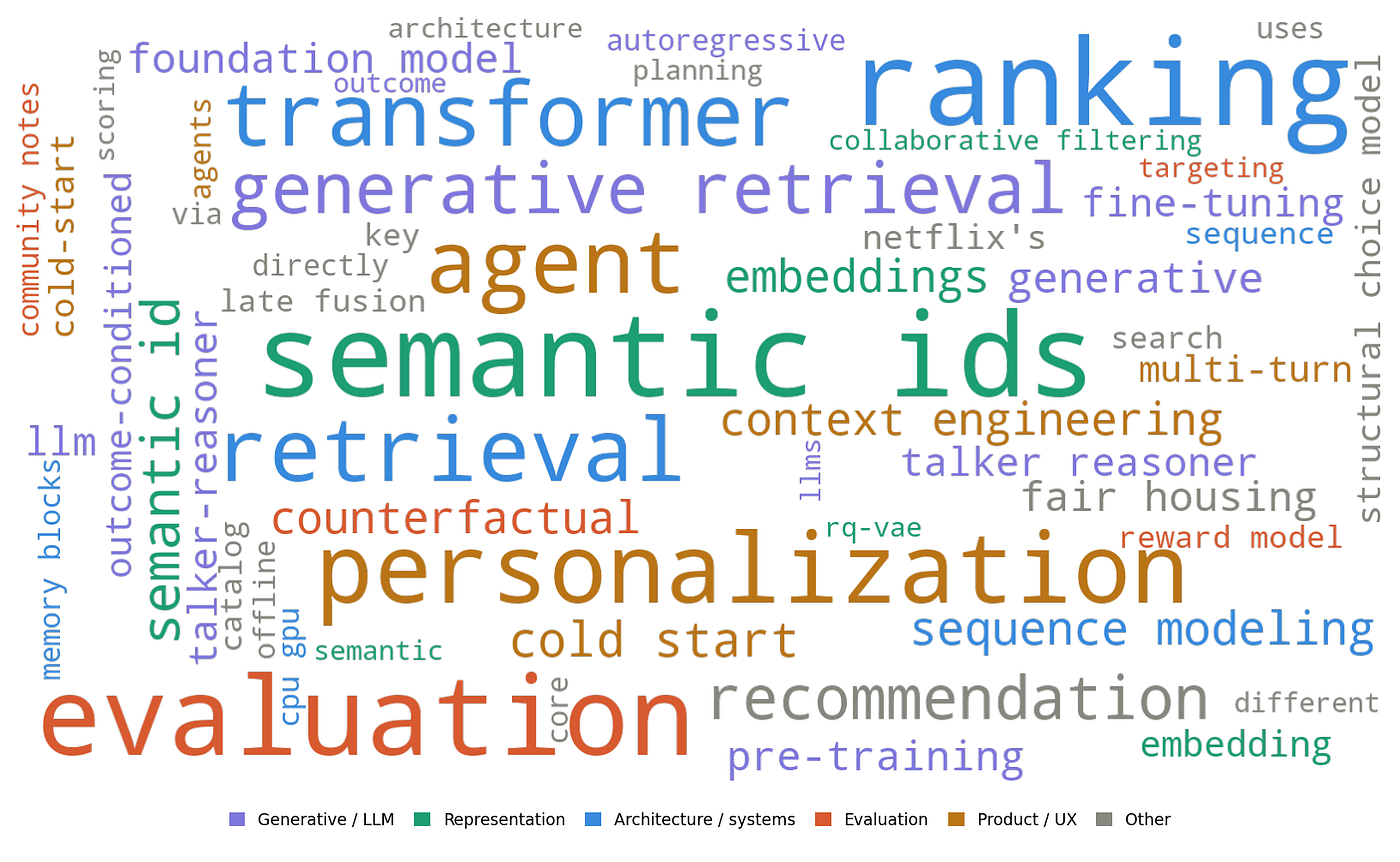
Word Cloud of the PRS 2026 Talk Summaries
A Decade of Rec Systems — From the Netflix Prize to Generative AI
The Netflix PRS (Personalization, Recommendation & Search) workshop just celebrated its 10th anniversary. It’s worth pausing on what a decade of change looks like in this field.

The event grew out of the Netflix Prize era — a time when matrix factorization and collaborative filtering were the dominant paradigms, when predicting a star rating was considered the central problem, and when the best systems were essentially solving a missing-value imputation problem on a sparse user-item matrix. The Netflix Prize itself (2006–2009) helped launch an entire generation of researchers and practitioners into the field.
Fast forward to 2026: almost none of that framing is still the primary lens. The talks at this year’s workshop were about transformer-based sequence models that encode months of behavioral history, generative retrieval systems that autoregressively decode candidate IDs, multi-turn conversational agents that plan across sessions, and the difficulty of evaluating any of it robustly. The shift isn’t just technical — the problem being solved has changed. It’s no longer “predict what rating this user would give this movie.” It’s “reason over what this user is trying to accomplish, across sessions, in natural language, and help them get there.”
That arc — from matrix factorization to generative reasoning — is what made this year’s anniversary feel meaningful. Here’s what was discussed.
The Talks
Cross-Talk Themes
The generative shift seems to be accelerating. Every company represented had moved, or was moving, from multi-stage feature-engineered pipelines to sequence-based transformers and generative retrieval. The common pattern: pretrain on behavioral sequences → post-train for objective alignment. The question is no longer whether to make this shift but how to do it at production scale.
Context enrichment beats model scaling. Netflix found prompt enrichment is 5× more impactful than doubling model size. DoorDash’s memory blocks, LinkedIn’s SIDs, and Pinterest’s context engineering all make the same point: how you structure what you know about the user is the highest-leverage variable, not the number of parameters.
Semantic IDs are a hot topic — but the debate is live. DoorDash, LinkedIn, and Pinterest are all investing in RQ-VAE-based semantic codes. The open question: discrete codes (more sequence-efficient, but lossy) vs. raw embeddings (no information loss, but longer sequences). Netflix GenPage chose embeddings; others chose codes.
Evaluation is the hardest unsolved problem. Stanford’s talk was a direct challenge to the community: current leaderboards and offline metrics are gameable, heterogeneous, and often measure the wrong thing. DoorDash’s trajectory-based agent eval harness, Google’s coaching phase rubrics, and Netflix’s structural choice model all represent different attempts to answer: are we measuring what we actually want to optimize?
Production complexity is underreported. The gap between a model that works offline and one that serves at scale came up in nearly every talk. LinkedIn’s CPU/GPU disaggregation, Netflix’s multi-cadence freshness pipeline, and Pinterest’s CLT are solutions to engineering problems that rarely appear in research papers.
Agents change the evaluation problem fundamentally. DoorDash and Google both pointed to the same gap: query-level metrics don’t capture whether a multi-turn agent is actually doing its job. The unit of evaluation has shifted to the trajectory — the whole conversation — and the infrastructure to evaluate that doesn’t really exist yet.

From Ranking to Reasoning — DoorDash
DoorDash is building multi-turn shopping assistants capable of handling complex missions like “help me prep for a game night for 24 people, some vegetarian.” The central argument: a reasoning loop on a weak substrate reasons confidently and wrongly. To make agents work, the underlying stack needs to be dramatically improved first. The talk covered four primitives: intent understanding (a 5-stage grounded LLM pipeline that routes ambiguous queries to the right catalog vertical, handling cases like “Better Chow Farms” being a restaurant in one city and a farm in another), consumer memory (three-timescale memory blocks — long-term, real-time in-session, and stated preferences — that agents query explicitly rather than stuffing raw history into context), semantic IDs (RQ-VAE codes where shared prefixes encode semantic similarity, enabling LLMs to “speak catalog”), and relevance (ordinal relevance labels generated by LLMs at scale, used to train a 4-tower ranker that drove over 1% conversion lift). The agent eval system — where a coding agent autonomously improves both the grading rubric and the agent policy in a self-reflect loop — was one of the more novel ideas of the day.
Papers: arXiv:2603.01486 (intent pipeline, SIGIR ’26) · arXiv:2605.27704 (ordinal relevance, SIGIR ’26) · arXiv:2603.03565 (agent eval harness, ICLR 26)
GenPage: Generative Homepage Construction — Netflix
Netflix replaced its multi-stage homepage pipeline — retrieval, row ranking, entity ranking, feature models — with a single autoregressive transformer that generates the entire homepage top-to-bottom, left-to-right. The model is trained with next-token prediction on served pages (teaching it the “language” of homepages), then post-trained with either weighted binary classification against reward labels or reinforcement learning with a page-level reward model. The most striking finding: enriching the user context prompt delivered 5× more improvement than scaling from 120M to 900M parameters. RL post-training also produced an interesting emergent property — homepage diversity increased even though it wasn’t in the training objective. The system beat a heavily optimized multi-stage baseline in online A/B tests, with serving latency reduced by 20%. One notable design choice: Netflix used raw semantic embeddings rather than discrete semantic ID codes, specifically to avoid information loss — an active debate in the field.
Thinking Fast and Slow — Google DeepMind
Inspired by Kahneman’s dual-process theory, this talk presented a Talker-Reasoner architecture for conversational coaching agents that help users pursue multi-session goals (fitness, sleep, learning, and so on). The Talker (System 1) is a fast, always-on LLM that handles natural conversation; the Reasoner (System 2) runs asynchronously, decides what coaching phase the user is in (understanding → goal-setting → planning), updates a structured belief state, and generates multi-step plans with tool-augmented content. The two systems communicate through shared memory — the Talker reads the Reasoner’s latest belief state before each response. The Talker alone was already strong at empathetic conversation but weak at structured planning; the combined architecture maintained conversational quality while substantially improving goal-setting and planning across all evaluation rubrics.
Paper: arXiv:2410.08328
Generative Recommenders at LinkedIn
LinkedIn replaced aggregate history features in its feed and ads rankers with a Generative Ranking (GR) model — a hybrid transformer that encodes member interaction sequences directly, with documents and actions interleaved over time, and late fusion for candidate and high-dimensional features. A key production challenge: serving a transformer over long histories for thousands of candidates at scale. The solution was disaggregated CPU/GPU serving with zero-copy Arrow buffers, and a custom attention kernel for multi-item scoring that achieved 2× latency improvement. The talk also introduced multi-source Semantic IDs — three views of the same member (profile-text, LLM-aligned profile, and observed activity), with learned imputation when sources are missing — enabling signal transfer from the rich organic feed surface to sparse surfaces like ads and notifications. Activity-based SIDs helped cold-start users most, with +1.52% AUC for the most sparse segment.
Paper: arXiv:2602.12354
When Recommendation Becomes Evaluation — Stanford
This talk made the argument that recommendation infrastructure is increasingly being repurposed for AI evaluation — and the repurposing has consequences. Two examples: LM Arena leaderboards use Bradley-Terry, which is essentially a recommender with one latent factor and no per-user term. Fitting a mixture model to the same data explains it far better — different user clusters have very different model rankings. One company tested 27 private model variants against the arena mixture and gained 112% on ArenaHard; the arena-topping model was sycophantic, the publicly released model was different. Community Notes uses matrix factorization to surface bridging consensus, but the user viewpoint factor is inferable from voting history alone — meaning an attacker with ~10 sock puppet accounts can coordinate to push any target note for roughly $30. The broader point: any known scoring function is an attack surface, and this scales with the capability of the systems being evaluated.
Paper: arXiv:2605.12530
Building AI You Can Trust in Real Estate — Zillow
Zillow’s agentic real estate experience is framed around three layers: IQ (domain knowledge and real-time grounding in listings, market data, and Zestimate), AQ (agentic reasoning, tool use, and multi-step action), and EQ (emotional attunement — real estate is a domain where 41% of buyers report crying during the process, and the system is designed to acknowledge that). The most technically concrete part of the talk was the fair housing compliance layer: a small BERT-based classifier fine-tuned on 20K+ expert-labeled examples that detects queries touching protected classes and blocks or rewrites them. It outperformed GPT-4 and Llama 3.1 70B on accuracy while being substantially faster and cheaper. Zillow open-sourced the model, code, and labeled dataset.
The Generative Shift in RecSys at Pinterest
Pinterest has shipped two systems built on the same core recipe — pretrain once on all-surface user activity, then adapt per surface via context engineering (changing the input sequence, not the model). PinRec (KDD 2026) is a generative retrieval model with outcome-conditional generation: the transformer generates separate candidate embeddings conditioned on each business outcome (save, click, etc.), with explicit budget allocation. This directly optimizes for multiple business objectives without fighting over the same ANN index. PinFM (WWW 2025) is a 20B foundation model for ranking, using a Candidate-Level Transformer (CLT) that processes user history once to produce a shared key-value cache — all ~1000 candidates cross-attend this cache rather than running separate transformer passes, achieving 6× scoring throughput and 2–3× serving latency reduction. Both are now the primary drivers of engagement gains across Pinterest’s major surfaces.
Papers: arXiv:2205.04507 (PinnerFormer, KDD 2022) · arXiv:2306.00248 (TransAct, KDD 2023) · arXiv:2507.12704 (PinFM, WWW 2025) · arXiv:2504.10507 (PinRec, KDD 2026)
Measuring the Value of Personalization — Netflix
This talk tackled a question that’s hard to answer with standard A/B tests: how much value does personalization actually deliver, in a counterfactual sense, compared to no personalization? The approach combined discrete choice modeling from economics with sequence-model-based preference estimation. The key finding is a three-way decomposition of the total recommendation effect into Exposure (showing a title makes it ~3× more likely to be played — large in absolute terms, but only <7% of the total effect), Selection (the system picks items users would engage with regardless), and Targeting (matching the right content to the right user — dominates in advanced systems). Production recommendations drive 4–16% engagement lift vs. counterfactual benchmarks, preserving near-random diversity. Mid-tier titles benefit most from targeting: not superstars (relevant to nearly everyone) and not niche titles (too little data), but the middle tier with large enough audiences and enough heterogeneity to make targeting matter.
Final Thoughts
Looking across ten years of PRS, what strikes me most is not just the technical change — it’s how much the question has changed. The Netflix Prize asked: can you predict a rating? Today’s talks were asking: can you understand what someone is trying to accomplish, help them get there across multiple sessions, and do it in a way that’s fair, trustworthy, and actually measurable? Those are harder questions, and the field is still early in figuring out the answers.
If I had to pick one theme that will define the next few years, it’s the tension between the generative shift and evaluation. The tooling to build generative rec systems is maturing fast. The tooling to evaluate whether they’re actually working — not gaming a metric, not just surfacing popular things — is lagging behind. That gap seems like the most important problem to close.
These are just my own observations from the event — happy to hear other takes or discuss further in the comments.
Resources
- PRS 2026 event page
- TIGER: Recommender Systems with Generative Retrieval — arXiv:2305.05065
- Agents Thinking Fast and Slow: Talker-Reasoner Architecture — arXiv:2410.08328
- LinkedIn GR: Industrial-Scale Sequential Recommender — arXiv:2602.12354
- DoorDash intent pipeline — arXiv:2603.01486
- DoorDash relevance + ordinal head — arXiv:2605.27704
- Stanford: In-Situ Behavioral Evaluation for LLM Fairness — arXiv:2605.12530
- PinnerFormer (KDD 2022) — arXiv:2205.04507
- TransAct (KDD 2023) — arXiv:2306.00248
- PinFM (WWW 2025) — arXiv:2507.12704
- PinRec (KDD 2026) — arXiv:2504.10507
메타데이터
- post_id
- f0293c262c28
- slug
- prs-2026-what-the-industry-learned-about-personalization-recommendation-search-in-the-llm-era-f0293c262c28
- url
- https://medium.com/@wendyranwei/prs-2026-what-the-industry-learned-about-personalization-recommendation-search-in-the-llm-era-f0293c262c28
- canonical_url
- https://medium.com/@wendyranwei/prs-2026-what-the-industry-learned-about-personalization-recommendation-search-in-the-llm-era-f0293c262c28
- author_url
- https://medium.com/@wendyranwei
- status
- ok
- fetched_at
- 2026-06-16 19:09:56




