Visiting Bookstores in Madina
Visiting Bookstores in Madina
This is a continuation of my previous Umrah journey and my bookstore visits along the way. We travelled by car from Makkah to Madinah, where we spent two days. The drive itself was nerve-racking. The driver repeatedly dozed off at the wheel, and I found myself sincerely praying that we would reach our destination alive.

Along the journey, I occupied myself with a book I had picked up in Makkah titled Maʿālim Masjid al-Nabawī al-Sharīf (Landmarks of the Noble Prophet’s Mosque). I had purchased it specifically as preparation for visiting the Rawḍah and the blessed grave of the Prophet Muhammad ﷺ. Unfortunately, I did not get the opportunity to enter the Rawḍah, as I was unable to secure a booking on the app.
I learned that many specialised Islamic bookstores are located near the university, and those were the ones I visited. However, there are many others scattered throughout the city.
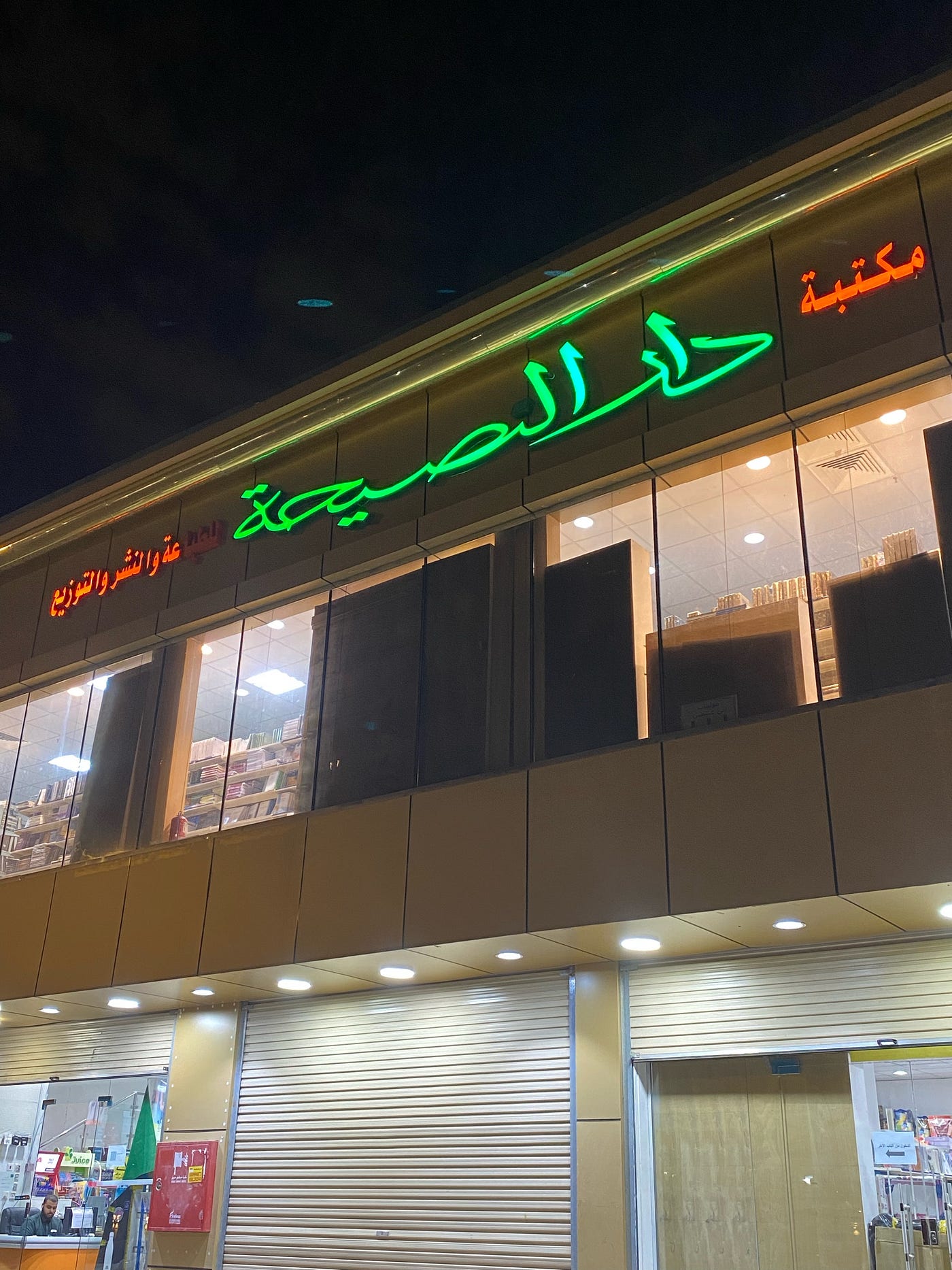
Al-Maktabah Dār al-Naṣīḥah
This store is large and well organised. The ground floor consists mainly of stationery and other school essentials, while the first floor houses a serious and well-stocked library.
The shelves are carefully categorised and sub-categorised. Under fiqh, for example, works are organised according to the four madhāhib, and under ʿUlūm al-Qurʾān, one finds sections such as asbāb al-nuzūl. This layout is a real time-saver, especially when you are searching for something specific.
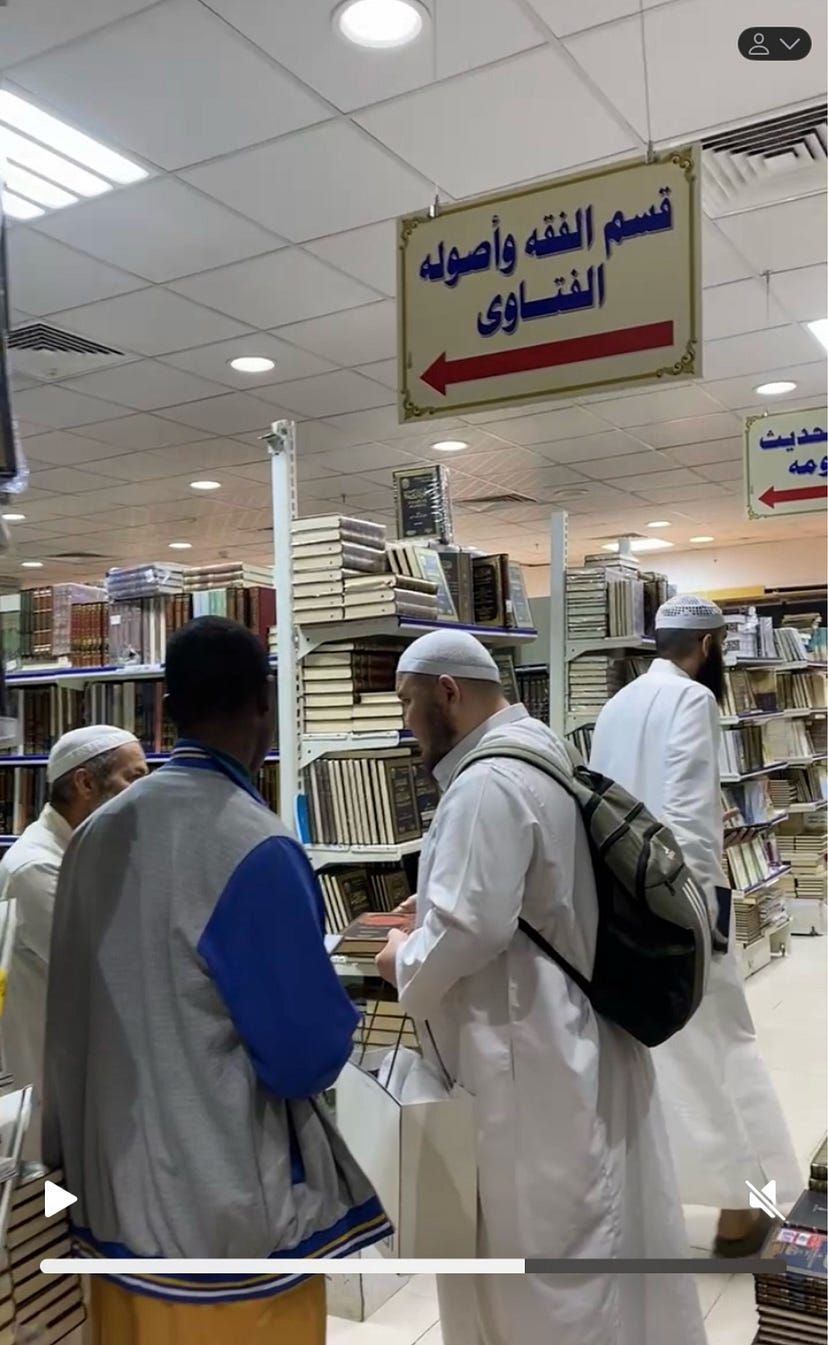
To my delight, I found a muṣḥaf in which the variations of the riwāyah of Shuʿbah are highlighted — exactly what I had been looking for. I also came across Ahsan al-Ṣuḥbah fī Riwayat Shuʿbah, which served as a fitting supplementary text.


I have always loved a good thrift, and before leaving, I noticed a one-riyāl basket near the exit. While rummaging through the pile, I noticed an old copy of Ṣafwat al-Tafāsīr by Shaykh ʿAlī al-Ṣābūnī — meaning the entire set would have cost a mere three riyāls.


The breadth of material in this bookstore was extensive, and someone more deeply versed in the Islamic sciences would undoubtedly uncover far more than what I have mentioned here.
Other Bookstores
I also visited four smaller bookstores all a stone’s throw from one another and from Dār al-Naṣīḥah. The staff I encountered were consistently helpful. When asked about a particular book, they knew exactly where to find it. Some of these shops also had bargain sections, which is helpful for those on a tighter budget.


Among the books I picked up were:
· The Characteristics and Virtues of the Family of the Prophet ﷺ and Their Rights by Dr. Ṭunaydib al-Fāyidī
· Masājid al-Buyūt, a discussion of the rulings and etiquette of praying at home
· Al-Fatḥ fī al-Ṣalāh, addressing the rulings and etiquette of correcting the imam during prayer
· The Dīwān of Imām al-Shāfiʿī, a compilation of his poetry
· Ṣafaḥāt min Ṣabr al-ʿUlamāʾ by ʿAbd al-Fattāḥ Abū Ghuddah, recommended to me by a friend, which explores the hardships scholars endured in their pursuit of knowledge
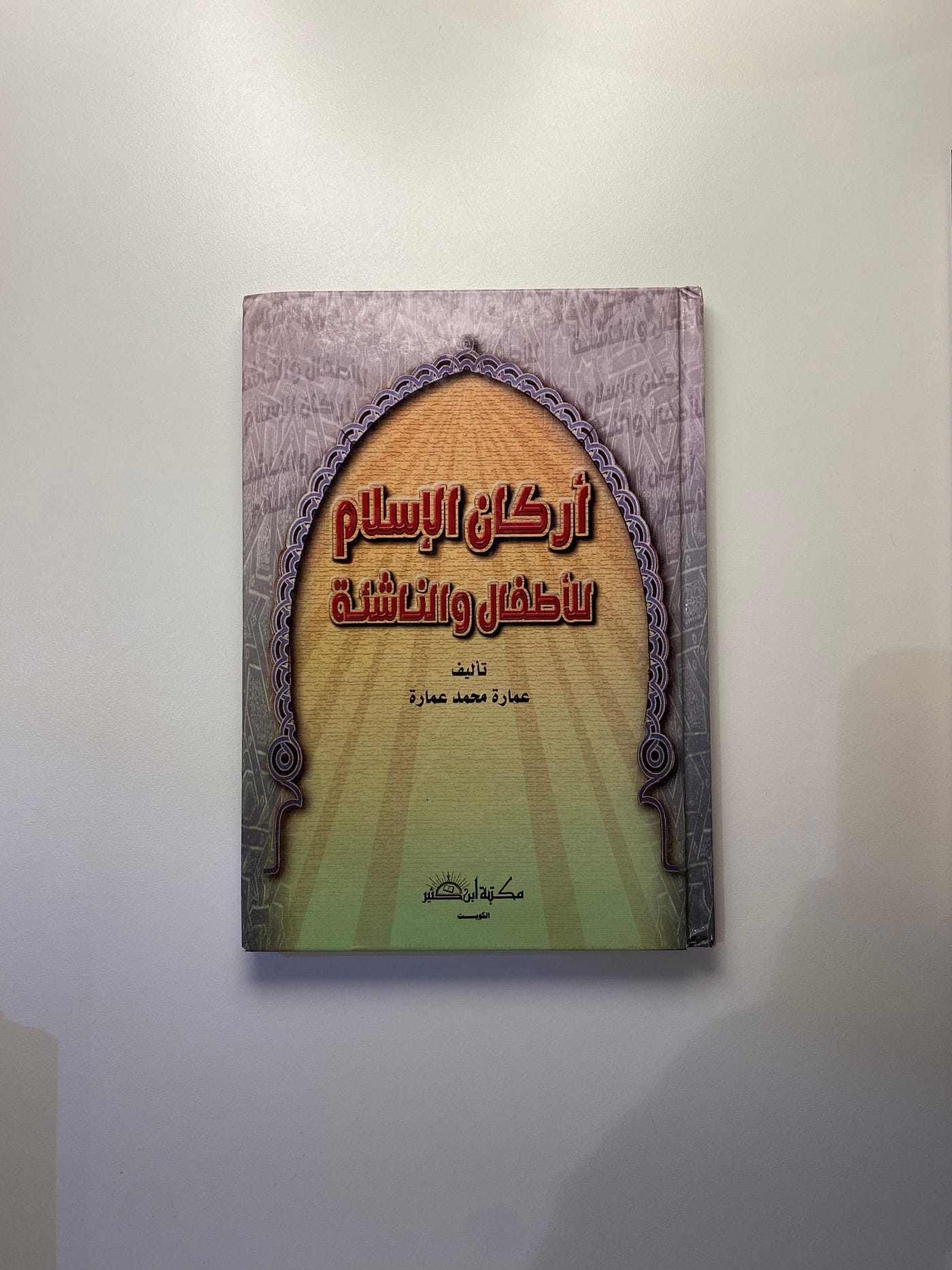
· For my daughter, Arkān al-Islām lil-Aṭfāl, which teaches the pillars of Islam through stories. I bought this hoping that she might be able to read it herself in the near future
· Finally, a copy of the well-known Al-Raḥīq al-Makhtūm by Ṣafī al-Raḥmān al-Mubārakpūrī. I had deliberately delayed purchasing this book so that I could acquire it in Madinah.


Concluding Thoughts
Spending time in the vicinity of Madinah University, and experiencing the vibrant scholarly atmosphere was beneficial in many ways. I felt fortunate to have access to such an abundance of books, but more importantly, I was reminded that access alone is not enough. What is more crucial is having the tools to unlock the knowledge contained within those books — chief among them, the Arabic language.
Observing students from across Africa, Central Asia, and Southeast Asia conversing with one another in fuṣḥā Arabic was comforting and reaffirming. Seeing the language bridge cultures and backgrounds reminded me that Arabic is a truly universal language and belongs not to a single people. It is the language of the Qur’an, a message addressed to all of mankind, and the language of Paradise. Learning it is not an act of imitation or cultural borrowing, rather it is a reconnection with a part of our identity that has long since been obscured by time and history.
Equally moving was seeing people from diverse walks of life frequent these spaces of learning. I noticed, for instance, a tow-truck driver stopping by to purchase books — a subtle reminder that the pursuit of knowledge is not confined to titles, professions, or institutions.
메타데이터
- post_id
- f02beb9f25eb
- slug
- visiting-bookstores-in-madina-f02beb9f25eb
- url
- https://medium.com/@achmadridhaa/visiting-bookstores-in-madina-f02beb9f25eb
- canonical_url
- https://medium.com/@achmadridhaa/visiting-bookstores-in-madina-f02beb9f25eb
- author_url
- https://medium.com/@achmadridhaa
- status
- ok
- fetched_at
- 2026-07-13 06:23:13