AI Routes Cut Delivery Costs 30%: Logistics Dev Guide
AI route optimization drives transport cost reductions and improves delivery efficiency by adjusting routes in real time based on traffic…
AI Routes Cut Delivery Costs 30%: Logistics Dev Guide
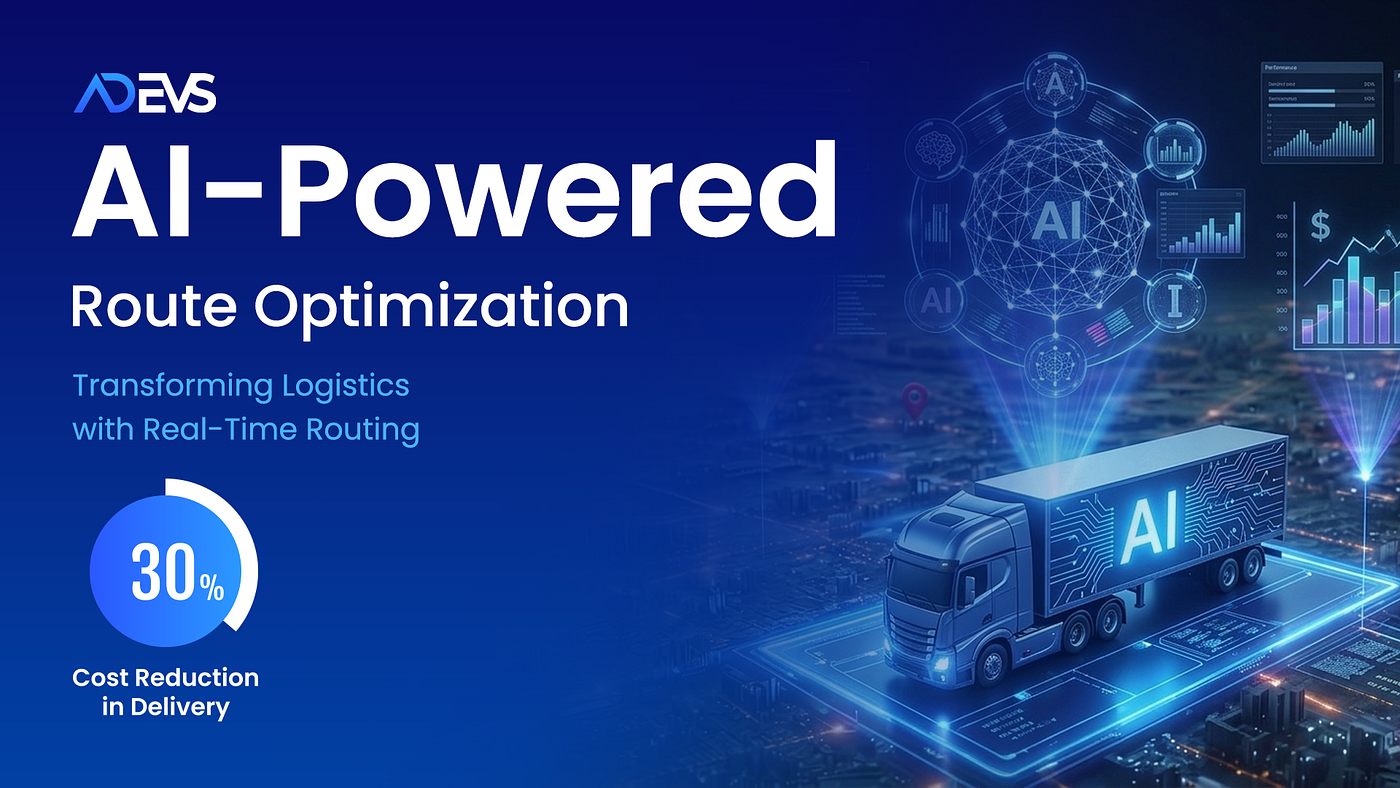
AI route optimization drives transport cost reductions and improves delivery efficiency by adjusting routes in real time based on traffic, capacity, and delivery constraints. Logistics operators using AI tools report improved performance and cost savings.
McKinsey’s 2025 analysis shows that AI in supply chains enhances forecasting, planning, and execution, resulting in better visibility, speed, and responsiveness across logistics. AI-driven technologies help reduce logistics costs and improve operational performance.
However, many organizations see only modest improvements because they treat AI as a tool rather than a system-wide change. The key to success lies in proper implementation, data integration, and change management. This guide explains how to deploy AI routing that works in real-world logistics environments.
Why Traditional Route Optimization Falls Short

Traditional routing software uses variants of the Vehicle Routing Problem (VRP) algorithm. These work well for static, predictable environments but break down in real-world logistics:
Problem 1: Static optimization
Routes are planned once daily based on known deliveries. Real-world changes (new orders, traffic, vehicle breakdowns, customer availability) require manual intervention and dispatcher judgment.
Problem 2: Limited variables
Traditional systems optimize for distance or time. Real reality involves 20+ variables: fuel costs, driver hours of service, customer delivery windows, vehicle capacity constraints, traffic patterns, weather conditions, delivery priorities, return loads, and more.
Problem 3: No learning
Routes don’t improve over time. The algorithm applies the same logic regardless of historical outcomes. Failed deliveries, consistent delays, and customer preferences don’t inform future planning.
Problem 4: Batch processing
Routes are calculated in batch overnight. Real-time changes require replanning from scratch or manual dispatcher adjustments.
Real example:
A food distributor using traditional routing software planned routes at 6 PM for next-day delivery. By 8 AM, 15–20% of routes needed manual adjustment due to:
- New rush orders received overnight
- Drivers calling in sick
- Vehicle maintenance issues
- Customer cancellations or reschedules
Dispatchers spent 2–3 hours daily fixing routes. The “optimized” plans were obsolete before trucks left the yard.
What AI-Powered Routing Actually Does

AI routing transforms static planning into continuous optimization:
Real-time adaptation: Routes update automatically as conditions change. New orders integrate seamlessly. Traffic delays trigger proactive rerouting. Driver availability changes dynamically adjust assignments.
Multi-objective optimization: Simultaneously optimizes for cost, time, customer satisfaction, driver fairness, environmental impact, and business priorities. Machine learning weights these objectives based on business outcomes.
Predictive planning: Predicts traffic, delivery duration, customer availability, and potential delays using historical data and ML models. Routes account for predicted conditions, not current state.
Continuous learning: Every delivery outcome trains the model. Actual delivery times, traffic conditions, customer interactions, and driver performance feed back into routing decisions.
Constraint satisfaction: Handles complex real-world constraints traditional algorithms struggle with: driver skills, vehicle equipment requirements, customer preferences, regulatory limits, and business rules.
Technical Architecture for AI Routing
Modern AI routing systems typically implement this architecture:
Data layer:
- Historical delivery data (times, locations, outcomes)
- Real-time traffic feeds (Google, HERE, TomTom)
- Weather data and forecasts
- Customer data (delivery windows, access constraints, preferences)
- Vehicle data (capacity, equipment, location, fuel efficiency)
- Driver data (skills, hours of service, performance metrics)
ML models:
- Delivery duration prediction (time at each stop)
- Traffic delay prediction (route-specific forecasts)
- Customer availability prediction (when they accept deliveries)
- Demand forecasting (which areas need capacity when)
- Failed delivery prediction (identifying high-risk deliveries)
Optimization engine:
- Multi-objective genetic algorithms or reinforcement learning
- Constraint satisfaction solvers
- Real-time route recalculation (sub-minute latency)
- What-if scenario modeling for planning
Integration layer:
- TMS/WMS integration for order data
- Telematics integration for vehicle location and status
- Mobile apps for driver updates and proof of delivery
- Customer notification systems for ETA updates
Implementation Case Study: Regional LTL Carrier

Starting point:
160 trucks serving 8-state region. Traditional routing software planned routes using distance optimization. Routes took 6 hours to calculate nightly and required 3–4 hours daily dispatcher intervention.
Key metrics:
- Average delivery cost: $18.50 per stop
- On-time delivery: 78%
- Route plan accuracy: 62% (percent of routes executed as planned)
- Dispatcher overtime: 15–20 hours weekly
AI routing implementation:
Phase 1 (Months 1–2): Data preparation
Cleaned and standardized 18 months of historical delivery data:
- 480,000 completed deliveries
- Actual vs planned delivery times
- Traffic conditions during deliveries
- Weather data correlation
- Driver performance metrics
Built training datasets for ML models:
- Delivery duration prediction model (trained on 380K deliveries)
- Failed delivery prediction model (trained on 12K failed attempts)
- Customer availability patterns (trained on delivery window compliance data)
Phase 2 (Month 3): Model development
Developed four core ML models:
Delivery time prediction:
- Inputs: Address, time of day, day of week, weather, historical patterns, driver
- Output: Predicted delivery duration with confidence interval
- Accuracy: 87% within +/- 5 minutes on test set
Traffic delay prediction:
- Inputs: Route segment, time, day, weather, real-time traffic feeds
- Output: Expected delay and variability
- Accuracy: 82% within +/- 3 minutes on test set
Failed delivery prediction:
- Inputs: Customer history, delivery window, driver, time, weather
- Output: Failure probability and likely reason
- Accuracy: 76% precision, 68% recall on test set
Route quality scoring:
- Inputs: Proposed route characteristics
- Output: Predicted cost, on-time performance, customer satisfaction
- Used to evaluate route options during optimization
Phase 3 (Month 4): Integration and pilot
Integrated AI routing with existing systems:
- TMS API integration for order data
- Telematics integration for vehicle tracking
- Driver mobile app updates for dynamic routing
- Customer portal updates for accurate ETAs
Piloted on 20 trucks (12% of fleet) serving one region. Ran parallel with existing routes for 4 weeks to validate.
Phase 4 (Months 5–6): Rollout and optimization
Expanded to full fleet over 8 weeks. Continuous model retraining based on actual outcomes.
Implementing comprehensive logistics software development practices ensured the system integrated seamlessly with existing operations while maintaining data quality needed for AI effectiveness.
Results after 12 months:
Cost reduction:
- Average delivery cost: $18.50 → $12.95 per stop (30% reduction)
- Annual savings: $2.52M on $8.2M transportation spend
- Dispatcher overtime: 15–20 hours weekly → 4–6 hours weekly
- Fuel efficiency: 14% improvement through optimized routing
Performance improvement:
- On-time delivery: 78% → 96%
- Route plan accuracy: 62% → 91%
- Failed first-delivery attempts: 12% → 5%
- Customer satisfaction (NPS): +23 points
Operational benefits:
- Route planning time: 6 hours → 12 minutes
- Real-time route adjustments: Manual → Automated
- Driver route adherence: 68% → 94%
- New order integration: Hours → Minutes
Pro Tip: Start with a single geographic region or customer segment for pilot. Prove ROI before full rollout to build internal support and refine implementation.
Technical Implementation Details

Data requirements:
Minimum data for effective AI routing:
- 6–12 months historical delivery data
- GPS coordinates for all delivery locations
- Actual delivery times (not just planned times)
- Order characteristics (weight, volume, special requirements)
- Vehicle specifications (capacity, equipment, fuel type)
- Driver data (skills, preferences, performance)
Computation requirements:
Real-time routing requires:
- Sub-minute route recalculation for 100–200 stops
- Continuous optimization running 24/7
- Scalable infrastructure handling 500+ vehicles
- Low-latency integration with mobile devices
Cloud infrastructure costs:
- Small operation (50–100 vehicles): $2K-4K monthly
- Medium operation (200–500 vehicles): $8K-15K monthly
- Large operation (1000+ vehicles): $25K-50K monthly
Model training and maintenance:
Initial model development:
- 2–3 months for data preparation and model training
- Requires data science expertise (ML engineering, logistics domain knowledge)
- Testing and validation before production deployment
Ongoing maintenance:
- Weekly or monthly model retraining with new data
- Continuous monitoring for model drift
- A/B testing new model versions against production
- Performance tracking and alerting
Integration complexity:
Typical integrations required:
- TMS/ERP for order management
- WMS for inventory and picking
- Telematics for vehicle tracking
- Mobile apps for driver communication
- Customer portals for delivery updates
- Accounting systems for cost tracking
Integration timeline:
- Simple integrations (APIs available): 2–4 weeks
- Complex integrations (custom development): 2–3 months
- Legacy system integration: 3–6 months
Common Implementation Challenges
Challenge 1: Data quality issues
Most Logistics Company discover their historical data has quality problems:
- Missing or incorrect GPS coordinates
- Incomplete delivery time records
- Inconsistent address formats
- Lack of failed delivery documentation
Solution: Invest 4–8 weeks in data cleanup before model training. Implement data quality processes going forward.
Challenge 2: Change resistance
Experienced dispatchers resist AI routing, believing manual judgment is superior. Drivers resist dynamic routing that changes their familiar routes.
Solution: Involve dispatchers and drivers in pilot design. Show performance data demonstrating improvements. Implement gradually with manual override options initially.
Challenge 3: Integration limitations
Legacy TMS or WMS systems may lack APIs or real-time data access needed for AI routing.
Solution: Evaluate integration options early. Budget for custom logistics integration development if needed. Consider phased approach using manual data bridges initially.
Challenge 4: Model accuracy in edge cases
AI models trained on historical data struggle with novel situations: new delivery areas, unusual weather events, pandemic-level disruptions.
Solution: Implement model confidence scoring. Human oversight for low-confidence scenarios. Continuous retraining as edge cases become normal cases.
Build vs Buy Decision Framework
Build in-house when:
- Highly specialized routing requirements unique to your business
- Large scale operation (500+ vehicles) justifying investment
- Strong internal data science and engineering capability
- Competitive advantage from proprietary routing logic
- Budget for 12–18 month development timeline
Buy commercial solution when:
- Standard logistics operations (last-mile, LTL, FTL)
- Small to medium scale (under 500 vehicles)
- Limited internal AI/ML expertise
- Need faster time-to-value (3–6 months)
- Ongoing vendor support and updates preferred
Hybrid approach:
- Commercial platform as foundation
- Custom ML models for specific predictions
- Proprietary business rules and constraints
- Integration with existing systems
Most organizations achieve best ROI with commercial platforms customized to specific needs rather than building from scratch.
Measuring ROI
Track these metrics to validate AI routing value:
Cost metrics:
- Cost per delivery (total transportation cost / deliveries)
- Fuel efficiency (miles per gallon fleet average)
- Labor efficiency (deliveries per driver hour)
- Vehicle utilization (percent of capacity used)
Performance metrics:
- On-time delivery percentage
- Failed first-delivery attempts
- Route plan adherence (actual vs planned routes)
- Customer satisfaction scores
Operational metrics:
- Route planning time
- Dispatcher intervention frequency
- Real-time route adjustments handled automatically
- Order-to-route assignment time
ROI calculation:
Annual transportation spend reduction
- Labor efficiency gains (overtime reduction, productivity improvement)
- Customer satisfaction improvement value (retention, new business)
- Asset utilization improvement (fewer vehicles for same volume)
- AI routing platform costs
- Integration and implementation costs = Net annual value
Typical ROI: 200–400% in year one for successful implementations.
The Development Roadmap
Months 1–2: Foundation
- Data audit and quality assessment
- Historical data cleanup and standardization
- Requirements definition and success metrics
- Platform selection (build vs buy decision)
Months 3–4: Core development
- ML model training (duration prediction, traffic forecasting)
- Optimization engine development or configuration
- Integration design and API development
- Pilot plan and success criteria
Months 5–6: Pilot and validation
- Limited rollout (one region or 10–20% of fleet)
- Performance monitoring and model tuning
- User feedback collection and refinements
- ROI validation before full deployment
Months 7–9: Full deployment
- Phased rollout to complete fleet
- Training and change management
- Integration completion
- Process documentation
Months 10–12: Optimization
- Continuous model retraining
- Feature enhancements based on usage
- Scaling and performance optimization
- Full ROI realization
The 2026 Logistics Reality
AI route optimization has matured from experimental to production-ready. Organizations implementing it properly achieve 25–35% cost reductions consistently.
The key differentiator isn’t the algorithm. It’s the implementation approach: data quality, change management, proper integration, and continuous improvement.
The companies achieving 30%+ savings:
- Started with clear ROI targets and measurement
- Invested in data quality upfront
- Piloted before full deployment
- Involved operational teams in design
- Continuously optimized based on outcomes
The competitive advantage goes to logistics providers who can deliver lower costs, better on-time performance, and superior customer experience simultaneously. AI routing makes that combination achievable.
Start with your current routing pain points. Calculate the cost of manual dispatching, failed deliveries, and suboptimal routes. That’s your opportunity. Then implement AI routing systematically to capture it.
The 30% cost reduction is replicable with proper planning and execution.
메타데이터
- post_id
- f04d943ef8e1
- slug
- ai-routes-cut-delivery-costs-30-logistics-dev-guide-f04d943ef8e1
- url
- https://medium.com/@adevsinc/ai-routes-cut-delivery-costs-30-logistics-dev-guide-f04d943ef8e1
- canonical_url
- https://medium.com/@adevsinc/ai-routes-cut-delivery-costs-30-logistics-dev-guide-f04d943ef8e1
- author_url
- https://medium.com/@adevsinc
- status
- ok
- fetched_at
- 2026-06-29 01:02:39