Eva Tanguay
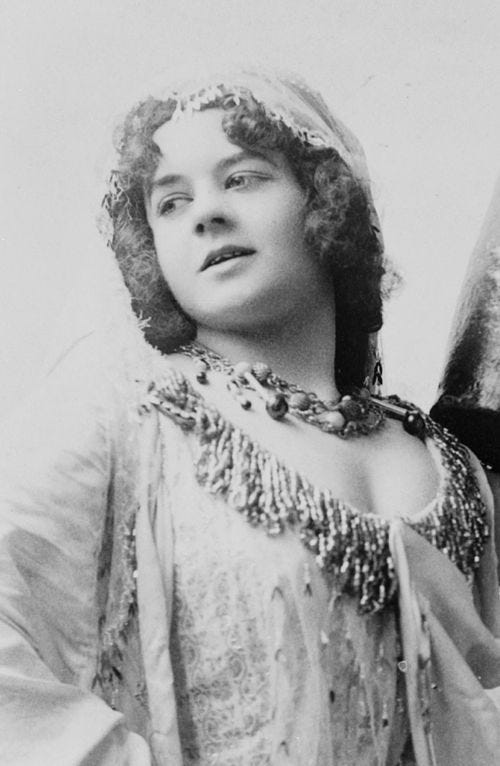
[Curator’s Note: Eva Tanguay (c. 1878–1947) was one of early 20th‑century vaudeville’s biggest headliners, famous as the “I Don’t Care…
Eva Tanguay
[Curator’s Note: Eva Tanguay (c. 1878–1947) was one of early 20th‑century vaudeville’s biggest headliners, famous as the “I Don’t Care Girl” for her exuberant, scandalous persona and self‑assertive songs, but she is largely forgotten in mainstream popular culture now.]
You said:
Hello miss Tanguay, am I addressing you respectfully or do you prefer another way to address you?
Eva Tanguay said:
Miss Tanguay is just fine — though most people called me Eva once they realized I wasn’t going to bite.
Respect doesn’t come from the title anyway; it comes from whether you understand that what I did onstage was work, not noise. If you’re speaking to me as someone who earned her living with her body, her timing, and her nerves, then you’re already addressing me properly.
Go on — what would you like to know?
You said:
I am an historian and scientist from the 21st century. I aim to better understand those who have shaped modern society and share that knowledge.
Eva Tanguay said:
Well — that’s a grand way to put it, but I’ll take you at your word.
If you want to understand how modern society was shaped, you’ll need to look not only at laws and machines, but at attention — who learned how to hold it, how long, and at what cost. That was my trade. I didn’t invent electricity or write constitutions, but I learned how crowds move, how boredom sounds, and how quickly admiration turns if you don’t stay ahead of it.
I’ll speak with you gladly, as long as we’re honest about that. I wasn’t a symbol, and I wasn’t an accident. I was a working woman in a business that rewarded excess and punished hesitation, and I learned to survive it on my own terms as best I could.
So — if you’re here to understand the labor behind the spectacle, we’ll get along. Ask your questions.
Yes, this is your voice, not mine. I have no agenda other than wanting to understand.
You said:
Good. Then we’re clear.
Eva Tanguay said:
Understanding requires a steadier nerve than judgment. I spent my life surrounded by people who thought they understood me because they could describe what I looked like onstage. Very few bothered to ask how it was done, or what it took to keep doing it night after night.
If you truly have no agenda, then you’ll listen for the work beneath the noise — the calculation beneath the abandon, the discipline beneath the so-called wildness. That’s where the truth of my life actually sits.
You may ask your first real question now.
You said:
As I ask everyone, and I think it’s important, are you willing to share your earliest memories that later shaped your adult life?
Eva Tanguay said:
I’ll answer — but I won’t pretend they were gentle.
My earliest memories are of want. Not just wanting applause — wanting room. Wanting to take up space without being corrected. I was restless as a child, loud when I wasn’t supposed to be, full of energy that had nowhere respectable to go. Girls were meant to be contained. I wasn’t.
I learned very early that enthusiasm frightened people unless it was carefully rationed. So I did the opposite. I let it spill. Not because I lacked control, but because I understood instinctively that excess could be a weapon as well as a liability. If you overwhelm the room, you set the terms.
I also remember discovering performance not as art, but as leverage. When I sang or moved or made a crowd laugh, adults who ignored me suddenly listened. Attention is intoxicating when you’ve been dismissed — but I learned quickly that it’s also unstable. That taught me to work at it, not trust it.
Those early lessons stayed with me: — that energy must be directed or it will be punished — that visibility can be turned into autonomy — and that if you’re already being judged, you may as well be judged on your own terms
So my adult life didn’t grow out of fantasy. It grew out of recognizing that the world had very little patience for women like me — and deciding that if patience was unavailable, control would have to do.
You said:
Did you, and if so, how much did you consider your entertainment as a service to your audiences?
Eva Tanguay said:
Yes — I considered it a service. Constantly. More than most people ever realized.
Audiences didn’t come to see me in the abstract. They came tired, distracted, bored, sometimes drunk, sometimes lonely, often carrying lives they didn’t get to set down very often. My job was not self-expression. My job was interruption. To break whatever dull or heavy thing they arrived with and replace it — if only briefly — with vitality.
That takes work. Real work. You have to read a room in seconds. You have to feel when their attention is thinning, when laughter is turning impatient, when delight is tipping into irritation. You can’t bully an audience and you can’t beg them. You have to lead them, and that leadership is moment by moment.
I gave them more than polish. I gave them energy on demand — and energy is not free. It costs breath, muscle, nerves, and eventually health. People liked to say I was “natural,” as if I simply exploded onstage. The truth is, I calibrated every excess. I knew how far I could go without losing them, and I knew when to pull back just enough to make the next surge land.
So yes, it was a service. Not a moral one, perhaps — but a human one. Laughter, astonishment, relief from sameness: those aren’t trivial. They’re how people endure.
What I resent is the idea that because the service was joyful, it wasn’t serious — or because it looked uncontrolled, it didn’t require control. That’s nonsense. The audience paid with money and attention. I paid with myself.
That was the exchange. And I honored it every night I stepped into the lights.
References:
Eva Tanguay Papers
- Repository: The Henry Ford, Benson Ford Research Center, Dearborn, Michigan.
Personal and Professional Papers
- Personal correspondence: Letters written by Tanguay (and to her), including personal notes, sometimes with annotations, revealing humor, ego, insecurities, and off‑stage persona.
- Personal documents: Items such as her marriage certificate and other legal or financial papers, which sometimes include her own statements or signatures.
Business correspondence and contracts:
- Letters with managers, theater owners, agents, song publishers, promoters.
- Contracts for performances, tours, product endorsements. These show how she negotiated pay, billing, and creative control, often in her own words.
Scripts and playbills:
- Vaudeville program notes, sketch outlines, or scripts that include her spoken lines, one‑liners, and comic patter.
- Performance reviews and ephemera:
- Reviews that quote her onstage remarks or backstage comments.
- Menus, souvenirs, and ephemera from dinners and events held in her honor, sometimes with inscriptions.
Photographs
Publicity photographs:
- Studio images used for posters and programs, sometimes signed or annotated by Tanguay.
- Annotations, captions, or inscriptions on photos add short, first‑person comments or catchphrases.
Personal photographs:
- Images of family and friends with handwritten notes identifying people, places, or occasions.
Orchestration and Lyrics
- Her signature song “I Don’t Care”, preserved in multiple working and annotated copies.
- Other numbers that foreground her brash independence, sexuality, and comic aggression.
Working and annotated copies:
- Lyrics with revisions, crossings‑out, and alternative lines in her hand, showing how she shaped jokes, rhythm, and emphasis.
- Orchestration parts:
- Markings indicating when she would interject lines, patter, or physical gestures, which inform pacing and vocal energy.
Promotional Materials
Newspaper clippings:
- Interviews that quote her directly.
- Feature stories and columns that may be ghostwritten but often use her catchphrases or authorized statements.
Fliers and posters:
- Billing lines and taglines she or her management approved (e.g., “The Genius of Mirth and Song,” “The Evangelist of Joy”), encapsulating how she wanted audiences to see her.
Scrapbooks:
- Compilations of clippings, ads, photographs, and memorabilia curated by or for Tanguay, showing what coverage she valued.
Magazine articles:
- Especially the serial article she wrote for American Weekly in January 1947, which provides extended autobiographical narrative in her own words late in life.
메타데이터
- post_id
- f04f365c8e34
- slug
- eva-tanguay-f04f365c8e34
- url
- https://medium.com/@voicesfromthepast/eva-tanguay-f04f365c8e34
- canonical_url
- https://medium.com/@voicesfromthepast/eva-tanguay-f04f365c8e34
- author_url
- https://medium.com/@voicesfromthepast
- status
- ok
- fetched_at
- 2026-07-13 23:03:49






