The AI Cost Paradox
Why Healthcare’s Unsexy Operations Are Becoming an Algorithmic Arms Race
The AI Cost Paradox
Why Healthcare’s Unsexy Operations Are Becoming an Algorithmic Arms Race
July 2026
by Marta G. Zanchi
“The slowdown in medical spending growth is not only large substantively, it is unprecedented historically. Since the advent of systematic data on medical spending in 1960, no 14-year period has seen as slow growth of medical spending relative to GDP as was realized over the 2010–24 time period. […] Technology is no longer as vital a driver of increased spending.” by David M. Cutler & Lev R. Klarnet, in: Has the United States Bent the Health Care Cost Curve? https://www.nber.org/papers/w35231
Once again, we are faced with macroeconomic figures that should alarm every employer and policymaker in the country. In 2025, the United States spent $5.7 trillion on healthcare, which is a 7.3% increase from the previous year. This marks the third consecutive year of growth above 7%, according to the Office of the Actuary at CMS. Healthcare now consumes 18.4% of GDP, up from 18% in 2024. CMS projects that by 2034, this figure will reach 20.6%, translating to roughly $9 trillion flowing into a single sector.
When experts are asked to identify the causes of this ongoing crisis, they often mention the same factors: the rapid increase in GLP-1 usage, the aging baby boomer generation, the aggressive consolidation of hospitals, and the fact that the U.S. pays higher prices for many medical procedures, from common medications like aspirin to complex surgeries like open heart surgery. These are all real, undeniable drivers.
However, a less obvious, more subtle force is steadily driving up costs from within. Artificial intelligence, deployed across the administrative machinery of American medicine, is being adopted both to contain spending and, paradoxically, to amplify it.
To identify the real healthtech prospects for the next ten years, we need to look beyond the surface-level marketing of operational efficiency. We must examine how software behaves when it interacts with a fee-for-service reimbursement structure that rewards volume and documented complexity over actual clinical outcomes.
Part I: The Invisible Victory (Bending the Macro Curve)
Before examining why artificial intelligence is driving prices higher, it is important to understand the historical backdrop of healthcare spending projections. For decades, the consensus among economists was that healthcare costs were an untamable beast. However, in May 2026, David M. Cutler and Lev R. Klarnet published a landmark National Bureau of Economic Research (NBER) working paper that challenged this fatalism. They asked a fundamental question: Has the United States bent the healthcare cost curve?
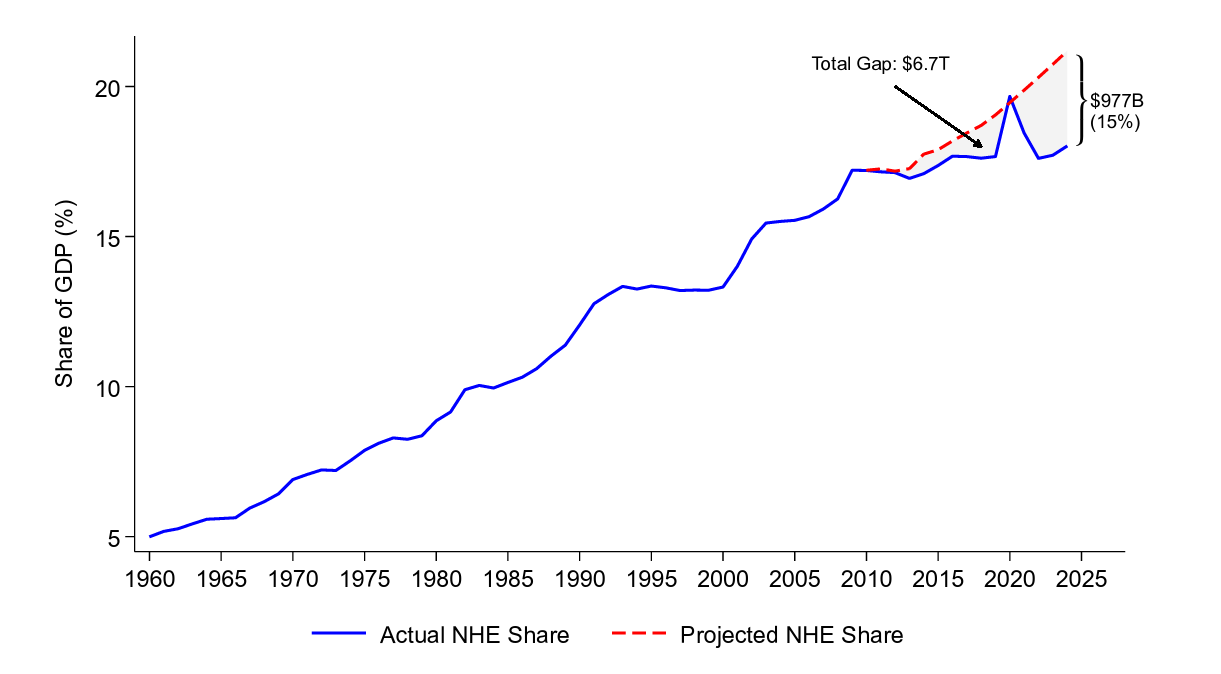
Medical Spending as a Share of GDP and Forecasts, 1960–2024. Source CMS NHE Fact Sheet.
The answers they uncovered were surprising. In 2010, when the Affordable Care Act was enacted, CMS actuaries forecast that medical spending would climb to 19% of GDP by 2019, outpacing economic growth by 2.2 percentage points each year. Had these growth trends continued uninterrupted through 2024, healthcare spending would have reached 21.2% of the GDP, amounting to $6.3 trillion.
However, in reality, national healthcare spending in 2024 was “only” 18.0% of GDP. This figure is 15% lower than state-of-the-art models predicted. This deviation yielded annual savings of nearly $1 trillion in 2024 alone and a cumulative reduction of $6.7 trillion between 2011 and 2024.
This slowdown is unprecedented since systematic data collection began in 1960. It defies three dominant economic theories of medical cost inflation: Baumol’s cost disease (which states that slow labor productivity in healthcare leads to higher prices to retain workers), the luxury goods theory (which claims that spending increases disproportionately as a society becomes richer), and the theory of unchecked technological expansion.
Cutler and Klarnet claim that this massive multi-trillion-dollar gap was driven by five main structural factors:
1. Cost-saving technology (14% of the slowdown): Innovation shifted toward changes that improve health and lower delivery costs simultaneously. The clearest example is the shift of major surgeries from inpatient hospital stays to outpatient departments and ambulatory surgery centers.
2. Improved population health (9% of the slowdown): Age- and sex-adjusted health status improved due to long-term declines in smoking and better preventive care. This manifested as a sharp drop in urgent and emergency hospital admissions, particularly for acute cardiovascular events such as heart attacks and strokes.
3. Utilization Management and Demand-Side Shocks (28%-45% of the slowdown): The spread of high-deductible health plans and value-based reimbursement frameworks, such as Accountable Care Organizations (ACOs), as well as aggressive insurance-based restrictions, altered patient and provider behavior.
4. Long-Run Supply Elasticities (7% of the slowdown): Products became significantly cheaper over time as their markets matured. This includes massive patent expirations for blockbuster drugs, such as Lipitor and Plavix, and declining costs for advanced imaging equipment.
5. Slower Price Growth (27% of the slowdown): The annual rate of price increases across hospitals, physician services, and imaging dropped from historical highs to rates closer to general inflation.
This macro data points to an important lesson: the cost curve did not bend because of a single policy or sudden scientific breakthrough. It bent because the industry gradually modernized its unsexy infrastructure, shifting care to cheaper settings and using administrative levers to suppress unnecessary utilization.
Part II: The Algorithmic Re-inflation (The Upcoding Arms Race)
While the macroeconomic curve experienced a temporary period of slower growth, the microeconomic reality inside today’s hospital billing departments tells a different story. The hard-won operational savings of the past decade are currently threatened by how administrative software is implemented.
Consider the modern implementation of ambient AI scribes and automated coding tools. The standard venture capital pitch for these products is compelling. By capturing clinical conversations in real time, these platforms eliminate the manual data entry that causes widespread clinician burnout. They return time to physicians and eliminate administrative waste, which is estimated to account for 25% to 30% of total U.S. healthcare spending.
However, when these tools are used within a fee-for-service reimbursement framework, an immediate tension emerges. Recent commercial insurance reviews have documented that, when providers adopt ambient listening and automated coding systems, the software captures a level of clinical specificity and documentation detail that rushed human doctors would routinely omit.
If a patient has a complex chronic condition, for example, the algorithm ensures that every secondary diagnosis, complication, and severity marker is logged exhaustively in the electronic health record (EHR). In a system where insurance payouts are tied directly to documented clinical complexity, better documentation automatically leads to higher-reimbursing codes.
This is not fraud. The patient actually has the underlying illness. However, the systemic result is an artificial increase in the average severity per claim without a corresponding increase in the volume or quality of care delivered. It is tech-enabled upcoding on a large scale.
The economic impact of this phenomenon is already visible. Historical data from Cutler and Klarnet show that, even before widespread automation, traditional manual upcoding and optimization of clinical documentation software added 3% to inpatient hospital expenditures. Now, with automated software processing millions of clinical encounters daily, this inflationary pressure is accelerating. A recently published PwC study found that about 70% of health plans cite the rapid adoption of provider-side AI coding tools as a primary cause of rising medical costs.
This has triggered a defensive response from private insurers. They are realizing that they cannot audit these automated submissions using human claims processors alone. In response, health plans are deploying their own specialized algorithms to scan incoming provider data, cross-reference documentation histories, flag statistical anomalies, and systematically deny or reduce automated claims.
The industry is entering into a costly and consequential algorithmic competition. On one side, provider-side algorithms optimize documentation to maximize contractual revenue. On the other side, payer-side algorithms audit that same documentation to maximize claim rejections. Millions of dollars of venture capital are funding opposing lines of code that neutralize each other, providing no clinical value to patients while increasing administrative overhead costs.
Part III: Augmentative Fluff vs. Structural Economics
For healthtech investors and founders, this arms race reveals a distinction between two types of software companies.
The first generation of healthcare automation has largely been augmentative. These tools are designed to sit on top of existing workflows, making human workers more productive within traditional fee-for-service models. Examples include ambient scribes that accelerate charting, radiologist triage tools that flag specific scans, and automated tools that help billers clear backlogs.
While these applications solve immediate operational pain points for providers, their financial value is cyclical and easily captured by incumbents. For example, if an ambient scribe becomes a feature built directly into the operating system or the core EHR platform, such as Epic or Oracle, the standalone software vendor loses its pricing power. More importantly, because these augmentative tools operate within the old incentives of the fee-for-service architecture, they ultimately contribute to the inflationary friction of the system by generating higher volumes of optimized billing data.
The real venture opportunity lies in the shift toward transformative software. These platforms are designed to alter the underlying labor and economic factors of administrative tasks. They don’t just help humans do old work faster; they automate entire back-office processes without human oversight, fundamentally changing the cost of operations.
We are beginning to see this transition play out in pharmaceutical commercialization and regulatory compliance. For example, Veeva Systems recently acquired Copli, an automated platform built for medical, legal, and regulatory reviews. Copli was relaunched as Veeva Falcon MLR. Historically, reviewing promotional and medical content against local compliance frameworks required weeks of manual labor from specialized legal and medical teams, creating a persistent bottleneck in commercial drug launches. Veeva projects that, by deploying autonomous agents to evaluate content directly against approved labels and regional statutes, the platform can eliminate 70% or more of the manual labor required for MLR cycles, compressing timelines from weeks to hours.
When software eliminates entire units of labor rather than merely optimizing a billable encounter, it has a deflationary effect. This mirrors the structural efficiencies that Cutler and Klarnet highlighted in their macroanalysis, such as the historic shift of major joint replacement surgeries to outpatient facilities.
In the late 2010s, total knee and hip replacements were moved off Medicare’s Inpatient Only list because minimally invasive surgical techniques reduced recovery time and tissue damage. This technological advance enabled providers to transfer over three-quarters of these common procedures to outpatient departments and ambulatory surgery centers by 2024. Since the cost of an outpatient procedure is approximately 40% lower than an inpatient stay, this operational shift alone accounted for 18% of the total Medicare cost slowdown.
Technology companies should take note: lasting economic value is created when software changes the delivery model to reduce total costs, not when it tweaks a billing code to get a higher price from a payer.
Part IV: The Venture Capital Playbook for Provider Operations
As private commercial medical costs are projected to increase by 9.0%, employers and risk-bearing entities are demanding immediate, hard-dollar ROI on their technology expenditures. For startups looking to build defensible businesses in this environment, the playbook requires moving away from point solutions and building foundational infrastructure for a post-fee-for-service stack.
The most compelling vectors for capital allocation are concentrated across four unsexy operational areas:
Autonomous Prior Authorization: The current prior authorization framework places a significant administrative burden on the American medical system, costing billions of dollars in manual review cycles. Platforms that can sit between payer rulesets and clinical documentation and utilize automated agents to clear authorizations without manual paperwork or human intervention have the opportunity to capitalize on this.
AI-native revenue integrity: Rather than building software that helps billing teams fight claims rejections after the fact, the goal is to build automated infrastructure that ensures claims are processed cleanly and accurately the first time. By integrating deeply with clinical data streams, these engines can eliminate the 15% to 20% error rates that lead to structural rework and administrative waste.
Real-time payer-provider reconciliation can eliminate the financial disputes and delayed payment cycles that plague the relationship between insurers and health systems. Platforms that enable real-time matching of adjudicated claims against expected reimbursement can eliminate the need for thousands of back-office hours spent on manual reconciliation.
- Data Portability and Interoperability Infrastructure: The technical layer required to move clinical and administrative data on demand is finally reaching critical mass. The number of documents exchanged across the federal TEFCA network increased from 10 million to nearly 500 million, signaling that the underlying data infrastructure is solidifying. The next generation of value will be captured by intelligence platforms that translate this raw data liquidity into actionable, compliant operational workflows.
In this landscape, enterprise buyer standards are shifting. Operational accuracy, not clinical diagnostic perfection, is the benchmark that matters for enterprise adoption. A model does not need to outperform a board-certified radiologist to deliver immediate financial value. Rather, it must process a prior authorization, clear a denied claim, or route an unstructured clinical document more reliably, cheaply, and quickly than a human worker in a back-office cubicle.
Conclusion: The $5.7 Trillion Question
NBER data proves that the United States can bend its healthcare cost curve when structural incentives, innovations in care settings, and operational controls are aligned. Slower growth is possible, but not guaranteed. Recent spending increases in 2024 and 2025 remind us that the system naturally defaults to inflation if left unchecked.
The $5.7 trillion question for today’s technology founders and venture capitalists is not whether automated tools can boost productivity. The question is how we choose to apply them.
If we just use software to patch the flaws of an obsolete fee-for-service model — automating upcoding for providers and accelerating denials for payers — we will perpetuate a cost structure that employers and patients cannot afford. However, if we build automated infrastructure that changes how administrative and operational work is processed, we won’t just optimize the old system. We will redefine its economics entirely.
by Marta
메타데이터
- post_id
- f065bce3e18d
- slug
- the-ai-cost-paradox-f065bce3e18d
- url
- https://medium.com/ninacapital/the-ai-cost-paradox-f065bce3e18d
- canonical_url
- https://medium.com/ninacapital/the-ai-cost-paradox-f065bce3e18d
- author_url
- https://medium.com/@martagaiazanchi
- status
- ok
- fetched_at
- 2026-08-11 19:31:38





