Lost Bones #4 (A Dip with the Sea Creatures)
Minnesota’s Megafauna Fossil Shortage (Equus)
Lost Bones #4 (A Dip with the Sea Creatures)
Minnesota’s Megafauna Fossil Shortage (Equus)
In 1945, Clifford R. Stauffer published Some Pleistocene Mammalian Inhabitants of Minnesota in The Journal of the Minnesota Academy of Science, Vol. 13, №1. In it, he describes the discovery of a tarsal bone from an ancient horse, possibly Equus caballus, unearthed in October 1939 by the McCarthy Well Drilling Company at a depth of 31 feet. The bone was recovered from unconsolidated glacial deposits, “drift,” during the installation of a city well in Marshall, Minnesota.
Equus caballus is the species known today as the domestic horse. However, in Pleistocene North America, its ancestors, caballoid horses, are believed to have emerged as the dominant equine lineage between one million and 500,000 years ago.
The current location of the Stauffer tarsal bone is unknown. He does not mention it further in the publication, and it has not been referenced in any subsequent scientific papers.
This is to my knowledge the closest scientifically documented representation of any possible Pleistocene Equus species specimen found in Minnesota. However, we know many of these horses’ Pleistocene megafauna counterparts were here. Mammoth, mastodon, multiple species of bison, and even the enigmatic, and proposed Minnesota State fossil Castorioides ohioensis, the Giant Beaver, which roamed Minnesota skimming the bottoms of the newly formed kettle lakes after the glaciers retreated. So where are all the Pleistocene horse bones today?
There are definitely candidates. If you’ve read some of my other Lost Bones posts here, you’ll know that I have a friend, Bill, who is an avid “bone hound.” He loves to walk the river valleys of southern Minnesota, looking for signs of Minnesota’s Pleistocene faunal past. Over the past six years, he has found many specimens and donated nearly 30 fragments of bone, teeth, or whole bones to the Science Museum of Minnesota. Several of these specimens were horse teeth, four in total, but the first one he found intrigued me the most. It is long and narrow, more gracile than any other horse molars I’ve seen. It is a “p2” lower left second premolar. parts of it are jet black and seem amazingly hard and heavy to me.
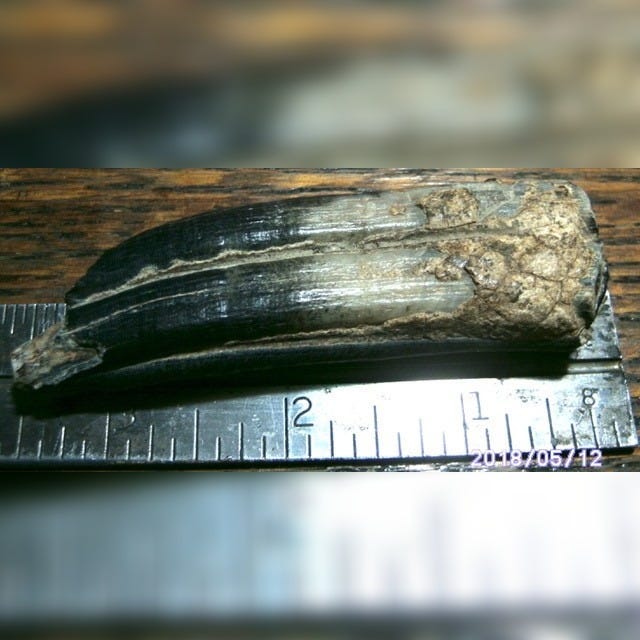
Bill’s original/first horse tooth form 2019.
This tooth sent me down a rabbit hole on the Internet, researching horse tooth morphology — paracones, ectoflexids, linguaflexids, hypoconids, oh my! These terms describe the fine patterns and structures in the occlusal (chewing) surface of horse teeth — often used in paleontology to define the evolutionary relationships between extinct and modern species of horses. I contacted several paleontologists online who have studied these patterns, sent pictures, and fielded emails. Is “the black tooth” as Bill and I now refer to it Pleistocene in age? The answer? Maybe. The gain? I now have a better sense of what to look for when I come across horse molars during my research.
To date I’ve visited 28 small town or historical museums across the state of Minnesota and corresponded with over 50. I reviewed vertebrate mammal specimens in the majority of the 28 I’ve visited. Horses are the seventh most common taxa I’ve documented behind turtles, woolly mammoth, mastodon, elk, Columbian mammoth, and — headed up by the ever-dominant bison. The most common bone/element — teeth mostly molars, with mandibles (usually only one side or the other) and rib bones following after.
Among the horse teeth I have encountered in collections connected to Minnesota ( some specimens lack location or donor documentation), three specimens stand out to me so far, and they are:
- Upper molar (Crow Wing County, Sagamore Iron Mine, 1975, donated by Carl Zappfe)

In the fall of 2024, I was invited by Dr. Alex Hastings, the Fitzpatrick Chair of Paleontology at the SMM, to help review a collection of specimens at the Crow Wing County Historical Society Museum and Library (CWCHS). We had been informed by John Westgaard, a paleontologist with the MN Discovery Center, that the historical society’s collection included several bison skulls, as well as many specimens with tags indicating they had once been part of a collection at the SMM.
It was a highly productive visit. All available accession information was provided along with the specimens upon our arrival. Altogether, we documented 39 specimens — including turtle, muskrat, bison, fish, bird, and bear — which bore “Science Museum Paleontology Collection” tags. Additionally, several other specimens were available for review, including multiple bison skull caps found in the Brainerd area, two bison teeth, a horse femur, and two horse teeth.
The two horse teeth CWCHS holds in its collection are a large upper molar and a small incisor, both brownish black from the sediment in which they were found. They were donated in the fall of 1975 and are believed to have originated within or below a glacial deposit at the Sagamore Iron Mine near Riverton, Minnesota, in the 1920s. Sagamore was part of Minnesota’s historic Cuyuna Range Mining District, which played a significant role in the iron mining industry during the early 20th century. The mine, which opened in 1919, operated as an open-pit facility, producing iron ore until the 1950s. Now decommissioned, the mine site has been transformed into a recreational area. The former open pit mine itself, is now known as Sagamore Mine Lake, and is part of the Cuyuna County State Recreation Area.
There is an accompanying 5x7 card in the accession file of the specimens:
“HORSES IN MINNESOTA 35,000 YEARS AGO. When stripping operations on the Cuyuna Range near Riverton finally got beneath a hundred feet of sand and gravel, representing ground-up Canadian rock from the mighty glaciers of the last Great Ice Age, parts of a vanished landscape came back in view — — clays and muds, trees, bones of animals who were killed and buried in the global catastrophe. The larger of these two teeth has been identified as belonging to a horse, and a large one. The other perhaps belongs to a beaver. Dating by radiocarbon shows an age greater than 33,000 years, going off the limits of the analysis. So, the Spaniards were not the ones who brought us horses! We had them here ourselves over 30,000 years before Spain was ever heard of, even by the ancient Romans.”
I previously researched Sagamore Mine, which is also the site of a bison bone bed documented by Oliver Perry Hay in the Proceedings of the United States National Museum (vol. 63, 1923). The bone bed was uncovered in June 1921 by workers operating a hydraulic excavator to remove overburden at the mine. The remains were discovered near the bottom of a peat deposit, approximately eight feet below the surface. Numerous skulls, vertebrae, ribs, and limb bones were eventually collected and sent to the Smithsonian Institution, then known as the United States National Museum, for research. Hay’s research determined the bones to be the remains of Bison occidentalis, often considered an intermediate species between Bison antiquus and the modern American bison (Bison bison). Today, the Crow Wing County Historical Society displays a partial skull from this discovery.

A plate from O.P. Hay’s 1923 paper. Bison occidentals

A remaining Bison occidentals skull form the mine on display a the Crow Wing County Historical Society Museum
- Lower molar (Wright County, Lakeshore — Olson’s Point, 1976)

In June 2024, I contacted and then visited the Wright County Historical Society after finding an interesting specimen online: a tooth donated to the historical society in 1976. My interest in the tooth was sparked by an image I had seen on mncollections.org and seeing it in person made me even more intrigued. The tooth is golden-brown, a relatively small size, and, although I know it can mean little in determining age, it is notably heavy. I identified it as the right p2 (second lower premolar) and was struck by some unique patterns on its chewing surface. According to its mncollections.org entry, the tooth is described as “ One piece of a ruminating animal’s tooth. It was fossilized and is now brown and the white teeth are still visible. It is rectangular shaped and open on top to show the inside.” Its accession information revealed that the tooth was found by a local resident on the shores of Olson’s Point, a location along Buffalo Lake in Wright County, Minnesota. Buffalo Lake spans 1,552 acres and exhibits the classic irregular bowl-shaped form of a glacial “kettle” lake. These lakes were created when massive blocks of ice, left behind by retreating glaciers, melted and formed depressions — features that define the majority of Minnesota’s lakes. The lake was named for the buffalo fish, a freshwater species that once thrived in its waters.
- Upper molar (Goodhue County, Flower Valley — near Red Wing, 1960, Donated by Lavern Albers)

LaVern Albers was born in the city of Goodhue in 1923. In 1950, he moved his wife and daughter from St. Paul to a 160-acre farm nestled in a valley southeast of Red Wing. Flower Valley, a region celebrated for its fertile farmland and wildflowers that bloom across the landscape each year. The Red Wing area’s terrain, including remarkable features like Lake Pepin, was shaped at the end of the Ice Age as the Laurentide Ice Sheet retreated north of Goodhue County, forming several expansive proglacial lakes. Lake Agassiz, in particular, located in northwestern Minnesota, was larger than all of today’s Great Lakes combined. When these lakes eventually drained, Lake Agassiz may have breached catastrophically, the result was a massive outrush of glacial meltwater that made its way downstream and reshaped the Mississippi River valley.
The Goodhue County Historical Society holds many mammal specimens from this period at the end of the Pleistocene — four woolly mammoth molars, three bison scapulae, a bison mandible, a mammoth molar, two equid (horse) teeth, as well as an unidentified canine tooth (from either a wolf or bear), a suid (hog) molar, and multiple collections of bone tools and implement artifacts from Native American archaeological sites. I was also surprised to see many Ordovician-age specimens in the collection. I have not reviewed any of the Ordovician fossils; however, I can estimate that there are close to 500 individual specimens in the collection. Just search “Decorah” or “Ordovician” on mncollections.org, and you will find specimens with descriptions like: “Brachiopoda/ Sowerbyella punctostriata/ Middle Ordovician/ Decorah Sh./ Goodhue County, Minn.”, and “Coelenterates (Horn Coral),” “Horn Coral- genus Lambeophyllum/ Decorah Shale or Galena Limestone/ Middle-Ordovician period/ Trentonian stage.”

“Horn Coral/ Lambeophyllum- Tetracoralla/ Anthozoa- Coelenterata/ Cambrium- Ordovician/ Decorah Shale/ Cannon Falls, Mn.” mncollections.org
The Decorah Shale near Red Wing, Minnesota, is part of the Ordovician period rock formations in Minnesota that date back roughly 450 million years. This shale is known for its soft, fossil-rich layers, which were deposited in a shallow marine environment. The area around Red Wing provides exposures of the Decorah Shale, often visible along riverbanks. During the Ordovician period, North America was part of a larger landmass called Laurentia. It was located near the equator and mostly covered by shallow, warm seas.
LaVern knew the story of the shallow sea that once covered North America. How do I know? I recently contacted his oldest daughter Sharon who clearly remembers the day her father found the tooth while plowing the southwest field bordered by Ballard Creek. She was ten-years-old in 1960 and recalled her father as a continuous reader who shared with her the story of an enormous sea that once covered all of Flower Valley.
“The farmstead still sits in the valley surrounded by bluffs. A favorite memory is of finding white clam shells on the top of the bluff where Dad worked a field, and we picked blackberries. As we handled the worn shells, Dad and I looked out over the valley. He told me the land had once been covered by water. I imagined sea creatures swimming among the bluffs, a visual I still cherish.”
Shari’s family had been farming in Flower Valley for three generations. Her grandmother grew up on a farm just over the hill from her father’s 160-acre property. Shari also recalled being disappointed that the tooth wasn’t from a dinosaur when the historical society deemed it horse.
“The tooth was found while Dad was plowing the northwest field bordered by Ballard Creek and the gravel road (now paved and called Flower Valley Road). Dad and I walked out to the site to look for more teeth or bones but found nothing.”
- I awoke from my daydream dip with the sea creatures… Shari’s story resonated with me. After exploring the specimens in the Goodhue County Historical Society’s collection, both online and in person, the story tied so many things together for me. Bringing together the Ordovician and Pleistocene geology of the region, the numerous donors who contributed thousands of artifacts from the Red Wing area, and the ways in which the museum and its collections tie the community of Red Wing back to the land and its rich history.

Star Tribune, 05/12/2019, pE14 from Newspapers.com
I continue to research additional possible Pleistocene horse specimens in conjunction with the Science Museum of Minnesota and this summer have plans to visit an additional 8–10 county historical societies. There will be more #Lostbones stories to come so stay tuned, paleo and history friends.
Follow Up:
My friend Bill found another great horse tooth on a river gravel bar in southern Minnesota. It is in great shape and although is appears just a bit dirty the matrix adhered to it is extremely solid, this one has been buried for a while. I asked bill to clean off the occlusal surface and send me a photo and he informed me he couldn’t without damage. He has already donated to the Science Museum of Minnesota.

Bill’s latest find from a gravel bar on the Cottonwood river near New Ulm, Minnesota
Sources:
Bell Museum. (n.d.). Let’s Get a State Fossil, Minnesota! Retrieved April 6, 2025, from Link.
Forstén, A. (1988). Middle Pleistocene replacement of stenoid horses by caballoid horses: Ecological implications. Paleogeography, Paleoclimatology, Paleoecology, 65, 23–33.
Stauffer, C. R. Some Pleistocene mammalian inhabitants of Minnesota. University of Minnesota. Retrieved from Link.
The Diggings. (n.d.). Retrieved from Link .
Minnesota Geological Survey. (1949). Clay deposits in the Red Wing area, Minnesota. University of Minnesota Digital Conservancy. Retrieved from Link.
National Park Service. (n.d.). Ordovician period. Retrieved April 5, 2025, from Link
Collaboration:
Shari Albers
메타데이터
- post_id
- f07d2d898e70
- slug
- lost-bones-4-a-dip-with-the-sea-creatures-f07d2d898e70
- url
- https://medium.com/@dbrake40/lost-bones-4-a-dip-with-the-sea-creatures-f07d2d898e70
- canonical_url
- https://medium.com/@dbrake40/lost-bones-4-a-dip-with-the-sea-creatures-f07d2d898e70
- author_url
- https://medium.com/@dbrake40
- status
- ok
- fetched_at
- 2026-08-21 23:54:32