Why the Seat, Not the Recline, Wins Ranked
The seat wins ranked. Gaming chairs are sold on how far they recline, the flatter the better, as though lying back were the goal of sitting…
Why the Seat, Not the Recline, Wins Ranked
The seat wins ranked. Gaming chairs are sold on how far they recline, the flatter the better, as though lying back were the goal of sitting in one. For competitive play that is the wrong specification to chase, because ranked outcomes are decided by whether you can hold an upright, ready posture with a steady reaction through a whole match, and that is a job for the seat and its support, not for the backrest’s maximum angle. The recline number on the box and the thing that actually wins ranked are barely related to each other.
The reason is that competitive play happens in the upright, forward posture, so the parts of an ergonomic gaming chair that support that posture are the ones that matter. The seat that keeps you from sliding, the lumbar that holds your lower back while you sit forward, the stability that does not wobble under quick movement, these are what let you stay ready and steady for hours. The recline angle governs a resting posture you should not be playing in, so it sits outside the competitive equation almost entirely, even though it is the number printed largest on the box. By 2026 the recline figure has become the headline marketing spec for gaming chairs, which is exactly why it is the one competitive buyers should trust least. An ergonomic gaming chair for ranked is one whose seat and support are built for upright play, regardless of how far it reclines. Understanding why the seat wins ranked redirects the buying decision from a headline number to the support that actually decides matches.
Why Upright Support Is the Competitive Spec
If competitive play is done upright and forward, then the chair’s competitive quality is its upright support, which is a property of the seat and lumbar, not the recline. Holding an upright, slightly forward posture for a long session demands a seat that keeps the pelvis from sliding forward, firm lumbar support that holds the lower back in its curve while the torso is forward, and a base stable enough that quick movements do not rock the chair. A chair that delivers these lets the player stay in the ready posture without strain or drift; a chair that lacks them lets the posture collapse over the session, taking reaction down with it. The competitive spec is the support of the forward posture, start to finish.
This is why the recline angle is close to a vanity number for ranked. It describes how well the chair does the one thing competitive players should not do during play, lie back, while saying nothing about how well it holds them upright, which is the thing they do constantly. A chair can fold completely flat and still support the upright posture poorly, so the recline spec and the competitive spec are different axes. The way posture degrades across a long session, dragging reaction with it, is exactly what good upright support resists, the decline traced in why your last hour gaming is your worst posture.
Why a Sliding Seat Loses Form
Among the seat’s jobs, stopping the forward slide is the one that most directly decides whether form holds. When you sit upright and forward for hours, gravity and the forward lean tend to slide the pelvis forward in the seat, which rolls the lower back into a slump as the session wears on. A seat shaped and surfaced to hold the pelvis back, with the right depth and a supportive lumbar behind it, resists that slide and keeps the upright posture intact; a flat, slippery, or over-deep seat lets the pelvis creep forward and the posture decay. So the seat is the part that keeps the competitive posture from collapsing over a match, which is why it, not the recline, governs late-session form, the physical cost of the session arc set out in why the session arc has a physical cost.
Recline Spec Against Competitive Spec
Separating the two axes shows how little the recline number says about ranked performance. The table below contrasts what each property governs.
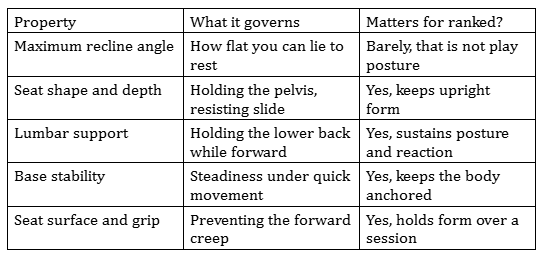
Read down the table and every competitive property lives in the seat and support, while the recline angle governs the resting posture that ranked play does not use. The buyer who chooses on recline is optimising the one axis that does not decide matches, while the properties that do, seat, lumbar, stability, may be quietly mediocre on a chair that reclines impressively and photographs well. This is why competitive players judge a chair by how it holds them upright, not by how flat it goes, and why the support from a reliable ergonomic gaming chair provider that builds the seat and lumbar well beats a rival sold on recline.
Why the Two Specs Can Even Conflict
There is a further twist: chasing recline can actively work against the competitive spec. A chair engineered to fold deeply flat may prioritise a reclining mechanism and a backrest geometry that suit lying back, sometimes at the expense of firm upright lumbar support or a seat that holds you forward, so the deepest-reclining chairs are not always the best upright ones. The two specs are not just different but can pull against each other, which means a buyer optimising recline may be unwittingly de-optimising the support that wins ranked. The safe approach is to ignore the recline number for competitive purposes and judge the chair on its upright hold, the posture faults that creep in unnoticed being the ones detailed in the posture mistakes gamers make without realising.
When Recline Still Earns Its Place
In fairness, recline is not worthless, and it is worth saying where it counts. For rest between competitive sessions, a good recline lets the player lie back and relieve the spine, which aids recovery for the next stretch, and for players who mix competitive and passive gaming, the recline serves the passive half well. So a competitive player can still value some recline, just as a secondary feature for rest, not as the spec that decides play. The order of priority is what matters: judge the chair first on its upright seat and support, then treat the recline as a bonus for downtime, the support for play being the deciding factor across gaming chairs in Australia.
Common Mistakes
The first mistake is buying a ranked chair on recline angle. Competitive play happens upright and forward, so the recline governs a posture you should not be playing in. The seat, lumbar, and stability decide ranked, not how flat the chair folds.
The second is ignoring the forward slide. A flat or slippery seat lets the pelvis creep forward over a session, slumping the lower back and decaying the posture. A seat that holds the pelvis back is what keeps upright form intact through a match.
The third is treating recline and upright support as the same axis. A chair can fold completely flat and still support the upright posture poorly, so the recline spec says nothing about the competitive spec. They are different properties that have to be judged separately.
The fourth is assuming deeper recline means a better chair. Chasing recline can compromise upright lumbar and seat support, so the deepest-reclining chairs are not always the best upright ones. The two specs can pull against each other, so recline can come at the competitive spec’s expense.
Conclusion
The seat, not the recline, wins ranked because competitive play happens in an upright, forward posture, and the parts that support that posture are the seat and its support, not the backrest’s maximum angle. The seat that holds the pelvis from sliding, the lumbar that supports the lower back while you sit forward, and the stability that stays anchored under quick movement are what let you hold form and reaction through a whole match. The recline angle governs a resting posture you should not be playing in, so it sits almost entirely outside the competitive equation.
This redirects the buying decision from a headline number to the support that decides matches. Judge a ranked chair on how well it holds you upright over a long session, not on how flat it folds, and be aware that chasing recline can even compromise the upright support that wins. Keep the recline as a secondary feature for rest between sessions, where it earns its place, and let the seat and lumbar lead the choice. The box advertises the recline, but the match is decided by the seat and its support, which is the spec competitive players actually buy on once they have learned what holds their form through a long session.
Frequently Asked Questions
What should I look for in a gaming chair for competitive play?
Upright support, which lives in the seat and lumbar, not the recline. Look for a seat that holds your pelvis from sliding forward, firm lumbar support that holds your lower back while you sit forward, and a stable base that does not rock under quick movement. These let you hold the upright, ready posture through a long match. The maximum recline angle barely matters, since competitive play is not done lying back.
Does the recline angle matter for ranked gaming?
Very little, because ranked play happens in an upright, forward posture, while the recline governs a resting posture you should not play in. A chair can fold completely flat and still support the upright posture poorly, so the recline number says nothing about competitive quality. Treat recline as a secondary feature for rest between sessions, and judge the chair for play on its seat, lumbar, and stability.
Why does the seat matter more than the recline?
Because the seat is what keeps your competitive posture from collapsing over a match. Sitting upright and forward for hours tends to slide the pelvis forward, slumping the lower back, and a seat shaped to hold the pelvis back resists that slide and keeps the posture intact. The recline angle does nothing for this, so the seat governs whether your form and reaction hold late into a session, which is what decides ranked.
Can a deeply reclining chair be bad for competitive play?
Yes, sometimes. A chair engineered to fold deeply flat may prioritise a reclining mechanism and backrest geometry suited to lying back, occasionally at the expense of firm upright lumbar support or a seat that holds you forward. So the deepest-reclining chairs are not always the best upright ones, and chasing recline can compromise the support that wins ranked. Judge the chair on its upright hold, not its recline depth.
Is recline useless on a competitive gaming chair?
Not useless, just secondary. A good recline lets you lie back and relieve your spine between sessions, which aids recovery, and serves the passive half of mixed gaming well. So recline earns a place as a rest feature, not as the spec that decides play. The priority order is to judge the chair first on its upright seat and support, then treat the recline as a bonus for downtime.
How do I judge a gaming chair for ranked when buying?
Test how it holds you upright and forward, not how flat it reclines. Sit forward as you would in active play and check whether the seat keeps your pelvis back, whether the lumbar supports your lower back in that position, and whether the base stays steady under quick movement. If it holds the upright posture without strain over time, it suits ranked, regardless of its recline angle, which is the spec that does not decide matches.
메타데이터
- post_id
- f082d3df782e
- slug
- why-the-seat-not-the-recline-wins-ranked-f082d3df782e
- url
- https://medium.com/@mikapixel16/why-the-seat-not-the-recline-wins-ranked-f082d3df782e
- canonical_url
- https://medium.com/@mikapixel16/why-the-seat-not-the-recline-wins-ranked-f082d3df782e
- author_url
- https://medium.com/@mikapixel16
- status
- ok
- fetched_at
- 2026-07-19 12:05:52