Why Turbulence Can’t Break an Airplane Wing
In May of twenty twenty-four, a Singapore Airlines jet flying over Myanmar dropped a hundred and seventy-eight feet in less than five…
Why Turbulence Can’t Break an Airplane Wing
[embed]
In May of twenty twenty-four, a Singapore Airlines jet flying over Myanmar dropped a hundred and seventy-eight feet in less than five seconds. Inside the cabin it was chaos — people thrown into the ceiling, one passenger killed, more than a hundred injured — and yet the airplane itself landed in Bangkok without a single crack in its structure. That gap is the entire story. The terror you feel in turbulence is real. The threat to the aircraft is almost completely imaginary. And the thing that actually decides whether you walk off fine or end up in a headline has nothing to do with engineering.
Here’s what nobody tells you while you’re white-knuckling the armrest. A modern airliner is not fighting to survive turbulence. It was built, tested, and certified to treat the roughest air on Earth like a routine Tuesday. The forces that make your stomach drop and your coffee jump are nowhere near the forces this machine was designed to shrug off. So over the next few minutes we’re going to take that fear apart, piece by piece. How the wing is engineered. The loads it’s tested against. And the real reason people get hurt up there — because once you understand what’s actually holding you in the sky, the bumps stop sounding like danger and start sounding like a suspension system doing its job.
But to get there, we need to start with what’s actually happening outside the window. So what is turbulence, really? At its core it’s just air that isn’t moving smoothly. The atmosphere is a fluid, and like any fluid it has currents, eddies, and sudden shifts in speed and direction. When your aircraft crosses from one pocket of air into another that’s rising, sinking, or moving at a different velocity, the lift on the wing changes in an instant, and that change is what throws you around. It comes in a few flavors. Convective turbulence boils up off thunderstorms, where warm air punches violently through the colder air above. That’s what struck Singapore Airlines flight three-twenty-one — a cluster of storm clouds that grew explosively, climbing from twenty-seven thousand feet to forty thousand right in the jet’s path. Then there’s clear-air turbulence, the unsettling kind, because there is nothing to see. No clouds. No warning. It lurks near the jet stream, and it’s the reason a flight can feel like glass one second and violent the next.
And here’s why your body reacts the way it does. You evolved on solid ground, where the floor does not suddenly drop out from under you. So when the aircraft sinks and your inner ear screams that you’re falling, every instinct says catastrophe. But your instincts are reading the wrong instrument. What feels like the plane breaking is just the plane moving, and moving is exactly what it was built to do.
To understand why the airframe doesn’t care, you have to understand how engineers measure the forces acting on it. They use g-force, multiples of normal gravity. Sitting in your seat right now, you’re feeling one g. The question every aircraft designer has to answer is simple: how many g’s can this thing take before something bends, and before something breaks? Those are two different numbers. The first is the limit load — the maximum force the structure should ever see in service with zero permanent damage. For a large passenger jet, regulators set that at two-and-a-half g upward and negative one g downward. Then there’s the ultimate load — roughly fifty percent beyond that — the force the structure has to survive without failing. That cushion isn’t a nice-to-have. It’s written into federal airworthiness law, in the exact rule that governs gust and turbulence loads. Now hold that against reality. Even severe turbulence, the kind that makes the news, the kind that puts people in hospitals, generates forces that sit well inside that envelope. The wing is certified to handle roughly fifty percent more than the worst turbulence on record. The margin isn’t thin. The margin is the entire design philosophy.
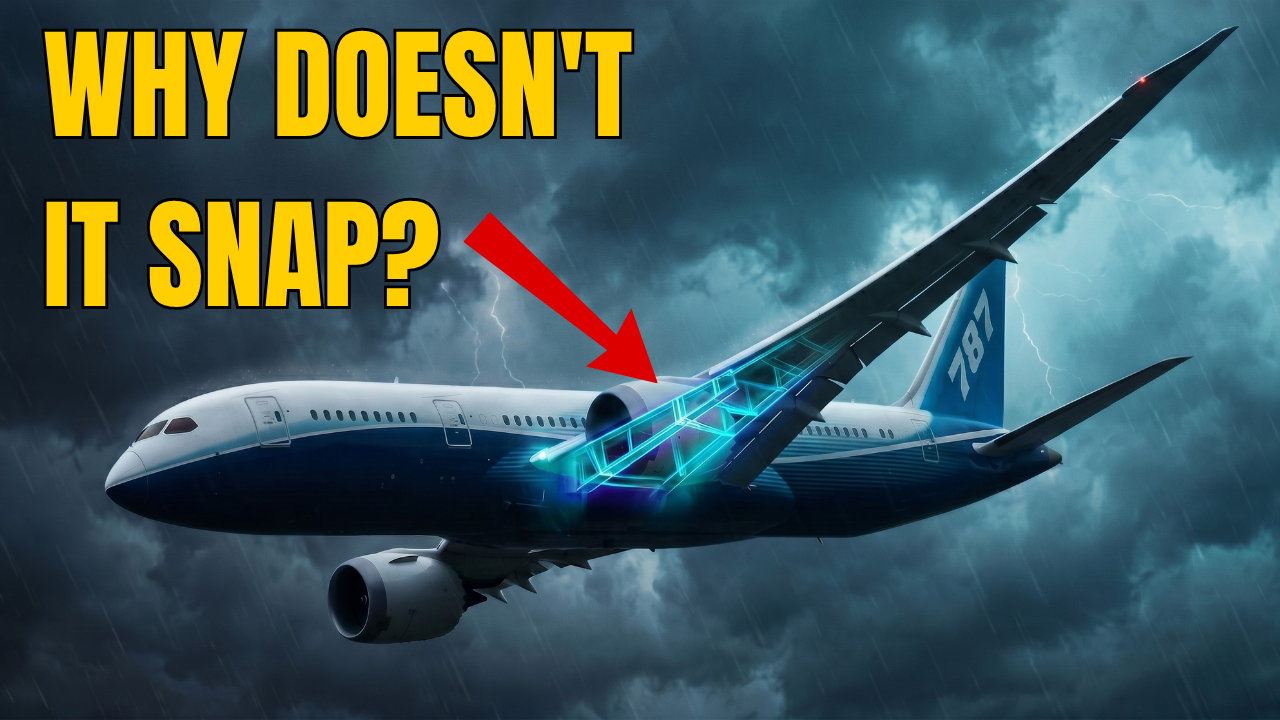
Here’s the part that scares people most, and should reassure them most. Look out the window in rough air and you’ll see the wingtips flexing, bouncing, riding the bumps. Every instinct says a wing moving like that is a wing about to snap. The opposite is true. That flex is the single most important thing keeping your ride survivable. A rigid wing would slam every jolt straight into the fuselage and into your spine. A flexible wing does exactly what your car’s suspension does over a pothole — it absorbs the energy and releases it smoothly. Underneath that skin sits an elegant skeleton: long beams called spars running the length of the wing, braced by smaller strips called stringers, all funneling their loads into a central wingbox built to carry the entire weight of the wings and everything hanging from them.
We know precisely how far that structure can go, because the people who build it bend it until it breaks. Before the Boeing seven-eight-seven Dreamliner could carry a single passenger, engineers clamped its wings and pulled them upward to a hundred and fifty percent of the most extreme load it would ever meet in flight. The wingtips rose roughly twenty-five feet. Twenty-five feet, and the wing held. Modern carbon-composite wings flex even further than the old aluminum ones, which is exactly why today’s jets give a softer ride than the stiff-winged aircraft of the past. So next time you watch a wingtip dance in the chop, remember what you’re really seeing. Not a structure straining toward failure. A structure doing precisely, calmly, what it was engineered to do.
So if the airplane is this overbuilt, why do people still get hurt? Here’s the twist that should change how you think about every flight you take. In turbulence, the danger was never the aircraft. The danger is everything inside the cabin that isn’t bolted down — including you. Go back to that Singapore Airlines flight. The structure was fine. The people were not, because when the jet dropped, anyone without a seatbelt became a projectile. They weren’t hurt by the plane failing. They were hurt by suddenly meeting the ceiling. And that’s the pattern in nearly every serious turbulence injury — not metal tearing, but bodies in motion inside a cabin that just changed direction faster than they did.
The numbers make it stark. In the United States, across the entire stretch from two-thousand-nine through twenty-twenty-two, only a hundred and sixty-three turbulence injuries were serious enough to require a hospital, over a period that carried billions of passengers. And here’s the most telling statistic of all: flight attendants account for seventy-nine percent of them. Not because their seats are more dangerous, but because they’re the ones up and unbuckled, doing their jobs, when the air turns rough. Which means the most powerful safety device on the entire aircraft, the one thing actually standing between you and that headline, isn’t the wing, or the spar, or the fifty-percent margin. It’s the strap across your lap. The engineering already won. Your only job is to stay attached to it.
So let’s go back to where we started: thirty-seven thousand feet over Myanmar. A jet falls a hundred and seventy-eight feet in a heartbeat. Inside, it’s pure terror. And when it’s over, the aircraft flies on and lands safely, its wings, its spars, its structure completely intact, exactly as designed. Turbulence is uncomfortable. Sometimes it’s violent. It earns your respect, and it absolutely earns your seatbelt. But it cannot do the one thing your gut is certain it’s about to do. It cannot crash the plane. The machine wrapped around you was built by people who assumed the sky would try its absolute worst, and then engineered for far beyond it. So next time the seatbelt sign chimes and the cabin starts to shake, go ahead and let your stomach do what stomachs do. Just know that the aircraft itself isn’t worried. It was built to bend, not break — and it has the margins to prove it.
메타데이터
- post_id
- f09de506f1fc
- slug
- why-turbulence-cant-break-an-airplane-wing-f09de506f1fc
- url
- https://medium.com/@officialengineeredexplained/why-turbulence-cant-break-an-airplane-wing-f09de506f1fc
- canonical_url
- https://medium.com/@officialengineeredexplained/why-turbulence-cant-break-an-airplane-wing-f09de506f1fc
- author_url
- https://medium.com/@officialengineeredexplained
- status
- ok
- fetched_at
- 2026-07-09 20:10:33