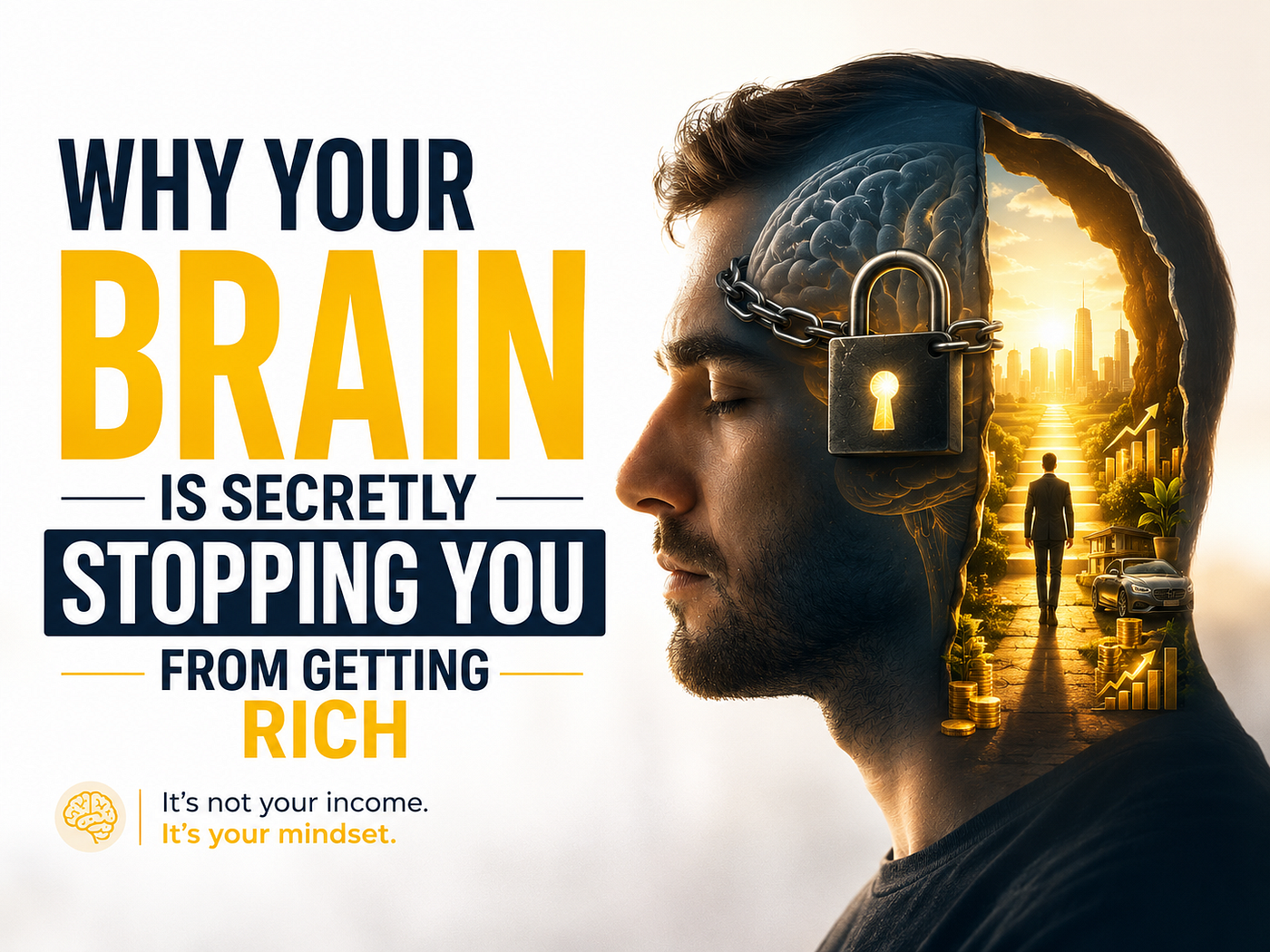
Why Your Brain Is Secretly Stopping You From Getting Rich
The human brain was designed to avoid risk, not build wealth, and that changes everything.
Why Your Brain Is Secretly Stopping You From Getting Rich
The human brain was designed to avoid risk, not build wealth, and that changes everything.
Hello, The Finletter Fam.
Every month starts the same way.
You promise yourself that this time things will be different.
You’ll save more money. Spend less. Take your finances seriously.
But by the end of the month, nothing really changes.
The bank balance still feels small. Stress feels bigger. And somewhere in your mind, a quiet thought appears again:
“Maybe I’m just bad with money.”
Most people think the biggest reason they struggle financially is that they don’t earn enough.
But the truth is deeper than that.
The real problem is often the way your brain thinks about money.
And the strange part?
Your brain was never designed to make you rich.
Your Brain Was Built to Survive — Not Build Wealth
Thousands of years ago, humans lived in a dangerous world.
See content credentials

One wrong decision could mean danger.
A bad food choice. A risky move. A small mistake.
So the human brain learned one thing extremely well:
Avoid loss. Stay safe. Survive.
Psychologists call this loss aversion.
In simple words:
Losing $100 feels more painful than gaining $100 feels exciting.
And honestly, this survival instinct helped humans stay alive for a very long time.
But modern money works differently.
Today, building wealth usually requires:
- patience,
- long-term thinking,
- consistency,
- and taking smart risks.
Unfortunately, the brain naturally feels uncomfortable with all of these things.
That means your mind is still using old survival wiring in a completely modern world.
The “Safe Option” Trap
Imagine someone gives you two choices:
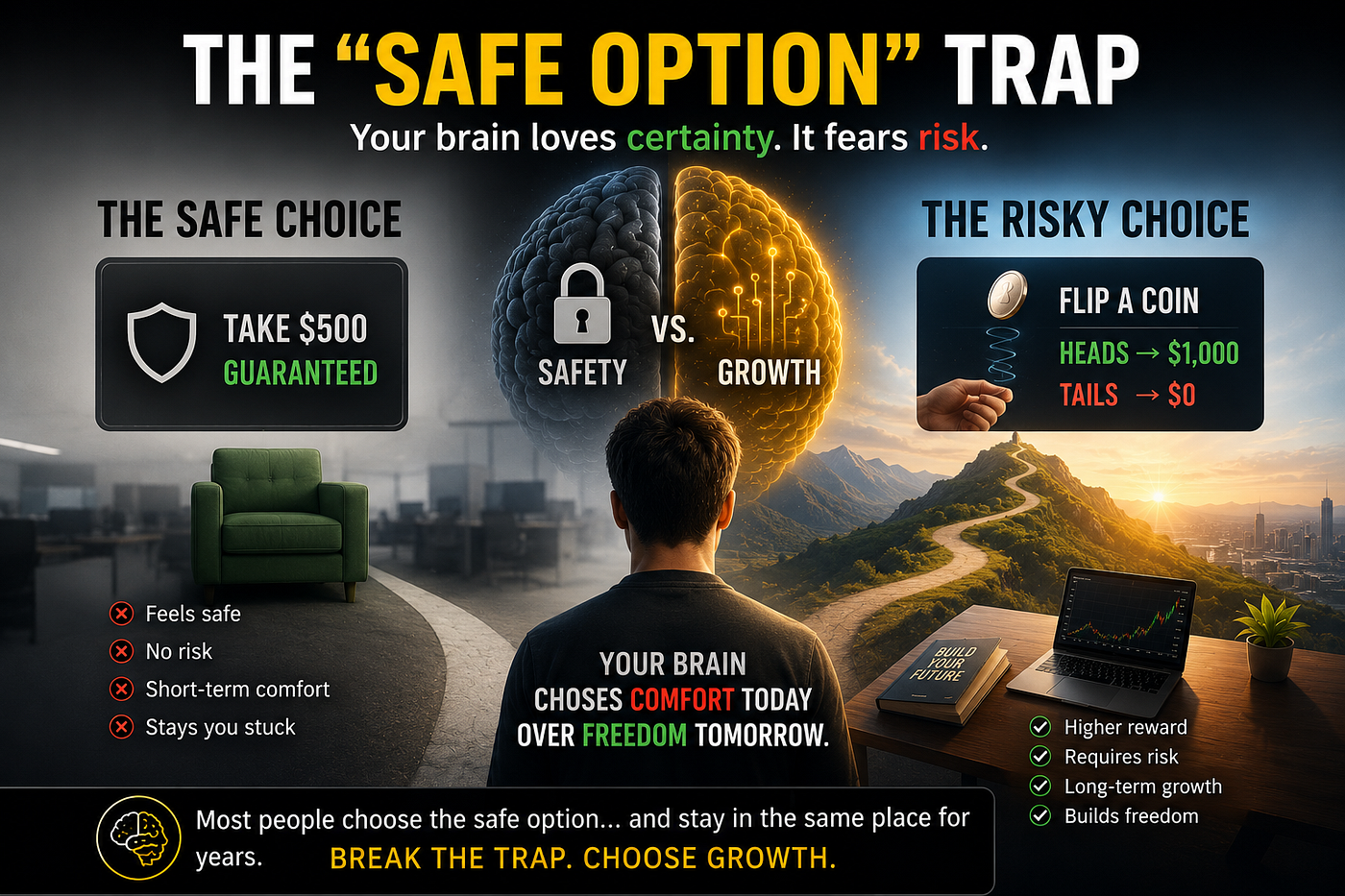
- Take a guaranteed $500 right now
- Or flip a coin:
Mathematically, both choices are equal.
But most people still choose the guaranteed $500.
Why?
Because the brain loves certainty.
It wants safety more than opportunity.
Now think about real life.
People stay in jobs they hate because the salary feels safe.
People never start businesses because failure feels scary.
People avoid investing because markets go up and down.
Again and again, the brain chooses short-term comfort over long-term growth.
And then people wonder why their financial life never changes.
The Money Beliefs You Learned As A Child
Most money habits don’t start in adulthood.
They start much earlier.
As kids, we quietly absorb beliefs about money from parents, relatives, school, and society.
Maybe you heard things like:
- “Rich people are greedy.”
- “Money creates problems.”
- “People like us never become wealthy.”
- “Investing is risky.”
Or maybe nobody talked about money at all.
And without realizing it, your brain learned that money is stressful, confusing, and difficult.
Over time, these beliefs become part of your identity.
And humans protect their identity very strongly — even when that identity hurts them.
Someone who secretly believes:
“I’m bad with money.”
will often unconsciously:
- overspend,
- avoid saving,
- delay investing,
- and ignore financial decisions.
Not because they’re lazy.
Because staying emotionally familiar feels safe.
Your Comfort Zone Can Keep You Financially Stuck
Psychologist Abraham Maslow once noticed something interesting:
People often choose familiar pain over unfamiliar opportunity.
Even if their current situation is stressful, the brain still prefers it because it feels “known.”
That’s why many people stay stuck in the same financial cycle for years:
Spend money. Feel stressed. Promise to improve next month. Repeat.
Maybe someone once told you to:
- learn a valuable skill,
- start a side income,
- or begin investing.
And instantly your mind created excuses:
“I don’t have time.” “What if it fails?” “I’ll do more research first.”
Most of the time, that isn’t logic.
It’s fear hiding behind logical-sounding excuses.
Social Media Is Quietly Making People Poorer
Social media has made comparison worse than ever.
You open Instagram and suddenly see:
- luxury cars,
- expensive vacations,
- perfect lifestyles,
- successful-looking people everywhere.
Without realizing it, your brain starts comparing your life to theirs.
You begin feeling behind.
This creates something called “keeping up with the Joneses” behavior.
People start spending money to look successful instead of actually becoming financially strong.
And the dangerous part?
You’re only seeing the highlight reel.
That luxury car could be on EMI. That lifestyle could be full of debt. That “success” online could be completely fake.
But the brain reacts emotionally before logic has time to think.
Meanwhile, truly wealthy people often focus quietly on:
- building skills,
- buying assets,
- investing,
- and creating long-term wealth.
Warren Buffett, one of the richest investors in the world, still lives in the same house he bought in 1958.
That wasn’t an accident.
It was a decision not to play the comparison game.
Why Saving Money Feels So Difficult
Most people believe:
“Once I earn more, I’ll finally start saving.”
But in reality, something else usually happens.
As income increases, lifestyle increases too.
This is called lifestyle inflation.
Things that once felt luxurious slowly start feeling normal.
Food delivery becomes a habit. The old phone suddenly feels embarrassing. Simple living starts feeling boring.
This isn’t because people are weak.
The human brain quickly adapts to comfort.
That’s why earning more money alone doesn’t automatically create financial freedom.
Without good systems, spending simply grows with income.
One of the smartest things you can do is automate your savings.
Move money into savings or investments automatically before your brain gets the chance to spend it.
3 Small Things You Can Start Doing Today

1. Understand Your “Money Story.”
Take 5 quiet minutes and finish this sentence honestly:
“Money is…”
Write whatever comes to your mind.
You might discover beliefs that have been controlling your decisions for years without you realizing it.
Awareness is where change begins.
2. Automate Important Financial Decisions
Your emotions change constantly.
Good systems don’t depend on motivation.
Set up automatic savings or investments as soon as your salary arrives — even if the amount is small.
Right now, consistency matters more than perfection.
3. Stop Comparing Your Real Life To Someone Else’s Highlight Reel
The next time social media makes you feel behind, ask yourself one simple question:
“Do I actually know their real financial situation?”
Probably not.
Nobody posts their debt, stress, anxiety, or money problems online.
You are comparing your real life to someone else’s edited version of life.
And that comparison will never be fair.
The Quiet Truth Most People Learn Too Late
Becoming financially stable is not just about earning more money.
It’s also about understanding yourself.
The people who win financially are not always the smartest or highest earners.
Usually, they are the people who:
- understand their emotions,
- control their habits,
- and build simple systems that work consistently.
Your brain is not broken.
It’s simply running old survival software in a modern financial world.
And once you understand that, money starts making a lot more sense.
That’s where real change begins.
For more simple and practical insights on business, finance, and startups, follow and subscribe to The Finletter 🚀
메타데이터
- post_id
- f0a5f535fa69
- slug
- why-your-brain-is-secretly-stopping-you-from-getting-rich-f0a5f535fa69
- url
- https://medium.com/@thefinletter/why-your-brain-is-secretly-stopping-you-from-getting-rich-f0a5f535fa69
- canonical_url
- https://medium.com/@thefinletter/why-your-brain-is-secretly-stopping-you-from-getting-rich-f0a5f535fa69
- author_url
- https://medium.com/@thefinletter
- status
- ok
- fetched_at
- 2026-06-09 14:34:10