American Cheap Drone Killers in the Middle East
The real competition is no longer between drones and missiles — it’s between innovation ecosystems.
American Cheap Drone Killers in the Middle East
The real competition is no longer between drones and missiles — it’s between innovation ecosystems.
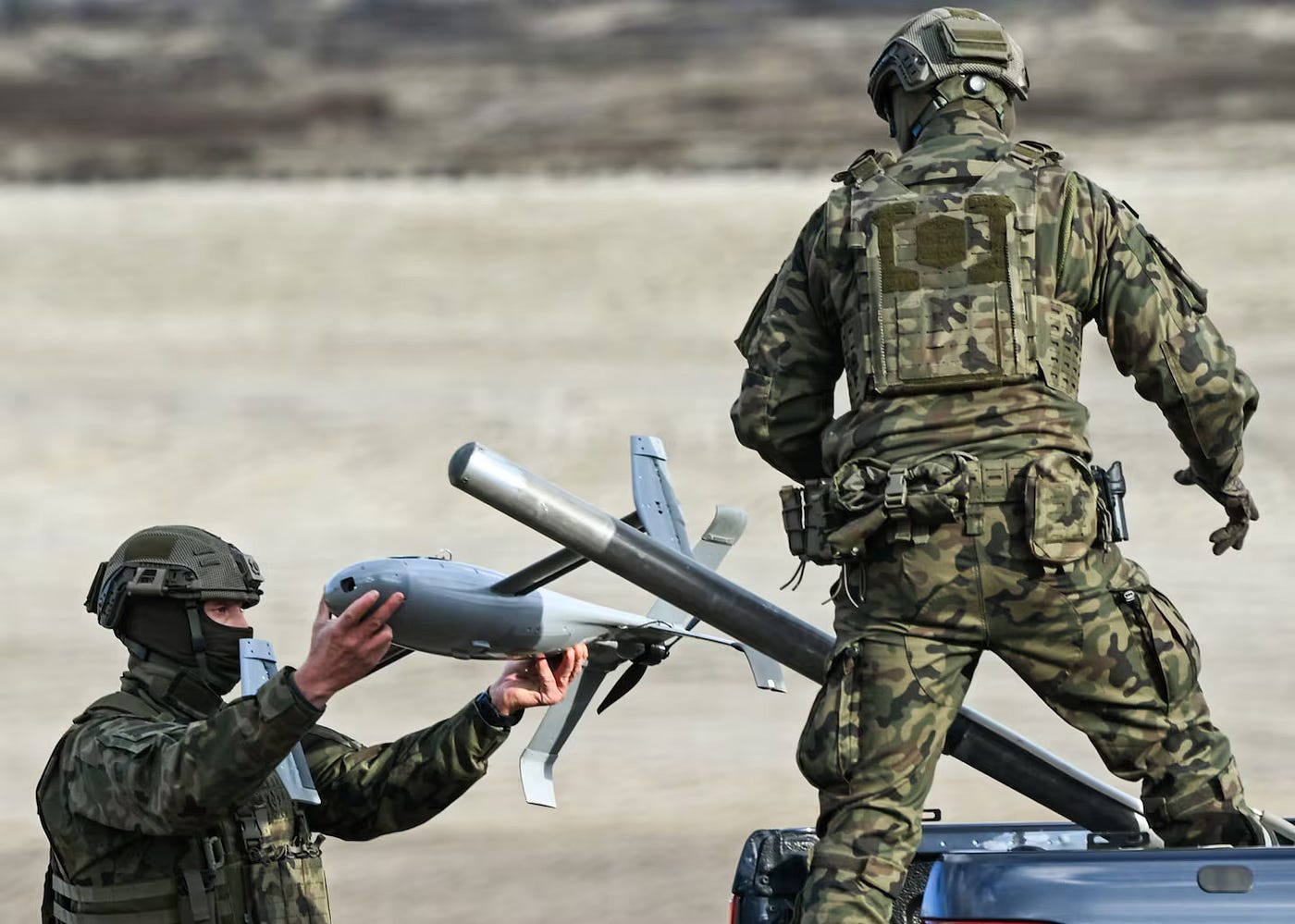
Photo taked from https://www.defensenews.com/global/europe/2026/05/05/nato-nations-size-up-an-interceptor-drone-bazaar-where-low-price-is-everything
“Every successful weapon eventually teaches its enemy how to defeat it.”
Every major war produces a weapon that appears to redefine the battlefield. During World War I, it was the machine gun. During the Cold War, it was the ballistic missile. In the war in Ukraine, that weapon was the inexpensive one-way attack drone.
For nearly two years, Iranian-designed Shahed-136 loitering munitions dominated headlines. They were not particularly sophisticated, nor did they rely on cutting-edge technology. Their real innovation was economic. A drone costing only tens of thousands of dollars forced defenders to launch interceptor missiles worth hundreds of times more. Air defense was still effective — but it was no longer affordable.
For a brief moment, it seemed that the economics of warfare had fundamentally changed. Then the defenders adapted.
Today, a new generation of AI-enabled interceptor drones is beginning to restore that balance. Instead of relying exclusively on multimillion-dollar missiles, militaries are deploying low-cost autonomous interceptors capable of defeating mass drone attacks at a fraction of the previous cost. One of the newest examples is Merops, an American-backed interceptor that has already demonstrated its potential in operational testing and is now finding its way into the Middle East.
But Merops is only part of a much larger story.
The real transformation is not about one drone replacing another. It is about a fundamental shift in the economics of air defense, the emergence of continuous battlefield learning, and a new technological competition in which data and innovation matter more than individual weapon systems.
The next arms race will not be won by the country with the most drones. It will be won by the country that learns the fastest.
When Cheap Drones Broke Air Defense
Military revolutions are often associated with groundbreaking technologies. The Shahed-136 tells a different story.
Technically, the drone is relatively simple. It lacks the sophistication of advanced cruise missiles or fifth-generation aircraft. Yet strategically, it achieved something far more significant: it challenged one of the basic assumptions of modern air defense — that defending against an attack should always be cheaper than launching one.
Instead, the opposite became true.
Each time a Patriot missile was fired to destroy a Shahed, defenders faced an uncomfortable reality. They were using one of the world’s most advanced — and expensive — air-defense interceptors against one of the world’s cheapest long-range attack drones. Analysts quickly realized that this cost imbalance could become unsustainable during prolonged conflicts.
According to estimates discussed by multiple defense analysts, the cost of a single Patriot interceptor could finance the production of well over one hundred Shahed drones, making large-scale drone attacks economically attractive even when many drones were successfully intercepted. (Link)
The wars in Syria, Libya, Nagorno-Karabakh, and ultimately Ukraine all pointed toward the same conclusion. For decades, military planners had measured superiority primarily in terms of speed, range, stealth, or precision. Ukraine introduced another variable into the equation: sustainability.
The question was no longer Can you intercept the drone?
The more important question became: Can you afford to intercept thousands of them?
Ukraine Became the World’s Largest Counter-Drone Laboratory
Russia’s extensive use of Shahed drones after 2022 (Link) transformed Ukraine into something unprecedented: the world’s largest real-world testing ground for counter-drone technologies.
Unlike controlled military exercises, Ukraine offered continuous operational data under actual combat conditions. Every intercepted drone, every failed interception, every electronic signature, and every radar track became valuable information for engineers developing the next generation of defensive systems.
Western governments responded with extraordinary speed.
NATO members, defense contractors, and technology companies invested billions of dollars (Link) in an entirely new ecosystem of counter-drone capabilities.
Rather than focusing exclusively on missiles, investment expanded across multiple layers of defense, including specialized radars capable of detecting small aerial targets, electro-optical sensors, AI-assisted target recognition, electronic warfare systems, integrated command-and-control networks, and inexpensive interceptor drones designed specifically to defeat mass attacks.
The Royal United Services Institute (RUSI) has documented how protecting military forces against small unmanned aerial systems has become one of the fastest-growing priorities in modern defense planning (Link). Meanwhile, researchers at the Center for Strategic and International Studies (CSIS) argue that future military competition will increasingly revolve around innovation ecosystems rather than individual platforms (Link).
That distinction is critical.
Battlefields are no longer simply places where weapons are used. They are becoming laboratories where algorithms learn, sensors improve, and military organizations continuously refine their tactics through real-world data.
Every intercepted drone teaches the defender how to intercept the next one. Every attack accelerates the development of better defenses. Ironically, the widespread deployment of the Shahed may have done more than demonstrate the effectiveness of inexpensive drones. It may also have accelerated the development of the technologies that will eventually make them far less effective.
America’s Search for a Cheaper Shield
By 2023, the U.S. Department of Defense had reached an important conclusion: Instead of defeating cheap drones with even more expensive weapons, the Pentagon began investing heavily in technologies that could match the economics of the threat. The focus shifted toward low-cost interceptor drones, AI-assisted targeting, specialized radars for small aerial objects, electronic warfare systems, and integrated command-and-control networks (Link).
At the same time, U.S. Central Command (CENTCOM) expanded efforts to strengthen the air-defense capabilities of America’s regional partners in the Middle East. Rather than simply selling weapons, Washington increasingly emphasized building an integrated defensive network capable of detecting, tracking, and intercepting drone attacks in real time.
The goal was straightforward: make defending against drones financially sustainable. This shift represents one of the most significant changes in military thinking since the beginning of the war in Ukraine.
Meet Merops: The Drone Designed to Hunt Drones
Among the newest products of this transformation is Merops, an interceptor drone developed specifically to destroy loitering munitions such as the Shahed. The system combines radar, electro-optical sensors, a portable launcher, and a compact ground-control station. Once airborne, onboard artificial intelligence assists with target recognition, tracking, and terminal guidance, allowing the interceptor to lock onto its target even in highly contested environments (Link).
One of its most impressive features is its resilience against electronic warfare. Modern battlefields are increasingly saturated with GPS jamming and communication interference. Merops addresses this challenge by relying heavily on onboard navigation and visual tracking systems, enabling it to continue operating even when satellite navigation or radio links are disrupted.
Each interception is estimated to cost roughly $15,000 (Link) — a tiny fraction of the price of traditional surface-to-air missiles. That single number changes everything. For the first time, defenders can respond to mass drone attacks without suffering an overwhelming economic disadvantage.
Designed for Real Wars, Not Military Parades
Merops is also remarkably practical. The system requires only a four-person crew, and operators can be trained in approximately two weeks (Link). It supports manual, semi-autonomous, and fully autonomous operating modes, allowing commanders to choose the level of human involvement depending on battlefield conditions (Link).
Deployment is equally simple. Rather than relying on large launch vehicles or fixed military infrastructure, the interceptor can be launched directly from ordinary pickup trucks, making it highly mobile and difficult to target (Link).
More importantly, Merops is no longer a prototype. It has already been tested under operational conditions in Ukraine, where NATO members have independently evaluated its performance (Link). Reports indicate that the system has even been launched from an Antonov An-28 aircraft during testing, demonstrating its operational flexibility (Link).
Why in the Middle East?
Although Merops emerged from the lessons of Ukraine, its strategic significance extends far beyond Eastern Europe. The Middle East has become one of the world’s most active theaters for drone warfare. Energy infrastructure, military bases, ports, airports, desalination plants, and critical civilian facilities have all become vulnerable to relatively inexpensive drone attacks during the US/Israel war against the Islamic Republic of Iran.
As a result, Persian Gulf states have dramatically increased investments in counter-drone capabilities. They are looking for integrated systems capable of combining early warning, intelligence sharing, electronic warfare, artificial intelligence, and inexpensive interception into a single defensive architecture (Link). Merops fits naturally into that vision.
Its deployment complements America’s broader effort to create a networked regional air-defense system in which partners share surveillance data, coordinate responses, and reduce the burden on expensive missile-defense assets such as Patriot and THAAD batteries.
Instead of replacing those systems, interceptor drones preserve them — allowing high-end missiles to remain available for genuinely strategic threats while inexpensive interceptors deal with mass drone attacks. That distinction may prove decisive in future conflicts.
Had Iran’s low-cost drones not been extensively used by Russia in Ukraine, they might have become the surprise weapon of Iran’s war with the US.
Final Thoughts
History shows that every breakthrough weapon eventually inspires an equally determined search for a countermeasure. Tanks led to anti-tank missiles. Battleships gave way to submarines. Strategic bombers prompted integrated air-defense systems.
The story of Merops is not really about one interceptor drone. It is about how military power evolves. The winner of tomorrow’s conflicts may not possess the most advanced technology. Instead, it may be the country capable of producing effective technology at a sustainable cost while continuously improving it through operational experience.
The most important lesson is not that offensive drones like the Iranian Shahed are becoming less effective. It is that military advantage increasingly belongs to countries capable of learning faster than their adversaries, and that may become the defining characteristic of warfare in the decades ahead.
메타데이터
- post_id
- f0a7f583875a
- slug
- american-cheap-drone-killers-in-the-middle-east-f0a7f583875a
- url
- https://medium.com/@adeli/american-cheap-drone-killers-in-the-middle-east-f0a7f583875a
- canonical_url
- https://medium.com/@adeli/american-cheap-drone-killers-in-the-middle-east-f0a7f583875a
- author_url
- https://medium.com/@adeli
- status
- ok
- fetched_at
- 2026-07-08 23:38:59
