The Molecular Redlining of American Medicine: Why Pharmacogenomics is the New Standard in Clinical…
While the global healthcare narrative often fixates on blockbuster drug launches and headline-grabbing biotech valuations, a more…
The Molecular Redlining of American Medicine: Why Pharmacogenomics is the New Standard in Clinical Outcomes
While the global healthcare narrative often fixates on blockbuster drug launches and headline-grabbing biotech valuations, a more fundamental shift is occurring beneath the surface. The global pharmacogenomics (PGx) testing market is currently valued at approximately USD 11.1 billion as of 2026 and is on a trajectory to hit USD 17.9 billion by 2031. This isn’t just a numerical uptick; it represents a pivot from “trial-and-error” medicine to a predictive, molecular-first approach. In international markets, from the burgeoning genomic hubs in Singapore to the centralized health systems of Western Europe, the focus remains on cost-containment and population health. However, as we cross the threshold into 2026, the United States has moved beyond theoretical utility into a phase of aggressive, data-driven integration.
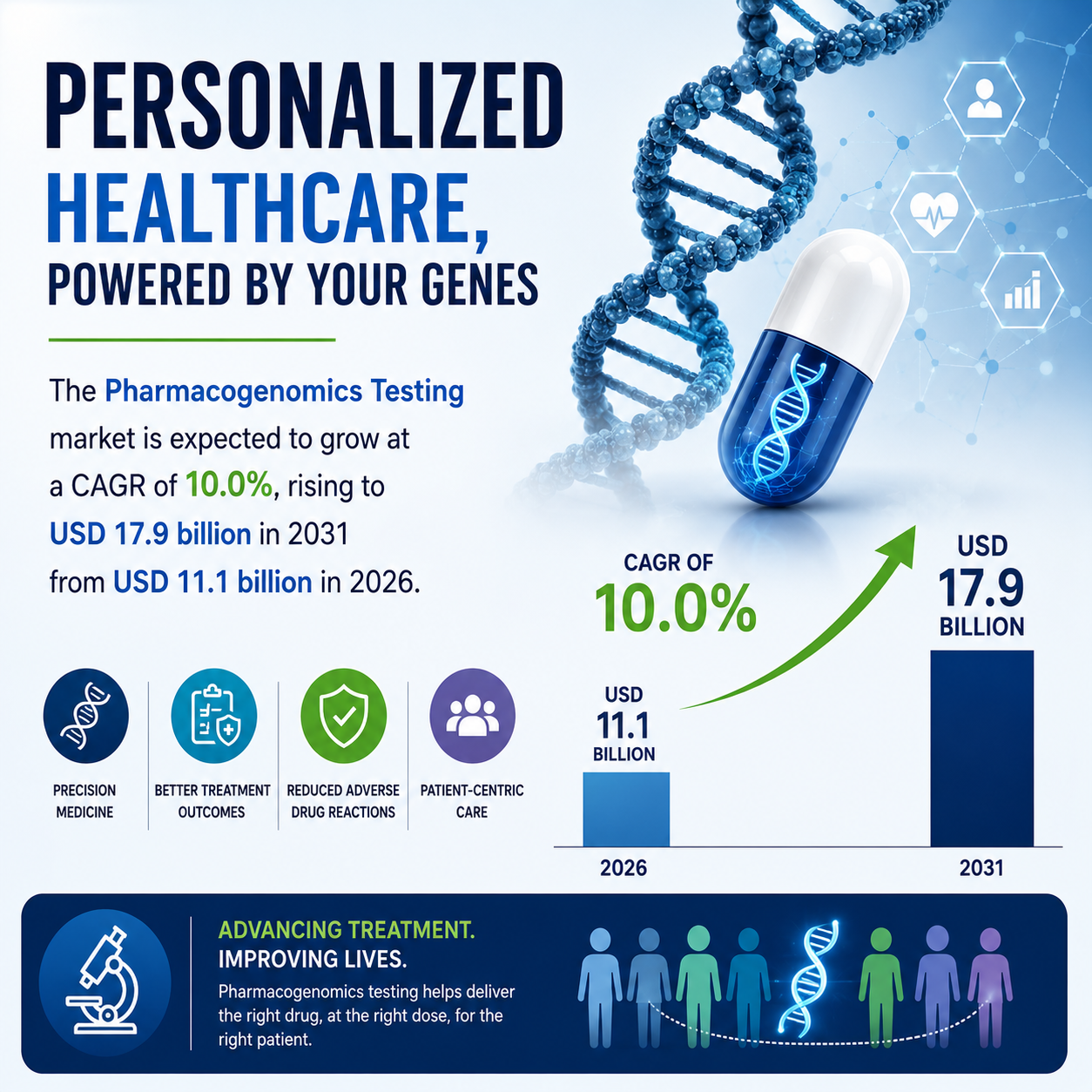
pharmacogenomics-(PGx)-testing-market
The American Context: Moving Beyond the “Niche” Label
In the U.S., pharmacogenomics is shedding its reputation as an academic luxury. For years, PGx was the “next big thing” that never quite arrived for the average primary care physician in Ohio or Florida. That has changed. The catalyst hasn’t been a single breakthrough, but a convergence of Medicare reimbursement clarity and a harsh realization by private insurers: adverse drug reactions (ADRs) are costing the American economy upwards of $500 billion annually.
We are seeing a maturation of the market where the “test” itself is becoming a commodity, while the “insight” is the premium product. In the U.S. healthcare ecosystem, the friction has always been the “last mile”, getting genetic data into the Electronic Health Record (EHR) in a way that actually stops a doctor from writing a dangerous prescription. The current growth is driven by companies that aren’t just sequencing DNA, but are providing the software “plumbing” to make that data actionable at the point of care. Emerging in silico variant-effect predictors and deep mutational scanning are now providing scalable platforms for functionally annotating variants and modeling human drug toxicity in real-time.
The Shift Toward Polypharmacy Management
The real growth engine in the States isn’t oncology — which has already embraced genomics — but the management of the aging American population. We are a nation of “polypharmacy” patients. It is not uncommon for a 70-year-old in Scottsdale to be on twelve different medications. When you layer genetic variability on top of drug-drug interactions, the complexity is staggering.
Analytical depth suggests that the move toward value-based care models is the strongest tailwind for PGx. If an Accountable Care Organization (ACO) is on the hook for the cost of a hospital readmission, they are suddenly very interested in knowing if a patient’s Plavix (clopidogrel) isn’t working because of a CYP2C19 mutation. This shift from volume to value is doing more for PGx adoption than twenty years of peer-reviewed papers ever did.
Innovation Hubs: The Companies Redefining the US Landscape
The American PGx market is highly localized, with specific clusters of innovation in the Bay Area, the Research Triangle, and the Northeast. Unlike the broader diagnostic giants, these firms are specializing in clinical decision support.
Myriad Genetics (Salt Lake City, Utah)
Myriad has pivoted significantly from its historic focus on hereditary cancer toward mental health and companion diagnostics. Their flagship product, GeneSight, is a psychotropic PGx test that has become a staple in American psychiatry. Developed and analyzed in their Salt Lake City facilities, GeneSight analyzes how a patient’s genes affect their response to medications for depression and anxiety. Myriad’s recent development focus has also included the MyChoice CDx for ovarian cancer, which integrates loss of heterozygosity (LOH) and telomeric allelic imbalance into a composite Genomic Instability Score. In a country facing a mental health crisis, the ability to bypass the “six-week wait” to see if an antidepressant works is a massive competitive advantage.
Invitae (San Francisco, California)
Based in San Francisco, Invitae has focused on the “democratization” of genetic testing. Their Invitae Pharmacogenomics Panel is designed for broad clinical utility, offering deep coverage of targeted sequences. What makes their development path interesting is their aggressive integration with EHR systems. Invitae isn’t just selling a report; they are selling a digital result that lives in the patient’s portal forever. They have been pioneers in the “buy once, query often” model, suggesting that a patient’s PGx profile should be a permanent part of their medical identity.
OneOme (Minneapolis, Minnesota)
Co-founded with the Mayo Clinic, OneOme reflects the Midwestern pragmatic approach to healthcare. Their RightMed Test is a comprehensive solution covering hundreds of medications. Their development focus in Minneapolis has been centered on the RightMed Advisor, a tool specifically for pharmacists. In the U.S., pharmacists are increasingly recognized as the primary gatekeepers of medication therapy management. OneOme’s strategy focuses on empowering the pharmacist to intervene before the medication is even dispensed, a move that aligns perfectly with the expanding scope of practice for pharmacists in many U.S. states.
The AI Inflection Point: Why AI-Powered Elderly Care is the New Frontier
While the title of this shift often focuses on the technology, the soul of the movement is the American senior. There is a defining shift occurring: Why AI-Powered Elderly Care Is Becoming a Defining Shift in American Healthcare.
We are currently witnessing the marriage of artificial intelligence and pharmacogenomics, specifically tailored for the Medicare population. The “Defining Shift” isn’t just about robots in nursing homes; it’s about using machine learning to parse through billions of data points to predict which elderly patients are at the highest risk for a “prescribing cascade.”
AI-driven PGx platforms are now able to provide risk stratification for entire populations. An insurer can run an algorithm over their 50,000 members in Florida and identify the 500 seniors who have the highest genetic risk for a catastrophic drug interaction. This proactive intervention is the holy grail of modern American medicine. It moves the needle from “sick care” to “preventative management.” Modern human-augmented AI systems are now embedding clinician feedback as an integral component of model learning, moving beyond static, rule-based tools toward dynamic ecosystems that learn from real-world decision-making.
The Regulatory and Reimbursement Reality
The U.S. FDA has been uncharacteristically assertive in this space. By updating drug labels to include genomic information for drugs like warfarin and abacavir, the regulator is essentially forcing the hand of the clinician. However, the “wild west” of the early 2020s, where dozens of small labs popped up with questionable claims, is over. We are seeing a consolidation phase.
I suspect we will see a “reimbursement squeeze” where only tests backed by massive clinical utility data survive. The 10% CAGR isn’t guaranteed for everyone; it will be captured by those who can prove that their test reduces ER visits. In the U.S., the payer is king. If a major insurer decides a test is “investigational,” the market for that test evaporates overnight. Fortunately, for PGx, the evidence is finally catching up to the marketing.
Subtle Opinions: The “Missing” Pieces
If there is a critique to be made of the current American trajectory, it is the lack of diversity in the genomic databases. Most PGx data is derived from European-descendant populations. As the U.S. market grows, there is a massive commercial and ethical risk if these tests don’t work as well for African American or Hispanic populations. The companies that invest in “inclusive genomics” now will be the ones that dominate the diverse markets of the 2030s.
Furthermore, we must address the “Physician Burnout” factor. American doctors do not want more data; they want answers. A twenty-page genetic report is a liability to a busy doctor. The market winners will be those who can condense that data into a simple “Green/Yellow/Red” light inside the doctor’s workflow.
Final Outlook: A Trillion-Dollar Foundation
As we look toward 2031, the pharmacogenomics testing market should be viewed as the foundation of a much larger ecosystem. PGx is the “gateway drug” for personalized medicine. Once a health system integrates genomic alerts, the infrastructure is in place for whole-genome sequencing and advanced gene therapies.
In the United States, the convergence of an aging population, a shift toward value-based reimbursement, and the integration of AI into clinical workflows has created a “perfect storm” for PGx. It is no longer a question of if pharmacogenomics will be standard of care, but how fast the laggards in the medical community can catch up to the technological reality. The shift is here, and it is molecular.
메타데이터
- post_id
- f0b761394249
- slug
- the-molecular-redlining-of-american-medicine-why-pharmacogenomics-is-the-new-standard-in-clinical-f0b761394249
- url
- https://medium.com/@abhi.knp82/the-molecular-redlining-of-american-medicine-why-pharmacogenomics-is-the-new-standard-in-clinical-f0b761394249
- canonical_url
- https://medium.com/@abhi.knp82/the-molecular-redlining-of-american-medicine-why-pharmacogenomics-is-the-new-standard-in-clinical-f0b761394249
- author_url
- https://medium.com/@abhi.knp82
- status
- ok
- fetched_at
- 2026-06-09 15:37:30