The Wheeler-DeWitt Equation: Unveiling the Quantum Fabric of the Universe
Since time immemorial, humanity has gazed at the stars, pondering the grandest questions: How did the universe begin? What is its true…
The Wheeler-DeWitt Equation: Unveiling the Quantum Fabric of the Universe
Since time immemorial, humanity has gazed at the stars, pondering the grandest questions: How did the universe begin? What is its true nature? And what secrets does its very fabric hold? For centuries, physics has offered powerful insights, but a profound schism exists at its heart. Einstein’s General Relativity brilliantly describes gravity and the cosmos on large scales, while Quantum Mechanics excels at detailing the behavior of matter and energy at the subatomic level. Reconciling these two pillars remains the holy grail of modern physics, a quest for a “theory of everything” that can describe the universe from its smallest particles to its grandest structures.
Enter the Wheeler-DeWitt Equation, a monumental theoretical framework proposed in the 1960s. This enigmatic equation is not just a mathematical curiosity; it represents one of the most ambitious attempts to bridge the gap between quantum mechanics and general relativity, offering a potential glimpse into the quantum nature of the universe itself. It suggests a reality far stranger and more profound than our everyday experience, hinting at a universe that might not even contain intrinsic time. Join us as we delve into the depths of this remarkable equation and explore its mind-bending implications for our understanding of existence.
What is the Wheeler-DeWitt Equation?
A Quest for Quantum Gravity
The need for a theory of quantum gravity arises from the limitations of our current understanding. General Relativity breaks down at extreme conditions, such as the Big Bang singularity or inside black holes, where quantum effects are expected to dominate. Similarly, quantum mechanics, in its standard form, doesn’t account for gravity. Physicists like John Wheeler and Bryce DeWitt recognized this fundamental incompatibility and sought a way to quantize gravity, treating the gravitational field itself as a quantum entity, much like other fundamental forces. The Wheeler-DeWitt Equation (WDE) emerged from this pioneering endeavor, a direct attempt to apply quantum principles to the entirety of spacetime.
The Equation’s Core Idea
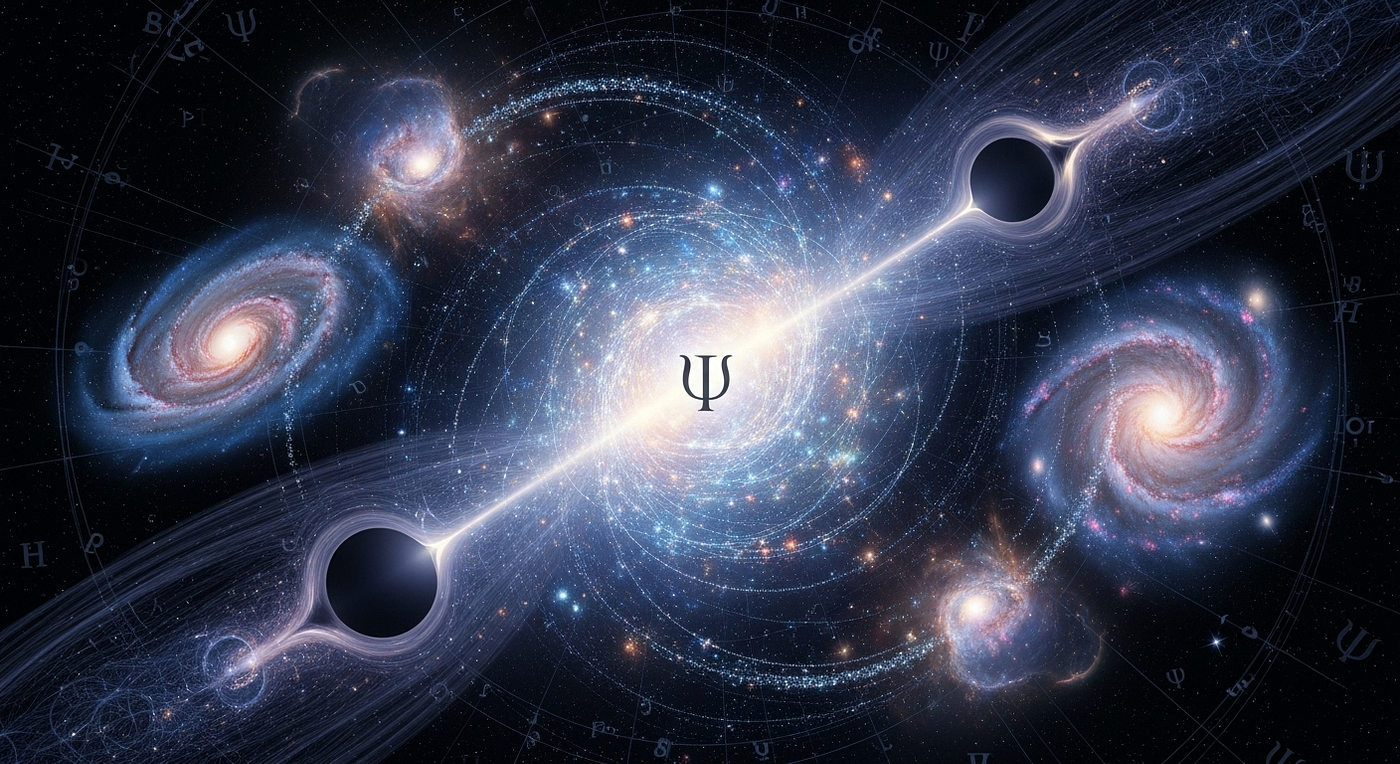
At its heart, the Wheeler-DeWitt Equation is a functional differential equation. Instead of describing the evolution of a particle in space over time, it describes the “wave function of the universe” (often denoted by Ψ, the Greek letter Psi). This wave function doesn’t evolve in time in the traditional sense; rather, it describes the probability amplitude of different “geometries” or configurations of the entire universe. It combines all possible gravitational fields and matter fields into a single, comprehensive quantum state.
Conceptually, you can think of it as asking: “What is the probability of the universe existing in this particular shape, with this particular distribution of matter and energy?” The equation essentially dictates which configurations of the universe are permitted by the laws of quantum gravity.
Understanding the “Wave Function of the Universe”
Probability in Cosmology
Just as the wave function of an electron describes the probability of finding it at a certain location, the “wave function of the universe” (Ψ) in the context of the Wheeler-DeWitt Equation describes the probability amplitude for the entire cosmos to be in a particular state. This means that instead of a single, deterministic universe unfolding, the WDE suggests a superposition of all possible universe configurations. These configurations encompass everything from the shape of spacetime to the distribution of galaxies and fundamental particles.
This probabilistic nature is a cornerstone of quantum mechanics, but applying it to the entire universe is a conceptual leap. It implies that our universe, with its specific properties and history, is just one possible outcome from an infinite set of quantum possibilities.
The Universe’s States
What exactly constitutes a “state” of the universe in this framework? It refers to a complete specification of all the gravitational fields and matter fields across all of space. Imagine mapping out every curve in spacetime and every particle’s quantum properties at a given “moment.” The wave function assigns a probability amplitude to each such complete map. It doesn’t evolve from one state to the next with respect to an external clock, but rather describes a timeless relationship between all possible states. Interpreting this vast, single wave function for the cosmos is one of the profound challenges of quantum cosmology.
A conceptual diagram illustrating a superposition of different possible “universes” or cosmological states, showing varying geometries, matter distributions, and fundamental constants.
The Timeless Universe Concept
How WDE Suggests No Intrinsic Time
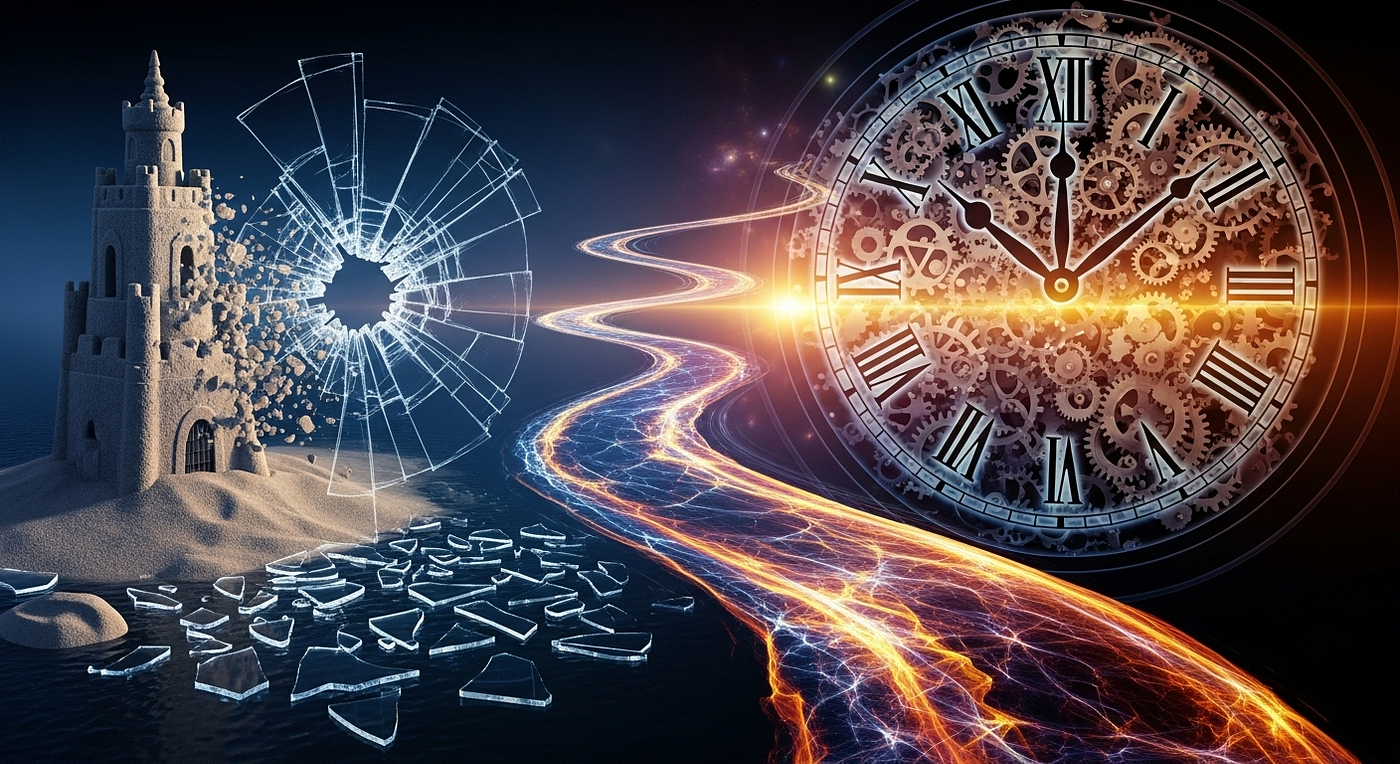
Perhaps the most startling and revolutionary implication of the Wheeler-DeWitt Equation is the “problem of time.” When you look at the WDE, a crucial variable is conspicuously absent: time (t). Unlike almost every other equation in physics, the WDE does not contain a time parameter that governs its evolution. This suggests that, at the most fundamental quantum level of the universe, time as we perceive it does not exist as an independent, external entity.
Instead, the equation is a constraint equation, meaning it states that the total Hamiltonian (representing the total energy and evolution generator) of the universe must be zero. This “frozen formalism” implies that the wave function of the universe describes all possible configurations of space and matter simultaneously, without any inherent progression from one to the next. The universe, in this quantum description, is fundamentally timeless.
Emergent Time Phenomena
If the universe is fundamentally timeless, how do we experience the relentless march of moments? Physicists propose that time is an “emergent phenomenon.” This means that what we perceive as time arises from changes within the universe itself, from the correlations between its internal components, rather than from an external clock.
For example, time could emerge from the increasing entanglement between different degrees of freedom in the universe, or from the semiclassical approximation where gravity behaves classically. Our clocks, and our sense of past, present, and future, might simply be manifestations of the universe’s internal dynamics, much like a complex pattern emerges from simpler rules. The Wheeler-DeWitt Equation prompts us to reconsider time not as a fundamental given, but as a property that arises from the very fabric of the cosmos.
An abstract representation of time emerging from changes in spatial configurations and internal correlations, rather than a linear arrow moving forward, perhaps showing entangled particles.
Impact on Big Questions
The implications of the Wheeler-DeWitt Equation reach into the most profound questions about existence, reshaping our understanding of the universe’s beginning and end.
Origin of the Universe
The WDE offers a framework for contemplating the origin of the universe without invoking a classical singularity. In a timeless quantum universe, the concept of a “beginning” in the conventional sense becomes fuzzy. Instead, proposals like the “no-boundary proposal” by Stephen Hawking and James Hartle suggest that the wave function of the universe doesn’t have a specific initial condition at a singularity. It smoothly “tunnels” into existence from nothingness, akin to a particle tunneling through a potential barrier in quantum mechanics. This quantum leap avoids the problematic infinities of classical general relativity, providing a consistent quantum description for the universe’s earliest moments. The WDE is crucial for evaluating the probability of such a “no-boundary” state.
The End of the Universe
Just as it informs the beginning, the Wheeler-DeWitt Equation can potentially describe the future states of the universe. If the wave function encompasses all possible configurations, it would also include states corresponding to various cosmological fates: a Big Crunch (where the universe collapses back on itself), a Big Freeze (where it expands indefinitely and cools to absolute zero), or even a Big Rip (where expansion tears everything apart). The probability amplitudes assigned by the wave function to these future scenarios would offer insights into the ultimate destiny of our cosmos, viewed not as a determined outcome, but as one of many potential quantum possibilities.
Current Status and Ongoing Research
While the Wheeler-DeWitt Equation remains famously unsolved in a complete and universally accepted form, it has profoundly influenced and continues to be a central equation in various approaches to quantum gravity.
Loop Quantum Gravity
In Loop Quantum Gravity (LQG), the Wheeler-DeWitt Equation takes center stage as the “Hamiltonian constraint.” LQG attempts to quantize spacetime itself, proposing that space is not continuous but made up of discrete “loops” or quanta. Within this framework, the WDE is used to describe the dynamics of these quantum gravitational states, dictating how the network of loops evolves (or rather, relates different configurations of loops). It provides a mathematical foundation for understanding how the quantum geometry of space can change, even if the concept of time is still emergent.
String Theory Connections
String theory, another leading candidate for a theory of quantum gravity, views fundamental particles not as points but as tiny, vibrating strings. While string theory’s mathematical apparatus is quite different from canonical quantization methods that lead directly to the WDE, the underlying principles and challenges are shared. Concepts arising from the Wheeler-DeWitt Equation, such as the timelessness of fundamental reality and the holographic principle (where gravity in a volume can be described by a theory on its boundary), often find parallels or deeper explanations within string theory’s diverse landscape. Researchers continue to explore how WDE-like constraints might emerge in various string theory compactifications.
A comparative diagram illustrating the conceptual differences and goals of Loop Quantum Gravity (showing a network of quantum loops) and String Theory (showing vibrating strings), and how both aim to solve the challenge of quantum gravity.
Why the Wheeler-DeWitt Equation Matters (Even if Unsolved)
Despite its formidable mathematical complexity and the ongoing quest for a definitive solution, the Wheeler-DeWitt Equation is arguably one of the most important theoretical constructs in modern physics. It matters for several crucial reasons:
-
A Foundation for Quantum Gravity: It provides a concrete, mathematical starting point for building a theory of quantum gravity. It’s a “Rosetta Stone” guiding physicists towards understanding the quantum nature of the universe.
-
Redefining Time and Space: It forces us to confront radical ideas about the nature of time and space, suggesting that our intuitive understanding might be fundamentally flawed at the deepest levels of reality. The concept of an emergent time, rather than fundamental time, is a direct legacy of the WDE.
-
Inspiration for New Physics: It has inspired decades of research and continues to drive new ideas and frameworks in quantum cosmology, including much of the foundational work in Loop Quantum Gravity and concepts explored in string theory.
-
Addressing Grand Questions: It offers a framework to discuss the origin and fate of the universe in a quantum context, moving beyond the classical singularities and providing a consistent quantum mechanical description for the cosmos.
The Wheeler-DeWitt Equation isn’t just an abstract formula; it’s a testament to humanity’s relentless pursuit of understanding the ultimate secrets of existence, pushing the boundaries of what we thought possible about our universe.
Conclusion: A Glimpse into the Quantum Cosmos
The Wheeler-DeWitt Equation stands as a monumental, albeit challenging, achievement in theoretical physics. It’s a bold attempt to unite the two great pillars of modern physics — general relativity and quantum mechanics — into a single, comprehensive description of the quantum nature of the universe. From its enigmatic suggestion of a fundamentally timeless cosmos to its role in shaping our understanding of the universe’s origin and destiny, the WDE has profoundly influenced quantum cosmology.
Though a complete solution remains elusive, its core ideas continue to fuel cutting-edge research in fields like Loop Quantum Gravity and string theory. It reminds us that our universe, at its most fundamental level, may operate on principles far stranger and more beautiful than we can easily conceive. As we continue to probe the mysteries of the cosmos, the Wheeler-DeWitt Equation remains a guiding star, offering a tantalizing glimpse into the true, quantum fabric of our universe. The journey to fully comprehend the Wheeler-DeWitt Equation and the Quantum Nature of the Universe is far from over, promising further revelations about reality itself.
메타데이터
- post_id
- f0bb87a45a7c
- slug
- the-wheeler-dewitt-equation-unveiling-the-quantum-fabric-of-the-universe-f0bb87a45a7c
- url
- https://medium.com/@algomehr/the-wheeler-dewitt-equation-unveiling-the-quantum-fabric-of-the-universe-f0bb87a45a7c
- canonical_url
- https://medium.com/@algomehr/the-wheeler-dewitt-equation-unveiling-the-quantum-fabric-of-the-universe-f0bb87a45a7c
- author_url
- https://medium.com/@algomehr
- status
- ok
- fetched_at
- 2026-06-17 08:20:12