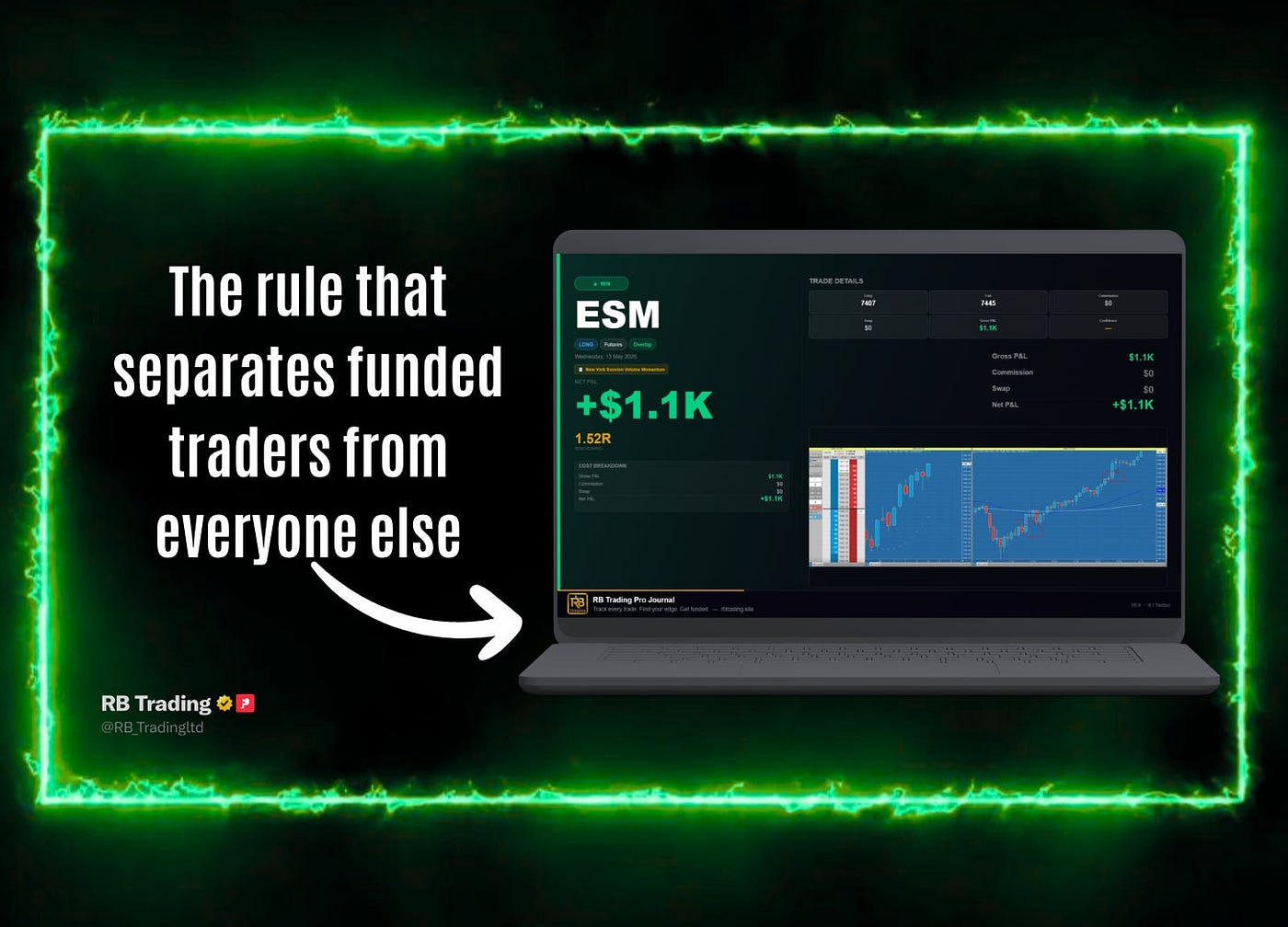
The rule that separates funded traders from everyone else
On position sizing, the psychology of oversizing, and the one calculation that protects your account on every trade.
The rule that separates funded traders from everyone else
On position sizing, the psychology of oversizing, and the one calculation that protects your account on every trade.
The problem
Most traders don’t blow up their accounts on a bad setup. They blow up on a good one they sized too big.
Between 74% and 89% of retail traders lose money. That figure has held across every platform, education level, and regulatory environment studied over three decades and across millions of accounts. The researchers isolated the variables. The setups were not the problem. The entries were not the problem. What destroyed those accounts was the decision made in the ten seconds before the buy button was pressed.
80% of day traders quit entirely within the first two years. Not because the market was unreadable. Because one oversized position started a cascade they never recovered from, financially or psychologically.
This is not a talent problem. It is a process problem. And process is fixable.
Inside the Trade: is a reader-supported publication. To receive new posts and support my work, consider becoming a free or paid subscriber.
Why oversizing feels like confidence
The reason it happens is the same every time. A strong setup produces a feeling, and that feeling says go bigger. You have done the analysis. You believe the trade is right. The chart is clean, the structure is clear, the risk-reward makes sense. So you size up. What you are actually doing in that moment is something very different from confidence.
You are converting a mechanical edge into an emotional bet.
The market does not reward emotional bets. It punishes them, specifically at the worst possible moment. The trade you were most certain about is statistically the one most likely to go hard against you, because certainty is what makes you hold past your stop, add to a loser, and rationalise away the rules you set before the trade opened.
Conviction without position sizing is just risk with a story attached to it.
The fixed fractional method
The solution is mechanical and it has been the professional standard for decades. You decide in advance, before the chart even loads, what percentage of your account you are willing to lose on a single trade. For traders operating at a serious level that number sits between 1% and 2%. That decision is made once, written into your rules, and it does not move based on how good a setup looks.
Here is the maths at 1% risk on a $10,000 account:
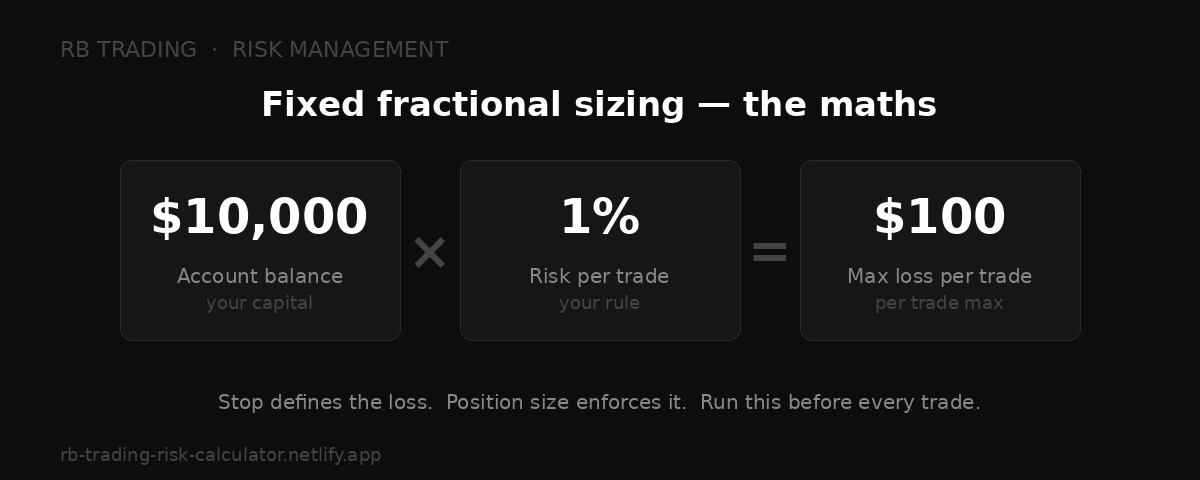
If your stop on a forex pair is 20 pips and each pip on a micro lot is worth $0.10, you run 5 micro lots. Not 6. Not close enough. Five. The stop defines the loss. The position size enforces it. Those are the only two variables that matter before you press the button.
The calculation takes 20 seconds. The reason most traders skip it is that doing it properly means accepting the stop in advance, and accepting the stop means admitting the trade might fail. Traders who skip this step are not more confident than everyone else. They are less honest with themselves.
Account balance. Risk percentage. Entry. Stop. It gives you a number. That number is what you trade.
The full session risk framework, drawdown limits across a full trading week, the cascade model, this week’s sized setups, and the prop firm framework are all inside RB Pro.
Join 7,000 traders who get the full picture every week.
Why a losing streak on correct size is survivable
This is the part most risk management content never reaches, because it requires talking honestly about what happens after the loss, not just how to prevent it.
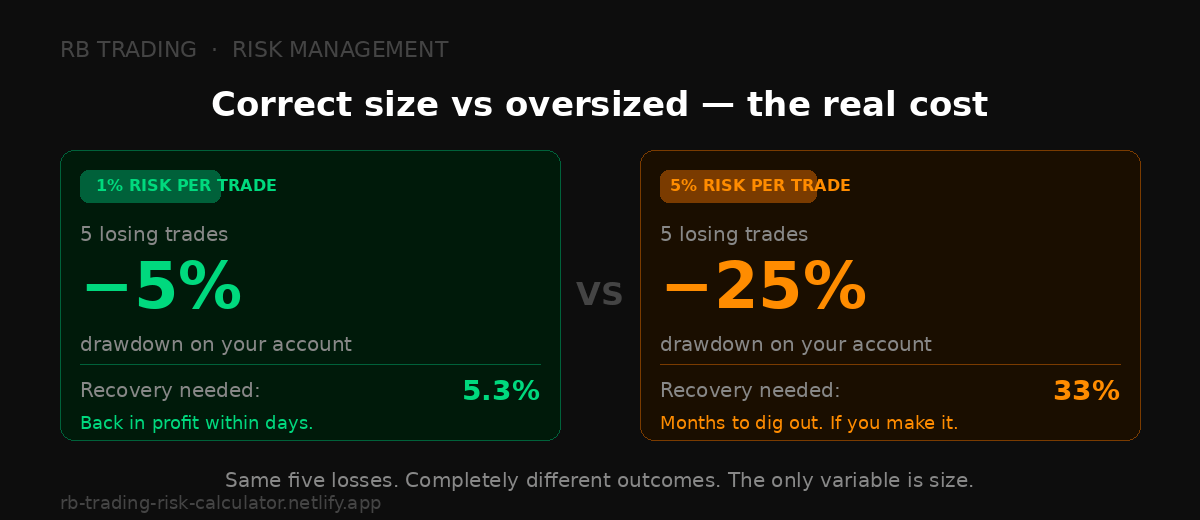
A sequence of losing trades at 1% risk is uncomfortable. Five losses in a row costs you 5% of your account. That is a bad week. It is recoverable in a single good week with correct sizing. Now run the same sequence at 5% risk per trade. Five consecutive losses costs you 25%.
A 25% drawdown requires a 33% gain on the remaining capital just to break even. You are no longer trading. You are digging yourself out of a hole that will take months to climb from.
The deeper damage is never the capital. It is what happens to your decision-making inside a drawdown. The trader who takes a 15% loss in a single position does not come back to the next setup with a clean analytical mind. They come back trying to win it back. The next position is sized emotionally. Then the one after that. The original oversized trade was not just one bad decision. It was the first domino in a sequence, and the only thing that stops the sequence is the number you set before the first trade opened.
Proper size breaks the cascade before it starts. It is the only intervention that works at the source.
What prop firms are actually testing
The industry average pass rate for funded account evaluations sits between 5% and 10%. Most traders who fail assume the problem was their entries, their strategy, or their ability to read the market. It almost never is.
The firms that fund traders are not running a test of your chart reading ability. Every retail trader with six months of screen time can read a chart adequately. What they are testing is whether you can manage risk across a sequence of trades, under the psychological pressure of a live evaluation, without letting any single position threaten the account balance.
The entire evaluation is a position sizing exam with a chart in front of it. The traders who pass are not better analysts. They are the ones who ran the number before every trade and stuck to it when the setup looked too good to size small.
The habit that locks this in
The system only works if it becomes automatic. Run the calculator before every trade without exception, including the setups that feel obvious. Especially those. Log the position size in your journal at entry, not after. At the end of every week, pull the actual risk figures and compare them against your stated rules. If the number has drifted above 1% or 2%, you already know where the leak is.
The account is the only asset in this business that cannot be replaced on a timeline you control. The calculator takes 20 seconds. Use it on every trade, every session, regardless of how obvious the setup looks.
We trade what we can verify. Everything else is noise. Not financial advice. Never risk more than you can afford to lose.
— RB Trading
메타데이터
- post_id
- f0bf3a446b4e
- slug
- the-rule-that-separates-funded-traders-from-everyone-else-f0bf3a446b4e
- url
- https://medium.com/inside-the-trade/the-rule-that-separates-funded-traders-from-everyone-else-f0bf3a446b4e
- canonical_url
- https://medium.com/inside-the-trade/the-rule-that-separates-funded-traders-from-everyone-else-f0bf3a446b4e
- author_url
- https://medium.com/@rb_tradingltd
- status
- ok
- fetched_at
- 2026-06-13 09:11:36