Lola (1961, dir. Jacques Demy): The Light and Darkness of Waiting Love
Love is the willing offering of one’s time.
Lola (1961, dir. Jacques Demy): The Light and Darkness of Waiting Love
0.
Love is the willing offering of one’s time. — Writer Lee Ki-joo
1.
It may be a cliché, but love is like a traffic accident. You can fall in love at any moment — with someone you meet by chance on a business trip, along a street you happened to walk down, in a bookstore you wandered into. Stubborn love appears as it pleases and takes root as it pleases, leaving no room for control. It pays no mind to the circumstances of the one who loves, nor of the one who is loved. The sailor who must depart for his next port, the unemployed man suddenly forced to go abroad, the man who could not return to his wife for seven years — none of their situations matter.
If we had met at a different time, would our love have been different. If it had begun in a different place, would our love have been different. Anyone who has experienced a serious love — and an even more serious parting — has likely asked such questions at least once. As with life, love ultimately comes down to timing. That is why love feels like fate.
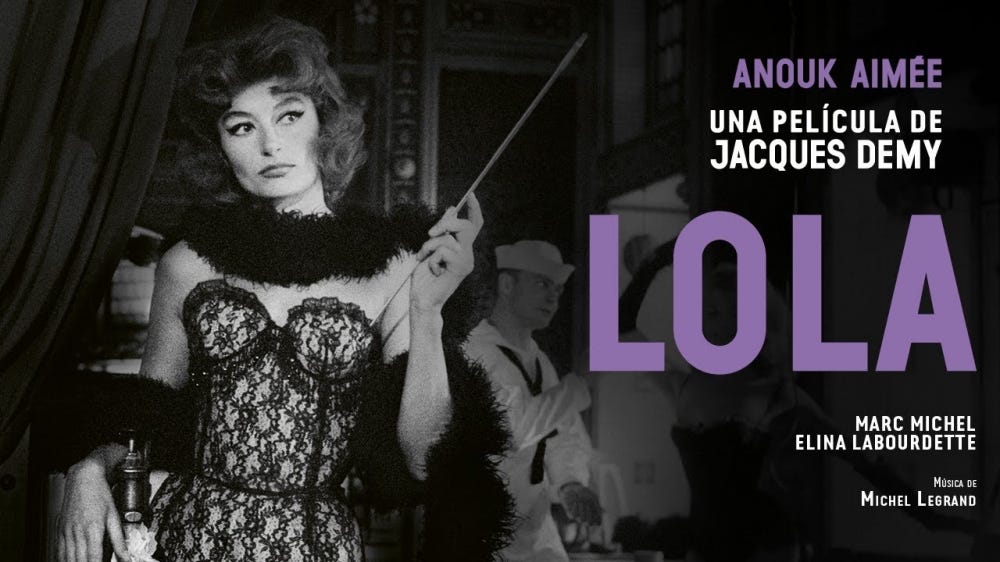
Known for The Umbrellas of Cherbourg and The Young Girls of Rochefort, Jacques Demy’s debut Lola is a melodrama released in 1961. Set in Nantes, his hometown in France, it depicts the love of three men surrounding Lola, a dancer. Lola, a cabaret performer, raises her son Yvon while waiting for her husband Michel, who left seven years ago. To the alluring Lola, the American sailor Frankie offers passionate courtship, and her childhood friend Roland offers sincere affection, but she refuses them both out of unwavering love for her husband, and is eventually reunited with Michel.

2.
Love is the willing offering of one’s time. The contrast between the absurdly long seven years of separation and the absurdly short three days of courtship serves to understand love through the lens of time. Frankie frequents the cabaret to win her favor and gives toys to Lola’s son, yet he does not truly spend his time. Lola is attractive enough to him, but not to the extent that he would take off his uniform and remain in Nantes.
That said, simply giving one’s time blindly is not love either. For the time one offers to be love, that time must first be precious. Roland is an idle drifter who has carelessly abandoned his job and nearly dabbled in crime; the time he spends is not especially valuable.
Lola is both a dancer and a mother. A dancer is something physical. Throughout the film, Anouk Aimée wears glamorous outfits, dances, and sings. She parties all night with sailors and seems willing to share their beds when necessary. But for Jacques Demy, this is not love. Physical relationships that do not involve the offering of time are nothing more than trivial deviations, dry transactions.
If this were simply a film about romantic love between a man and a woman, the detail of her being a mother would not have been necessary. In fact, to emphasize the purity of a woman desired by many men, it might have been better for her not to have a child. Yet the director carefully emphasizes that Lola is a mother. Even as she struggles between work and love, she never neglects her child’s school, bedtime, gifts, or meals. That is love. Love is the offering of time for someone else, and it does not apply only to lovers.

3.
For that reason, waiting becomes the very essence of love. One spends time on the other, yet receives none in return. This is the darkness that resides beneath what appears, at first glance, to be a light and cheerful film. Lola, the cabaret dancer, embodies both the brightness of one who loves and the darkness of one who is not loved. The black-and-white imagery, with its emphasis on light and shadow — particularly the exaggerated contrasts in certain scenes — becomes the light and darkness of waiting love.
The director reinterprets this spatially through the images of “a port that cannot stop arriving ships” and “ships that must depart when the time comes.” Nantes, where departure, encounter, and waiting coexist, becomes a city of love where dazzling nights and quiet days exist together.
It is characteristic that the film constructs a multilayered narrative by alternating between the perspectives of its characters. Rather than focusing on individual interiors, it seeks to explore the love they share. It may be helpful, then, to attend to Lola waiting for Michel, Roland waiting for Lola, and Cécile waiting for Roland.
The sweet music of Michel Legrand and the performance of Anouk Aimée combine to create a romantic atmosphere. In particular, the music — where classical and jazz blend seamlessly — is a major strength. The opening, in which Beethoven’s Symphony №7 plays as a white sports car cuts across the beaches of Nantes, is a masterpiece.

Note: Originally written in Korean, with English translation assisted by AI. Appreciate you reading.
메타데이터
- post_id
- f0c77be39d84
- slug
- lola-1961-dir-jacques-demy-the-light-and-darkness-of-waiting-love-f0c77be39d84
- url
- https://medium.com/@realpierr/lola-1961-dir-jacques-demy-the-light-and-darkness-of-waiting-love-f0c77be39d84
- canonical_url
- https://medium.com/@realpierr/lola-1961-dir-jacques-demy-the-light-and-darkness-of-waiting-love-f0c77be39d84
- author_url
- https://medium.com/@realpierr
- status
- ok
- fetched_at
- 2026-06-20 20:29:01