Agent Memory Architectures: The Missing Piece Behind Truly Intelligent AI Agents
Ask most people what makes an AI agent intelligent, and you’ll hear answers like:
Agent Memory Architectures: The Missing Piece Behind Truly Intelligent AI Agents

Ask most people what makes an AI agent intelligent, and you’ll hear answers like:
- Better models
- Better prompts
- Better reasoning
- Better tools
All important.
All incomplete.
The real difference between a chatbot and an intelligent agent often comes down to one capability:
Memory.
Without memory, every interaction begins from zero.
Without memory, an AI agent cannot learn.
Without memory, an AI agent cannot build context.
Without memory, an AI agent becomes trapped in an endless cycle of digital amnesia.
This is why many early AI agents felt impressive during demonstrations but disappointing in production.
They could reason.
They could plan.
They could call tools.
But they couldn’t remember.
Imagine hiring an engineer who forgets every conversation after leaving a meeting room.
Every project discussion.
Every architecture decision.
Every incident response.
Every customer interaction.
That engineer would struggle to function.
Yet that’s exactly how many AI agents operate today.
As organizations move from simple chatbots to autonomous agents, memory is rapidly becoming one of the most important components of modern AI architecture.
In many ways, memory architectures are becoming the databases of the agentic AI era.
Why Agent Memory Matters
Most LLMs operate inside a context window.
The model can only see:
Current Prompt
+
Conversation Context
Once information leaves the context window, it effectively disappears.
The model doesn’t retain it.
The model doesn’t learn from it.
The model doesn’t remember it.
This creates several problems.
Problem 1: No Personalization
The agent forgets user preferences.
Problem 2: No Long-Term Learning
Past experiences are lost.
Problem 3: Repeated Conversations
Users constantly repeat information.
Problem 4: Poor Multi-Step Planning
Agents struggle with long-running tasks.
Memory architectures solve these limitations.
The Evolution of AI Memory
The journey looks remarkably similar to human cognition.
Generation 1: No Memory
User
 ↓
LLM
 ↓
Response
Every interaction starts fresh.
Generation 2: Conversation History
User
 ↓
Conversation Buffer
 ↓
LLM
Short-term memory appears.
But context windows eventually overflow.
Generation 3: Retrieval Memory
User
 ↓
Memory Retrieval
 ↓
Relevant Memories
 ↓
LLM
Only relevant memories are retrieved.
This dramatically improves scalability.
Generation 4: Agent Memory Systems
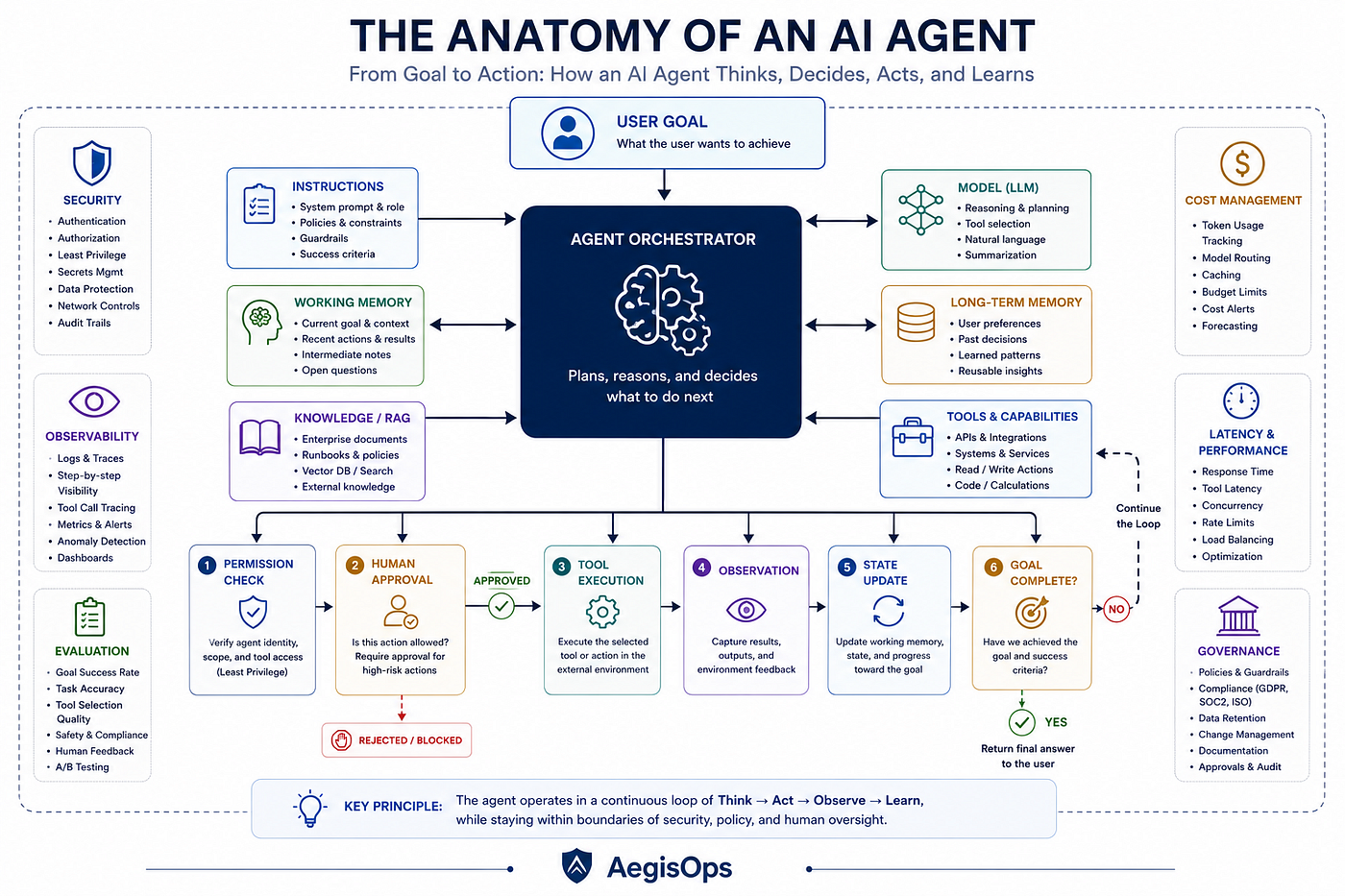
Agent
 ├── Episodic Memory
 ├── Semantic Memory
 ├── Procedural Memory
 ├── Working Memory
This is where the industry is heading.
Understanding Human Memory First
The easiest way to understand agent memory is through human memory.
Humans don’t have one memory system.
We have several.
AI agents are evolving similarly.
Working Memory
Working memory is the agent’s immediate attention span.
Think:
Current Conversation
Current Goal
Current Task
Examples:
- User’s current question
- Current workflow
- Active reasoning chain
This memory is temporary.
Once the task completes, much of it disappears.
Episodic Memory
Humans remember experiences.
Agents can too.
Examples:
Incident resolved last week
Customer interaction history
Previous troubleshooting session
Episodic memory answers:
What happened?
For AI agents, this often becomes a searchable event history.
Semantic Memory
Humans remember facts.
Examples:
- Paris is in France
- Kubernetes uses pods
- AWS IAM controls access
Agents maintain similar knowledge stores.
Semantic memory answers:
What do I know?
Common implementations include:
- Vector databases
- Knowledge graphs
- RAG systems
- Document repositories
Procedural Memory
Humans remember how to perform tasks.
Examples:
- Riding a bicycle
- Driving a car
- Troubleshooting a server
Agents also require procedural memory.
Examples:
How to deploy Kubernetes
How to restart a service
How to execute incident response
Procedural memory often contains workflows and playbooks.
The Four-Layer Agent Memory Architecture
Modern AI systems increasingly adopt a layered approach.
┌─────────────────────────┐
│ Working Memory          │
├─────────────────────────┤
│ Episodic Memory         │
├─────────────────────────┤
│ Semantic Memory         │
├─────────────────────────┤
│ Procedural Memory       │
└─────────────────────────┘
Each layer serves a different purpose.
Together they create continuity.
Working Memory Architecture
Working memory is usually stored inside:
- Context windows
- Agent state
- Runtime buffers
Example:
Current User Goal
Current Tool Results
Current Reasoning State
Characteristics:
✓ Fast
✓ Temporary
✓ Frequently updated
✗ Limited capacity
This is the equivalent of RAM in computing systems.
Episodic Memory Architecture
Episodic memory stores experiences.
Example:
User: Deploy applicationAgent:
- Created Kubernetes deployment
- Updated ingress
- Validated rolloutMonths later:
The agent can retrieve this experience.
Common storage options:
- Vector databases
- Event stores
- Time-series systems
This becomes increasingly important for autonomous agents.
Semantic Memory Architecture
Semantic memory contains facts and knowledge.
Architecture:
Documents
      │
      ▼
Embeddings
      │
      ▼
Vector Database
      │
      ▼
Retrieval
Popular technologies:
- Qdrant
- Pinecone
- Weaviate
- Milvus
- pgvector
This memory layer powers:
- Enterprise knowledge systems
- RAG platforms
- AI assistants
Procedural Memory Architecture
Procedural memory enables repeatable behavior.
Examples:
Runbook
Playbook
Workflow
SOP
Automation Sequence
Storage options include:
- Knowledge bases
- Workflow engines
- Git repositories
- Agent frameworks
This memory tells agents:
How should I do this?
Long-Term Memory Pipeline
Most production architectures look like:
Interaction
     │
     ▼
Memory Extraction
     │
     ▼
Importance Scoring
     │
     ▼
Storage
     │
     ▼
Retrieval
Not every interaction deserves permanent storage.
Memory systems must decide:
- What to keep
- What to forget
- What to summarize
This becomes a critical challenge.
Memory Retrieval Architecture
Storing memory is easy.
Finding useful memory is hard.
Modern systems use:
Vector Search
Retrieve semantically relevant memories.
Metadata Filtering
Retrieve memories by:
- User
- Team
- Application
- Date
Knowledge Graph Retrieval
Retrieve relationship-aware information.
Hybrid Search
Combine keyword and semantic retrieval.
The future belongs to hybrid retrieval systems.
Memory Compression and Summarization
A common misconception:
Just store everything.
This doesn’t scale.
Human brains summarize.
AI agents must do the same.
Example:
500 Conversations
       ↓
Summarization
       ↓
Key Learnings
Benefits:
- Lower costs
- Faster retrieval
- Better relevance
Memory compression is becoming a major area of innovation.
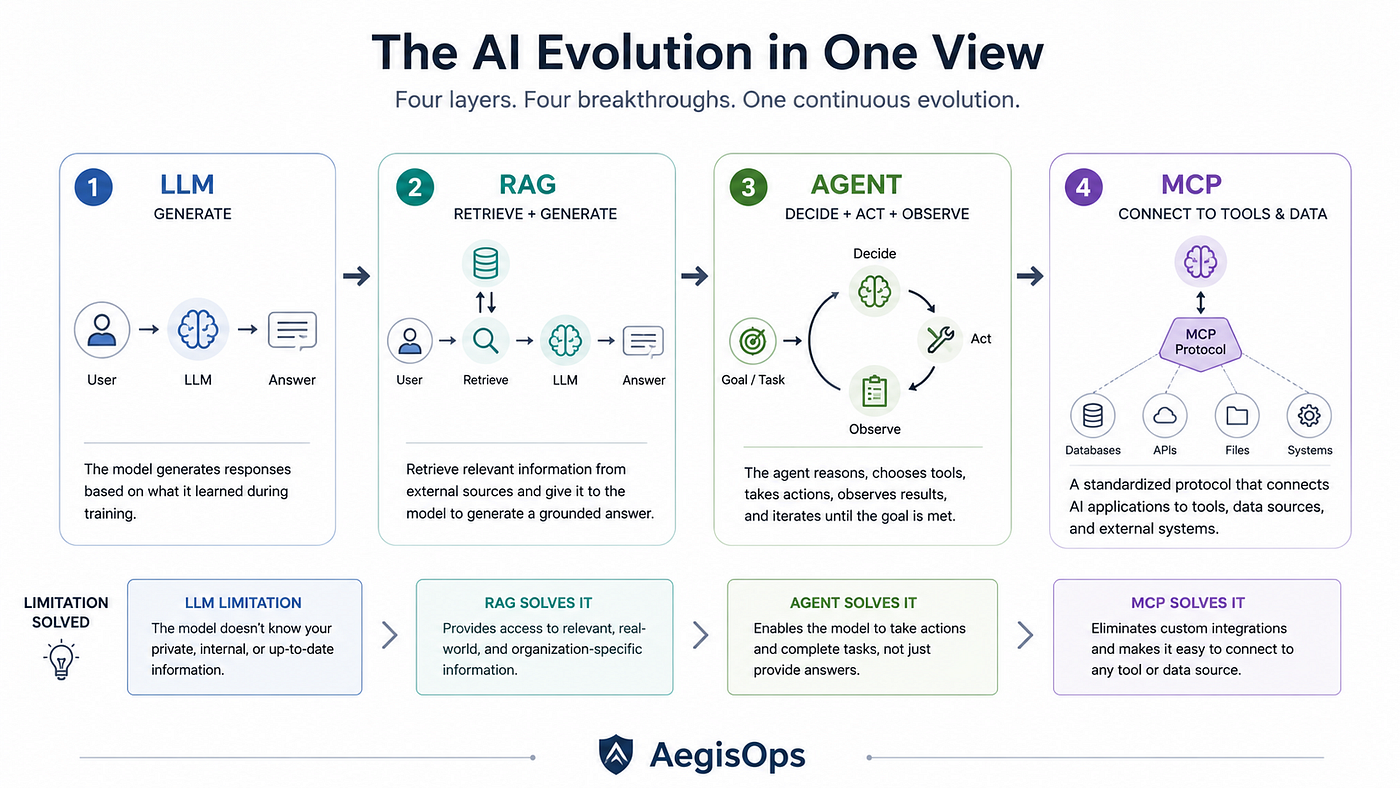
Agent Memory + RAG
Many people confuse memory with RAG.
They’re related but different.
RAG answers:
What information should I retrieve?
Memory answers:
What should I remember?
A mature AI platform often contains both.
Architecture:
Agent
 │
 ├── Memory Layer
 │
 ├── RAG Layer
 │
 ├── Tool Layer
 │
 └── LLM
Together they create intelligent behavior.
Agent Memory + MCP
The rise of MCP changes memory architectures.
Example:
Agent
 │
 ├── GitHub MCP
 ├── Jira MCP
 ├── Kubernetes MCP
 ├── Slack MCP
Instead of storing everything locally, agents can access external memory systems through MCP.
This creates distributed memory architectures.
Think:
Network-attached memory for AI.
Security Challenges
Memory introduces risk.
Examples:
Data Leakage
Sensitive information persists.
Unauthorized Access
Memory retrieval bypasses controls.
Privacy Violations
Personal information accumulates.
Memory Poisoning
Malicious users influence future behavior.
Enterprise memory systems require:
- Encryption
- Access controls
- Auditing
- Retention policies
Memory governance will become a major discipline.
What Most Organizations Get Wrong
Many teams focus on:
- Bigger models
- Better prompts
- More tools
While ignoring memory.
Yet memory often determines:
- Personalization
- Agent quality
- User trust
- Long-term effectiveness
A highly intelligent agent with no memory often performs worse than a moderately intelligent agent with excellent memory.
The Future of Agent Memory
Over the next few years, I expect several trends:
Persistent Agent Memory
Agents retain knowledge across months and years.
Shared Organizational Memory
Multiple agents share a common memory layer.
Memory Graphs
Knowledge graphs replace isolated memories.
Memory Governance Platforms
Dedicated products emerge for memory management.
Memory Observability
Organizations monitor memory quality like application metrics.
Federated Memory Systems
Agents retrieve memory across distributed environments.
Memory is becoming the next major platform layer in AI.
Key Takeaways
- Memory is one of the most important components of intelligent agents.
- Most LLMs have no true long-term memory.
- Working memory handles active reasoning.
- Episodic memory stores experiences.
- Semantic memory stores facts and knowledge.
- Procedural memory stores workflows and skills.
- Memory retrieval is often harder than memory storage.
- RAG and memory solve different problems.
- Security and governance become critical as memory grows.
- The future of AI agents will be defined as much by memory as by reasoning.
The next breakthrough in AI will not come from simply building larger models. It will come from building agents that remember, learn, adapt, and accumulate knowledge over time. In many ways, memory architectures are becoming the operating system of the agentic AI era.
AgentMemory #AIAgents #AgenticAI #ArtificialIntelligence #GenerativeAI #AIEngineering #AIArchitecture #EnterpriseAI #LLM #LongTermMemory #SemanticMemory #RAG #VectorDatabase #ContextEngineering #MCP #ModelContextProtocol #AIInfrastructure #PlatformEngineering #AIObservability #FutureOfAI
메타데이터
- post_id
- f0ca6eff8c2f
- slug
- agent-memory-architectures-the-missing-piece-behind-truly-intelligent-ai-agents-f0ca6eff8c2f
- url
- https://medium.com/aegisops/agent-memory-architectures-the-missing-piece-behind-truly-intelligent-ai-agents-f0ca6eff8c2f
- canonical_url
- https://medium.com/aegisops/agent-memory-architectures-the-missing-piece-behind-truly-intelligent-ai-agents-f0ca6eff8c2f
- author_url
- https://medium.com/@cloudsignal
- status
- ok
- fetched_at
- 2026-06-22 08:33:11