The API-First Mindset: How to Build Software That Doesn’t Trap You
Every software project starts with ambition and ends, eventually, with a constraint. Sometimes that constraint is budget. Sometimes it’s…

The API-First Mindset: How to Build Software That Doesn’t Trap You
Every software project starts with ambition and ends, eventually, with a constraint. Sometimes that constraint is budget. Sometimes it’s time. But an increasing number of the most painful constraints in modern software development are self-inflicted — the result of architectural decisions made in the first weeks of a project that quietly shape everything that follows for years.
The most common of these is the tightly coupled system. Backend logic tangled into frontend rendering. Business rules embedded in database procedures. Third-party services accessed directly from application code without any abstraction layer. These patterns feel practical at the time — faster to write, simpler to reason about at small scale — and they become traps the moment anything needs to change.
The API-first mindset is the antidote. Not API-first as a trend or a methodology label, but as a genuine way of thinking about how software components relate to each other and to the world outside them. When you design your system with well-defined interfaces from the start, you don’t just make your current integrations cleaner. You make every future decision easier.
What API-First Actually Means
The phrase gets used loosely, so it’s worth being precise. API-first development means that before you write a single line of implementation code, you design the contract between your system’s components. What data does this endpoint accept? What does it return? What are the error states? What authentication does it require? These questions are answered — documented, reviewed, agreed upon — before the first function is written.
This is different from API-last development, which is the default mode in most projects: build the backend, then expose an API because something else needs to talk to it. API-last systems work, but they carry the fingerprints of their construction history. Endpoints are shaped by internal data models rather than external consumer needs. Response formats are inconsistent because they evolved piecemeal. Adding a new client — a mobile app, a partner integration, a reporting dashboard — requires negotiating with an API that was never designed to serve that client.
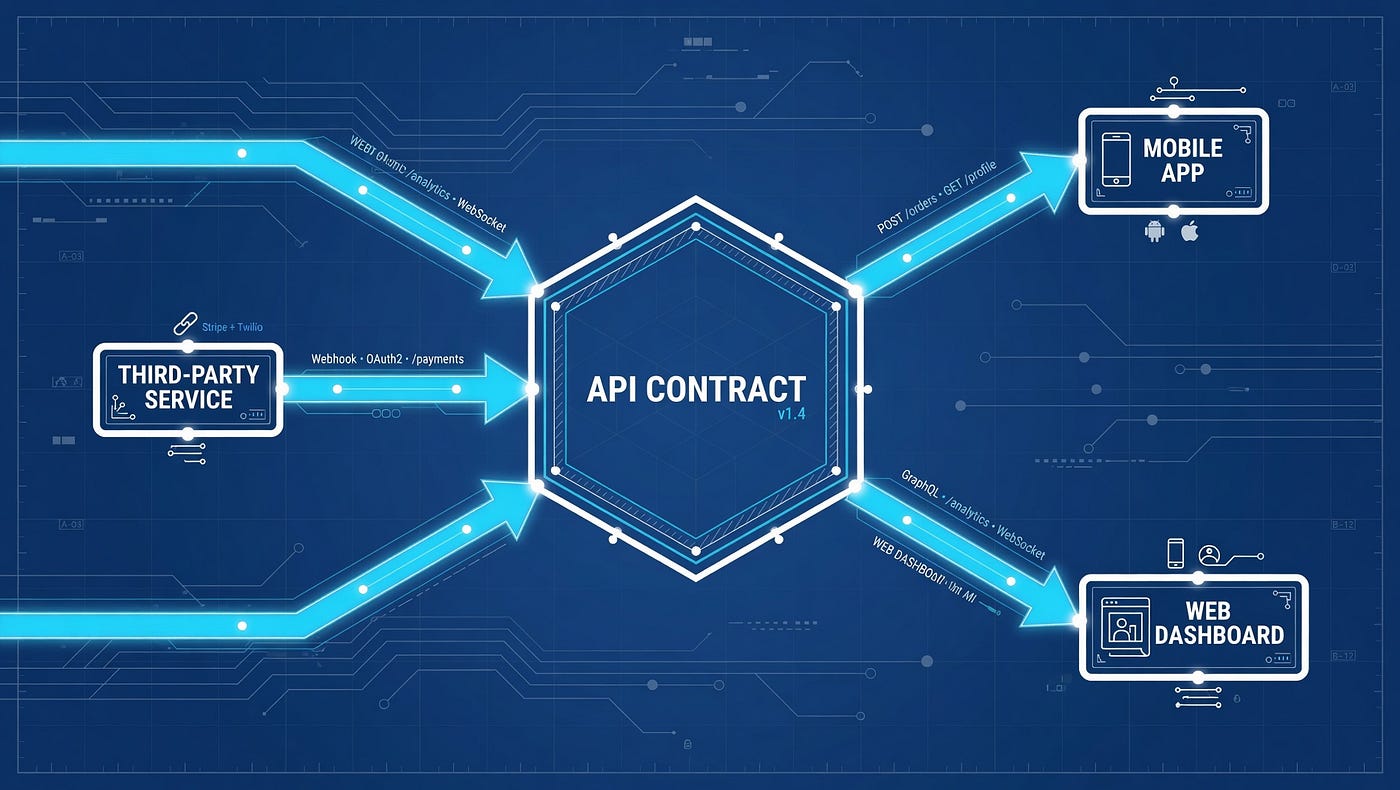
API-first inverts this. You start by asking who will consume this API and what they need. You design the interface from the outside in, not the inside out. The implementation follows the contract, which means the implementation can change without breaking the consumers — as long as the contract is respected.
The Freedom That Comes From Good Boundaries
There is a counterintuitive truth at the center of API-first thinking: constraints create freedom. By defining the boundaries between components explicitly, you free each component to evolve independently. Your frontend team doesn’t need to wait for the backend team to be finished. Your mobile app can be developed against a mock server that implements the agreed contract before the real server exists. Your third-party integrations don’t need to change when you refactor your internal database schema.
This matters enormously at scale, but it also matters on day one. Small teams are constrained by coordination overhead just as large teams are — arguably more so, because they have fewer people to absorb the cost of blocked work. When a two-person team has the frontend developer waiting on the backend developer because their work is tightly coupled, they are effectively operating as a one-person team for the duration of that blockage. API contracts eliminate whole categories of this coordination friction.
The parallel development benefit compounds over time. A team that builds with well-defined interfaces from the start develops a habit of thinking in contracts. When they add a new feature, they instinctively ask what interface that feature exposes before they start building it. This habit accelerates development not just in the present project but in every subsequent one.
The Integration Problem in Practice
Most businesses today run on a collection of systems that need to share data, trigger each other’s actions, and maintain consistency across different data stores. The question is not whether you will have integrations. It is whether those integrations will be clean or messy.
Messy integrations are the norm. Direct database connections between systems that should be independent. Scheduled jobs that copy data because there is no clean way to stream it. Point-to-point API calls woven through application logic in ways that make it impossible to change either system without carefully auditing all the places it is called. These patterns work until something changes — a vendor API update, a new business requirement, a system migration — and then they fail expensively.
The API-first approach treats integration points as first-class architectural concerns rather than implementation details. Every external system your software talks to, and every external system that talks to yours, interacts through a defined interface. That interface is versioned, documented, and tested. When the external system changes, you update the interface layer and everything downstream is protected.
Consider a SaaS platform integrating with multiple payment processors — Stripe in some markets, a regional provider in others, with new options as the business expands. An API-last approach bakes Stripe’s specific patterns directly into business logic. Adding a second provider requires modifying code throughout the codebase. An API-first approach builds a payment interface that business logic talks to. Adding a new provider means implementing that interface, not touching any business logic code.
Documentation as a Design Tool
One of the underrated benefits of API-first development is that it forces documentation to exist. In most software projects, documentation is an afterthought — written after the code is finished, already out of date, by engineers who would rather be building something new. API-first development makes documentation a prerequisite rather than a deliverable. You cannot build to a contract that has not been written down.
The OpenAPI specification has become the standard format for this documentation layer. An OpenAPI document describes every endpoint, every request and response schema, every error code, and every authentication requirement. It is machine-readable as well as human-readable, which means it can be used to automatically generate client SDKs, mock servers for testing, and interactive documentation portals. The documentation is not a separate artifact that needs to be maintained in sync with the code. It is the source of truth from which code is generated.
When you build with clean, documented APIs, you make your system extensible by parties outside your organization. Customers who want custom integrations can do so without a support ticket to your engineering team. Partners can work from public documentation rather than reverse-engineering your behavior. Developers who join your team six months from now can understand the system’s structure without requiring hand-holding from whoever built it.

Testing at the Contract Level
Testing is where API-first thinking delivers some of its most concrete returns. When your components communicate through well-defined contracts, you can test those contracts directly. Consumer-driven contract testing — a pattern popularized by tools like Pact — lets you verify that a provider’s API still satisfies all of its consumers’ expectations, even as the provider’s implementation changes. This is categorically different from end-to-end testing, which is slow, brittle, and expensive to maintain.
When you access a third-party service through a well-defined interface layer rather than directly, you can mock that layer in your test suite. Your tests run fast, they run offline, and they don’t fail because the third-party service had a brief outage during your CI run. Teams that invest in contract-level testing find that their confidence in deploying changes increases significantly — and deployment frequency is one of the most consistent predictors of software delivery performance.
Versioning and the Long-Term Maintenance Advantage
You cannot always update all consumers of an API at the same time. Mobile apps have release cycles. Partner integrations have their own development schedules. Enterprise customers have change management processes that mean your API update takes six months to propagate through their systems. If you build without versioning in mind, every API change becomes a negotiation.
API-first design includes versioning strategy from the start. This doesn’t mean you will need multiple major API versions — good API design minimizes breaking changes — but it means you have a plan when breaking changes are unavoidable. You know how long you will maintain compatibility with previous versions. You know your deprecation timeline. You know your migration path. Having thought about this upfront prevents the chaotic “we need to support three different API versions in production” situation that teams end up in when they don’t.
There is also a security dimension. Deprecated API versions are attack surface. Teams that plan their API lifecycle carefully — explicit deprecation timelines, active migration support for consumers, hard sunset dates — end up with smaller attack surfaces and cleaner systems.
GraphQL, REST, and When to Choose What
The API-first mindset is not tied to a specific protocol. REST remains the dominant choice for most web APIs because it is simple, widely understood, and well-supported by every HTTP client in existence. Its conventions around resources and HTTP verbs make it immediately legible to any developer who encounters it. For most use cases, a well-designed RESTful API is the right choice.
GraphQL makes sense in specific scenarios: multiple clients with significantly different data requirements, overfetching as a genuine performance problem, or highly graph-like data models where clients need to traverse complex relationships in a single request. The trade-off is complexity — more sophisticated tooling, more careful attention to authorization at the field level, more investment in schema design upfront.
gRPC is worth considering for internal service-to-service communication in performance-sensitive contexts. Its use of Protocol Buffers for serialization is significantly more efficient than JSON, and its strongly-typed contracts make integration errors detectable at compile time rather than runtime. The downside is that it is less accessible for external consumers who want to call your API from a browser or an unfamiliar tech stack.
The choice of protocol is secondary to the principle. What matters is that the choice is made deliberately, based on the actual requirements of your consumers, and that the interface is designed before the implementation begins.
The Cost of Not Doing This
The costs of tightly coupled, poorly interfaced systems accumulate slowly and then all at once. For the first few months, things move fast. The codebase is small, everyone knows where everything is, and the shortcuts don’t hurt yet. Then the team grows, or the product expands to new markets, or a strategic partnership requires an integration the current architecture can’t cleanly support. Suddenly the engineering team is spending more time managing the complexity of their own system than building new things.
We see this pattern often in companies that built their core product quickly on tight timelines and are now spending 60 or 70 percent of their engineering capacity on maintenance and firefighting rather than forward progress. The technical debt is not abstract. It is hours of engineering time, every week, that could be building competitive advantage but are instead servicing past decisions.
The migration story is also worth considering. At some point, every successful software system needs to evolve its underlying technology. If your components are tightly coupled, every migration is a full-system project. If your components communicate through well-defined APIs, each one can be migrated independently, behind its interface, with zero disruption to the components it serves.
Building the Habit
API-first doesn’t require a massive upfront investment in design. It requires a shift in sequence: before you write implementation code, spend an hour writing the interface. Before you build the feature, write the endpoint definition. This small change in workflow creates the discipline without adding significant overhead.
Tools like Postman, Insomnia, and Stoplight have made API design significantly more accessible. You can define an OpenAPI specification in a visual interface, generate a mock server from it immediately, and share documentation with your team and stakeholders before a single line of implementation code is written. A product manager can review the API design and catch misaligned assumptions before they are baked into code.
Code review practices need to evolve alongside this. API-first teams add a layer of interface review: is this endpoint designed for the right consumer, does the response schema include everything the client needs without including things it doesn’t, are the error codes specific enough to be actionable? These questions take five minutes in a code review and save hours in debugging later.
The Compounding Returns
The most significant thing about API-first development is that its benefits compound. Each well-designed interface makes the next one easier. Each clean integration point reduces the coordination cost of the next feature. Each versioned API makes the next migration more manageable. Teams that build this way for a year don’t just have better software. They have a fundamentally different capacity for change — the ability to respond to new requirements, new market conditions, and new opportunities without being slowed down by the weight of their own architecture.
This is ultimately what good software architecture buys you. Not just cleaner code. Not just fewer bugs. But the organizational capacity to keep moving fast as the system grows — to ship new features in days rather than weeks, to integrate new partners without multi-month projects, to migrate infrastructure without planned downtime.
The teams we have seen move fastest are not the ones who skipped architecture in favor of speed. They are the ones who invested in the right architecture early and found that the investment paid back in the form of sustainable velocity. API-first is not the only architectural principle that enables this, but it is one of the most reliably impactful — and one of the most consistently underinvested in by teams that are too focused on shipping to think about how they are shipping.
메타데이터
- post_id
- f0d069250acb
- slug
- the-api-first-mindset-how-to-build-software-that-doesnt-trap-you-f0d069250acb
- url
- https://medium.com/@lycore/the-api-first-mindset-how-to-build-software-that-doesnt-trap-you-f0d069250acb
- canonical_url
- https://medium.com/@lycore/the-api-first-mindset-how-to-build-software-that-doesnt-trap-you-f0d069250acb
- author_url
- https://medium.com/@lycore
- status
- ok
- fetched_at
- 2026-06-09 15:37:30