Tired Of Trying To Make It Work?
When the Formula Stops Working
Tired Of Trying To Make It Work?
When the Formula Stops Working

What the Book of Job Says to Tired, Hurting, and Exhausted Souls
Let me talk to you about a book that most preachers rush past.
Not because it is unimportant.
Because it is uncomfortable.
The book of Job does not give easy answers. It does not offer a five-step plan. It does not end with a neat formula for getting God to respond the way you want.
What it does is far more important.
It tells the truth about life.
And it reveals something about God that performance-based religion will never show you.
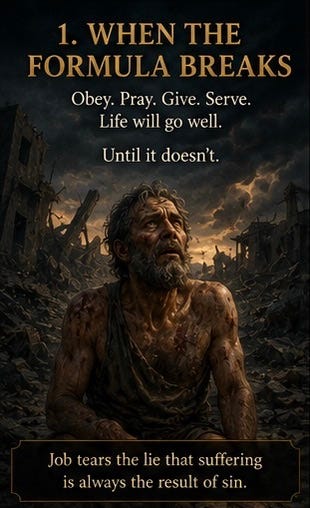
Most of us were handed a formula somewhere along the way.
It goes something like this:
Obey God. Pray enough. Give enough. Serve enough. And life will go well.
The reverse works out just as neatly in that system:
Life is falling apart. Therefore, you must have done something wrong.
That formula sounds spiritual. It even sounds biblical to people who have not read Job carefully.
But it is a lie.
And it is a lie that will crush you when the diagnosis comes, when the child dies, when the marriage ends, when the ministry collapses, and life stops making sense.
Job comes along and tears that formula to pieces.

Here is what the book of Job tells us right at the beginning, and you need to let this settle in your spirit:
There was a man in the land of Uz, whose name was Job; and that man was perfect and upright, and one that feared God, and eschewed evil. (Job 1:1)
God’s own assessment of Job is that he is the finest man on the earth.
And then everything falls apart.
His children are killed. His wealth is destroyed. His health collapses. He sits in the ashes, scraping his sores, with a wife who has given up and friends who keep insisting he must have done something to deserve all of this.
Performance-based religion cannot make sense of this.
So it does what it always does when reality does not cooperate with the formula.
It blames the person who is suffering.
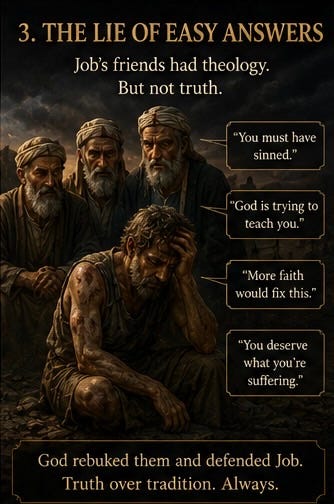
Job’s friends are not evil men. They are sincere men with a dangerous theology.
They sit with him in silence for seven days, which is actually the kindest thing they do. Then they open their mouths, and the comfort evaporates.
Eliphaz tells Job that innocent people do not suffer like this.
Bildad suggests that maybe Job’s children died because of their own sin.
Zophar says that whatever Job is suffering, he probably deserves more.
Before you judge them too harshly, let me ask you something.
Have you ever heard someone say:
“If you had more faith, you’d be healed.”
“God must be trying to teach you something.”
“Have you searched your heart to see what’s blocking your blessing?”
“If you were tithing faithfully, God would protect you from this.”
That is Job’s friends. In modern clothing. In Christian language.
And they are still just as wrong as they were in the ancient world.
Here is what God says at the end of the book:
My wrath is kindled against thee, and against thy two friends: for ye have not spoken of me the thing that is right, as my servant Job hath. (Job 42:7)
God does not commend the friends.
He rebukes them.
That should stop every performance-based believer cold.
The theology that says suffering equals sin and blessing equals obedience is a theology God Himself corrects.

I want to speak directly to someone right now.
Maybe you are sitting in a hospital room. Maybe you are three rounds into chemotherapy and wondering if God has forgotten you. Maybe you are the one who prayed for healing, and nothing has changed, and now you are secretly asking:
Did I do something wrong? Is God punishing me? Has He turned His face away?
The book of Job has a word for you.
Your diagnosis is not proof that God stopped loving you.
Job was described by God as the most righteous man alive, and he suffered profoundly.
The entire book stands as evidence that suffering does not equal rejection.
Job asks the questions you are probably afraid to ask:
Where is God? Why won’t He answer? Why is this happening to me?
And the remarkable thing is that God never rebukes Job for asking.
God enters into conversation with him.
The Father is not threatened by your questions. He is not offended by your pain. He is not waiting for you to pretend everything is fine before He draws near.
You can bring your anguish to Him exactly as it is.
That is what Job did.
And the Father stayed.

Job lost his children in a single day.
Read that slowly.
His children. Gone. In a single afternoon.
If you have lost a child, a spouse, a parent, someone whose absence has left a hole in your life that nothing fills, Job knows your language.
He did not respond with a Sunday school answer. He tore his robe. He shaved his head. He fell on the ground.
And he said, Naked came I out of my mother’s womb, and naked shall I return thither: the LORD gave, and the LORD hath taken away; blessed be the name of the LORD. (Job 1:21)
That is not the response of a man who has no grief.
That is the response of a man who is devastated and choosing to hold on to God in the midst of devastation.
Faith is not the absence of grief.
Faith is continuing the conversation with God while the grief is still real.
Job never stopped talking to God. Even when his words were full of confusion and pain. Even when he could not understand what was happening. He kept turning toward the Father.
That is the invitation for every grieving person.
You do not have to have it together to come to God.
You come broken. You come confused. You come with your honest questions.
And you discover that He was there the whole time.

There is another person I want to speak to.
You are not in a hospital room. You are not in acute crisis. But you are exhausted in a way you cannot fully explain.
You have been trying so hard.
Praying harder. Reading more. Serving more. Giving more. Attending more. Striving more.
And somewhere in the back of your mind runs a quiet, relentless accusation:
It is still not enough.
That is the voice of performance-based religion.
It never tells you that you have done enough. It cannot. Because its entire system depends on keeping you striving, measuring, and falling short.
Job was not suffering because he had not done enough.
God’s testimony about Job was not “he almost has it together” or “he is improving.”
God called him perfect and upright.
And Job’s standing before God was never based on a single week’s performance.
Before the crisis began, God already delighted in Job.
That is a picture of grace.
The Father’s love for you is not swinging up and down based on how your week went. It is not cooling when you struggle, and it is warming when you succeed.
His love toward you is settled.
Not because of what you have done.
Because of who He is.

Performance-based believers often relate to God like a vending machine with moral currency.
Insert the right behaviors. Pull the lever. Receive the blessing.
Job discovers that God will not be reduced to a formula.
He will not be managed. He will not be manipulated. He cannot be calculated.
And here is the thing that surprised me when I really sat with this book:
That is actually good news.
Because if God cannot be manipulated into loving you, then His love cannot be earned in the first place.
If blessing depended entirely on your performance, you would never know if you had done enough.
But if God loves because He is love, then the question of whether you have done enough becomes the wrong question entirely.
Job spent most of the book trying to understand his circumstances.
The breakthrough did not come when he finally figured out the formula.
It came when he encountered God.
I have heard of thee by the hearing of the ear: but now mine eye seeth thee. (Job 42:5)
That is the turning point.
Not more information. Not a better explanation.
Revelation.
The performance-based believer is always searching for a technique.
Job discovered that knowing God is greater than understanding everything.
Right in the middle of his deepest suffering, Job says something that stops you in your tracks.
I know that my redeemer liveth, and that he shall stand at the latter day upon the earth. (Job 19:25)
In the darkest moment, when his friends have failed him and his health is destroyed, and God seems silent, Job reaches for something.
A Redeemer.
Someone who will make this right. Someone who will restore. Someone who will vindicate.
And earlier in the book, he longs for something else:
Neither is there any daysman betwixt us, that might lay his hand upon us both. (Job 9:33)
A mediator. Someone who could stand between a broken man and a holy God.
Job saw the need before he knew the name.
Jesus is the answer to both cries.
He is the Redeemer who lives. He is the Mediator who lays His hand on both God and man. He is the One who entered human suffering rather than remaining distant from it.
The Father’s answer to a world full of Jobs was not a philosophy.
It was not a formula.
It was a Person.
God Himself stepped into the suffering.
And when you wonder whether God understands what you are going through, the cross says yes.
He knows what it means to be abandoned by friends. He knows what it means to cry out and feel only silence. He knows what it means to suffer unjustly.
Jesus is the deepest answer to Job’s questions.
Here is what the reader of Job knows that Job himself does not know during the story.
God never abandoned him.
Not for a single moment.
While Job felt forsaken, while his friends accused him, while heaven seemed silent, the Father’s eye was on Job the entire time.
That matters enormously to anyone in the middle of a season when God seems absent.
Silence is not absence.
If Esther shows us a God who works behind the scenes when we cannot see Him, then Job shows us a God who is present in the darkness when we cannot understand Him.
The Father does not love you because your life is going well.
He loves you because He is love, and that does not change with your circumstances.
Your cancer does not change it.
Your grief does not change it.
Your confusion does not change it.
Your honest questions do not frighten Him away.
He is exactly the God Job finally encountered in the whirlwind.
Bigger than our understanding. More faithful than our formulas. More present than our pain has let us believe.
If I had to give you the one great lesson from this ancient book, it would be this:
God’s love is not a reward for good performance, and suffering is not proof of divine rejection.
The Father is not a transaction.
He is not waiting for you to finally earn His affection.
He is not disappointed every time you fall short.
He is not the cosmic version of a boss who is never quite satisfied.
He is the Father who stayed with Job through every dark moment.
He is the Father who met Job in the whirlwind not with an explanation but with Himself.
He is the Father who, at the end of the story, restored what had been lost.
And He is the Father who, even now, is nearer to you in your suffering than your pain has allowed you to believe.
If you are exhausted from trying to earn what was already freely given, Job has a word for you.
Stop trying to manage God.
Stop measuring your performance.
Stop listening to the voices that insist your suffering is your fault.
And start doing the one thing Job never stopped doing even in the darkest moments:
Keep the conversation going.
The Father is there.
He has been there the whole time.
And His love toward you has never once depended on whether you were doing enough.
Followed by Mercy
Originally published at https://waustingardner.com on June 19, 2026.
메타데이터
- post_id
- f0d82f6972b2
- slug
- tired-of-trying-to-make-it-work-f0d82f6972b2
- url
- https://medium.com/followed-by-mercy/tired-of-trying-to-make-it-work-f0d82f6972b2
- canonical_url
- https://medium.com/followed-by-mercy/tired-of-trying-to-make-it-work-f0d82f6972b2
- author_url
- https://medium.com/@waustingardner
- status
- ok
- fetched_at
- 2026-06-26 03:39:16