7 Surprising Things Your Brain Does While You Sleep (Number 4 Will Change How You Think About Rest)
You close your eyes and think nothing is happening. Your brain, however, is just getting started.
7 Surprising Things Your Brain Does While You Sleep (Number 4 Will Change How You Think About Rest)
You close your eyes and think nothing is happening. Your brain, however, is just getting started.
The Biggest Misconception About Sleep
Most people think of sleep as the absence of activity. The body powers down, the mind goes quiet, and for seven or eight hours, nothing much happens until the alarm pulls you back into consciousness.
This is almost perfectly wrong.
Sleep is not a pause in your life. It is some of the most intensive, purposeful biological work your body performs in any twenty-four-hour period. While you lie still in the dark, your brain is running processes so complex and so critical that no amount of waking effort can replicate or replace them. The research of the last two decades has fundamentally rewritten what scientists understand about sleep — and what they have found is extraordinary.
Here are seven things your brain is actually doing while you sleep. Some of them will surprise you. One of them might genuinely change how seriously you take rest.

- Your Brain Is Physically Cleaning Itself
This is perhaps the most dramatic discovery in sleep neuroscience of the past decade, and it still does not get the attention it deserves.
In 2013, researchers at the University of Rochester published a landmark study revealing the existence of what they called the glymphatic system — a network of channels surrounding the brain’s blood vessels that functions, essentially, as a waste-clearance system. During sleep, and almost exclusively during sleep, this system becomes dramatically more active. The brain’s cells shrink by up to 60 percent, creating space for cerebrospinal fluid to flow more freely through the tissue, flushing out metabolic waste products that have accumulated throughout the day.
Among the waste products cleared by this nightly cleaning process is beta-amyloid — the protein that forms the plaques associated with Alzheimer’s disease.
Let that sit for a moment. Every night you sleep, your brain runs what is essentially a biological dishwasher, removing the toxic byproducts of a day of thinking. Every night you do not sleep enough, some of that waste remains. Over years and decades, the accumulation of inadequate sleep has been linked in multiple large studies to significantly elevated risk of neurodegenerative disease.
Sleep is not laziness. For your brain, it is maintenance.
- Your Brain Is Consolidating Everything You Learned Today
Have you ever studied something intensively, gone to sleep, and woken up finding that you understood it better than you did the night before? That is not your imagination. That is memory consolidation — one of sleep’s most well-documented and important functions.
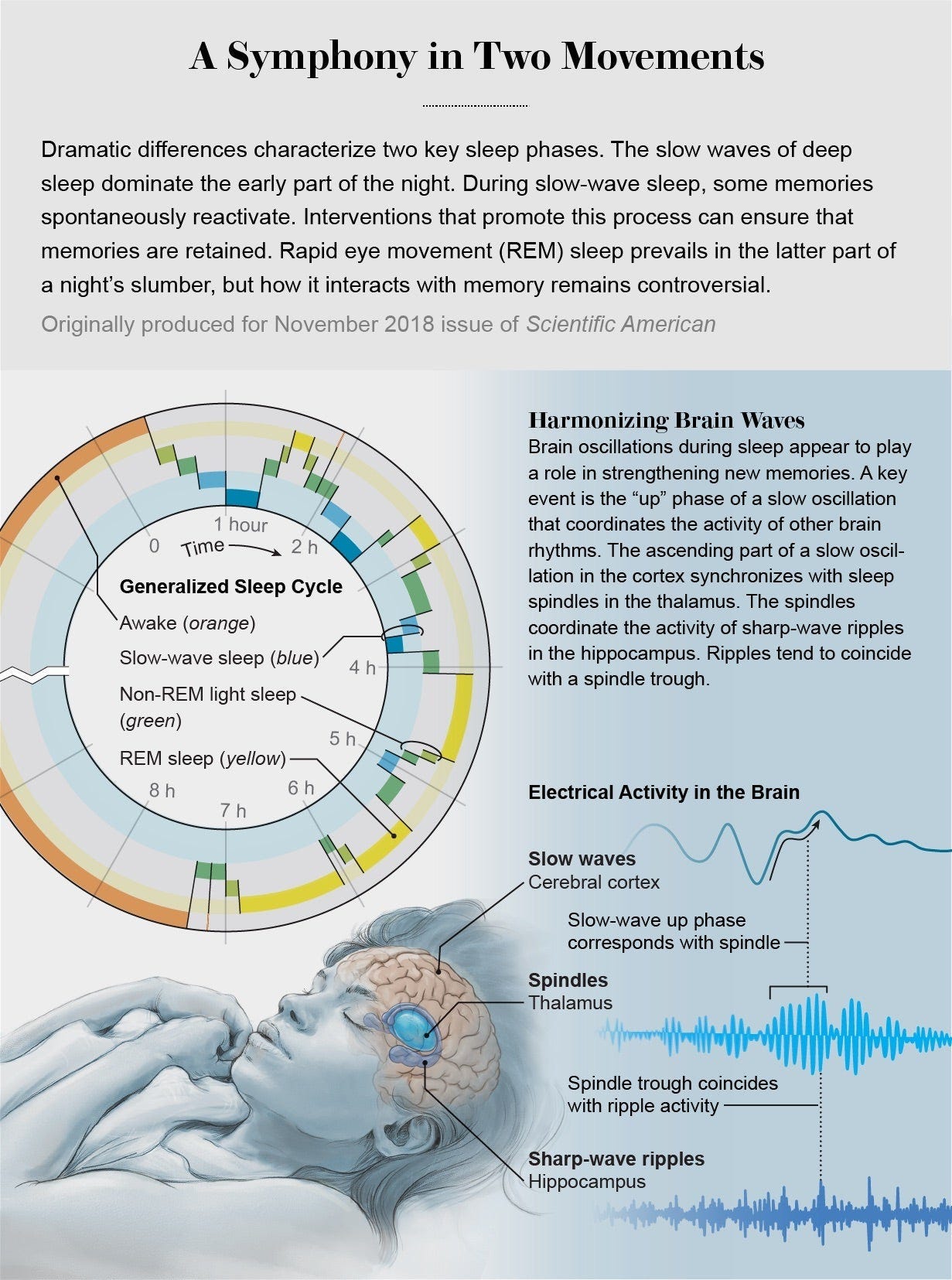
During sleep, particularly during the slow-wave deep sleep stages, the brain replays the experiences and information acquired during the day. Neural connections that were formed during waking hours are strengthened and integrated into long-term memory. Connections that are less relevant are quietly pruned away, making the overall memory network more efficient.
Research from Harvard Medical School has demonstrated that people who sleep after learning a new skill — whether a musical piece, a motor task, or a body of factual information — show significantly better retention and performance than those who remain awake for the same period. The sleep was not wasted time. It was the processing time.
This has profound implications for students, for anyone learning new skills, and for knowledge workers whose performance depends on retaining and applying information. Pulling an all-nighter to prepare for an exam or presentation is not just unpleasant — it is neurologically counterproductive. The material you stayed up cramming has far less chance of being retained than material reviewed before a full night of sleep.
- Your Brain Is Regulating Your Emotions
Sleep and emotional health are connected more deeply than most people realize — and the direction of causality runs both ways.
During REM sleep — the stage associated with vivid dreaming — the brain processes emotional experiences from the day in a neurochemically unique environment. Specifically, during REM sleep, levels of norepinephrine, a stress-related neurochemical, drop significantly. This creates a condition in which emotional memories can be reprocessed and integrated without the full physiological stress response they originally triggered.
Neuroscientist Matthew Walker, author of Why We Sleep, describes this as “overnight therapy.” The brain is essentially revisiting difficult or emotionally charged experiences from the day and filing them away with reduced emotional charge — helping to explain why things that feel overwhelming at night often seem more manageable in the morning.
When REM sleep is disrupted or insufficient, this emotional processing is incomplete. The result is what most people experience as emotional reactivity — heightened irritability, reduced frustration tolerance, exaggerated responses to minor stressors. Chronic sleep deprivation has been shown to increase amygdala reactivity by up to 60 percent, meaning the brain’s threat-detection center becomes dramatically more sensitive when you are not sleeping enough.
You are not just tired when you have not slept. You are neurologically primed to overreact.
- Your Brain Is Rehearsing Your Future
This is the one that tends to stop people.
During sleep — particularly during REM — the brain does not only replay the past. It actively recombines memories, experiences, and information in novel ways, generating new associations and connections that did not exist before sleep. This is the neurological basis of insight: the phenomenon of waking up with a solution to a problem you could not crack the night before, or seeing a connection between two ideas that seemed unrelated.
The famous examples are numerous. Paul McCartney reportedly woke from a dream with the melody of Yesterday fully formed. Dmitri Mendeleev claimed the structure of the periodic table came to him in a dream. August Kekulé discovered the ring structure of benzene after dreaming of a snake eating its own tail.
These are not coincidences or myths. They reflect a real neurological process. During REM sleep, the prefrontal cortex — the brain’s logical, rule-following center — is relatively quiet, while associative regions are highly active. This creates a cognitive environment uniquely suited to creative, non-linear thinking: connections that waking logic would dismiss as implausible are free to form and be evaluated.
Research at UC San Diego found that REM sleep improved subjects’ ability to solve creative problems by nearly 40 percent compared to equivalent periods of quiet waking rest. Your sleeping brain is not switched off. In a very real sense, it is doing some of its most original thinking.
- Your Brain Is Rebalancing Your Hormonal System
Sleep is one of the most powerful regulators of the endocrine system — the network of glands and hormones that governs nearly every physiological process in the body.
During deep slow-wave sleep, the pituitary gland releases the majority of the day’s growth hormone. Despite the name, growth hormone in adults is not primarily about height — it is critical for tissue repair, muscle recovery, immune function, and metabolism. Athletes and people engaged in physical training who do not sleep adequately are not just tired the next day; they are actively undermining the physical adaptations their training was designed to produce.
Sleep also plays a critical role in regulating cortisol, the body’s primary stress hormone. Under normal conditions, cortisol follows a predictable daily rhythm — highest in the morning to support wakefulness, lowest at night to allow rest. Inadequate sleep disrupts this rhythm, resulting in elevated cortisol levels throughout the following day. Chronically elevated cortisol suppresses immune function, promotes fat storage particularly around the abdomen, impairs memory consolidation, and accelerates cellular aging.
The hormonal consequences of poor sleep are not subtle. They affect your weight, your immune system, your stress response, your recovery from exercise, and your long-term health in ways that no supplement or intervention fully compensates for.
- Your Brain Is Strengthening — and Pruning — Your Neural Connections
Sleep plays a critical role in what neuroscientists call synaptic homeostasis — the process of maintaining the brain’s neural networks in a functional, efficient state.
During waking hours, the brain forms new synaptic connections in response to experience and learning. This is good, and it is how we adapt and grow. But if this process continued unchecked, the brain would eventually become overloaded — too many connections, too much noise, too much energy required to maintain them all.
During sleep, the brain selectively strengthens the connections that matter — the ones that were most actively used and most important — and weakens or eliminates the ones that are redundant or less relevant. This process, sometimes called synaptic downscaling, keeps the neural network lean, efficient, and capable of continued learning.
The practical consequence is that a brain that is regularly deprived of sufficient sleep becomes progressively less efficient at forming and retaining new memories, less adaptable to new information, and more susceptible to cognitive fog. The pruning and strengthening that should happen every night accumulates as a deficit.
- Your Brain Is Preparing You for Tomorrow
Everything described above — the cleaning, the consolidating, the emotional processing, the creative recombination, the hormonal rebalancing, the synaptic pruning — is, ultimately, preparation.
Sleep is the brain’s nightly reset. It is what allows you to wake up with a cleared cognitive slate, emotionally regulated, physically restored, and neurologically ready to engage with a new day at full capacity.
The research on this is unambiguous: cognitive performance on virtually every measurable dimension — attention, working memory, processing speed, decision-making, emotional regulation, creative thinking, physical coordination — is significantly worse after inadequate sleep and significantly better after adequate, high-quality sleep.
There is no cognitive enhancement supplement, no productivity hack, no quantity of caffeine that replicates what a full night of sleep provides. The biology is simply not replaceable.
What This Means for How You Live
Understanding what your brain actually does during sleep changes the frame entirely.
Sleep is not time stolen from productivity. It is the biological prerequisite for productivity — for learning, for emotional stability, for physical health, for creative thinking, for long-term cognitive function.
The cultural glorification of sleep deprivation — the hustle-culture badge of honor attached to running on five hours — is not just misguided. It is neurologically illiterate. Every night of insufficient sleep is a night the glymphatic system does not fully clear its waste. A night memory consolidation is incomplete. A night emotional processing is cut short. A night the hormonal system is disrupted.
These are not abstract risks. They are measurable, cumulative effects on the brain and body you depend on for everything you care about.
The most productive thing many high-achieving, chronically sleep-deprived people could do for their performance, their health, and their wellbeing is the simplest and least glamorous: go to bed earlier and protect their sleep with the same seriousness they bring to their most important work.
Your brain is not waiting for you to fall asleep so it can rest.
It is waiting for you to fall asleep so it can get to work.
The Bottom Line
Seven things. Seven processes running simultaneously, every single night, in the three pounds of biological machinery inside your skull:
Cleaning out the toxic waste of a day of thinking. Consolidating everything you learned into lasting memory. Processing your emotional experiences so tomorrow feels lighter. Rehearsing creative solutions to problems you have not solved yet. Rebalancing the hormones that govern your body. Pruning and strengthening the neural connections that define who you are and what you can do. And preparing you — completely, comprehensively — for tomorrow.
None of this happens on the couch. None of it happens in a twenty-minute nap. None of it can be replicated by any other means.
It only happens when you sleep. The science of sleep is one of the fastest-moving fields in neuroscience. If you are struggling with sleep quality or duration, speaking with a physician or sleep specialist is one of the highest-return investments you can make in your long-term health.

메타데이터
- post_id
- f0e2b06d02ef
- slug
- 7-surprising-things-your-brain-does-while-you-sleep-number-4-will-change-how-you-think-about-rest-f0e2b06d02ef
- url
- https://medium.com/@qurantechnical/7-surprising-things-your-brain-does-while-you-sleep-number-4-will-change-how-you-think-about-rest-f0e2b06d02ef
- canonical_url
- https://medium.com/@qurantechnical/7-surprising-things-your-brain-does-while-you-sleep-number-4-will-change-how-you-think-about-rest-f0e2b06d02ef
- author_url
- https://medium.com/@qurantechnical
- status
- ok
- fetched_at
- 2026-06-12 22:02:08