The Quiet Conversations That Shape How We Think About AI
I went to a networking event expecting to make connections. I left having to refine an opinion I had held for some time.
The Quiet Conversations That Shape How We Think About AI
I went to a networking event expecting to make connections. I left having to refine an opinion I had held for some time.
When I accepted an invitation to Monzo’s Beyond the Data event, I had the usual objectives in mind: expand my network, hear from people doing interesting work, maybe learn something about where financial services is heading. What I did not expect was for a conversation yesterday to sharpen a view I thought I would already worked out.
Having spent years in business aspect of banking before moving into data and AI, I have always been drawn to the tension between innovation and regulation. Like a lot of people working in this space, I had formed my own read on the pace of AI adoption in regulated industries, broadly, that UK and European financial institutions were moving more cautiously than their counterparts elsewhere. It felt like a reasonable, well-evidenced position.
The Room, Not Just the Stage
The event itself delivered on the usual fronts, but what struck me most was not what happened on stage. It was the room. People from different industries, disciplines, and career paths, all there out of genuine curiosity about data, technology and where financial services is going. A useful reminder that the best ideas rarely come from a single lane, they come from the friction between different ones.
Purposeful vs. Responsible
The highlight of the evening was a conversation during the networking session with Nathaniel, Monzo’s Data Director for Marketing. It picked up on themes I had written about before, but pushed me to think harder about them. The exchange made something click: conversations about AI adoption are rarely about the technology itself. They’re about how organisations choose to adopt it responsibly, within the regulatory and operational realities they actually operate in.
That conversation didn’t overturn my thinking. It refined it.
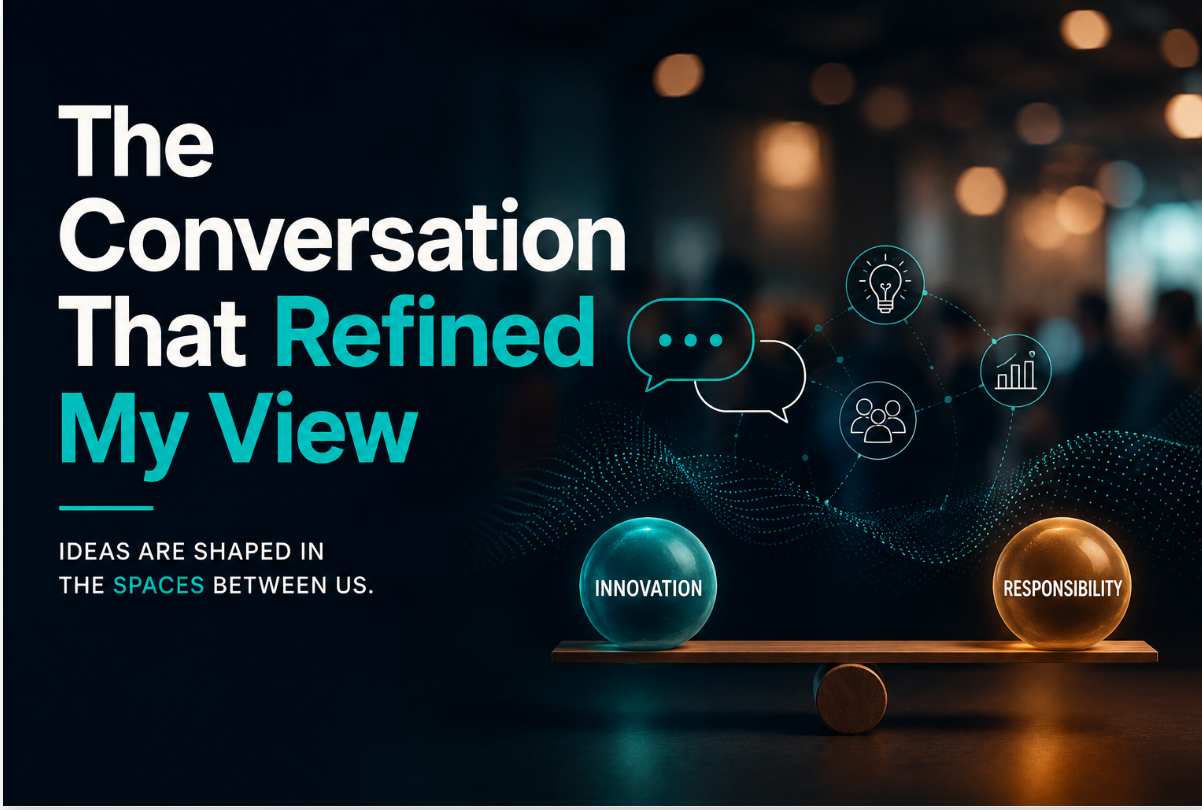
I had been framing AI adoption as a question of fast versus slow. What I started to see instead was a better distinction: purposeful versus responsible. In a sector like financial services, innovation was never going to be measured by speed alone. It is measured by governance, by the trust customers place in an institution, by regulatory expectation, and perhaps most tellingly, by whether the value being created is real and measurable, not just fast to ship. “Slow” is not necessarily the opposite of innovative. Sometimes it’s what disciplined innovation looks like from the outside.
A Different Pressure, Outside Financial Services
A separate conversation with another attendee, from an industry well outside financial services, added a useful counterweight to that view. Their experience was not one of caution — it was the opposite. In their organisation, the expectation that AI should make everyone faster had translated into a steady rise in output demands, to the point where it felt overwhelming. AI had not just changed how the work got done; it had reset what “normal” output looked like, regardless of whether the tools or the processes around them were actually ready for that pace.
Set against the Monzo conversation, it was a striking contrast. In financial services, regulation forces a kind of discipline around AI adoption — slower, perhaps, but deliberate. Outside it, in the absence of that same structure, the pressure can move in the other direction: adoption driven less by readiness and more by assumption, with people absorbing the gap between the two. It reinforced that “responsible” adoption is not only about compliance. It’s also about organisations being honest with themselves about what AI can realistically deliver, and not letting expectation outrun capability.
What the Conversations Leave You With
Both conversations stayed with me after the event ended. They are a reminder that some of the most useful professional moments do not come from the keynote. They come from the exchanges afterward that make you question something you thought was settled or see a familiar problem from an angle you had not considered.
Networking events get sold on outcomes like the next role or the next connection. Those matter. But this one reminded me they offer something just as valuable and far less talked about: the chance to have your thinking tested and improved by people who see the same problem from different angles.
Where This Leaves the Conversation
As AI continues to reshape how organisations work, I think the real conversation is shifting. It’s less about whether organisations should adopt AI and more about how they do it responsibly matching expectation to capability, whether that discipline is imposed by regulation or chosen deliberately in its absence.
This is not the deep-dive I usually publish, it is just a reflection I felt was worth sharing while it was still fresh.
How do you see AI adoption playing out in your industry? Is caution holding innovation back, is expectation running ahead of readiness, or is something more balanced taking shape? I would be interested to hear how others are thinking about this.
메타데이터
- post_id
- f0ee27ba29a2
- slug
- the-quiet-conversations-that-shape-how-we-think-about-ai-f0ee27ba29a2
- url
- https://medium.com/@tunjidina12/the-quiet-conversations-that-shape-how-we-think-about-ai-f0ee27ba29a2
- canonical_url
- https://medium.com/@tunjidina12/the-quiet-conversations-that-shape-how-we-think-about-ai-f0ee27ba29a2
- author_url
- https://medium.com/@tunjidina12
- status
- ok
- fetched_at
- 2026-08-07 06:35:50





