Agility in the Age of AI-Assisted Software Teams
Lessons I learned after 3 months observing how AI-assisted workflows are quietly reshaping Agile teams, software delivery, and team…
Agility in the Age of AI-Assisted Software Teams
Lessons I learned after 3 months observing how AI-assisted workflows are quietly reshaping Agile teams, software delivery, and team dynamics in real projects.
AI is not making Agile irrelevant. If anything, it is making the quality of Agile practices more visible than ever before.
For years, many teams could survive with mediocre processes because software delivery itself was slower. There was more time between decisions, more time between releases, more time to discover misunderstandings, and honestly, more time to recover from mistakes. But AI changes the speed of everything. Requirements move faster. Development moves faster. Reviews move faster. Stakeholder feedback arrives faster. Even confusion spreads faster.
And that is the strange thing I’ve been observing in my current team.
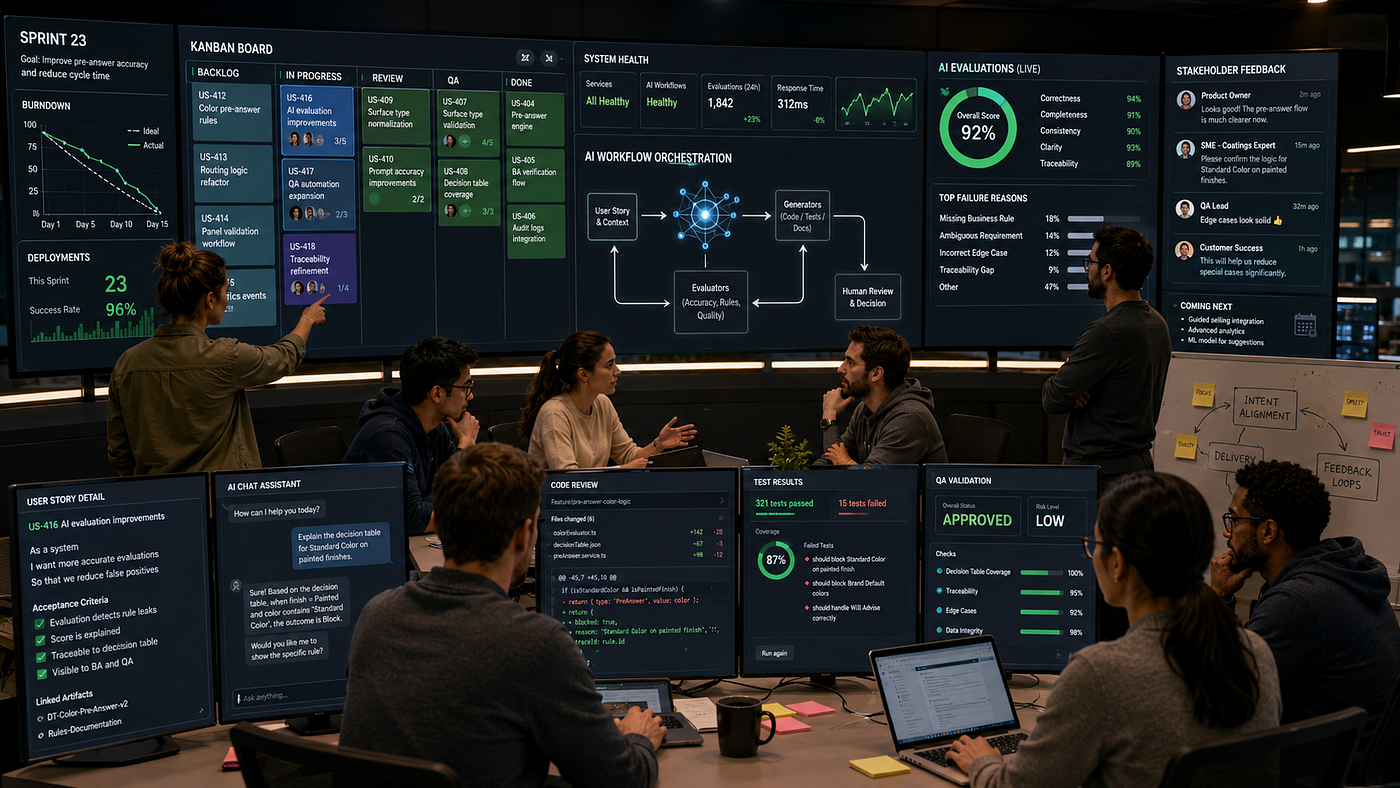
We are a team of 7 developers working heavily with AI-assisted workflows, evaluation systems, automated quality checks, and AI-supported development. Developers are able to close 1–2 user stories per day consistently, and larger stories usually take only a couple of days. A few years ago, this amount of work would have represented weeks of delivery. Today, it simply represents the pace of a normal sprint.
At first glance, this sounds like a pure productivity success story.
But after months working this way, I realized the deeper impact is not speed itself. The deeper impact is that software processes start behaving differently when teams can move this fast. Planning changes. Conversations change. Bottlenecks change. Agile ceremonies change. Even the interpretation of Agile values and principles starts evolving under this new pressure.
The technical challenges did not disappear.
They moved.
The Process Shift
AI changes Agile events because it changes the amount of work that can move between conversations. When implementation accelerates, uncertainty does not disappear; instead, it shifts toward validation, alignment, quality, prioritization, and trust.
Daily standups, for example, became significantly more important in our team. In slower environments, a Daily Scrum could sometimes feel repetitive because progress between days was relatively predictable. In AI-assisted teams, however, every day can completely change the shape of the sprint.
The change is not that autonomous agents are independently producing work. The change is that every individual contributor suddenly becomes an AI orchestrator and starts operating at a completely different speed.
As the Business Analyst of the team, my own workflow changed dramatically. A few years ago, writing 1–3 good user stories per day already felt productive because writing, validating, refining, discussing, and structuring requirements took significant time. Today, working with AI-assisted workflows, evaluation loops, refinement processes, and multiple specialized prompts, I can produce 10–15 stories in a day while still maintaining quality expectations.
The same thing happens across the team. Developers move faster because implementation, debugging, exploration, and code reviews accelerate. QA moves faster because validations, edge cases, and scenario generation become easier to analyze. Product conversations evolve faster because working software appears earlier and feedback cycles become tighter.
Every role starts behaving differently once AI becomes part of the daily workflow, not as a replacement for people, but as a layer of amplification around each contributor.
And suddenly, the amount of work moving between conversations changes completely.
QA may discover inconsistencies before the end of the day, stakeholders may review functionality earlier than expected, and priorities may shift the next morning after seeing the feature working in a near-production environment. The Daily Scrum stops being a simple status update and becomes a steering mechanism for a system that is constantly changing shape.
And honestly, the conversations themselves changed dramatically. A few years ago, technical discussions during standups sounded more like “I’m reading the documentation for this framework,” or “I’m building a proof of concept.” Today, conversations sound more like “the evaluation process rejected this story because it leaks implementation details,” or “the workflow is hallucinating validation rules,” or “the AI-generated implementation misunderstood the business behavior.”
The technical challenge is still there, but it moved away from simply understanding frameworks and libraries. The difficult part now is designing trustworthy systems capable of operating safely at this new speed.
Planning changed as well. Long planning horizons become less reliable when teams can build, validate, and redirect work continuously. In our case, we constantly under-plan, not because the team lacks capacity, but because delivery speed now outpaces our ability to validate what is truly worth building next. Sprint goals became far more important than fixed sprint scope because priorities shift much faster once stakeholders realize the team can react quickly to feedback.
Backlog refinement also became more cross-functional than before. Discussions are no longer centered only around technical feasibility or architecture decisions. Instead, conversations revolve around AI workflows, evaluation systems, prompt quality, orchestration logic, business restrictions, quality gates, and trust boundaries. Product, business stakeholders, SMEs, QA, and developers collaborate much earlier because implementation itself is no longer the primary bottleneck.
Sprint reviews became more important too. When teams can release functionality continuously, stakeholder feedback becomes the primary mechanism preventing teams from confusing output with value. AI can help teams generate more software, more artifacts, and more candidate solutions than ever before, but none of that matters if the product itself is moving in the wrong direction.
Retrospectives changed as well. In our team, retrospectives no longer feel like isolated ceremonies happening every two weeks. Process refinement happens continuously because the process itself evolves continuously. We constantly adjust prompts, workflows, evaluation systems, review structures, AI responsibilities, and quality gates. Improvement became operational rather than ceremonial.
Agile Values Under AI
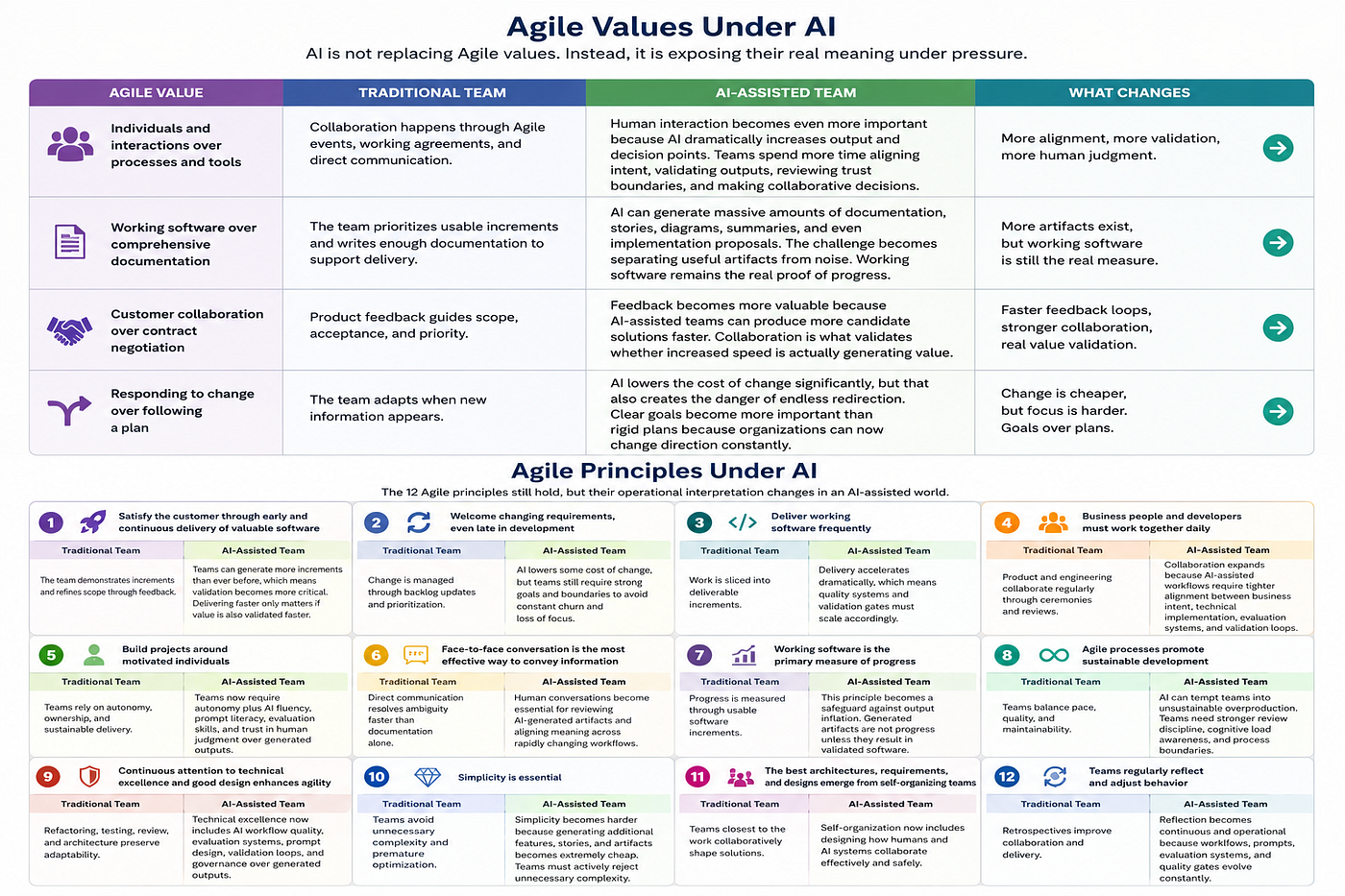
The interesting part is that AI is not replacing Agile values. Instead, it is exposing their real meaning under pressure. Some Agile values become even more important in AI-assisted environments, while others require reinterpretation because the relationship between humans, tools, and software delivery has fundamentally changed.
Individuals and interactions over processes and tools
- Traditional team: Collaboration happens through Agile events, working agreements, and direct communication.AI-assisted team: Human interaction becomes even more important because AI dramatically increases output and decision points. Teams spend more time aligning intent, validating outputs, reviewing trust boundaries, and making collaborative decisions.
Working software over comprehensive documentation
- Traditional team: The team prioritizes usable increments and writes enough documentation to support delivery.
- AI-assisted team: AI can generate massive amounts of documentation, stories, diagrams, summaries, and even implementation proposals. The challenge becomes separating useful artifacts from noise. Working software remains the real proof of progress.
Customer collaboration over contract negotiation
- Traditional team: Product feedback guides scope, acceptance, and priority.
- AI-assisted team: Feedback becomes more valuable because AI-assisted teams can produce more candidate solutions faster. Collaboration is what validates whether increased speed is actually generating value.
Responding to change over following a plan
- Traditional team: The team adapts when new information appears.
- AI-assisted team: AI lowers the cost of change significantly, but that also creates the danger of endless redirection. Clear goals become more important than rigid plans because organizations can now change direction constantly.
Agile Principles Under AI
The 12 Agile principles also start behaving differently under AI-assisted delivery. The principles themselves still hold, but the operational interpretation changes because software delivery economics changed.
Satisfy the customer through early and continuous delivery of valuable software
- Traditional team: The team demonstrates increments and refines scope through feedback.
- AI-assisted team: Teams can generate more increments than ever before, which means validation becomes more critical. Delivering faster only matters if value is also validated faster.
Welcome changing requirements, even late in development
- Traditional team: Change is managed through backlog updates and prioritization.
- AI-assisted team: AI lowers some cost of change, but teams still require strong goals and boundaries to avoid constant churn and loss of focus.
Deliver working software frequently
- Traditional team: Work is sliced into deliverable increments.
- AI-assisted team: Delivery accelerates dramatically, which means quality systems and validation gates must scale accordingly.
Business people and developers must work together daily
- Traditional team: Product and engineering collaborate regularly through ceremonies and reviews.
- AI-assisted team: Collaboration expands because AI-assisted workflows require tighter alignment between business intent, technical implementation, evaluation systems, and validation loops.
Build projects around motivated individuals
- Traditional team: Teams rely on autonomy, ownership, and sustainable delivery.
- AI-assisted team: Teams now require autonomy plus AI fluency, prompt literacy, evaluation skills, and trust in human judgment over generated outputs.
Face-to-face conversation is the most effective way to convey information
- Traditional team: Direct communication resolves ambiguity faster than documentation alone.
- AI-assisted team: Human conversations become essential for reviewing AI-generated artifacts and aligning meaning across rapidly changing workflows.
Working software is the primary measure of progress
- Traditional team: Progress is measured through usable software increments.
- AI-assisted team: This principle becomes a safeguard against output inflation. Generated artifacts are not progress unless they result in validated software.
Agile processes promote sustainable development
- Traditional team: Teams balance pace, quality, and maintainability.
- AI-assisted team: AI can tempt teams into unsustainable overproduction. Teams need stronger review discipline, cognitive load awareness, and process boundaries.
Continuous attention to technical excellence and good design enhances agility
- Traditional team: Refactoring, testing, review, and architecture preserve adaptability.
- AI-assisted team: Technical excellence now includes AI workflow quality, evaluation systems, prompt design, validation loops, and governance over generated outputs.
Simplicity is essential
- Traditional team: Teams avoid unnecessary complexity and premature optimization.
- AI-assisted team: Simplicity becomes harder because generating additional features, stories, and artifacts becomes extremely cheap. Teams must actively reject unnecessary complexity.
The best architectures, requirements, and designs emerge from self-organizing teams
- Traditional team: Teams closest to the work collaboratively shape solutions.
- AI-assisted team: Self-organization now includes designing how humans and AI systems collaborate effectively and safely.
Teams regularly reflect and adjust behavior
- Traditional team: Retrospectives improve collaboration and delivery.
- AI-assisted team: Reflection becomes continuous and operational because workflows, prompts, evaluation systems, and quality gates evolve constantly.
Lessons I Learned
One of the biggest lessons I’ve observed is that AI does not replace Agile discipline. If goals are vague, AI generates more vague output. If quality expectations are implicit, inconsistency scales faster. If validation is weak, teams can move incredibly fast while still moving in the wrong direction.
Another major lesson is that Agile ceremonies need sharper purpose than before. Daily standups cannot remain simple status updates when priorities and outputs change daily. Planning cannot focus only on scope commitment when implementation speed constantly reshapes priorities. Refinement cannot revolve only around technical feasibility when AI workflows, evaluations, and trust boundaries become equally important. Reviews become strategic alignment moments rather than simple demonstrations.
I also realized that goals matter far more than fixed scope in AI-assisted teams. Once implementation accelerates, the stability of scope naturally decreases because feedback loops become tighter and opportunities appear continuously. Teams require strong directional clarity rather than rigid prediction mechanisms.
And perhaps the most important lesson of all is that quality must become a designed part of the process itself. Our team now operates with subprocesses for requirements gathering, story evaluation, AI-assisted development, code review, QA validation, and business verification. Some validations are automated through evaluation workflows. Others require human review. Others depend on stakeholder feedback. Speed without validation quickly becomes chaos.
This became especially visible when developers started flagging issues in AI-generated stories and specifications. We realized user stories are no longer consumed only by humans capable of naturally filtering ambiguity. Stories are increasingly interpreted by AI systems that translate specifications directly into implementation decisions. Small mistakes in wording, excessive implementation detail, or accidental architectural assumptions suddenly become operational risks because AI treats them literally during generation.
That realization changed how I think about Business Analysis entirely.
My Personal Conclusions
AI-assisted software development is not a departure from Agile. In many ways, it is a stress test of Agile maturity.
Teams that use AI only as a speed multiplier may produce more stories, more documentation, more pull requests, and more artifacts without necessarily creating more value. Teams that combine AI with strong goals, clear validation systems, healthy collaboration, and disciplined quality practices are the ones truly improving adaptability and responsiveness.
The future of Agile is probably not fewer conversations.
It is better conversations.
Conversations about trust, validation, intent, quality, alignment, ownership, and decision-making in environments where software moves faster than ever before. AI changes how work moves through the system, but Agile still explains why the work matters and how humans collaborate to keep complexity under control.
메타데이터
- post_id
- f0efc19b8944
- slug
- agility-in-the-age-of-ai-assisted-software-teams-f0efc19b8944
- url
- https://medium.com/agileinsider/agility-in-the-age-of-ai-assisted-software-teams-f0efc19b8944
- canonical_url
- https://medium.com/agileinsider/agility-in-the-age-of-ai-assisted-software-teams-f0efc19b8944
- author_url
- https://medium.com/@yanetmoralesramirez
- status
- ok
- fetched_at
- 2026-06-09 15:37:30