How Laser-Based Anti-Drone Systems Work: India’s Next-Gen Defence Technology
The rise of drones has changed the nature of modern security threats. From border surveillance and smuggling to coordinated drone swarms…
How Laser-Based Anti-Drone Systems Work: India’s Next-Gen Defence Technology
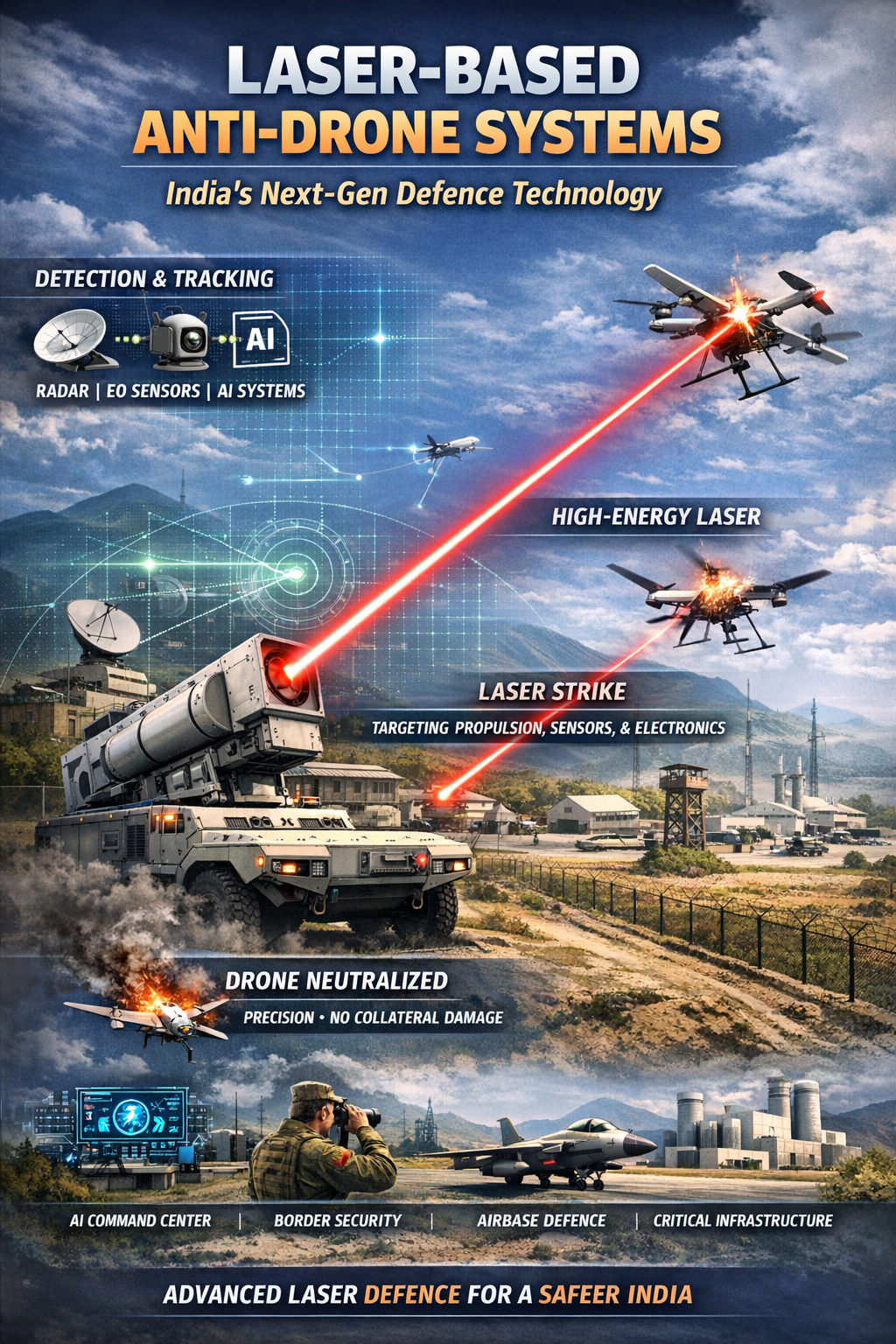
The rise of drones has changed the nature of modern security threats. From border surveillance and smuggling to coordinated drone swarms, unmanned aerial systems are now a serious challenge for national defence. To counter this evolving risk, India is increasingly investing in laser-based anti-drone systems, a key component of next-generation air defence.
Unlike traditional weapons, laser systems offer speed, precision, and scalability — making them an essential part of any modern anti drone system.
The Growing Drone Threat in India
India’s security environment includes long borders, dense urban centers, sensitive military installations, and critical infrastructure. Small, low-cost drones are difficult to detect and can bypass conventional air defence systems.
These challenges have accelerated the shift toward directed-energy weapons, particularly lasers, which can neutralize drones without explosive force or collateral damage.
What Is a Laser-Based Anti-Drone System?
A laser-based anti-drone system uses high-energy laser beams to disable or destroy hostile drones in mid-air. Instead of firing physical ammunition, the system focuses intense energy on a drone’s vulnerable components, such as:
- Propellers
- Sensors
- Navigation electronics
- Communication modules
Laser systems are usually deployed as part of a layered anti drone system, working alongside radar, electro-optical sensors, RF detection, and AI-based command platforms.
How Laser-Based Anti-Drone Systems Work
1. Detection and Identification
Advanced sensors and radars scan the airspace continuously. AI algorithms help distinguish drones from birds, aircraft, or environmental noise.
2. Tracking and Target Lock
Once identified as a threat, the drone is tracked in real time. The system calculates speed, altitude, trajectory, and potential intent.
3. Laser Engagement
A high-energy laser is directed at the drone with extreme precision. Sustained exposure causes overheating or failure of critical components.
4. Neutralization
The drone loses control, stops functioning, or is forced to land — without explosions or falling debris.
Why Laser Systems Are Critical for Modern Defence
Precision and Accuracy
Lasers can engage specific drone components without affecting nearby objects.
Instant Response
Laser beams travel at the speed of light, allowing immediate engagement.
Low Cost per Engagement
After deployment, laser systems are far more economical than missile-based interceptors.
Silent and Clean Operation
No sound, no smoke, and no physical ammunition make lasers ideal for urban and sensitive locations.
India’s Advancements in Laser-Based Anti-Drone Technology
India has made steady progress in developing indigenous laser-based systems through government research organizations and private defence innovators. These systems are increasingly being tested for:
- Military bases
- Border security
- Airports and airfields
- Strategic infrastructure
Modern Indian solutions focus on autonomous detection, AI-driven decision making, and multi-layered defence, ensuring laser weapons are integrated into a complete anti drone system rather than operating alone.
Laser-Based Systems vs Other Counter-Drone Methods
RF Jamming
Effective against commercial drones but limited against autonomous or pre-programmed UAVs.
Kinetic Weapons
Powerful but risky in populated areas due to debris and collateral damage.
Interceptor Drones
Flexible but complex and costly to operate at scale.
Laser Systems
Highly precise, scalable, and ideal for continuous defence when integrated into layered systems.
The Future of Laser-Based Anti-Drone Systems in India
As drone technology advances toward AI-enabled swarms and autonomous missions, laser systems will play a vital role in India’s defence strategy. Their ability to engage multiple targets rapidly makes them well-suited for future conflicts.
Advanced platforms — such as AI-powered, autonomous air-defence grids — are shaping the future of drone defence in India. Integrated solutions like Indrajaal are pushing this vision forward by combining sensors, analytics, and counter-measures into a unified anti drone system.
🔗 Learn more about next-generation anti-drone defence at 👉 https://indrajaal.in/
Conclusion
Laser-based anti-drone systems represent a major leap in India’s defence capabilities. With unmatched precision, speed, and operational efficiency, they are becoming a cornerstone of next-generation airspace protection.
As drone threats grow more advanced, laser-enabled anti drone systems will be critical to securing India’s skies — today and in the future.
메타데이터
- post_id
- f1037834cffb
- slug
- how-laser-based-anti-drone-systems-work-indias-next-gen-defence-technology-f1037834cffb
- url
- https://medium.com/@info.indrajaal/how-laser-based-anti-drone-systems-work-indias-next-gen-defence-technology-f1037834cffb
- canonical_url
- https://medium.com/@info.indrajaal/how-laser-based-anti-drone-systems-work-indias-next-gen-defence-technology-f1037834cffb
- author_url
- https://medium.com/@info.indrajaal
- status
- ok
- fetched_at
- 2026-07-09 06:39:14