Bing and Yahoo in 2026 The Updates Marketers Actually Need to Know
Two platforms most marketers ignore just got a lot more interesting.
Bing and Yahoo in 2026 The Updates Marketers Actually Need to Know
Two platforms most marketers ignore just got a lot more interesting.
Every marketer has a Google tab open right now. Fair enough — Google still commands roughly 90% of global search traffic. But if that number makes you ignore Bing and Yahoo entirely, you are probably leaving real opportunity behind, and in 2026, the gap between those platforms and where they were two years ago is wider than most people realize.
Both have moved fast. Bing has embedded conversational AI directly into its search experience and rolled out tools that measure something marketers have never been able to track before: whether an AI actually cited your content. Yahoo, for its part, stopped being just a search portal and became a fully automated ad-buying engine. If you last thought about either platform in 2022, you are looking at a different product today.
Here is what changed, what it means for your traffic, and what to actually do about it.
Bing Is No Longer Just an Alternative Search Engine
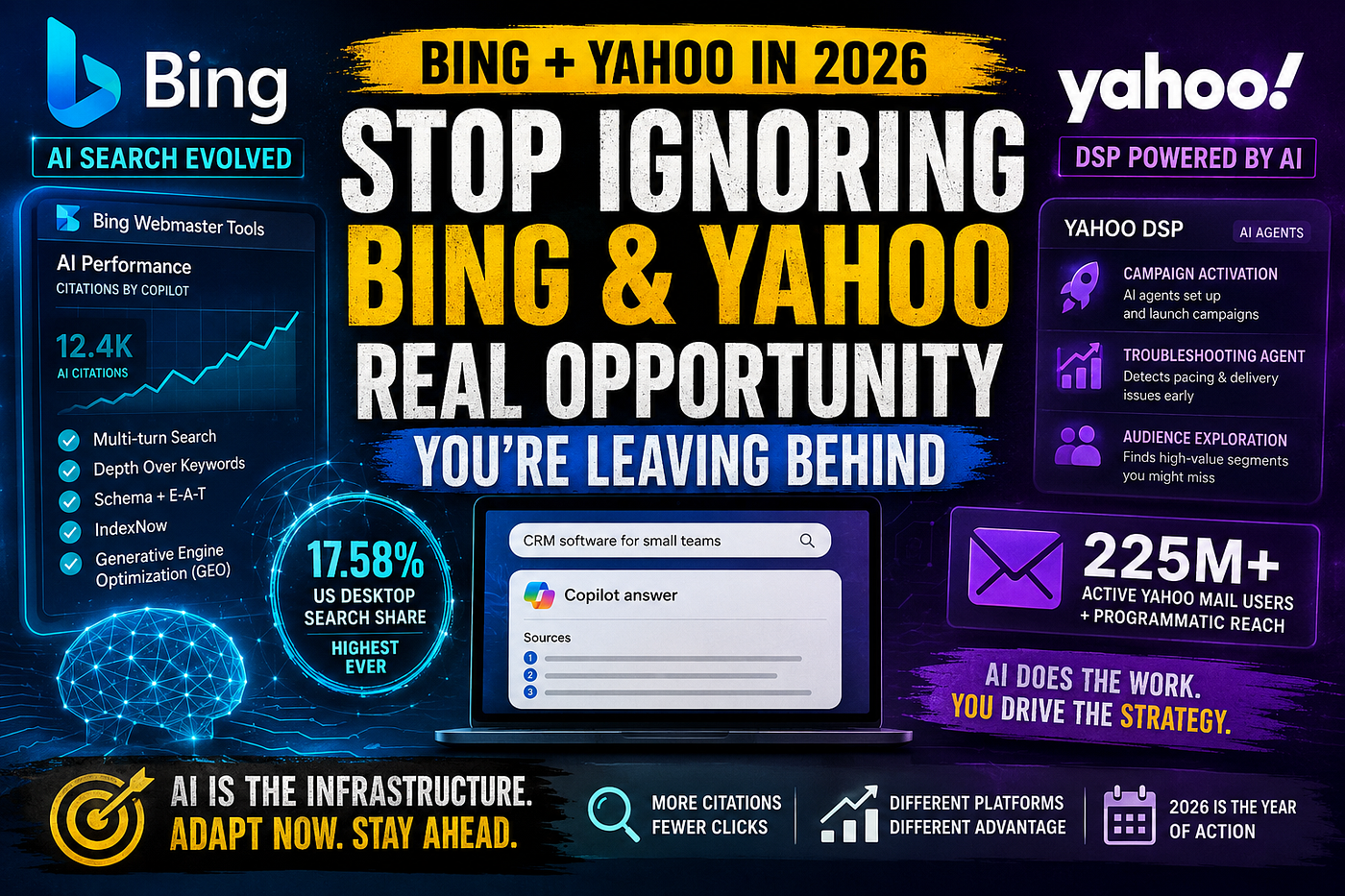
The clearest signal that Bing has changed is the February 2026 launch of the AI Performance report inside Bing Webmaster Tools. Before this, if your content appeared in an AI-generated answer on Bing or Microsoft Copilot, you had no way of knowing. That citation happened silently. Now it does not.
The AI Performance dashboard, released as a public preview in early 2026, tracks how often specific pages from your site are cited in Copilot answers and Bing AI summaries. This is the first time a major search engine has offered structured reporting on AI citations rather than just clicks and impressions. For SEO teams, it is a new column in the spreadsheet that simply did not exist before. The industry term that has emerged for this is Generative Engine Optimization, or GEO — and Bing just gave you a way to measure it.
That matters because the way people search on Bing has shifted. Microsoft completed the global rollout of multi-turn search in February 2026, following its initial US launch in 2025. Multi-turn search means the engine holds context across sequential queries within a session. A user who searches for ‘CRM software for small teams’ and then follows with ‘what does pricing usually look like’ gets results that remember the first question. The practical consequence for content: your pages now need to answer follow-up intent, not just the headline query.
Bing’s May 2026 algorithm update doubled down on this direction. The update explicitly rewards depth over keyword density. Pages with thin content or weak schema markup lost ground. Sites with clear authorship signals, fast load times, and structured data moved up. The shift lines up with the E-A-T framework that Google has been emphasizing, but Bing is applying it more aggressively in conjunction with its AI systems.
There is also a reach argument worth taking seriously. Bing currently holds about 17.58% of US desktop search traffic — its highest point on record. That is not a rounding error. Copilot is built into every Windows PC and Microsoft Edge, which means millions of professional users interact with Bing results daily without actively choosing to. Ignoring Bing SEO in 2026 is ignoring a meaningful slice of desktop-first, research-oriented, B2B-leaning users.
For a broader view of how market share is shifting across all major search engines — including where Bing fits against Google on mobile versus desktop — the 2026 Google Search Statistics guide on Coozmoo breaks it down with current data.
What Bing GEO Actually Requires from Your Content
Ranking in traditional Bing results and being cited in Copilot are not exactly the same task, though they overlap significantly. The AI Performance report from Bing Webmaster Tools draws a distinction between pages that rank and pages that get cited — and your highest-traffic page is not always your most-cited one.
Copilot citations tend to favor content that is factually grounded and easy to extract. If your page explains a concept clearly, cites sources, uses structured headings, and answers the question without making the reader wade through filler, it is more likely to be pulled into an AI-generated answer. Conversely, content that buries the key point in paragraph seven does not extract well, even if it ranks.
The practical checklist from current Bing guidance comes down to a few things: use schema markup consistently and keep it synced with what your page actually shows, implement IndexNow so Bing can crawl fresh pages quickly rather than waiting for its next scheduled crawl, make sure hreflang return tags are correctly set up for any localized URLs, and write for the follow-up question, not just the primary one. If someone asking your main topic would naturally follow with a ‘but how does that work in practice’ question, answer that too on the same page.
Yahoo Did Something Different — and It Is More Disruptive Than It Looks
Yahoo’s big move in 2026 was not on the search side. It was on the buying side.
At CES in January, Yahoo announced the integration of agentic AI into its demand-side platform. The launch introduced a framework called ‘Yours, Mine, and Ours’ that allows advertisers to bring their own AI models, use Yahoo DSP’s native AI agents, or connect both through secure Model Context Protocols. In plain terms: you can now run programmatic advertising campaigns where the AI does the setup, monitors for delivery problems, adjusts pacing, and flags issues — all without someone manually checking dashboards every few hours.
Three capabilities went live at launch: campaign activation that allows external AI agents to connect and execute setup, a troubleshooting agent that catches pacing and delivery problems before they compound, and an audience exploration tool that uses Yahoo’s data to surface segments a human planner might not have considered. More agents covering optimization and quality assurance are rolling out through the rest of 2026.
The argument for paying attention to this is straightforward. Yahoo DSP reaches over 225 million active Yahoo Mail users, plus broader programmatic inventory. An advertising system that removes manual steps from campaign management gives smaller teams a real capability advantage. A two-person marketing operation can now run campaigns with the kind of continuous monitoring that used to require a dedicated media buyer.
The honest caveat: agentic systems run on the quality of your inputs. Vague campaign briefs produce vague campaigns, AI-driven or not. The automation speeds up execution and catches errors, but the strategy still belongs to the human. Marketers who treat agentic tools as a replacement for thinking about audience fit and creative quality will get mediocre results faster than before.
If your team is evaluating how to split budget and effort across search, programmatic, and paid social in 2026, the digital marketing strategy overview from Coozmoo covers the practical framework for prioritizing channels based on your business model.
The Search Engine Land Perspective: AI-Driven Traffic Is Shifting
One number from the March 2026 Bing update reporting is worth sitting with: Pew Research found that AI summary features on search pages correlate with fewer link clicks on research-heavy queries. Bing itself noted this in its webmaster update guidance.
This is the core tension for SEO in 2026. More AI citations could mean more authority and brand recognition, but fewer direct clicks. The traffic model is changing. Pages that used to generate steady informational traffic may now generate citations that users see but do not click through, because the AI already answered the question.
The response is not to optimize less — it is to optimize for citation as well as for clicks, and to understand which pages serve which purpose. Your commercial pages (product descriptions, service pages, case studies) still need traditional rankings and clicks. Your informational content increasingly needs to be citation-worthy, which means it needs to be the kind of source an AI would trust: accurate, structured, and authoritative.
What to Actually Do This Quarter
Across both Bing and Yahoo, the thread connecting the 2026 updates is the same: AI is now part of the infrastructure, not a feature layer on top. Your content strategy and your ad buying strategy both need to account for systems that are making decisions continuously, not just when a human logs in.
For search: if you are not yet verified in Bing Webmaster Tools, start there. The AI Performance dashboard is now available in public preview and gives you citation data you cannot get anywhere else. Run the SEO Analyzer on your top pages and audit schema markup for consistency. Implement IndexNow if you update content regularly — it cuts the wait time between publishing and Bing crawling significantly.
For paid media: if you are already running programmatic campaigns, Yahoo DSP’s agentic tools are worth a pilot. Microsoft’s own documentation on Clarity AI Visibility — at clarity.microsoft.com — now shows which pages influence AI responses even when users do not click through, giving you another signal for content prioritization.
The deeper shift is this: the search and advertising platforms outside Google are no longer asking to be taken seriously. They are building the tools that make ignoring them expensive. Bing’s AI citation tracking and Yahoo’s agentic ad buying are not imitations of Google — they are different products solving real problems in ways Google has not fully addressed yet.
That is worth at least a quarter of your attention.
메타데이터
- post_id
- f10e24e030d0
- slug
- bing-and-yahoo-in-2026-the-updates-marketers-actually-need-to-know-f10e24e030d0
- url
- https://medium.com/@ayaanmishra957/bing-and-yahoo-in-2026-the-updates-marketers-actually-need-to-know-f10e24e030d0
- canonical_url
- https://medium.com/@ayaanmishra957/bing-and-yahoo-in-2026-the-updates-marketers-actually-need-to-know-f10e24e030d0
- author_url
- https://medium.com/@ayaanmishra957
- status
- ok
- fetched_at
- 2026-06-15 20:49:13