In-House AI Team vs Hiring an AI Development Company: Which Is Right for You?
Introduction
In-House AI Team vs Hiring an AI Development Company: Which Is Right for You?
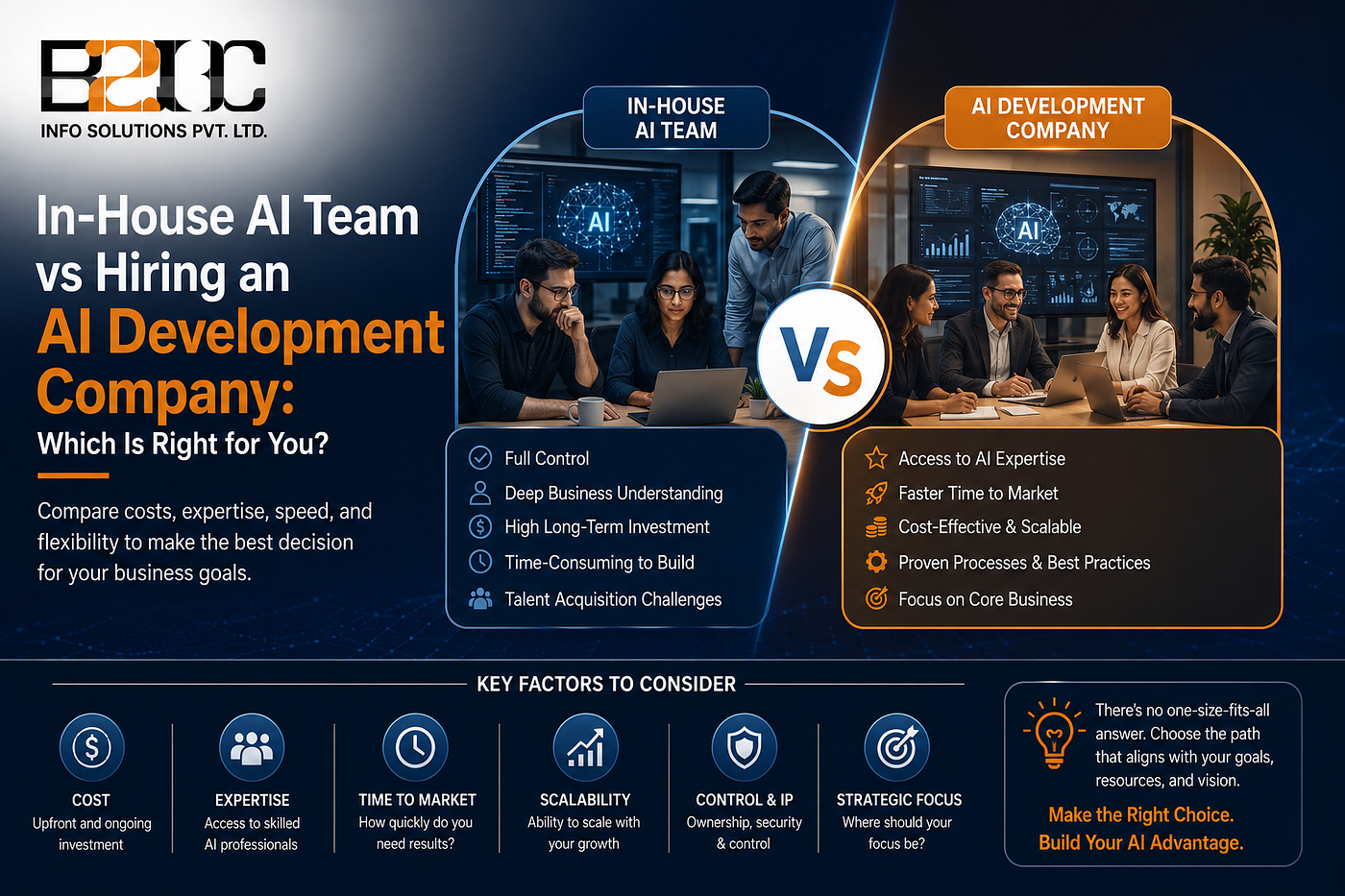
Introduction
You have decided your company needs AI. The next decision is structural and expensive: do you build an internal AI team, or hire an AI development company to do it for you? In 2026 this is no longer a simple cost comparison. It is a trade off between control and speed, set against a labour market where the talent you would need to hire is among the scarcest and most expensive in technology. Getting this choice right shapes your timeline, your budget, and your competitive position.
This guide lays out the real economics of both paths, the talent shortage that distorts them, the situations where each option wins, and the hybrid approach that most organisations are settling on. By the end you should be able to make the build versus buy call with clear eyes rather than instinct.
The Real Cost of an In-House AI Team
Most executives underestimate in house AI costs because they count only salaries. The full picture is heavier. In the US market in 2026, a single mid level machine learning engineer routinely commands a base salary north of 180,000 dollars, and a production ready AI capability needs more than one person. A functional squad typically includes a lead AI architect, data engineers, an MLOps engineer, and a product owner, each scarce and each expensive.
Then come the costs that do not appear on a salary line: recruiting fees, GPU and cloud infrastructure, tooling, ongoing training, and management overhead. Industry analyses put the true first year cost of a capable in house AI team well into seven figures once these are included. None of this is wasted if AI is central to your business, but it is a serious commitment to make before a single model reaches production.
The Talent Shortage Changes the Math
The deeper problem is not cost but availability. Engineers with genuine production experience in large language models, MLOps, and multi agent systems represent a tiny fraction of all software engineers, and every well funded company is hunting the same people. The consequences are concrete. The recruitment cycle for a senior AI architect commonly runs four to six months, with further time for onboarding, which means a team you decide to build today may not ship production ready work for the better part of a year. One widely cited study found that a large majority of companies have delayed AI projects specifically because of the talent shortage. In a fast moving market, that delay is itself a cost, often the largest one.
What Hiring an AI Development Company Gives You
Hiring a specialist firm solves the availability problem directly. Instead of spending months assembling a team, you plug into one that already exists, with established frameworks, deployment pipelines, and niche expertise across areas such as natural language processing and computer vision. The advantages are practical.
- Speed to value. An experienced partner can have a proof of concept live in weeks rather than the many months internal hiring requires.
- Access to scarce skills. You gain specialists you could not realistically recruit or afford full time, for exactly as long as you need them.
- Flexible cost. You shift from paying per headcount to paying per project, which is far easier to manage for early stage builds. Outsourcing typically reduces total cost by 30 to 50 percent compared with equivalent in house development once overheads are counted.
- Continuity. If a team member leaves, the partner replaces them from their bench, so your project does not stall on one person’s departure.
The Trade-Offs of Outsourcing
Outsourcing is not free of downsides, and an honest assessment names them. You give up some direct control over the team and how they work day to day. You take on a dependency on an external partner, which makes contract terms, code ownership, and knowledge transfer genuinely important rather than administrative details. And for AI specifically, you must ensure sensitive data is handled securely and that the partner does not build a black box your own team can never maintain. These risks are real, but they are manageable with the right partner and clear terms, rather than reasons to avoid outsourcing altogether.
In-House vs Outsourced vs Hybrid at a Glance

When Building In-House Makes Sense
In house development earns its high cost in specific situations. If AI is your actual product rather than a feature, model quality is your competitive moat and belongs inside the company. If you hold proprietary training data that creates a genuine advantage and cannot leave your infrastructure, internal ownership protects it. If regulation mandates that all development happen within your organisation and jurisdiction, you may have no choice. And if you are building for a five to ten year horizon with continuous model improvement as core strategy, the investment in permanent capability pays back. The common thread is that AI is strategic and enduring, not a one off initiative.
When to Hire an AI Development Company
Outsourcing is usually the better path when speed, validation, or specialised capability matter more than permanent ownership. It fits when you need to launch a proof of concept or automate a workflow faster than you could ever hire for, when you want to test AI return on investment before committing to a full internal team, when the work is a bounded project with a clear scope, or when your team simply lacks the deep AI expertise the project demands and the timeline is tight. For the majority of businesses adding AI as a capability rather than building an AI native company, this describes their situation well.
The Hybrid Model Most Companies Land On
For roughly four in five organisations in 2026, the answer is neither pure path but a governed hybrid. The pattern is consistent: start with an AI development company to move fast, prove value, and reduce hiring risk, then build internal ownership as the system becomes more strategic. Many businesses keep product management and critical architecture in house while outsourcing data engineering, model development, and integration. This captures the speed and specialist access of outsourcing while preserving the strategic control and institutional knowledge that come from owning the direction. It also gives you a natural path to transfer knowledge inward over time rather than committing fully before you have proven the value.
A Simple Decision Framework
Strip the debate down to a few honest questions. Is AI your product, or a feature of it? Do you need results in weeks, or can you wait many months? Is your data so sensitive it cannot leave your infrastructure? Is this a one off project or a multi year roadmap? If AI is core, data bound, and long term, lean in house. If speed, validation, and bounded scope dominate, hire a partner. If the truth sits in between, which it usually does, start with a partner and bring ownership in house as the initiative proves itself.
Conclusion
The choice between an in house AI team and an AI development company comes down to control versus speed, weighed against a talent market that makes building slow and costly. In house ownership is right when AI is your core product, your data is uniquely sensitive, or your horizon is long. Hiring a partner is right when speed, validation, and access to scarce skills matter most. For most businesses the smartest route is the hybrid: move fast with a specialist now, and build internal capability as the value becomes clear.
Want speed without the hiring risk? Whether you engage an AI development company in the USA for time zone proximity or an AI development company in India for specialist talent at lower cost, B2C Info Solutions can get a proof of concept moving in weeks and hand over ownership as you grow.
About the Author
Jitendra Tomar is the Global Business Head at B2C Info Solutions, a premium digital technology company that has delivered more than 1000 web and mobile projects worldwide. With a deep background in strategic formulation and product engineering, he specializes in helping businesses leverage AI, cloud, and experience design to build disruptive software solutions.
Based in Noida, JS is dedicated to nurturing a culture of excellence and delivering high-value digital transformations for clients across North America, Europe, and the Middle East.
메타데이터
- post_id
- f121c0ccd879
- slug
- in-house-ai-team-vs-hiring-an-ai-development-company-which-is-right-for-you-f121c0ccd879
- url
- https://medium.com/@seo.b2cinfosolutions/in-house-ai-team-vs-hiring-an-ai-development-company-which-is-right-for-you-f121c0ccd879
- canonical_url
- https://medium.com/@seo.b2cinfosolutions/in-house-ai-team-vs-hiring-an-ai-development-company-which-is-right-for-you-f121c0ccd879
- author_url
- https://medium.com/@seo.b2cinfosolutions
- status
- ok
- fetched_at
- 2026-07-09 03:40:04
