When Public Purpose Becomes Pressure
As Andhra Pradesh pushes forward with its capital city dream, non-LPS farmers are being cornered by acquisition notices, planning controls…
When Public Purpose Becomes Pressure
As Andhra Pradesh pushes forward with its capital city dream, non-LPS farmers are being cornered by acquisition notices, planning controls and a system that no longer leaves room to refuse.
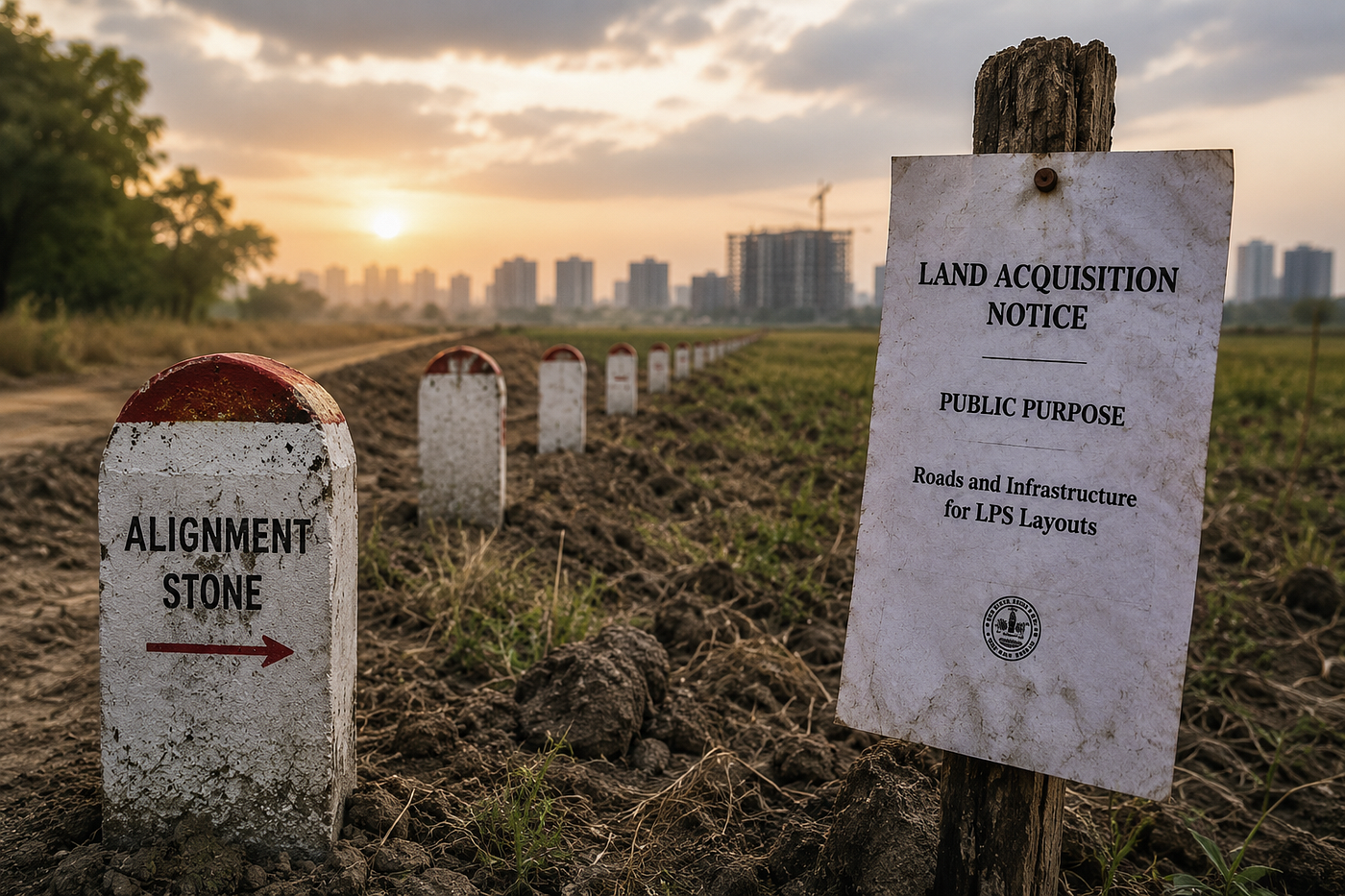
At the edge of Amaravati’s expanding capital region, stretches of agricultural land that once ran uninterrupted across village boundaries are now marked by survey stones, proposed road alignments and fragmented urban layouts. In some places, narrow strips of farmland sit trapped between planned infrastructure corridors and partially developed zones envisioned years ago on master plans and government presentations.
For many farmers who stayed outside the Land Pooling Scheme, the uncertainty that defined the last decade has now begun to harden into something more immediate: acquisition notices, regulatory pressure and a growing fear that the space to remain independent inside the capital city region is rapidly disappearing. What was once presented as a voluntary model of participatory development is increasingly being experienced by some landowners as a system where refusal itself carries escalating economic and legal consequences.
For years, Amaravati was promoted as a globally benchmarked greenfield capital city built on farmer partnership rather than coercive acquisition. The Land Pooling Scheme was repeatedly showcased as an innovative alternative to traditional land acquisition frameworks, with participating farmers promised returnable developed plots, annuity payments and integration into the future urban economy of the capital city. Those who joined the scheme were projected as stakeholders in a grand developmental transformation that would eventually convert agricultural communities into urban asset holders.
But outside this narrative remained another category of landowners — farmers who either refused to pool their lands, questioned the long-term viability of the project, feared losing agricultural security, or simply distrusted a political process that repeatedly shifted with changes in government and policy direction.
The concerns of these non-LPS farmers were not entirely unfounded. Amaravati itself became one of India’s most politically volatile infrastructure projects, surviving changes in government, attempts to decentralize the capital structure, repeal and revival of institutional frameworks, financial uncertainty, and prolonged legal disputes. For years, the region existed in a suspended state where neither full urbanization nor normal agricultural continuity was possible. Many farmers describe living inside a planning limbo where investment decisions became impossible, land transactions slowed, agricultural confidence weakened and uncertainty itself became embedded into everyday life.
In such an environment, voluntariness becomes difficult to measure simply by whether someone signed an agreement, because the conditions surrounding refusal gradually evolve into a form of structural pressure of their own.
That pressure appears to have entered a new phase. In recent weeks, non-LPS farmers have begun receiving preliminary land acquisition notifications citing “public purpose” for roads and infrastructure connected to layouts within the capital city region. But what alarmed many landowners even more was the sequence that followed. Within weeks of those notices, some farmers were informed that reconstituted plots associated with planned layouts had already been marked within portions of their lands, and that surrendering land would now be necessary to accommodate those alignments and allocations. The sequence has triggered difficult legal and ethical questions because it creates the impression that planning decisions may have already assumed the integration of lands whose owners had never voluntarily joined the pooling process in the first place.
For many affected landowners, this is not experienced merely as acquisition, but as a reversal of procedural logic itself. Ordinarily, acquisition is expected to precede planning integration, with ownership questions resolved before land is incorporated into urban layouts or redistributed planning structures. Here, however, several farmers argue that planning assumptions appear to have preceded consent, creating a situation where the State first establishes an urban reality on paper and later invokes public purpose to formalize or regularize that reality through acquisition. Whether that interpretation ultimately survives judicial scrutiny or not, the perception among farmers is increasingly shaped by the belief that the planning process itself has begun to outpace the protections traditionally associated with private ownership rights.
The consequences extend far beyond the portion of land directly acquired for roads or infrastructure. Agricultural land does not lose value only through physical reduction of acreage; it also loses viability when its geometry, access and continuity are disrupted. A road cutting through a field can leave behind disconnected fragments, irregular remnants and narrow parcels that are difficult to irrigate, cultivate or economically sustain. Farmers in the region increasingly fear that even where only part of their land is acquired, the balance may become functionally unusable for meaningful agriculture while simultaneously remaining trapped under planning restrictions that prevent independent urban development. In effect, they argue, the injury extends beyond the notified acquisition extent and gradually transforms entire holdings into economically weakened assets.
This is where the role of CRDA regulations and capital region planning controls has become deeply contentious among non-LPS farmers. On paper, Amaravati is envisioned as a highly regulated, master-planned urban region governed through integrated zoning norms, infrastructure obligations, layout controls and approval frameworks. But many farmers argue that these systems disproportionately favor large institutional developers and capitalized entities while making independent farmer-led urbanization economically unrealistic. Fragmented land parcels, mandatory infrastructure contributions, road-width norms, surrender conditions, development charges and complex approval pathways often require financial and technical capacities that ordinary agricultural families do not possess. As a result, farmers increasingly feel trapped between two collapsing possibilities: agriculture becoming unviable on one side and independent urban participation becoming inaccessible on the other.
The deeper contradiction lies in the language of empowerment surrounding Amaravati itself. The capital city has consistently been framed as a project that would transform farmers into long-term beneficiaries of urban appreciation and infrastructure-led prosperity. Yet many non-LPS landowners argue that the regulatory architecture leaves very little room for them to function as autonomous participants in that urban future. Instead, they describe a model where meaningful development remains heavily dependent on centralized planning structures, licensed developers, institutional financing and political alignment.
The question emerging from this tension is increasingly uncomfortable for the State: if Amaravati truly represents farmer empowerment, why does independent farmer-controlled urbanization appear structurally so difficult within the very city built on agricultural land?
Behind this conflict lies the larger financial logic of Amaravati itself. The project has repeatedly been described as a “self-financing” capital city, a model that depends heavily on land monetization, infrastructure-led appreciation and future urban transactions to sustain long-term development costs. But once land becomes central to fiscal strategy, its meaning begins to change. Land is no longer viewed merely as livelihood, heritage or community geography; it becomes inventory within a larger financial architecture. In such systems, delays become financial liabilities, resistance becomes transaction friction, and independent landholding becomes increasingly incompatible with the speed and predictability required for large-scale urban monetization. For many non-LPS farmers, this has created the growing perception that they are no longer negotiating simply with a planning authority, but with an economic structure that treats their continued refusal as a disruption to the financial logic of the project itself.
The role of the judiciary now sits at the center of this evolving conflict. Courts in India have historically emphasized that land acquisition cannot be reduced to a mechanical exercise of procedural compliance, particularly when fertile agricultural lands and livelihood structures are involved. Yet Amaravati presents a far more complex challenge than traditional acquisition disputes because the pressure here is not experienced only through visible force. It emerges through prolonged uncertainty, fragmented viability, planning dependency, market distortion and economic exhaustion accumulated over years. This creates a constitutional dilemma that extends beyond compensation alone: at what point does formally voluntary participation become structurally unavoidable when every surrounding condition gradually weakens the ability to remain outside the system?
To be clear, Amaravati is not merely a dispute about roads, layouts or compensation packages. It is becoming a larger test of how democratic institutions respond when urban planning, state financing, property rights and citizen autonomy begin colliding inside a mega-infrastructure project. The judiciary may ultimately uphold, modify or reject specific acquisition actions based on law and evidence, but the deeper institutional question will remain long after individual cases conclude. Did the system meaningfully protect the ability of ordinary citizens to refuse participation in a state-backed urban transformation, or did refusal itself slowly become economically and legally unsustainable over time?
One day, Amaravati may be remembered not only for the capital city that was built, but for the method through which dissenting landowners were absorbed into it. Modern dispossession rarely resembles the crude seizures of earlier eras. It often arrives through synchronized planning frameworks, valuation pressures, procedural layering, market uncertainty and gradual exhaustion of alternatives. By the time the bulldozers arrive, the economic foundations of resistance may already have been weakened beyond recovery.
That is why the struggle of Amaravati’s remaining non-LPS farmers now carries significance far beyond a few villages in Andhra Pradesh. It raises a broader question confronting rapidly urbanizing democracies everywhere: when the future of a city is mapped out in advance, how much room truly remains for those who choose not to surrender their land to it?
메타데이터
- post_id
- f13a1a8f39b5
- slug
- when-public-purpose-becomes-pressure-f13a1a8f39b5
- url
- https://medium.com/amaravati-speaks/when-public-purpose-becomes-pressure-f13a1a8f39b5
- canonical_url
- https://medium.com/amaravati-speaks/when-public-purpose-becomes-pressure-f13a1a8f39b5
- author_url
- https://medium.com/@theramnutakki
- status
- ok
- fetched_at
- 2026-07-28 06:17:56