Can We Save Hubble Before It Is Too Late?
Unless we act soon, time will run out for one of the greatest telescopes ever built
Can We Save Hubble Before It Is Too Late?
Unless we act soon, time will run out for one of the greatest telescopes ever built
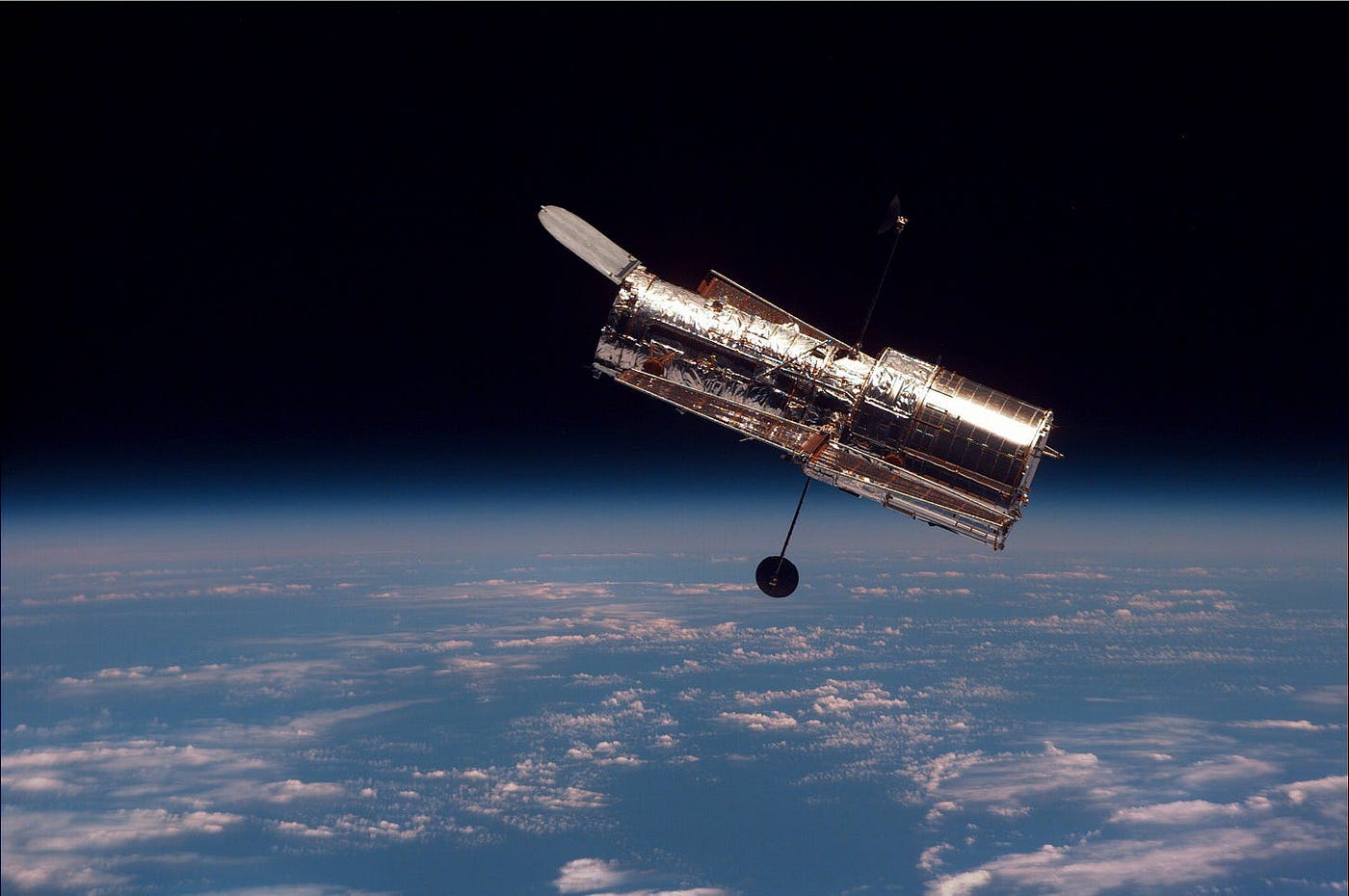
Hubble, seen after a servicing mission in 1997. Image credit: NASA.
Some think Hubble will die quickly.
If it does, it will probably be the fault of the gyroscopes it carries onboard. There are six of these, and they are essential to keeping the telescope running. But they are failing, and over the fifteen years since they were last replaced, four have ceased to function properly. The two that are left are carefully managed by NASA, and analysis shows they have a good chance of lasting a few more years.
But when they fail — perhaps tomorrow, perhaps ten years from now — it will spell the end for Hubble. Without its gyros, the telescope cannot control its attitude. It would no longer be able to look at the stars, and before long it would tumble out of control. Its scientific career, from that point on, would be over.
Others, NASA included, hope for a slower demise. Over time, the telescope is falling, tracing a long descent back to Earth. In the twenty years between 2002, the last time the orbit of Hubble was raised, and 2022, the telescope lost only forty kilometres of altitude. But this loss is now accelerating — since 2022, indeed, Hubble has lost another forty kilometres. It is now never more than five hundred kilometres from the Earth’s surface.
This fall may slow slightly in the coming years. Part of the recent acceleration came thanks to a more active Sun, which tends to heat and expand the upper atmosphere, and thus to drag things back to Earth more quickly. But this trend is now in reverse, and as the Sun quietens, Hubble’s descent should slow too. But at some point — and estimates here range from 2029 to 2035 — the fall will become fatal.
Until then, though, we have a chance to act. We do not need to abandon Hubble, nor accept that an aging telescope must eventually die. We could try to save it, as astronauts have done in the past. We could even try to preserve it, to bring it back to Earth, and so keep it as a treasured possession of humanity.
I. Reentry
Hubble’s falling altitude, as things stand, is its most troubling problem. Gyros can be replaced: and although this is not an easy operation, the telescope could be put into a safe mode until astronauts are ready to conduct a repair. But unless we can solve the altitude problem, any repair will be for naught.
Key to the problem is the Earth’s atmosphere. Though its thickest layers, the troposphere and stratosphere, linger close to the planet’s surface, its outer layers extend hundreds of miles upwards. The slight density of these layers exerts a slow drag on orbiting spacecraft, and slowly saps them of the energy they need to stay in orbit.
As a result, most spacecraft gradually fall. This is an accelerating process. The more a satellite falls, the more air it encounters, and the more drag it experiences. Eventually, after its altitude drops below about three hundred kilometres, maintaining an orbit becomes impossible. At this point, the spacecraft will plunge towards the surface and burn from the heat of reentry.

Hubble’s altitude always lies between the red and blue lines. Over the past few years, its loss of altitude has accelerated. From https://hubblereentry.com/.
This, if nothing is done, will be the fate of Hubble.
But there is a twist: parts of Hubble are likely to survive reentry. NASA is particularly concerned about its large mirror, a big chunk of which they think could hit the ground. This might be dangerous: indeed, NASA calculates the observatory has about a one in two hundred chance of killing someone. This is small, but rather higher than the one in ten thousand threshold normally demanded for a safe reentry.
Perhaps, an early study for NASA proposed, we could fire a missile at Hubble as it neared the moment of re-entry. This would blow the observatory to smithereens, ensuring, they thought, that no large chunks of it would hit the ground. But detailed calculations showed that big pieces of the mirror might still survive, and, indeed, that the resulting cloud of shrapnel might prove more dangerous than the telescope itself.
Instead of firing a warhead, then, NASA has vague plans to deorbit Hubble. This would likely require the agency to send a special vehicle to dock with the observatory. Once in place, it would steer the telescope back to Earth, and then make sure any surviving pieces fall into the depths of the Pacific Ocean, rather than on someone’s head.
II. Repair and Reboost
Of course, if we could send a vehicle to bring Hubble down, we could also send a vehicle to raise it up. This would make much more sense — after all, why should we allow one of the greatest observatories in human history to die any sooner than it must?
In principle at least, there is nothing especially difficult about such a mission. The vehicle could be fully robotic, so no astronauts are put in danger, and it could also make use of a docking ring installed on Hubble by its last servicing mission. In theory — although the engineering challenges of doing so are high — the vehicle could even take over some of the attitude control of the telescope, at least partially solving the problem with its gyros.
So why don’t we do this?
One reason is cost. Building such special vehicles tends to be expensive, and NASA is already facing steep budget cuts. The money to keep Hubble running is fortunately still there, but nothing is available to extend its life.
But the other reason is risk. As long as Hubble still works, its operators are unwilling to do anything that might damage it. A robotic mission to raise its orbit might seem simple enough, but such a craft would need to operate with extreme care around the observatory. Few similar missions have ever been executed before — although the upcoming Swift reboost might act as a kind of pathfinder.
This was the argument that doomed a previous concept proposed by the billionaire astronaut Jared Isaacman. He suggested sending a crew of astronauts to visit the observatory using SpaceX’s Dragon capsule. Through a series of spacewalks, those astronauts could repair Hubble, he said, and switch out its gyros. Dragon’s thrusters could then raise it to a higher orbit, and so extend its lifetime.
But after studying the proposal, NASA said no. The risks to the telescope were likely the biggest reason why. Accidentally causing damage to Hubble cannot be easily ruled out— even trained astronauts from NASA have mistakenly broken parts of it before. Somewhat understandably, the agency was not happy about the idea of having a bunch of semi-professional astronauts visiting their prized observatory.
Still, that doesn’t mean they will always say no. It is easy enough to imagine a scenario in which Hubble’s gyros do suddenly fail, and public pressure mounts to conduct a repair. With the telescope out of action, the risks of damaging it are inconsequential, and the benefits of repair huge. If the money could be found, Hubble might get the mission it needs — and NASA, should already start planning how it could be carried out.
III. Replace
Hubble, it is sometimes said, is a spy satellite that looks up instead of down. There is some truth in this claim. The telescope was built in the 1980s using technologies developed for military espionage. Most tellingly, its mirror — 2.4 metres across — is nearly identical to those probably used by the clandestine KH-11 satellites.
But if it is a spy satellite, it is an old one. Today’s technology has moved far beyond that of the 1980s. If we wanted to, and if we chose to once again look up instead of down, we could build a far more capable replacement.
A decade ago, one of America’s spy agencies donated two large mirrors to NASA. They were surplus, apparently, to the needs of espionage, and so NASA got the opportunity to repurpose them for science. But despite this offer, neither of the two mirrors has yet left Earth.
Fortunately that should soon change: one of the two has been installed in the Nancy Grace Roman Telescope, and barring a last-minute cancellation it should be sent into space by the end of 2026. In many ways, this observatory could be thought of as a worthy successor to Hubble. It will be capable of taking similar quality photographs, and of surveying more of the sky.
But as for the other mirror, there are no definite plans. NASA has, at times, considered making it part of a telescope that would orbit Mars, or that would devoted to studying the solar system. But with no plans and no money, it will likely remain in a warehouse for another decade or so.
This all highlights a few sad facts about America’s space telescopes. First, that the costs of building them are such that new ones are rare indeed. Second, that there are almost certainly a dozen or so telescopes with greater power than Hubble pointed downwards, towards the world of men and machines, rather than upwards, towards the cosmos of galaxies and stars. And third, that Hubble is getting old, and there are few serious plans to prolong its life any further.
And that, given both the scarcity of such Hubble-class observatories and the technological achievement of building one at all, is a real shame.
This article was originally published on my newsletter covering advances in space and physics. If you’d like to subscribe, you can do so for free by clicking here.
메타데이터
- post_id
- f13e202eb48a
- slug
- can-we-save-hubble-before-it-is-too-late-f13e202eb48a
- url
- https://sciencespectrumu.com/can-we-save-hubble-before-it-is-too-late-f13e202eb48a
- canonical_url
- https://sciencespectrumu.com/can-we-save-hubble-before-it-is-too-late-f13e202eb48a
- author_url
- https://medium.com/@alastair-williams
- status
- ok
- fetched_at
- 2026-07-14 02:47:01