JEPA vs Generative AI: The Real Shift No One’s Talking About
As generative AI scales, a new architecture is forcing the industry to rethink whether prediction alone is enough to build truly…
JEPA vs Generative AI: The Real Shift No One’s Talking About
As generative AI scales, a new architecture is forcing the industry to rethink whether prediction alone is enough to build truly intelligent systems.
Late-20th-century computing history often frames early AI systems as powerful but fundamentally limited — capable of solving narrow problems, yet unable to generalize beyond them.
Decades later, modern generative AI appears to have broken through those constraints. Systems can now generate text, images and code with remarkable fluency. But beneath that progress lies a familiar limitation: these systems still rely heavily on predicting the next token, pixel or pattern.
That dependency on prediction is increasingly being questioned.
The analogy surfaced again in recent AI research discussions as Joint-Embedding Predictive Architecture (JEPA) gained attention as an alternative framework. Rather than generating outputs directly, JEPA focuses on learning relationships between representations — a subtle but potentially transformative shift.
Facing growing pressure to move beyond pattern matching toward deeper understanding, AI researchers are exploring architectures like JEPA that promise to make systems more context-aware, data-efficient and robust in real-world environments.
A shift away from raw prediction
At its core, JEPA represents a departure from traditional generative models.
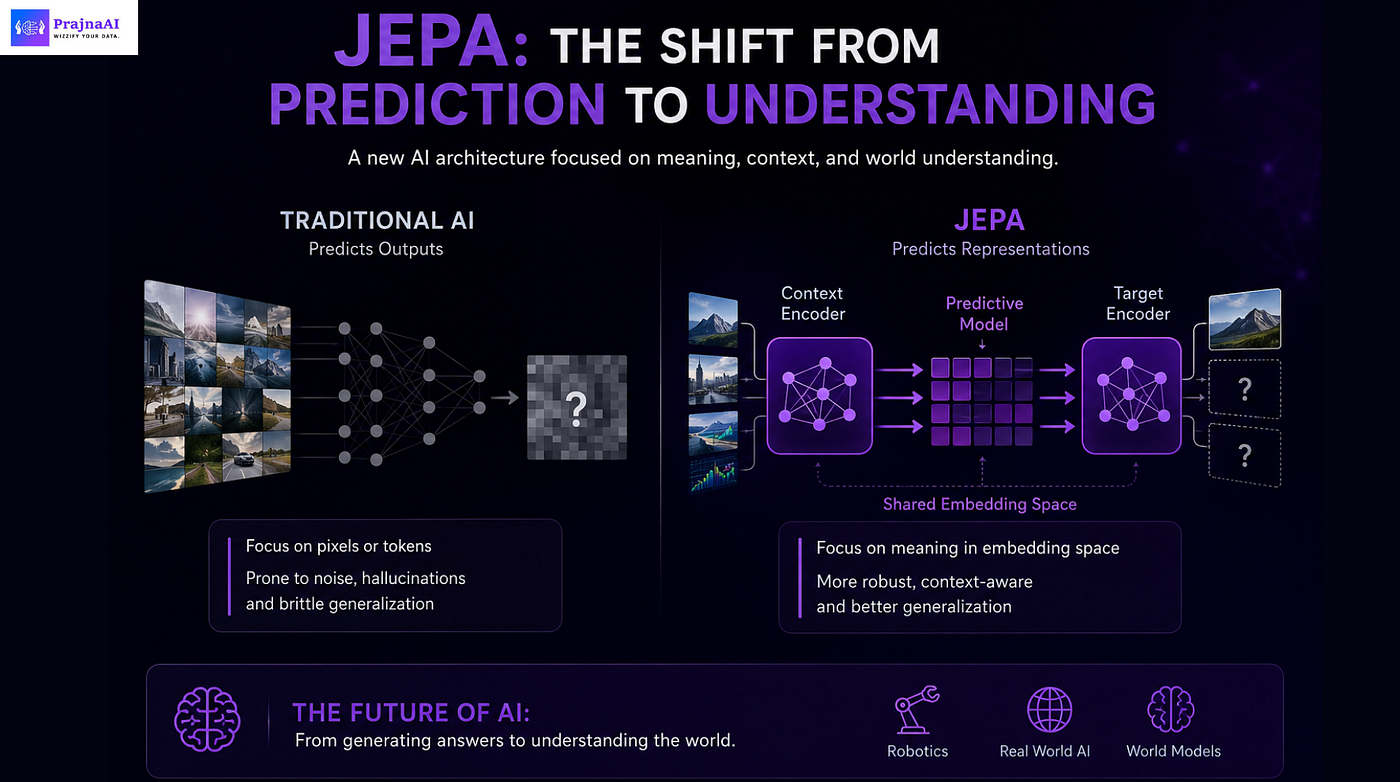
Instead of predicting exact outputs — such as the next word in a sentence or the next pixel in an image — JEPA predicts abstract representations of data. These representations, often referred to as embeddings, capture the underlying structure and meaning rather than surface-level detail.
This distinction matters.
While generative models attempt to recreate reality, JEPA aims to understand it.
The architecture works by encoding both context and target data into a shared embedding space, where a predictive model learns to align them. The result is a system that prioritizes consistency and coherence in meaning, rather than precision in reconstruction.
Open for a new kind of intelligence
Interviews with researchers and ongoing experimentation suggest that JEPA is part of a broader push toward what some describe as “world models” — AI systems capable of reasoning about how environments behave, rather than simply mimicking data distributions.
“Prediction has taken us far, but it’s not the same as understanding,” said a senior AI researcher working on representation learning. “Architectures like JEPA are trying to close that gap.”
This shift is especially relevant in domains such as robotics, autonomous systems and multimodal AI, where incomplete or noisy data is the norm. In such settings, the ability to infer missing information based on structure — rather than regenerate exact inputs — becomes critical.
Competitive pressure across the AI stack
The emergence of JEPA also introduces new dynamics across the AI ecosystem.
Generative models, which dominate current applications, are deeply integrated into enterprise workflows, content generation pipelines and developer tools. Their strength lies in producing outputs that are immediately usable.
JEPA, by contrast, operates at a more foundational level.
It does not generate polished outputs directly. Instead, it provides a representation layer that could power more reliable reasoning, planning and decision-making systems.
This creates both opportunity and tension.
On one hand, JEPA could complement generative models, improving their ability to handle context and reduce hallucinations. On the other, it challenges the assumption that generation should remain the primary interface for AI systems.
“Everyone is optimizing for output quality right now,” said an industry analyst tracking AI infrastructure trends. “JEPA is a reminder that the real bottleneck might be how systems understand inputs in the first place.”
Still early, with open questions
Despite its promise, JEPA remains an emerging approach with significant challenges.
Evaluating its effectiveness is less straightforward than measuring the output quality of generative models. Its success depends heavily on the design of embedding spaces and the ability to capture meaningful abstractions across diverse datasets.
There is also the question of adoption.
Organizations that have heavily invested in generative AI may be hesitant to shift toward architectures that are less directly tied to user-facing applications.
Still, the direction of research suggests growing interest in hybrid approaches that combine generative capabilities with representation-based learning.
The bigger picture: from imitation to understanding
JEPA’s rise reflects a broader transition in AI.
ThenNow EmergingPredictive AIRepresentational AIOutput-drivenContext-drivenSurface patternsStructural understanding
The shift is subtle but significant.
For years, AI progress has been measured by how convincingly systems can imitate human outputs. JEPA suggests that the next phase may depend on how well systems can model the underlying structure of reality itself.
A strategic inflection point
For builders and enterprises, this evolution raises important questions:
- Should AI systems prioritize generation or understanding?
- Will representation learning become the new competitive layer?
- How will hybrid architectures reshape the AI stack?
The answers are still unfolding.
But one thing is becoming clear:
The future of AI may not be defined by how well machines predict the world — but by how deeply they understand it.
메타데이터
- post_id
- f144b418ea70
- slug
- jepa-vs-generative-ai-the-real-shift-no-ones-talking-about-f144b418ea70
- url
- https://medium.com/@marketing_38292/jepa-vs-generative-ai-the-real-shift-no-ones-talking-about-f144b418ea70
- canonical_url
- https://medium.com/@marketing_38292/jepa-vs-generative-ai-the-real-shift-no-ones-talking-about-f144b418ea70
- author_url
- https://medium.com/@marketing_38292
- status
- ok
- fetched_at
- 2026-06-17 18:03:35