3 Takeaways for CTOs From Getty Vs AI case
How Version History and logs helped an AI company win a copyright case
3 Takeaways for CTOs From Getty Vs AI case
How Version History & logs helped an AI company win a copyright case
Getty Images holdings, Inc. is an American Visual media company and is a supplier of high-resolution stock images, vector art, video footage clips and stock music licenses with an image search photo library of over 477 million assets.
Stability AI is an AI image generating software using which one can edit and update images in seconds (for which Adobe photoshop used to take hours) using their proprietary AI model software called “Stable Diffusion”
Training AI models is not Stealing or Copying
For years, the legal debate around AI and copyright has been a fog of speculation, fear, and bold claims. Tech pioneers and media giants have been on a collision course, with the multi-billion-dollar future of generative AI hanging in the balance.
Not a Medium member? Read this member only article for free here.
Getty Vs Stability AI
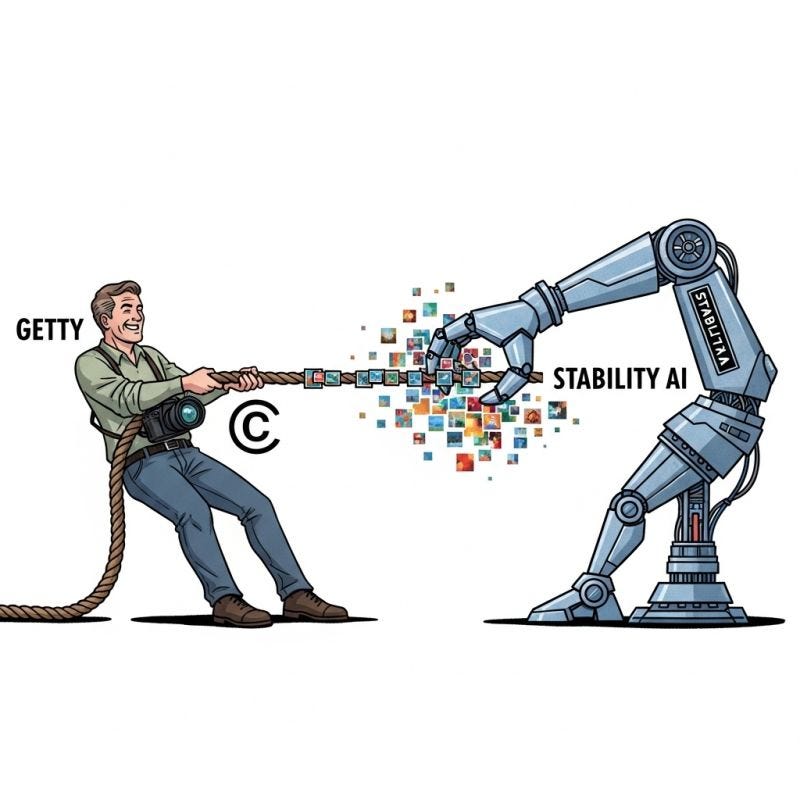
This week, the English High Court cut through that fog with a landmark judgment in Getty Images v Stability AI that provides the most important legal clarity to date. The ruling by Justice Joanna Smith doesn’t just settle a single case; it draws a bright line that will shape AI regulation, product development, and corporate strategy for years to come.
At its heart, the court delivered a fundamental finding that recalibrates the entire copyright debate: AI model weights are not copies of training data.
In other words, training an AI software model on images taken from Getty to prepare it for auto editing of images on a single prompt, does not amount to infringement of the Getty copyright on the Images. Because in the due process the model software does not store the original image anywhere.
The Core Finding: Learning vs. Copying
The court systematically dismantled the core argument of many copyright claimants. It affirmed that while copying can occur when training data is initially ingested and stored for processing, the trained model that emerges from this process is something entirely new.
The weights, the very “brain” of a model like Stable Diffusion, do not store photographs or text. They are, as the court recognized, the distilled result of learning patterns. This is a critical distinction. It separates the act of data ingestion from the artefact of learning, and it does so without needing to twist established copyright doctrine.
Much of Getty’s case was dismissed for jurisdictional reasons, which had the effect of sharpening the court’s focus on the most pressing legal questions. The remaining claims homed in on a bold proposition: that the entire Stable Diffusion model should be treated as an infringing copy simply because it was trained on copyrighted material.
The court rejected this outright. It also made a nuanced point that will resonate in courtrooms worldwide: even accepting that a copyrighted “article” can be intangible, a trained model that never contains the underlying works is not an infringing copy. This is a portable principle that other jurisdictions can readily adopt.
Trademarks, Watermarks, and the “Stochastic” Defense
On the trademark front, the findings were equally revealing. The court acknowledged limited instances where Getty’s watermark appeared in outputs, but crucially noted this was from early public versions and specific platform configurations. There was no evidence of this occurring in later, more refined models.
The court showed a sophisticated understanding of how these models work. It noted that experiments designed to provoke watermarks had “limited probative value” in a real-world context.
Furthermore, it recognized that the stochastic (randomly varied) nature of generation often produces distorted or non-identical signs, severely weakening arguments based on consumer confusion or identity. Claims of trademark dilution and tarnishing simply failed on the evidence.

A Getty image with watermark can be used for free however to get a watermark free image one has to purchase Editing and Custom rights

Each Getty image comes with a unique Id, Name and Copyright details
The Death of the “Neutral Tool” Defense and the Rise of Pipeline Governance
Perhaps the most significant part of the judgment for product teams and corporate boards is its treatment of responsibility. Stability AI’s attempt to position itself as a mere “neutral tool provider” was roundly rejected.
The court assessed the entire generation pipeline — from dataset curation and filtering to post-processing and user interface design. Its message was clear: where a provider makes deliberate choices about data, safety guardrails, and product features, responsibility follows.
This establishes a powerful new precedent for AI governance. It means liability is not confined to the base model but is distributed across the entire stack of decisions that shape the final user experience.
Three Immediate Takeaways for Boards and Product Teams
This ruling moves the legal debate from abstract theory to concrete action. For any company building or deploying AI, three practical consequences stand out:
- The Legal Battleground is Data, Not Weights. The primary pressure point is now clearly the acquisition and use of data for training. Robust data licenses, transparent opt-out mechanisms, and a smart jurisdictional strategy are your first line of defense.
- Documentary Hygiene is a Strategic Asset. In a world where the process is scrutinized, your documentation is your shield. Model cards, detailed dataset provenance notes, version histories, and filtering logs are no longer just best practices — they are essential for framing and limiting liability.
- Governance Must Cover the Entire Pipeline. You can no longer just worry about the model. Controls on user prompts, API configurations, and output rendering are just as legally relevant as the architecture of the base model itself. Governance must be end-to-end.
The Getty v. Stability AI decision is a watershed moment. It provides a coherent legal framework that acknowledges the technical reality of how AI models learn, while simultaneously establishing clear accountability for the companies that build and deploy them. The race is now on to build the responsible, well-documented, and legally-sound AI systems that this new era demands.
What are your thoughts on the court’s distinction between data ingestion and the trained model? How is your organization adapting its AI governance strategy?
Dream up a scene, click Create, then fine-tune every pixel — no design skills needed.
Turn text, images, or a quick lip-sync into scroll-stopping video in seconds.
✅[Create Magical Stories with One Click.](https://openart.ai/image?via=afx25)
Have an idea, beat, or character? One click turns it into a studio-quality story, ready to share.
메타데이터
- post_id
- f16fe1f96c2c
- slug
- ai-model-training-cannot-be-seen-as-copying-or-stealing-f16fe1f96c2c
- url
- https://medium.com/@techmonk/ai-model-training-cannot-be-seen-as-copying-or-stealing-f16fe1f96c2c
- canonical_url
- https://medium.com/@techmonk/ai-model-training-cannot-be-seen-as-copying-or-stealing-f16fe1f96c2c
- author_url
- https://medium.com/@techmonk
- status
- ok
- fetched_at
- 2026-06-21 22:35:58